

The Crocs Playbook: Embracing Controversy
In a fashion industry built on beauty, elegance, and aspiration, Crocs chose the opposite direction entirely. Rather than downplaying the fact that its shoes looked strange, the brand made strangeness its most valuable asset. Time magazine once named Crocs one of the worst inventions ever created. Today, the brand generates over $3.2 billion in annual revenue from the Crocs label alone, operates as a cultural phenomenon among young consumers worldwide, and has cultivated one of the most genuinely passionate brand communities in Chinese marketing — with the "Crocs fandom" hashtag accumulating nearly a billion mentions across Rednote and Douyin.

This didn't happen by accident, and it didn't happen by trying to make the shoes look more normal. It happened through a series of deliberate, counterintuitive strategic choices that fundamentally redefined what a brand could be. For international brands thinking carefully about how to build lasting identity in China and beyond, the Crocs story contains lessons that apply well beyond footwear.
The Context: Why the Market Was Ready for a Rebellion
To understand why Crocs' strategy worked, it helps to understand the consumer environment it was operating in — particularly among the younger demographic that now drives its growth.
The mainstream footwear market had long been governed by a narrow aesthetic consensus: sleek silhouettes, premium materials, a general aspiration toward sophistication and refinement. Comfort and style were treated as mutually exclusive. If you prioritized function, you were expected to sacrifice appearance. This framework served established players well, but it left a significant gap — and a significant tension — in the market.
Gen Z, the generation now entering its peak spending years, began pushing back against exactly this framework. Rather than accepting inherited aesthetic hierarchies, younger consumers in China and globally started embracing what critics called "ugly aesthetics" — intentionally unconventional choices that signaled authenticity and independence over conformity. Buying something because it looked strange, not despite it, became a form of cultural expression.
Crocs didn't create this shift. But it was positioned — almost accidentally at first, then very deliberately — to become its defining symbol. When consumers started celebrating the shoes' unconventional appearance rather than apologizing for it, the brand recognized what it had and made a strategic choice to amplify rather than suppress it.

Three Phases of a Remarkable Brand Journey
Crocs' commercial history is worth tracing because the mistakes are as instructive as the successes.
The brand's founding phase, from 2002 to 2007, was driven by genuine functional differentiation. The proprietary Croslite resin material delivered a comfort experience that had no real equivalent in the market. Early adopters were drawn from practical use cases — water sports, healthcare workers, people on their feet all day. Within three years of founding, annual sales crossed $100 million. The 2006 IPO set records for a footwear company. The product worked, and the market recognized it.
The crisis phase, from 2008 to roughly 2014, revealed the danger of abandoning the very thing that made a brand distinctive. Flushed with post-IPO capital, Crocs expanded aggressively into conventional footwear categories — shoes that looked normal, that didn't carry the clog's distinctive silhouette, and were designed to broaden appeal by being less polarizing. The result was a brand that had lost its reason to exist. Sales collapsed. The company lost $185 million in 2008 alone and spent nearly a decade cycling through financial instability. The lesson, in retrospect, is stark: trying to be everything to everyone by suppressing your most distinctive quality doesn't broaden your market. It eliminates your market.
The revival phase, beginning around 2014 and accelerating dramatically from 2017 onward, was built on a single strategic insight: stop trying to be normal. Private equity investment helped restructure the business, but the more important change was strategic. Crocs eliminated over 250 product lines that weren't variations on the core clog, concentrated all innovation energy on making the distinctive product more interesting rather than making it more conventional, and reframed the brand's relationship with its own unconventionality. By 2024, the Crocs brand alone was generating $3.2 billion in revenue with over $1.1 billion in operating profit. By 2025, total group revenue crossed $4 billion.
The Strategic Engine: Three Things Crocs Got Right
Behind the headline numbers, Crocs' revival rests on three interlocking strategies that reinforce each other in ways that are worth examining closely.
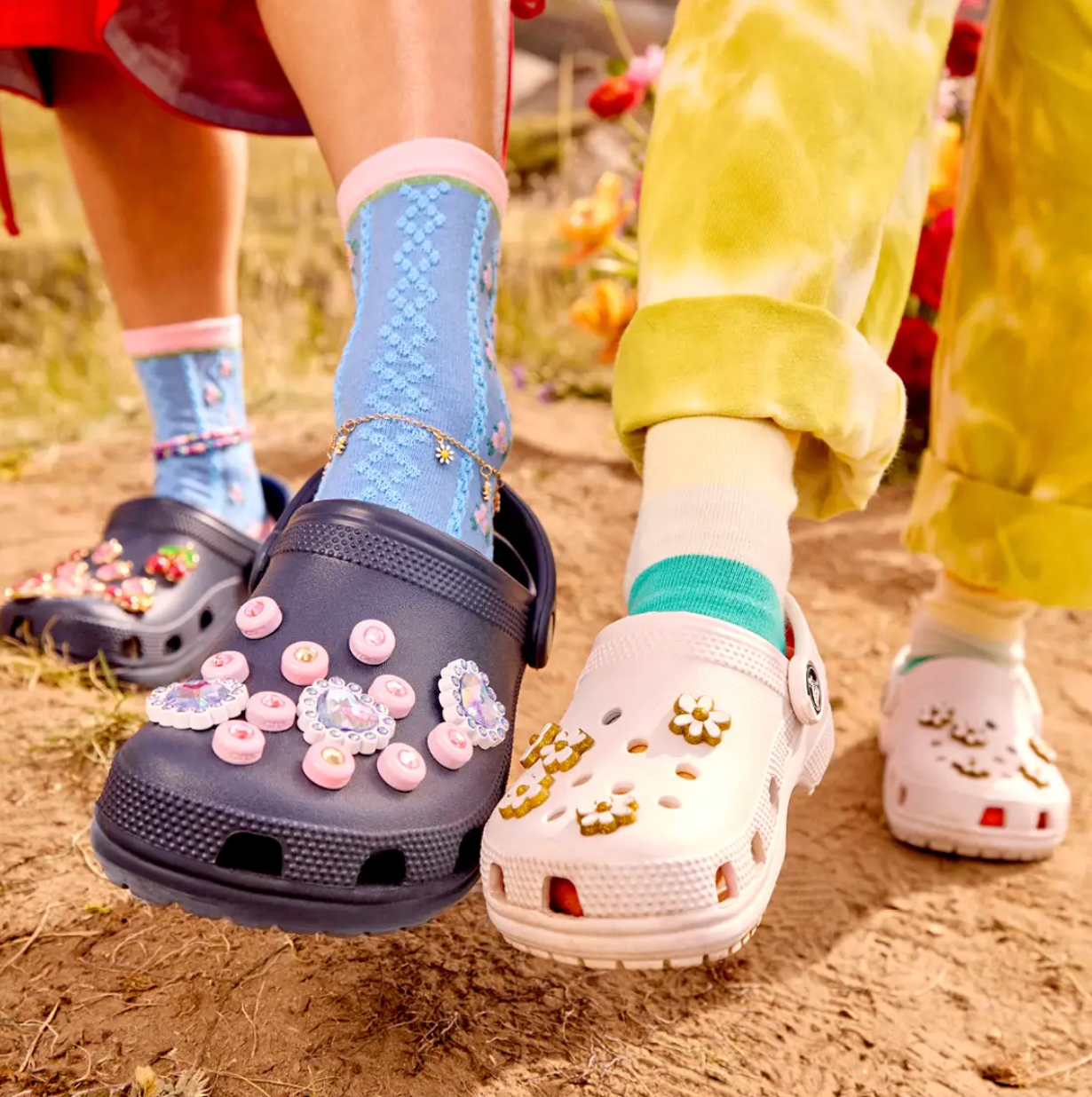
Making the product a platform, not a finished object. The thirteen holes on every pair of Crocs aren't a design quirk — they're deliberate open space left for the consumer to complete. The Jibbitz charm system, acquired by Crocs in 2006, transformed those holes into a customization platform that now generates $270 million in annual revenue on its own and is purchased by 75% of Crocs buyers at the point of shoe purchase. The strategic insight here goes well beyond accessories: when a product can be infinitely personalized, it becomes a canvas rather than a commodity. Consumers don't just buy the shoe — they invest in it, modify it, photograph it, share it. A pair of Crocs decorated with a specific set of charms is a self-portrait. That emotional investment creates loyalty that no discount can replicate. The Jibbitz model is effectively Crocs building its own version of LEGO — a base platform that becomes more valuable the more creatively the user engages with it.
Using collaboration as cultural currency, not just marketing reach. Crocs runs approximately 60 collaborations per year globally, with around 25% tailored to specific regional markets. The collaboration partners span an extraordinary range: luxury houses like Balenciaga, fast food brands like McDonald's, anime properties like Pokémon, and independent designers like Salehe Bembury. What these collaborations share is not demographic targeting but cultural relevance — each partnership places Crocs inside a specific cultural conversation that its target consumers care about. Crucially, every collaboration retains the unmistakable Crocs silhouette. The product changes its surface; its identity remains intact. The Salehe Bembury collaboration, featuring a rippled outsole and bold colorways, successfully extended Crocs into outdoor lifestyle and hiking-adjacent fashion communities — a genuine category expansion achieved without abandoning the core product. For international brands thinking about Chinese marketing, the collaboration model is directly applicable: in a market where cultural fluency matters enormously, strategic partnerships are one of the fastest ways to demonstrate it.
Converting controversy into participation. Rather than managing or minimizing negative perception, Crocs built its entire communications approach around celebrating what made it divisive. On TikTok, the brand actively encouraged users to share their most unexpected, unconventional, and outright strange outfit combinations featuring Crocs. The implicit message — that there is no wrong way to wear them, that individual expression matters more than external judgment — resonated powerfully with a generation that was already skeptical of top-down aesthetic authority. The result was a self-sustaining content ecosystem: users generating content because wearing and styling Crocs had become a form of self-expression, not just a purchase. The brand's role in this ecosystem was to set the cultural tone and then get out of the way.
How Crocs Built Its Chinese Social Media Presence
The China chapter of Crocs' story is particularly instructive for international brands, because it demonstrates what genuine localization looks like when it's done with real commitment rather than surface-level adaptation.
The "Crocs fandom" community — known in Chinese as 洞门 (literally "hole gate," a playful reference to the shoes' distinctive holes) — originated in China and subsequently spread to other markets globally. This is a remarkable reversal of the typical dynamic in which Western brand communities export their culture to Chinese consumers. On Rednote and Douyin, the 洞门 hashtag has accumulated nearly a billion mentions. Consumers self-identify as 洞门人 ("hole gate people"), share their Jibbitz configurations, debate outfit combinations, and celebrate new collaborations with the kind of enthusiasm typically associated with dedicated fan communities rather than commercial brands. This didn't happen because Crocs pushed a campaign — it happened because the brand created a product and a cultural permission structure that gave consumers something genuinely interesting to do together.
On Chinese social media specifically, Crocs' content strategy reflects its global approach adapted for local platforms. Rednote functions as the brand's primary visual and aspirational channel — a mix of professionally produced editorial content and authentic user-generated posts that collectively communicate the breadth of what a Crocs styling identity can look like. Douyin carries the brand's more participatory content: challenge formats, creator collaborations, product launch moments, and behind-the-scenes content from collaborations and events that rewards loyal followers. The "Crocs Hole Workshop" — an interactive offline experience format originating in China — has become a reference model for how the brand runs experiential marketing in other Asian markets.
The brand's China team, which has grown to over a thousand people locally, has been given genuine authority to lead on product development and marketing strategy rather than simply executing global templates. A winterized boot adaptation specifically designed for Chinese consumer preferences — effectively a cold-weather version of the classic clog — was developed by the local team and has since influenced product thinking in other markets. This is what real localization looks like: local teams with the mandate and capability to innovate, not just translate.
What International Brands Can Actually Take Away
The Crocs story is entertaining, but its value lies in the principles that can be extracted and applied. Several of them translate directly to international brands thinking about China and about building brand identity more broadly.
Leaning into what makes you distinctive — even if it's unconventional — is almost always a stronger strategy than softening it to broaden appeal. Crocs' near-collapse came from trying to look like every other shoe brand. Its revival came from doing the opposite. For international brands in China, where domestic competitors often have structural advantages in cost and speed, distinctiveness is frequently the most defensible position available.
Designing for participation, not just purchase, creates a category of consumer loyalty that transactional relationships cannot generate. The Jibbitz model — giving consumers creative agency over the product they've bought — extended the relationship between brand and consumer indefinitely. International brands don't need to replicate the Jibbitz model literally, but the underlying principle applies to any brand that can find ways to involve consumers in what the product becomes after purchase.
Collaboration strategy in China works best when it's about cultural fluency rather than aggregation. The question isn't "how many followers does this partner have?" but "does this partnership place our brand inside a conversation that our consumers genuinely care about?" In Chinese marketing, where cultural context shifts quickly and varies significantly across consumer segments, this requires real local knowledge — which is why the brands doing this well tend to have local teams with genuine creative authority.
Building community around a shared identity — rather than a shared purchase — is the highest form of brand building. Crocs didn't create the 洞门 community by planning it. It created conditions where the community could form naturally: a distinctive product, a permission structure that celebrated individuality, and a consistent brand voice that never took itself too seriously. The community then did the work that no marketing budget could replicate.
In Chinese marketing as in global brand building, the brands that earn genuine loyalty are the ones that give consumers something to believe in — and something to belong to — beyond the product itself.
Interested in exploring bespoke marketing tips and localized strategies for the Chinese market? Feel free to reach out to us!
