

WeCom Pricing and Costs: A Budget Guide for International Businesses
WeCom does not have one meaningful universal price for every international business. The app includes widely available communication and office capabilities, while the real project cost depends on the applicant, verification, customer-contact needs, team size, optional products, integration and the work required to operate the programme.
That is why a useful WeCom budget should answer two questions separately:
What does the current platform and application route charge this organisation?
What will it cost to design, launch and run the customer journey properly?
The first number can change with product rules. The second is usually shaped by the business itself.
Is WeCom free?
The WeCom app and a range of core capabilities can be accessed without buying a conventional per-user marketing subscription. However, “free to start” does not mean “free to operate.” Verification, optional capacity or services, third-party products, implementation and ongoing team work may introduce costs.
Do not base a budget on a fee table copied from an older article. Applicant type, organisation size, market, verification route and selected features can affect what is available and what is charged. Confirm the current position inside the official application or administrator route for the actual entity.
The six parts of a WeCom budget
1. Account readiness and verification
Budget for the work required to confirm the applicant, administrator, documents, verification route, payment method, renewal ownership and feature eligibility.
The platform or its verification provider may charge a fee. The amount and payment route should be treated as a live quotation until confirmed for the specific application. Existing online guides can be useful orientation, but they are not a substitute for the current application screen or written confirmation.
Lotus's account setup and verification service can help organise the readiness work. The existing WeCom registration guide should be read with the same live-check principle because fee and payment details can change.
2. Strategy and workflow design
The business needs to decide:
audience and use case;
relationship entry points;
account and employee ownership;
welcome, qualification and service logic;
permissions and escalation;
customer fields, tags and stages;
handover and offboarding; and
measurement and review.
Skipping design can make the first invoice look smaller, while creating more rework later.
3. Configuration and launch
Setup may include the enterprise profile, administrators, employee structure, customer-contact settings, groups, approved applications, Smart Sheets, message templates, asset libraries and initial testing.
The cost depends less on how many settings exist than on how many teams, regions and exceptions the system must support.
4. Chinese content and customer assets
WeCom needs useful material after launch. Depending on the programme, that may include welcome messages, event resources, product explainers, service responses, group content, campaign assets, training material and escalation templates.
Translation alone may not be enough. The content must match the Chinese audience, the stage of the relationship and what the operating team can actually deliver.
5. People, training and regular operations
Include the time of administrators, sales, service, marketing, reviewers and local operators. Regular work may cover responses, follow-up, group moderation, content planning, quality control, access reviews, reporting and optimisation.
This is often the most important cost category because WeCom is a relationship channel. An inactive account cannot be rescued by a clever initial setup.
6. Optional systems and integration
Some teams can use native contacts, tags and Smart Sheets. Others need a CRM, SCRM, service tool, Mini Program or custom application. Integration costs can include discovery, data mapping, development, testing, monitoring, licences and maintenance.
Start with the minimum useful customer record before buying more technology. The companion WeCom CRM and customer handover guide explains the operating questions to resolve first.
One-off, recurring and variable costs
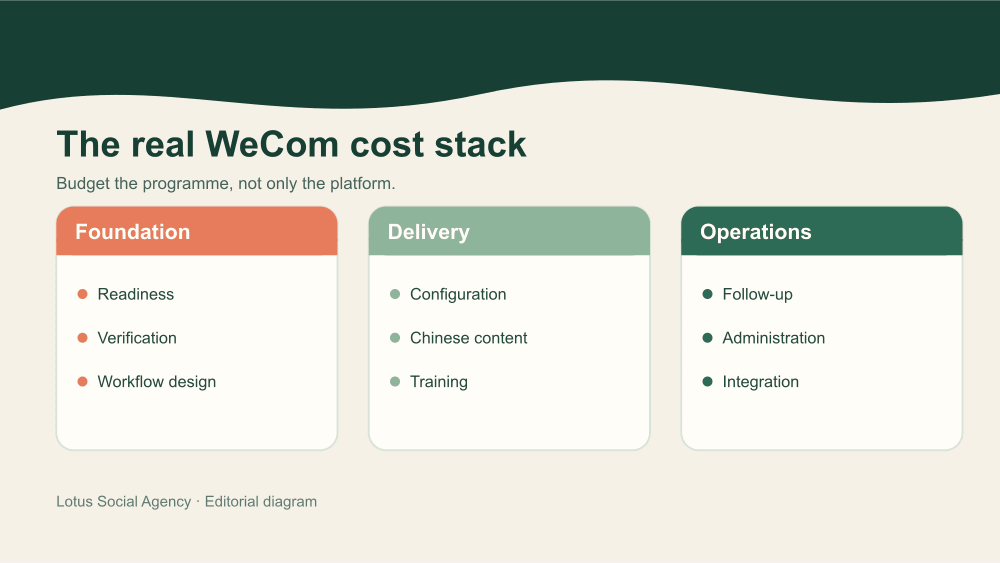
WeCom total cost stack covering account readiness, verification, workflow design, Chinese content, training, operations and integration
One-off costs — readiness review, account setup, workflow design, initial Chinese content, training and any integration build. Budgeting question: what must exist before the first customer enters the journey?
Recurring costs — renewals, account administration, content, customer or community operations, reporting and system maintenance. Budgeting question: who keeps the programme useful each month?
Variable costs — campaign assets, event support, paid media, added capacity, new integrations or new markets. Budgeting question: what changes with volume or scope?
Separate these categories in proposals. A low setup fee may exclude the work that makes the account operational; a higher recurring scope may include Chinese content, customer journeys and regular management.
What changes the WeCom project cost?
Applicant and eligibility
An overseas entity, mainland entity or other applicant route may face different requirements and available functions. Industry and intended activities also matter.
Number of teams and use cases
A single event follow-up pilot is simpler than a national sales, service and community programme. Each added team introduces ownership, access, training and reporting decisions.
Content volume and approval
The budget grows when the programme needs frequent Chinese materials, several audience segments, technical review or global and local approvals.
Service expectations
Customer response hours, escalation speed, languages, community moderation and specialist support change the operating model.
Data and integration complexity
More systems, historical records, custom fields, automated actions and compliance requirements require more discovery, testing and maintenance.
Internal capacity
A company with a China-based operator and established content process may need targeted support. A global team without local ownership may need a fuller strategy and delivery role.
A practical pilot budget brief
Ask potential internal or external delivery teams to quote the same defined pilot.
Include:
Audience and goal: Who will connect, and what useful action should the pilot support?
Entry point: Which event, article, service moment or campaign will create the conversation?
Account status: What entity, verification and administration already exist?
Operating team: Who responds, approves, escalates and reviews?
Required assets: Which Chinese messages, resources and group content are needed?
Systems: What must be recorded natively, and what must connect elsewhere?
Review: Which evidence will decide whether to refine, expand or stop?
Exclusions and contingency: Which platform fees, development, media or changing requirements sit outside the quote?
This produces comparable proposals and makes hidden assumptions visible. It also prevents a full rollout from being priced before the team understands the actual journey.
Questions to ask a WeCom provider
Which costs are platform charges, third-party charges and service fees?
Which prices are confirmed, and which remain estimates until eligibility review?
What content, training and operating work is included?
Who owns administrators, assets, customer records and integration accounts?
What happens when an employee leaves?
How are privacy, security and data questions escalated?
Which work is one-off, recurring or usage-based?
How will scope changes be approved?
What evidence will the team review after the pilot?
A credible provider should be comfortable saying which requirements need confirmation. WeCom changes over time, and the correct answer may depend on the organisation rather than a public list price.
How Lotus scopes WeCom work
Lotus begins with the audience, current account, team and customer journey. A scope can then combine the relevant parts of strategy, readiness, setup coordination, Chinese content, event or campaign follow-up, contact and group workflows, regular operations and reporting. Complex technical development is defined separately when needed.
This approach makes the budget easier to understand because each cost supports a real operating requirement.
Explore Lotus WeCom support or share your current setup and intended use case so the right first phase can be assessed.
