

How International B2B Technology Brands Can Build China Sales With an Overseas Team and WeCom
Short answer: an international B2B technology company does not need a sales team physically based in mainland China. It does, however, need a real sales team somewhere in the business that will own qualification, specialist follow-up and commercial decisions. WeCom can give that overseas team a credible China-facing relationship layer. It cannot replace sales ownership.
The model works well when a named regional or global salesperson owns each qualified opportunity, a Chinese-speaking sales/operator handles the local conversation, response expectations reflect the time-zone difference and useful context moves into the company’s existing CRM. If nobody has the capacity or authority to sell, demonstrate, scope or follow up, launching WeCom is premature.
This distinction matters for international software, data, analytics, cybersecurity, advertising technology, cloud and professional-services companies. Many already have salespeople in Singapore, Hong Kong, Europe, North America or another regional hub staying close to their core tech/business team. Their problem is not the total absence of a sales function. It is that Chinese buyers encounter language, channel, timing and trust gaps before the overseas team can apply its expertise.
Lotus Social Agency’s WeCom service helps international teams build that operating bridge through account coordination, Chinese content, enquiry workflows, day-to-day operations and reporting linked to the client’s sales process.
The right question is not “Do we have a China sales office?”
A mainland-China sales office and a China-ready sales operating model are not the same thing. An international brand can start with an overseas commercial owner if it can answer five practical questions:
- Who in the existing sales organization owns China opportunities?
- Who can respond clearly in Chinese and capture the buyer’s real question?
- How quickly can the team reply across time zones?
- How will product, security, legal, implementation and pricing specialists join?
- Where will the opportunity and next action be recorded?
If these responsibilities are clear, WeCom can support a focused market-entry model before local hiring. If they are unclear, the company risks creating a visible contact point with nobody dependable behind it.
Why China Sales Opportunities Get Lost When Teams Rely on Overseas Communication Tools
Chinese B2B buyers may discover an international technology brand through a conference, Chinese article, WeChat Official Account, partner introduction, webinar, overseas exhibition or colleague. The buyer may be interested, yet still hesitate to complete an English form or schedule a call before basic questions are answered.
Common failure points include:
- an English-language lead form routes to a global queue with no China context;
- a Chinese enquiry arrives while the overseas salesperson is offline;
- the first responder can translate words but cannot identify the business need;
- technical or security questions have no defined escalation route;
- a partner or freelancer keeps the relationship in a personal account;
- the overseas salesperson receives a name but not the conversation context;
- the CRM shows a lead without a clear source, owner or next action; and
- the buyer is pushed into a demo before the company understands what help is needed.
A good China-facing model reduces these gaps. It does not pretend that every contact is sales-ready. Its first job is to make the company understandable, responsive and easy to evaluate.
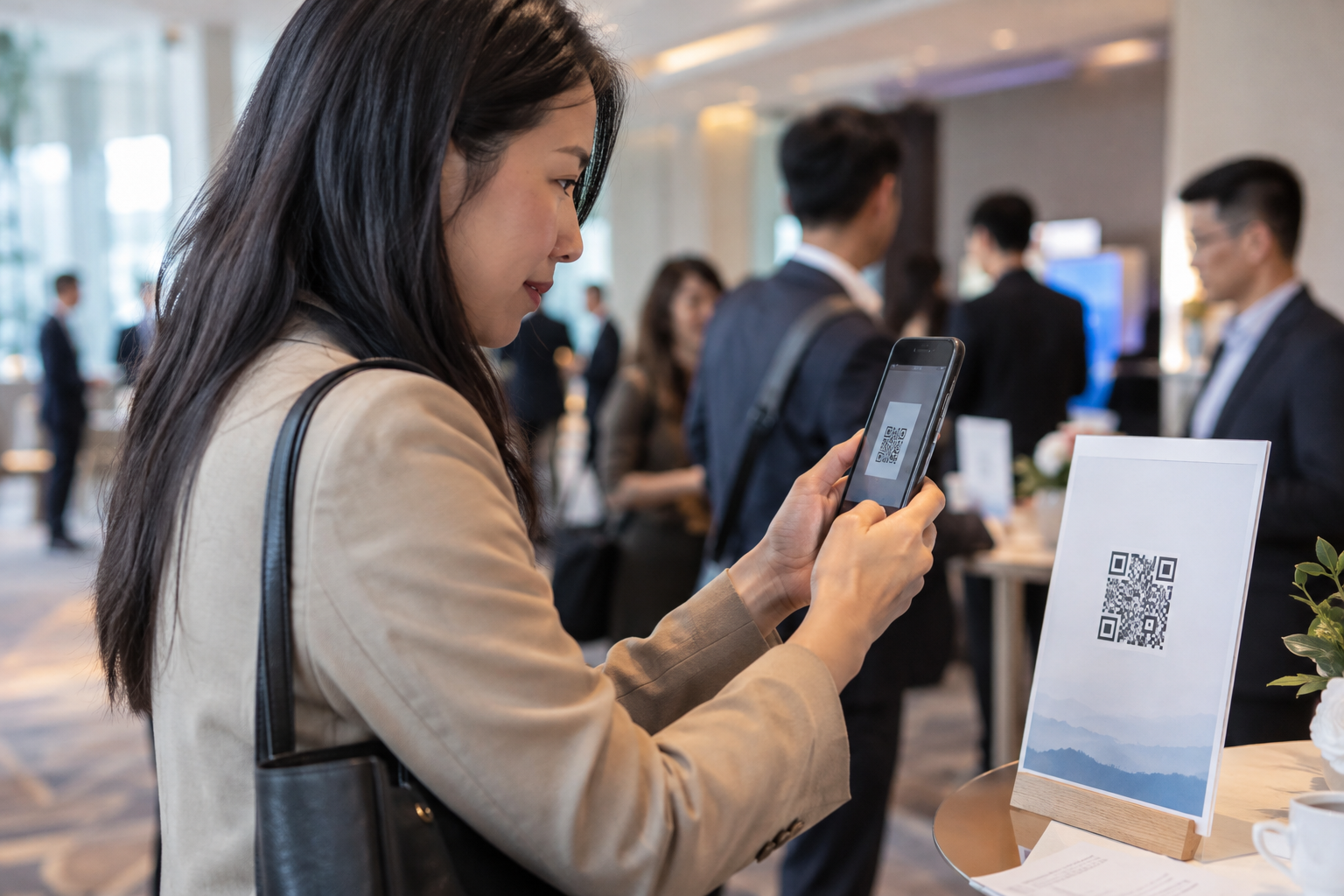
(A Chinese business visitor scans a QR code at a small technology industry event to begin a WeCom enquiry)
Where WeCom fits an overseas B2B sales team
WeCom is Tencent’s enterprise communication platform. Tencent describes it as connecting enterprise employees with customers who use Weixin, using a professional and consistent business identity. Tencent also states that the customer relationship belongs to the company and can be preserved when an employee moves on.
For an international technology brand, that creates four useful advantages.
A familiar China-facing conversation
A prospect can continue a business conversation in the Weixin environment instead of relying only on email or repeatedly completing forms. The profile, welcome message and first response should identify the brand, explain the purpose of the contact and set a credible expectation.
A managed company relationship
The contact does not have to remain attached to an unexplained personal account. The brand can define who operates the account, who supervises it and how responsibility changes when staff or suppliers change. Company ownership still requires a tested handover process; it should not be interpreted as a promise that every historical message, attachment, note or connected-system record transfers automatically.
A bilingual bridge to overseas specialists
A Chinese-speaking operator can clarify the buyer’s question, provide approved material and route the opportunity to the appropriate salesperson or specialist. The operator does not need to improvise pricing, product commitments or legal answers.
A route into the global sales process
Tencent says WeCom supports third-party applications, but technical connectivity is not the same as a sound CRM design. The company must still define what information enters the CRM, which system is authoritative, who updates the opportunity and how failed or incomplete handoffs are resolved.
A six-part model for selling into China from overseas
1. Assign a China opportunity owner inside the sales team
Name a salesperson or regional sales leader who is accountable for China-sourced opportunities. This person decides whether an enquiry is commercially relevant, coordinates specialists, agrees the next step and closes the feedback loop. “The global sales team” is not a usable owner.
2. Add a Chinese-language operating layer
The front line needs enough language, product context and judgment to understand the request and move it safely. It may be an internal bilingual employee or an authorized local partner. Lotus can provide Chinese content, enquiry handling within an agreed scope and day-to-day WeCom operations while the client’s sales team retains commercial authority.
3. Design coverage around time zones
Set a service window, acknowledgement rule and escalation time. An operator in China can receive and structure the enquiry during local hours; the overseas owner can take the qualified handoff when their working day begins. Do not promise instant specialist access when the organization cannot sustain it.
4. Use one compact qualification brief
Capture only the information required to choose the next action: organization, buyer role, use case, location, urgency, current environment, key constraint and requested step. Avoid turning the first WeCom exchange into an interrogation. A useful brief helps the overseas salesperson enter the conversation informed.
5. Prepare approved Chinese sales-enablement content
The operator should have current, approved explanations of the product, target customer, use cases, demonstration process, deployment model and support route. High-impact claims about functionality, security, pricing, eligibility, licensing or compliance should be verified by the relevant client specialist. Lotus can turn global material into clear Chinese content and sales-support assets without inventing claims the product team has not approved.
6. Define the CRM and specialist handoff
Agree the minimum CRM fields, source naming, opportunity stage, receiving owner, response deadline and evidence of completion. Product, solutions engineering, security, legal, implementation and customer-success teams should know when they may be called and what context they will receive.
Who owns what?
The operating model becomes easier to scale when responsibilities are explicit:
- Overseas sales owner: qualification decision, commercial relationship, opportunity stage and next step.
- Chinese-language sales/operator: first response, needs clarification, approved content, routing and local follow-up.
- Product and technical specialists: demonstrations, feasibility, security and implementation answers.
- Marketing: source journey, Chinese content, events, campaigns and lead context.
- CRM owner: definitions, data quality, integration and reporting rules.
- Legal, privacy and security teams: applicable requirements for the actual entity, data flow, contracts and market activity.
The local layer should make the overseas sales team more effective, not conceal it from the buyer or replace accountable commercial judgment.

An international and Chinese B2B technology team reviews an enquiry handover during a video call.
From a China enquiry to a global sales opportunity
Stage 1: Entry
The prospect reaches WeCom from a relevant touchpoint such as an industry event, Chinese article, webinar, partner introduction, Official Account or landing page. The invitation states what the person can ask and who will respond.
Stage 2: Local clarification
The Chinese-language operator identifies the organization, role, problem and requested next step. They provide only approved information and avoid presenting every contact as a qualified lead.
Stage 3: Sales acceptance
The overseas owner reviews the brief, accepts or redirects the enquiry and states the next action. An accepted lead is not merely copied into an email; it has a person, deadline and outcome to track.
Stage 4: Specialist progression
The right product, technical or commercial expert joins when needed. Chinese-language support continues so the buyer is not forced to rebuild the context in another channel.
Stage 5: Learning
The team reviews which buyer groups, questions, use cases and sources produce meaningful progression. Those findings should inform China market research, positioning, content and decisions about local investment.
What WeCom must not be asked to do
WeCom can support communication and relationship management, but it does not create product-market fit, guarantee qualified leads or replace a capable sales organization. It is not automatically a CRM or SCRM, and connecting it to one does not automatically produce accurate identity matching, attribution or pipeline data.
It also does not decide whether a product can be offered in China or whether a particular data, licensing, tax, security or contractual model is appropriate. Account eligibility, verification routes and available functions can depend on the applicant and current platform rules. Confirm the actual route before designing a journey around a feature.
Personal-information processing, third-party operations and cross-border data flows require review for the company’s actual situation. Define which information is necessary, where it is stored, who can access it and which system is authoritative. Use qualified legal, privacy and security specialists.
When an overseas team is not ready for WeCom
Delay the launch if:
- no salesperson is willing and able to own China opportunities;
- the company cannot provide a credible Chinese-language first response;
- there is no approved explanation of the product or target customer;
- technical, pricing and security questions have no escalation route;
- the organization cannot offer a realistic next step such as a consultation, demo or partner conversation;
- the CRM and ownership rules are undefined; or
- the proposed account and verification route has not been checked.
In that situation, start by clarifying the market, offer and operating responsibility. A contact channel without a dependable team behind it can reduce trust rather than create demand.
When to add China-based sales capacity
An overseas-led model is a practical starting point, not a permanent answer for every company. Consider deeper local sales or technical coverage when evidence shows:
- repeat opportunities from a defined Chinese buyer group;
- a volume of enquiries the current time-zone model cannot serve well;
- regular requirements for Chinese demonstrations, procurement support or on-site coordination;
- complex partner, contracting or implementation work;
- meaningful pipeline that justifies dedicated local investment; or
- buyers need a level of local continuity the overseas model cannot provide.
Lotus can combine China B2B technology marketing, WeCom, Chinese content, social media and local coordination while helping the client see where a stronger commercial presence is becoming necessary.
Frequently asked questions
Can an overseas B2B sales team use WeCom for China?
Potentially, if the company has an appropriate account and verification route, a named sales owner, Chinese-language operations and a workable handoff process. Eligibility and available features can vary, so confirm the current setup before launch.
Must the salesperson be based in mainland China?
Not necessarily. A salesperson elsewhere can own qualification and progression, provided the team covers Chinese-language communication, time-zone expectations and specialist follow-up. The appropriate entity, employment, tax and contracting structure requires separate professional advice.
Can Lotus answer enquiries for the sales team?
Lotus can support agreed first-response, content, qualification-input and routing workflows. Product commitments, commercial qualification, pricing, contracts and specialist advice remain with the client unless a different authorized scope is explicitly established.
Can WeCom replace the global CRM?
Usually not. WeCom can support direct conversations and company-managed relationships, while the CRM remains the authoritative commercial record. Define the role of each system and the fields, owners and controls connecting them.
Does company ownership mean every conversation transfers when an employee leaves?
No blanket assumption should be made. Tencent says customer relationships can be preserved at company level, but the brand should test its handover workflow and confirm what message history, files, notes and connected-system context remain accessible.
Build a China sales bridge your overseas team can operate
The most useful early WeCom program does not imitate a large local sales organization. It gives Chinese buyers a credible local-language route while connecting every qualified opportunity to the international team that can actually progress it.
Lotus helps B2B technology brands design the journey, coordinate the account, create Chinese sales-enablement content, operate agreed WeCom workflows and report what the market is revealing. Talk to Lotus about building a WeCom operating model for your overseas sales team.
