

The Chinese Guest Journey for International Hotels: From RedNote to the Stay
Imagine a traveller who saves a useful hotel guide on RedNote six weeks before a trip. The room looks right for her family. Later, she finds the property on Ctrip, reserves a different room type by mistake, and sends a question about arriving after midnight. By the time she reaches the front desk, she is no longer thinking about the original post. She wants someone to understand the booking and help her get upstairs.
This is a hypothetical journey, but the weak points are familiar. A hotel can have attractive Chinese content and still lose confidence at the room-selection screen or the arrival desk. The work is to keep the same facts true wherever the guest encounters them.
That is why a Chinese traveller strategy should begin with the stay itself. RedNote can make the property discoverable and worth considering. A booking listing or hotel website has to make the choice clear. Reservations and the front desk must be ready to deliver what those pages led the guest to expect. Only then do advertising, relationship tools and loyalty activity have something solid to build on.
This guide is for international hotels welcoming travellers from mainland China. It is not a claim that all Chinese guests behave alike. A first-time family visitor, a repeat business guest and a couple planning a quiet resort week will ask different questions and use different routes.
The research gives a useful sense of those routes without prescribing one for every property. The China Tourism Academy's outbound-travel research identifies online social media as an important information source and highlights accommodation and service quality among traveller concerns. In Dragon Trail's March 2025 survey, Ctrip was the most-used destination-information channel among experienced outbound travellers overall, while Xiaohongshu (RedNote) was especially important to younger respondents. A survey is a signal, not a substitute for learning what your own guests need.
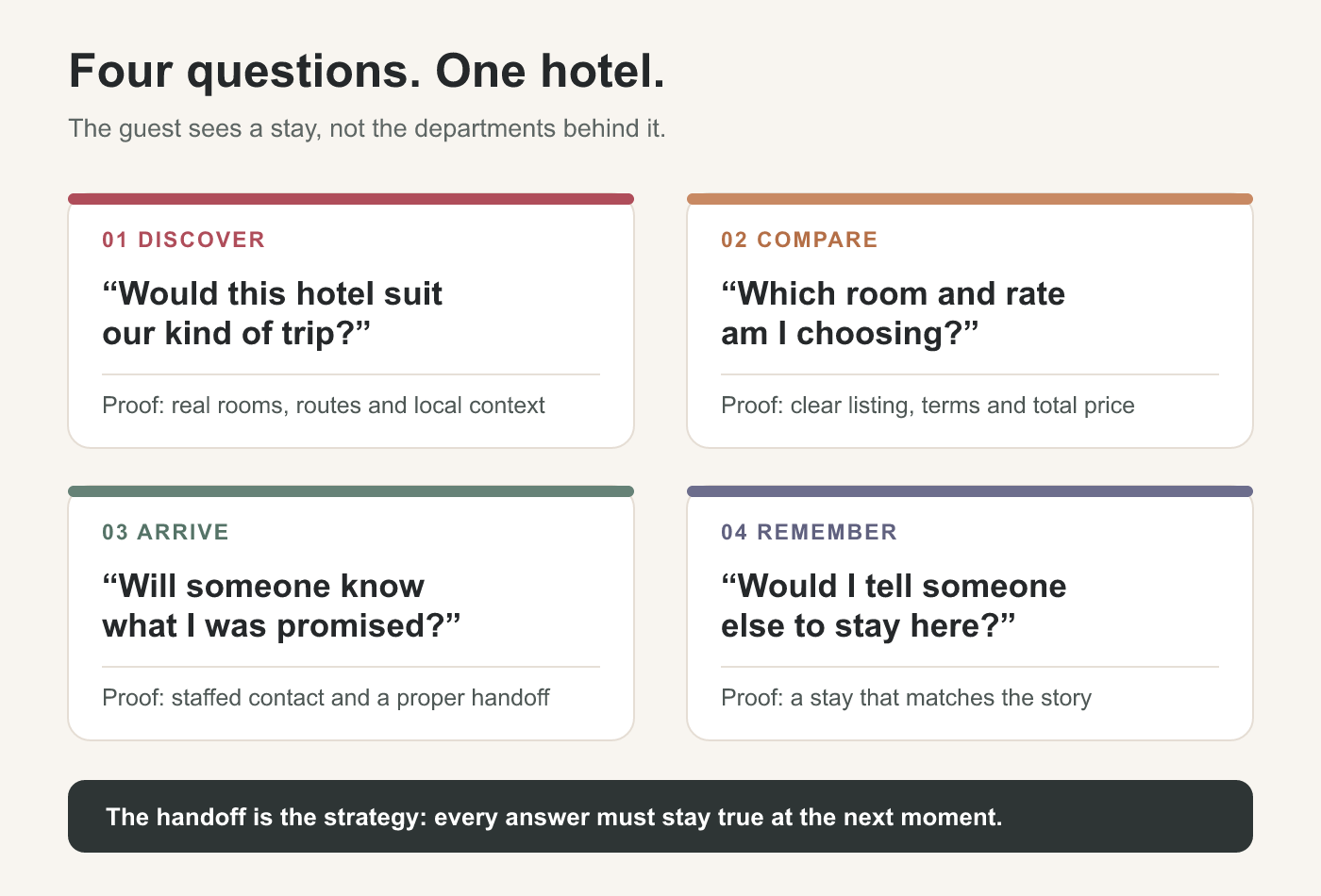
Start with a stay you can describe honestly
The quickest way to make this practical is to choose one priority stay, not an abstract “Chinese market.” A three-night city break for parents and a child is a different proposition from a couple's wellness escape or a business traveller landing late and leaving early. Pick one, then ask what might stop that guest from feeling sure about the hotel.
For the family, it may be the exact bed configuration, breakfast and the distance to a station. For the late-arriving guest, it may be whether check-in is staffed, how to reach the hotel and what happens if the flight is delayed. These details can shape content, but first they need confirmation from the people who operate the property. A marketing team should not discover the real child policy in the comments beneath a post.
Begin with a short evidence pack: current room photographs by category, occupancy and breakfast rules, transfer options, seasonal facility hours, accessibility information where relevant, and a named contact for unusual requests. Give every fact an owner and a date to review it. This is unglamorous work; it is also what makes the Chinese story believable.
Use RedNote to answer the questions a brochure skips
For many outbound travellers, Xiaohongshu—often called RedNote—is part of planning, not just entertainment. People search by destination, occasion and practical concern. A hotel should therefore look at Chinese-language searches around the type of stay it can genuinely offer, as well as existing posts and questions about the property or its neighbourhood. The Lotus RedNote service is built around that combination of audience questions, Chinese search language, useful content and regular account care.
The best first posts usually do not start with an adjective. They start with a decision. “Which room works for three people?” is more useful than “a luxurious family escape.” “Here is the route after an evening arrival” is more useful than “conveniently located.” A seasonal guide can show what is open and what is not. A neighbourhood note can show an actual walk, with time and terrain, instead of a list of attractions copied from a destination brochure.
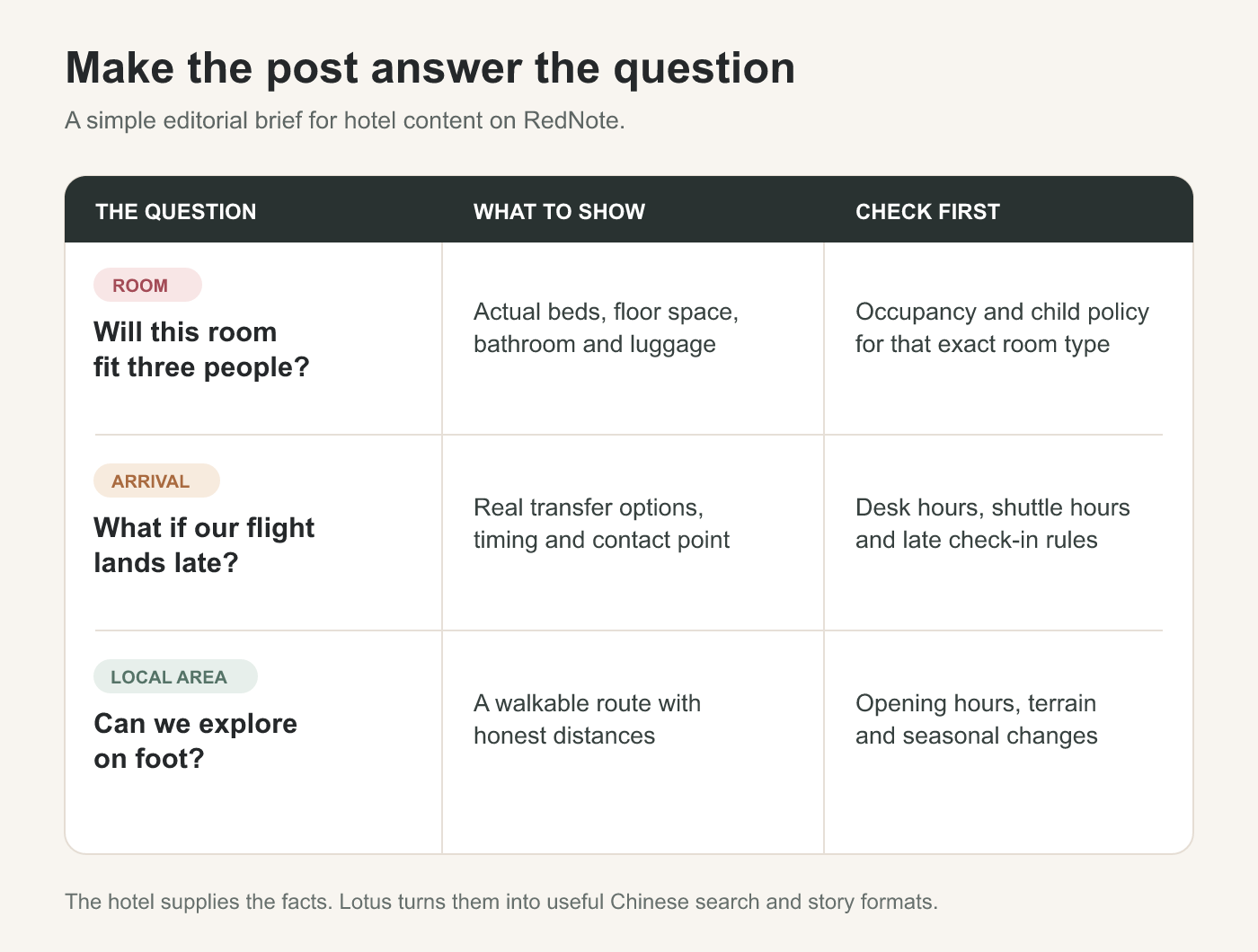
The hotel's own account can provide authoritative details. Creators can contribute a different perspective: what the room felt like, how the transfer worked, what they actually did nearby. Choose them for the traveller and the content job, not just the size of their audience. Agree on access, fees, disclosure, factual checks and reuse rights before a visit. Lotus can coordinate Chinese content and creator work while keeping the hotel's voice distinct from a guest's independent experience.
Read the comments as research. If several people ask whether a child can share an existing bed, there may be a missing room guide. If they cannot tell how far the station is, the location story is incomplete. Some questions will reveal an operational problem, not a copywriting problem. Pass those back to the hotel rather than writing a smoother answer to an unresolved issue.
RedNote should not have to carry the whole journey. A note may prompt someone to search the property's Chinese name on a booking platform, visit a hotel website, ask a friend or contact the property. Keep the Chinese name and essential facts consistent so the hotel remains recognisable. Do not assume every account can link directly to every booking destination; use the current permitted account route.
Make the booking choice match the story
A traveller who has found the right hotel still has to choose a room, rate and route to reserve it. For many mainland travellers, Ctrip is relevant here; it is not simply another name for the global Trip.com storefront. Trip.com Group describes Ctrip as China-facing and Trip.com as serving global users. The hotel's distribution team should check the actual Chinese-facing presentation rather than assume that a polished English listing carries across unchanged.
Try a simple phone test with a Chinese-speaking colleague who has not worked on the campaign. Give them the RedNote post and ask them to find the same property, select the room the post described and explain the full cost, breakfast terms, child policy and cancellation conditions. Watch for hesitation. If the post shows a sofa bed but the listing names only a double bed, that is not a small editorial inconsistency; it changes the decision.
Trip.com's accommodation-partner FAQ says its eBooking tools can manage property details, rates, availability, reservations, guest reviews and guest communication. The particular Ctrip and Trip.com setup for a hotel depends on its contract and distribution arrangements. The hotel or its authorised distribution partner should control rates, inventory, booking terms and settlement. Lotus can identify gaps in the Chinese-facing story and coordinate corrections with the right team; it should not pretend to own the revenue system.
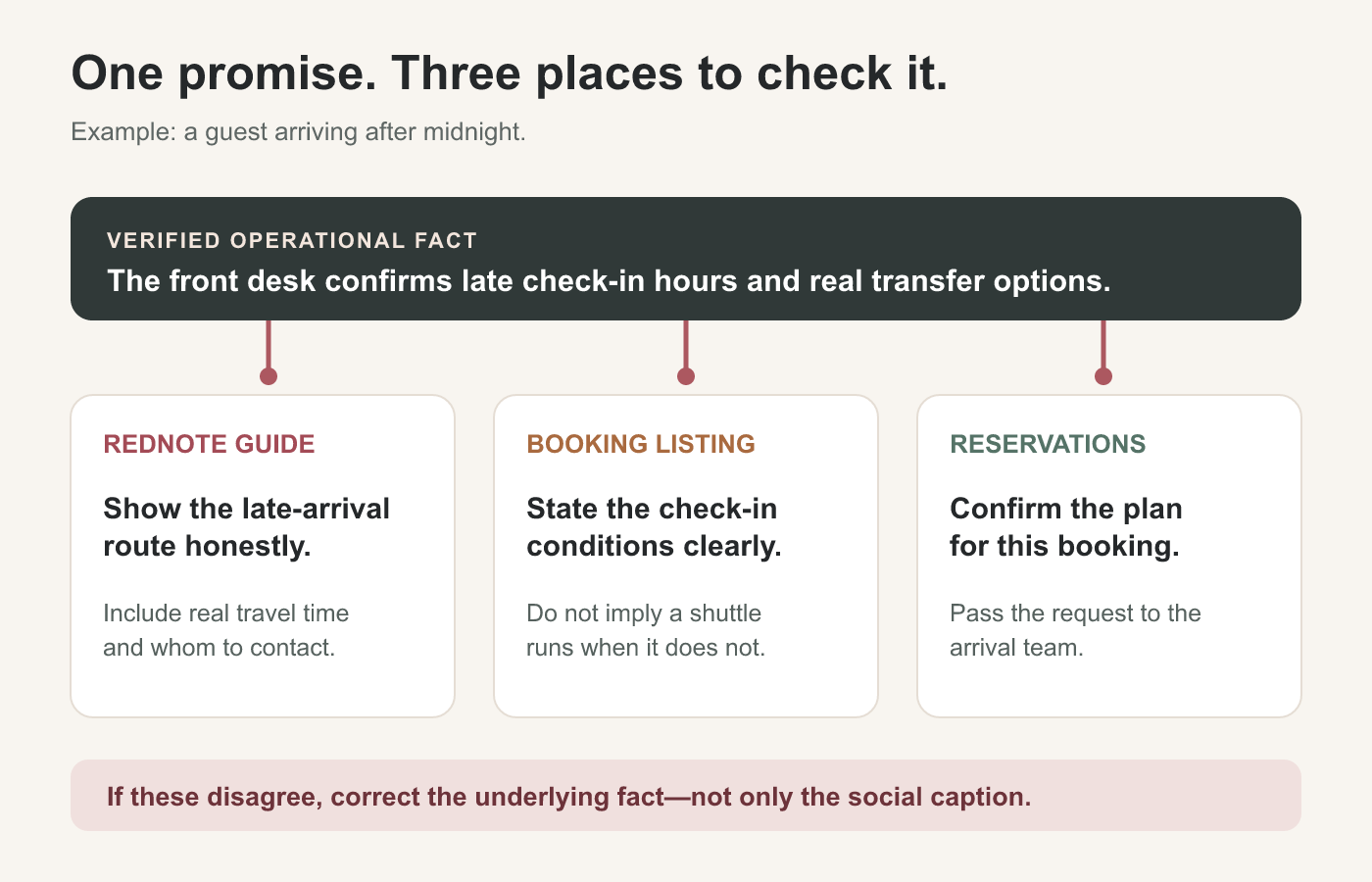
Keep room and rate facts consistent from the RedNote post to the booking listing and the arrival.
Give the arrival a human handoff
The stretch between reservation and check-in is where a confident story can become uncertain. A guest may need an airport route, a late-arrival plan, a way to mention a child or a clear answer about a deposit. One concise Chinese-language arrival note can remove several messages—provided it is current and the contact route is staffed.
Do not send guests to a WeChat account just because it exists. A contact button is only helpful if someone can answer, identify the booking where appropriate and pass a request to the team on shift. If the property uses an OTA's guest-message system, a hotel contact channel or both, agree which one handles which issue. A missed message about a delayed flight is a service failure, no matter how good the social campaign was.
The same applies on the property. A translated QR menu or Chinese-language guide can be useful; it is not a substitute for a colleague who knows whether the kitchen is open or a transfer can still be arranged. Where the hotel has Chinese-speaking staff, make their availability clear without implying around-the-clock coverage if that is not true. Where it does not, write concise service information and a reliable escalation route.
Add WeChat and WeCom when they solve a real service problem
An official WeChat presence can be useful for verified hotel information, updates and communication. It does not mean every hotel needs a mini-program before it can serve Chinese guests. If the current booking routes work and the team cannot maintain another product, a new interface may add effort without removing friction.
WeChat advertising can be considered when the hotel has a clear audience, an approved account route, a strong Chinese message and a destination after the click that it can actually support. An overseas business licence alone does not settle eligibility. Tencent's published overseas-advertiser requirements include tourism, with category exclusions, and the current applicant documents, creative and landing destination still need review. Paid reach is more useful after the content and booking answers are sound.
WeCom is a later-stage tool for hotels receiving enough Chinese enquiries to need company-managed contact, handovers and relevant follow-up. It can help reservations and guest-service colleagues keep context, rather than leave a conversation in one person's personal inbox. Lotus's WeCom work covers the practical contact flow and operating responsibilities. The hotel still needs a reason for guests to connect, appropriate permission to stay in touch and people assigned to respond. A traveller interest group deserves the same test: will someone keep it useful, or will it become another stream of promotions?
Measure the weak handoff, not just the loudest channel
A RedNote save is encouraging, but it is not a room night. An OTA reservation may have been influenced by a post that receives no booking credit. A monthly report should be honest about both.
Look at a few signals together: whether relevant Chinese searches surface helpful hotel content; whether people save it or ask more specific questions; whether they can recognise the correct property and room on the booking route; what reservations hears; and what booked guests say prompted their choice. Check identifiable enquiries and bookings where the data is available, but do not manufacture a single-channel attribution story from incomplete evidence. For a hotel with several properties, break the results out by property and guest need—otherwise a strong destination can hide a weak one.
The most useful question in the review meeting is often: Where did a guest have to ask twice? A repeated question suggests missing information. A contradiction between the post and listing suggests a broken handoff. A complaint at check-in may point to an operational promise the marketing team should stop making until it is resolved.
Build a small working rhythm before a large ecosystem
In the first month, choose one priority traveller and one property or stay type. Audit what Chinese travelers can currently find, including RedNote mentions, the Chinese property name and the live booking presentation. Collect the questions reservations and front desk already hear. Confirm the source facts and who can update them.
In the second month, publish a focused set of RedNote notes, correct the biggest booking mismatches with the hotel's distribution team and agree how comments or enquiries are answered. Use creators only if they add evidence the hotel's own account cannot. A paid test can wait until there is somewhere useful for new attention to go.
In the third month, run the phone-based booking test again. Compare the questions people asked before and after the content went live. Decide whether to expand the RedNote library, test measured paid reach, improve arrival information or set up a better guest-contact workflow. Do not open another channel simply because it appears in a competitor's plan.
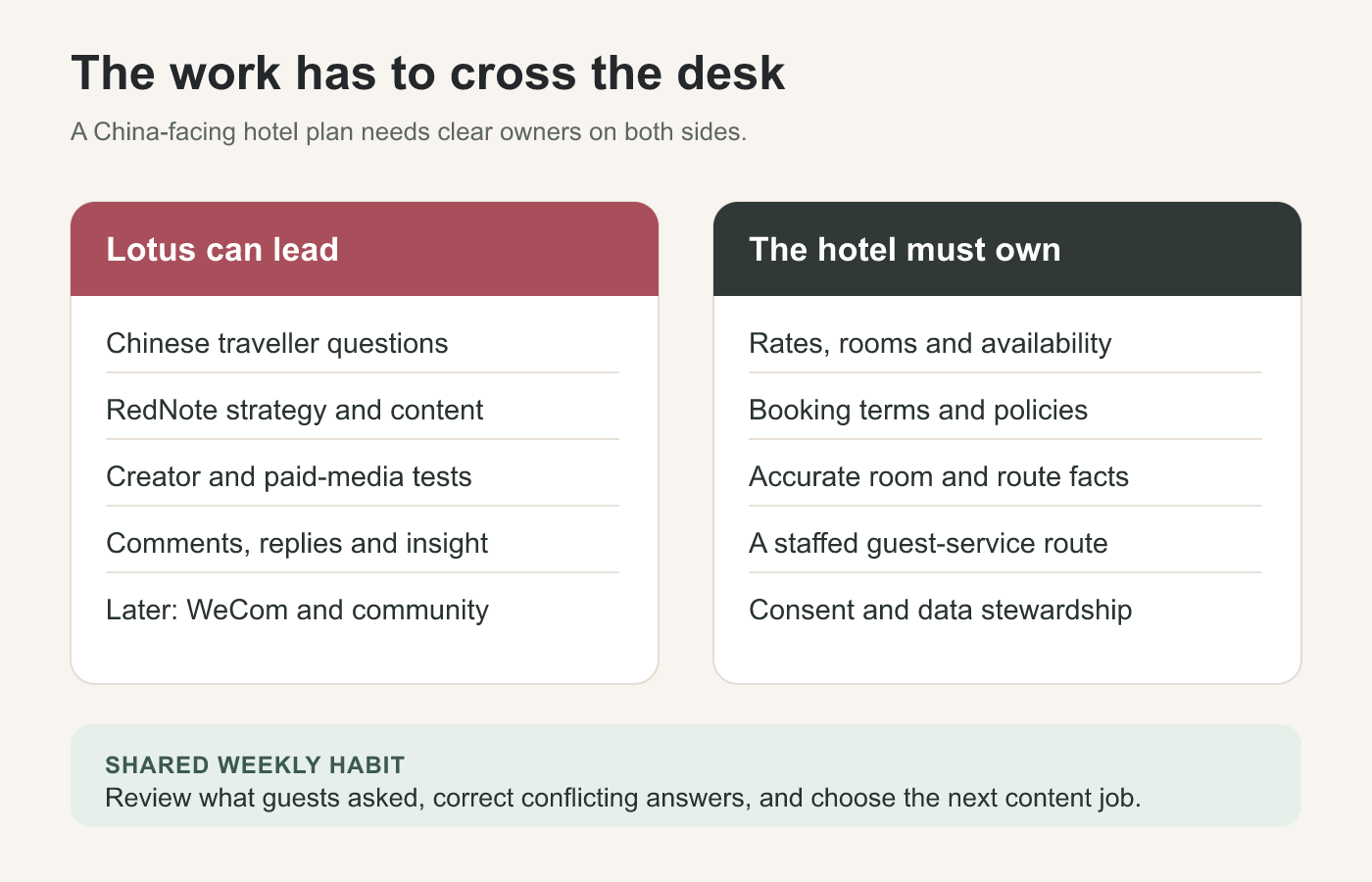
A simple team handoff connects online questions to the people who can deliver the stay.
This is where Lotus is most useful to an international hotel team: traveller research and China travel strategy, RedNote positioning, Chinese content, creators, account operations, community response and carefully scoped paid media. Later, if guest volume warrants it, the work can extend to WeCom or managed interest groups. It should remain connected to the hotel staff who will deliver the stay.
Questions international hotel teams ask
Should we prioritise RedNote or WeChat?
For a hotel trying to become easier to find during trip planning, RedNote is often the stronger first content priority. WeChat may already be more useful to a property with an established Chinese guest base and regular service or member communication. Check the audience, the existing accounts and who can operate them before choosing.
Do we need a WeChat mini-program to attract Chinese guests?
No. First make sure guests can understand the stay, choose the right room and reach the hotel when needed. A mini-program may be worthwhile for a larger, repeatable service or loyalty use case, but it is a separate product and operating commitment, not a prerequisite for a credible China presence.
Can a hotel tell whether RedNote influenced a Ctrip booking?
Sometimes there are clues: changes in branded search, identifiable enquiries, booking-path traffic, guest surveys and what reservations hears. A person may discover the hotel on one device and reserve later elsewhere, so perfect attribution is unlikely. Use a pattern of evidence to decide what to improve.
Who should answer questions posted under hotel content?
An agency can monitor and draft Chinese replies, but the hotel's rooms, reservations or guest-service team must verify answers about availability, charges, policies and special requests. Agree on a response owner and an escalation route before posting regularly.
Make the next guest's question easier to answer
You do not need to build every China platform at once. You need a truthful story about a real stay, a booking route that matches it and a team that can deliver it. RedNote is often the best place to start that story, because the questions people ask there tell you what they need before they are ready to reserve.
Tell Lotus about your property, the Chinese-facing pages guests see now and three questions your team keeps answering. We can discuss where the journey is breaking and which piece of research, RedNote content, creator work or account support would make the most useful first project.
