

The Complete WeCom Guide for International Brands in China: Strategy, Setup and Operations
WeCom is Tencent’s enterprise communication platform. It was previously known internationally as WeChat Work and is called 企业微信 in Chinese. It combines internal work tools with the ability for approved employees to communicate with customers, partners and other external contacts who use WeChat or Weixin.
For an international brand in China, WeCom’s most useful role is often not internal office chat. It is the relationship layer between public marketing and the company’s sales, service or community team.
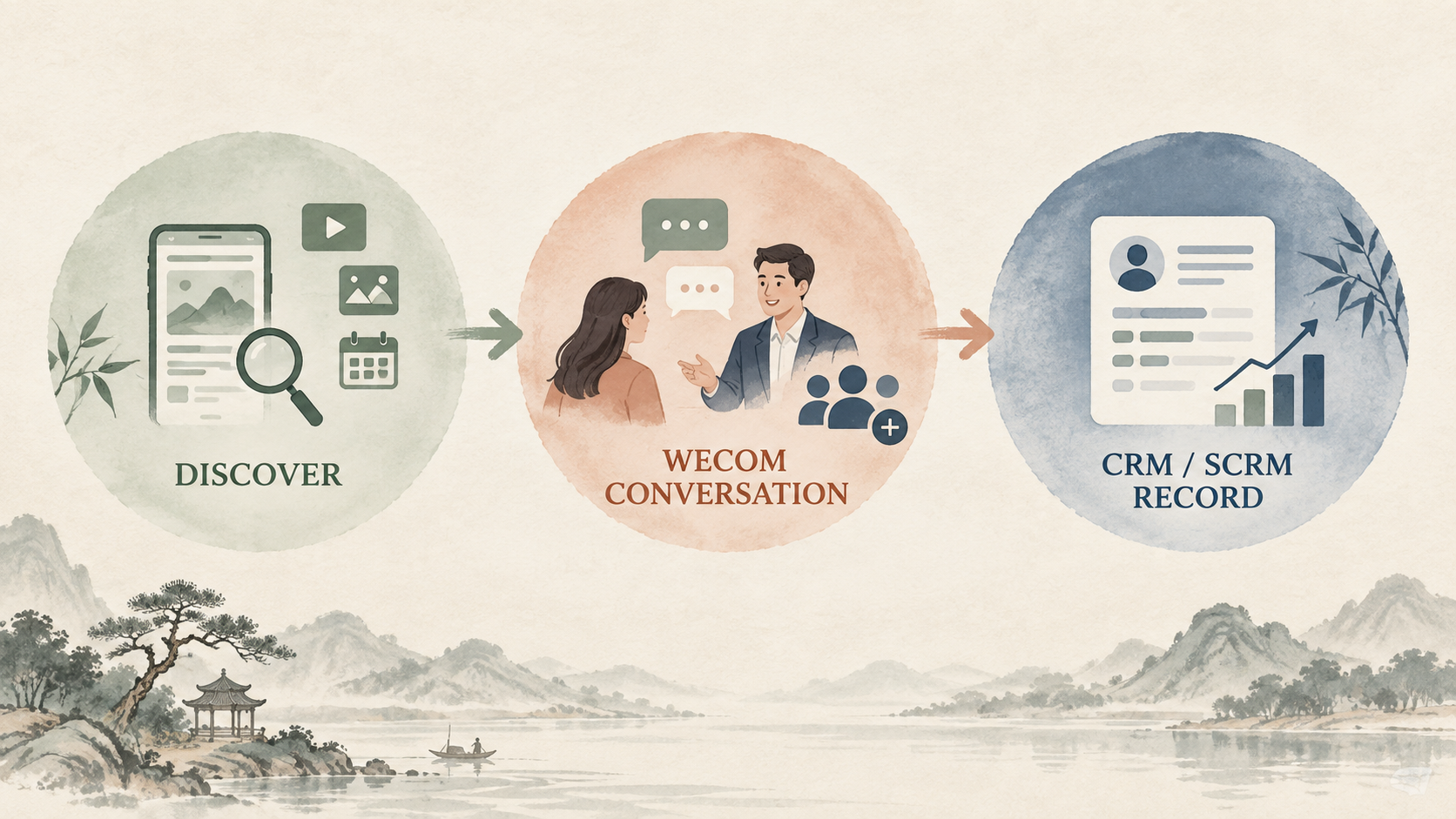
A person may discover the brand through Chinese search, a WeChat article, WeChat Channels, a campaign, an exhibition or a recommendation. WeCom can then give that person a clear route to a company-managed conversation with an appropriate employee or operator.
That does not make WeCom a complete China strategy or an automatic CRM. The brand still needs a real audience, a reason to connect, Chinese-language ownership, useful content, response rules and a wider sales or service process.
WeCom, WeChat Work and 企业微信: are they the same platform?
Yes. WeChat Work was the earlier international name. The platform is now called WeCom in English and 企业微信 in Chinese.
“WeChat” and “Weixin” require a separate distinction. Tencent describes them as separate but interoperable sister services: Weixin serves users in mainland China, while WeChat is designed for users elsewhere. International business conversations often use “WeChat” as a broad shorthand, but features, terms and account requirements can differ.
For that reason, a brand should confirm the current route for its actual audience, applicant and intended features rather than relying on an old global guide.
What does WeCom do?
Tencent describes WeCom as an enterprise communication and office platform with a communication experience connected to Weixin. Its official overview says employees can communicate with Weixin users through a professional company identity. Tencent also says customer relationships can remain owned by the company when an employee moves on, and that WeCom supports third-party applications and more than 200 APIs.
For international brands, those capabilities can support four connected jobs.
1. Internal coordination
Teams can use WeCom for communication and selected office workflows. The relevant functions depend on the account, configuration and current product version.
2. Customer and partner conversations
Approved employees can communicate with external contacts through supported WeCom and Weixin journeys. These conversations may support sales follow-up, service, event leads, partner communication or communities.
3. Company ownership and operating control
A managed WeCom structure can make ownership clearer than relying only on personal WeChat accounts. The business can define who operates the account, who may contact customers and how responsibilities change when employees move roles or leave.
Company ownership of the relationship should not be interpreted as a promise that every historical message, file, note or connected-system record transfers automatically. A tested handover process remains necessary.
4. Connections with other systems
WeCom can connect with parts of the wider Weixin ecosystem and with approved third-party applications. CRM, SCRM, Mini Program, data and automation requirements should be designed around a real workflow and scoped separately when technical delivery is needed.
How is WeCom different from WeChat and a CRM?
The platforms are related, but they do different jobs.
Personal WeChat or Weixin
This is a person’s individual account. It can be convenient for business communication, but customer relationships may become attached to the employee rather than governed by the company.
WeChat Official Account
An Official Account is primarily an official publishing and service destination. It can host Chinese articles, menus, automated replies, campaign information and links to other parts of the customer journey.
Explore Lotus’s WeChat marketing support for international brands.
WeCom
WeCom is designed for company-managed employee communication and supported relationships with customers, partners or communities. It can take an interested person from public content or an event into a closer conversation with the right team.
CRM or SCRM
A CRM normally remains the main commercial record for accounts, opportunities, stages, actions, forecasting and reporting. An SCRM may add social-channel data or workflows. Neither connection should be assumed: the required fields, permissions, integrations and ownership rules need to be defined.
In a sensible operating model, the Official Account helps people discover and understand the brand, WeCom supports direct relationships, and the CRM records the material commercial process.
When does an international brand genuinely need WeCom?
WeCom is most useful when the brand has a real relationship-management problem to solve.
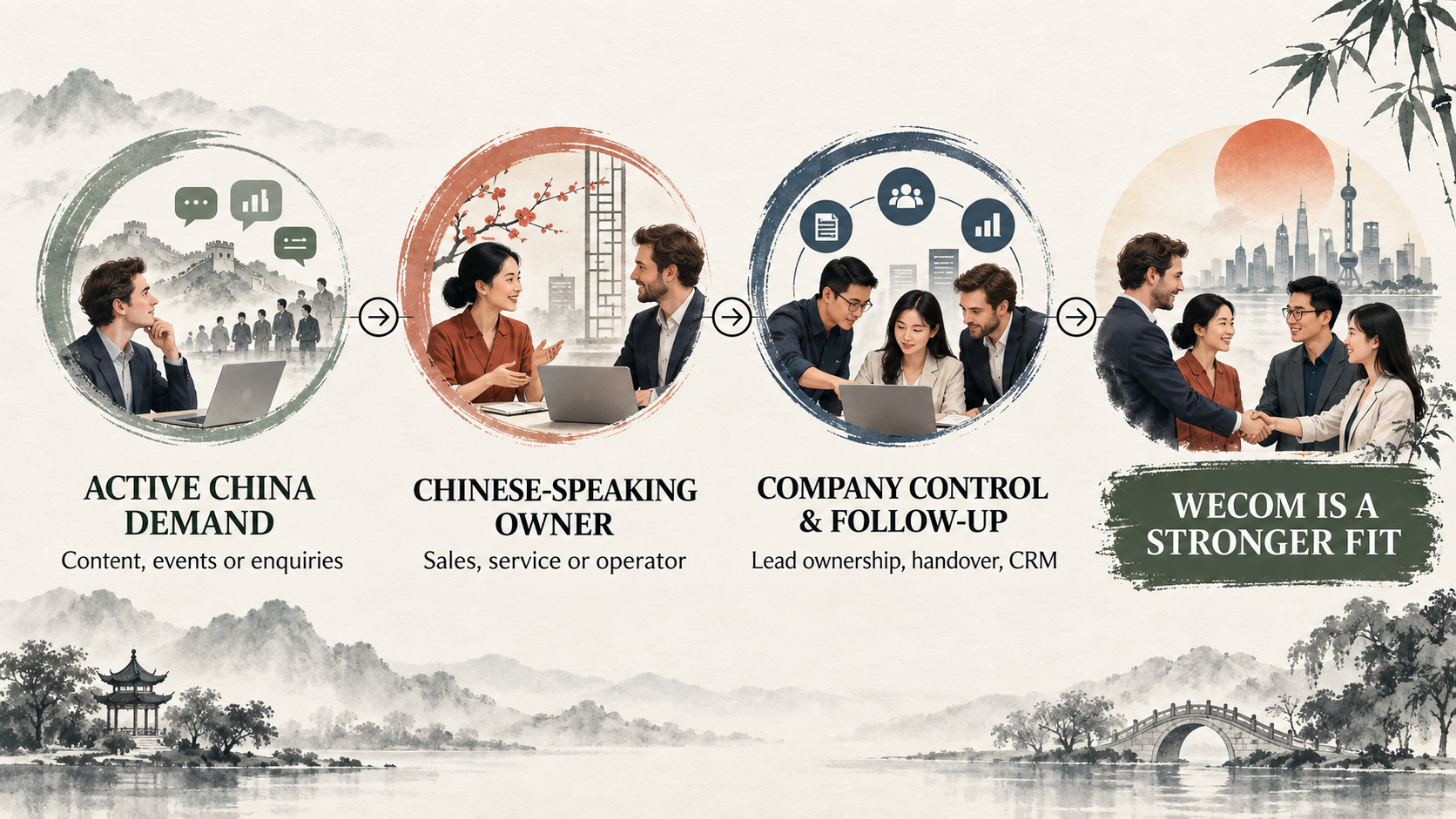
The strongest trigger is usually not “we want another Chinese platform.” It is that mainland China demand already exists, Chinese-speaking employees or operators are already handling customer conversations, and the company needs stronger control, continuity and measurable follow-up.
A stronger case usually includes several of these conditions:
The brand is actively marketing, selling or providing service in mainland China.
Chinese content, paid activity, exhibitions or events are producing enquiries.
A Chinese-speaking salesperson, operator or authorised partner can respond.
Valuable contacts are being managed through employees’ personal WeChat accounts.
The company lacks visibility over who owns Chinese leads and what happens next.
Salespeople or local partners may take relationships with them when they leave.
Different teams need clearer rules for lead routing, escalation and customer handover.
The brand has useful Chinese content or service information for ongoing follow-up.
There is a measurable sales, service, partner or community journey.
WeCom is probably premature when the company has no validated audience, no Chinese-speaking owner, no clear reason for customers to connect and no team able to act on the resulting conversations.
The platform cannot compensate for an unavailable product, an unclear offer or a sales team that is not prepared to support Chinese opportunities.
Six practical WeCom use cases for international brands
B2B sales and complex buying journeys
Technology and professional-service opportunities often involve several decision-makers. WeCom can support expected follow-up, Chinese sales content and coordination with overseas specialists.
Read Lotus’s guide to selling B2B technology in China through multiple decision-makers.
Exhibition and event follow-up
A relevant QR code or contact route can connect an event conversation with a named owner, useful Chinese follow-up and a defined next action. Collecting contacts without response ownership is not a useful event strategy.
Retail and VIP clienteling
For suitable premium, retail and lifestyle journeys, WeCom may support appointment coordination, product education, after-sales service and relevant relationship-building. Consent, brand standards, employee permissions and message frequency still matter.
Customer service and customer success
WeCom can provide a familiar route for appropriate support, onboarding or customer-success conversations. It does not automatically replace a ticketing system, help centre or service-level process.
Distributor and partner communication
International brands may use a managed structure to coordinate distributors, installers, agents or service partners. The company still needs to define commercial ownership and which information belongs in formal systems.
Communities and member relationships
Customer groups can be useful when members share a genuine purpose and receive ongoing value. Groups should not be created simply to increase contact volume. Every group needs an owner, participation logic, content plan, moderation rules and an exit process.
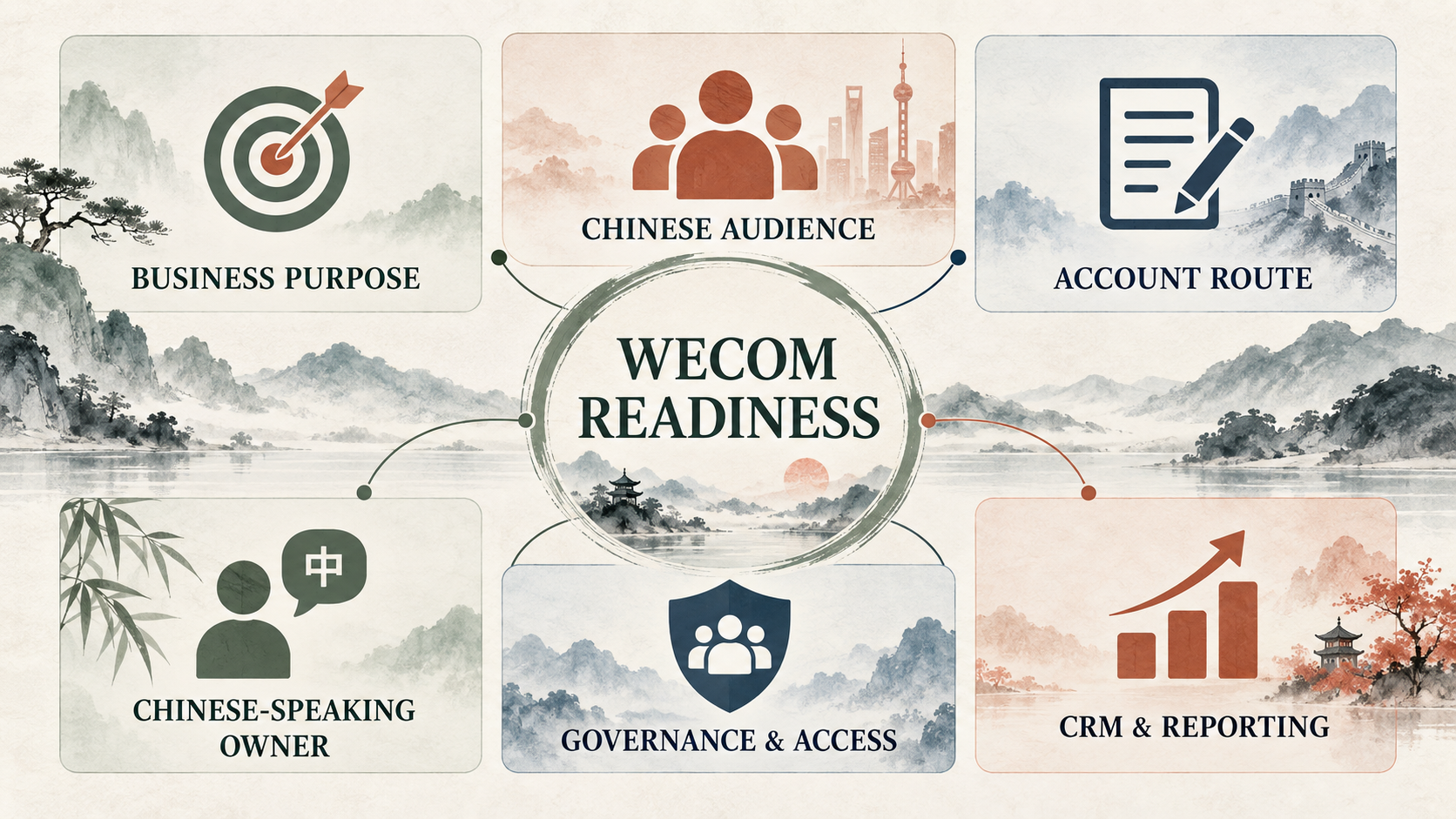
What should be ready before WeCom setup begins?
A clear business purpose
Define what WeCom is expected to improve: event follow-up, lead control, customer service, clienteling, partner communication or another specific journey.
“We need WeCom because it is popular in China” is not an operating brief.
A defined Chinese audience
Know who should connect, why they would choose to do so and what help or information they expect afterwards.
The right applicant and account route
Registration, verification, administration and feature eligibility depend on the applicant, jurisdiction, required capabilities and current platform rules. Some international structures may be workable, while other requirements may need a mainland China entity or operating arrangement.
Lotus checks the current circumstances before recommending a route. Explore Chinese social media account setup and verification.
A Chinese-speaking owner
Someone must be responsible for understanding enquiries, responding within an agreed time, coordinating specialists and moving useful information into the correct internal system.
This can be an employee or an authorised operating partner, but responsibility must be explicit.
Governance and access rules
Define administrators, employee permissions, customer ownership, approval responsibilities, offboarding and escalation. Decide what happens when a salesperson changes role or leaves.
Useful Chinese content
Welcome messages, follow-up articles, FAQs, demonstrations, service guidance, event materials and case studies should answer the audience’s real questions. Translating a global brochure is rarely enough.
Lotus supports Chinese content localisation and production across social, sales, event and customer journeys.
A CRM and reporting rule
Agree which material information must leave the chat and enter the CRM or other system of record. This may include lead source, account owner, qualification, opportunity stage, service case, next action and outcome.
Can a foreign company register for WeCom?
The answer depends on what “register” and “use” mean for the proposed programme.
The workable route can vary according to the applicant, country or jurisdiction, verification needs, administrator arrangement, features, integrations and intended audience. Requirements and fees may change. A brand should not make a legal-entity decision based on an old blog post or assume every feature is available through every account route.
The better sequence is:
Define the business journey and required functions.
Review the brand’s current entity and administrator structure.
Check the current applicant and verification options.
Confirm which functions are available through the proposed route.
Test the operating workflow before scaling.
This avoids both extremes: assuming a mainland China entity is always mandatory, or assuming an overseas structure can support every requirement.
Does WeCom replace a CRM or SCRM?
No—not automatically.
WeCom can be an important communication and customer-relationship layer. A CRM normally remains responsible for the structured commercial record. An SCRM may add social relationship data, campaign workflows or customer profiles, depending on the product and integration.
Before technical work begins, define:
which system is authoritative for customer identity;
who owns an account or opportunity;
what data should be recorded;
which events should trigger a workflow;
who can access or export information;
what the team does when an integration fails; and
how consent, privacy and retention requirements will be handled.
Connecting systems without these decisions can reproduce the same confusion in more places.
What happens when an employee leaves?
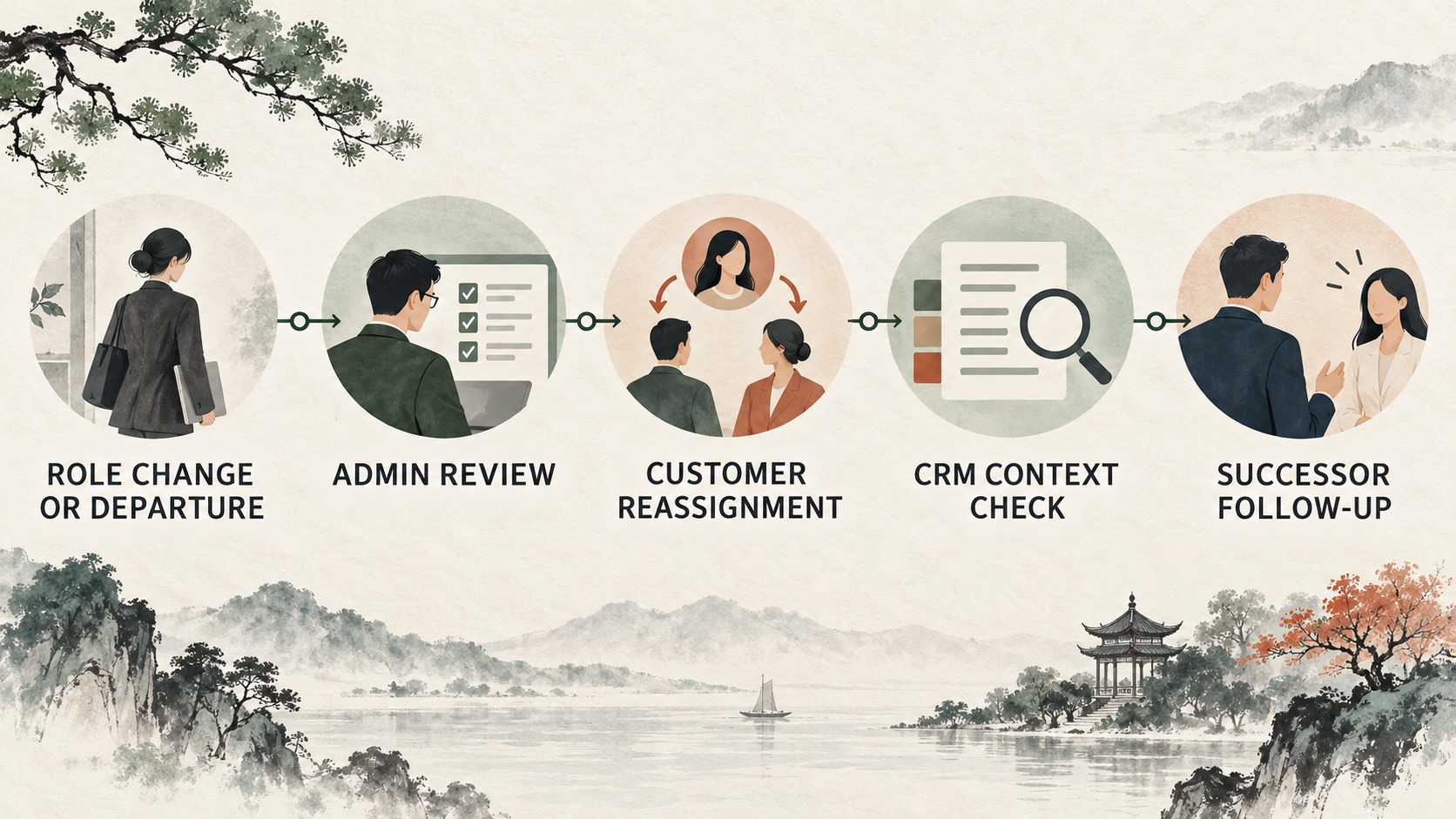
Tencent states that WeCom can keep customer relationships owned by the company when an employee moves on. This is a meaningful advantage over unmanaged personal accounts.
It still needs governance. The company should know:
who starts the reassignment;
which successor is appropriate;
how the customer is informed;
what context is available to the successor;
which records must already exist in the CRM; and
what historical messages, files or notes do not transfer through the chosen process.
Test this process before an urgent departure. Relationship ownership and complete conversation-history transfer are not the same promise.
What WeCom cannot do by itself
WeCom cannot automatically:
create demand in the Chinese market;
turn every contact into a qualified lead;
replace a Chinese-speaking sales or service owner;
make unsupported product, pricing or compliance claims accurate;
replace a CRM, help desk or legal review;
guarantee message-history transfer;
make an irrelevant customer group valuable; or
improve results without regular content, follow-up and operational learning.
The technology matters, but the operating system around it determines whether customers receive a useful experience.
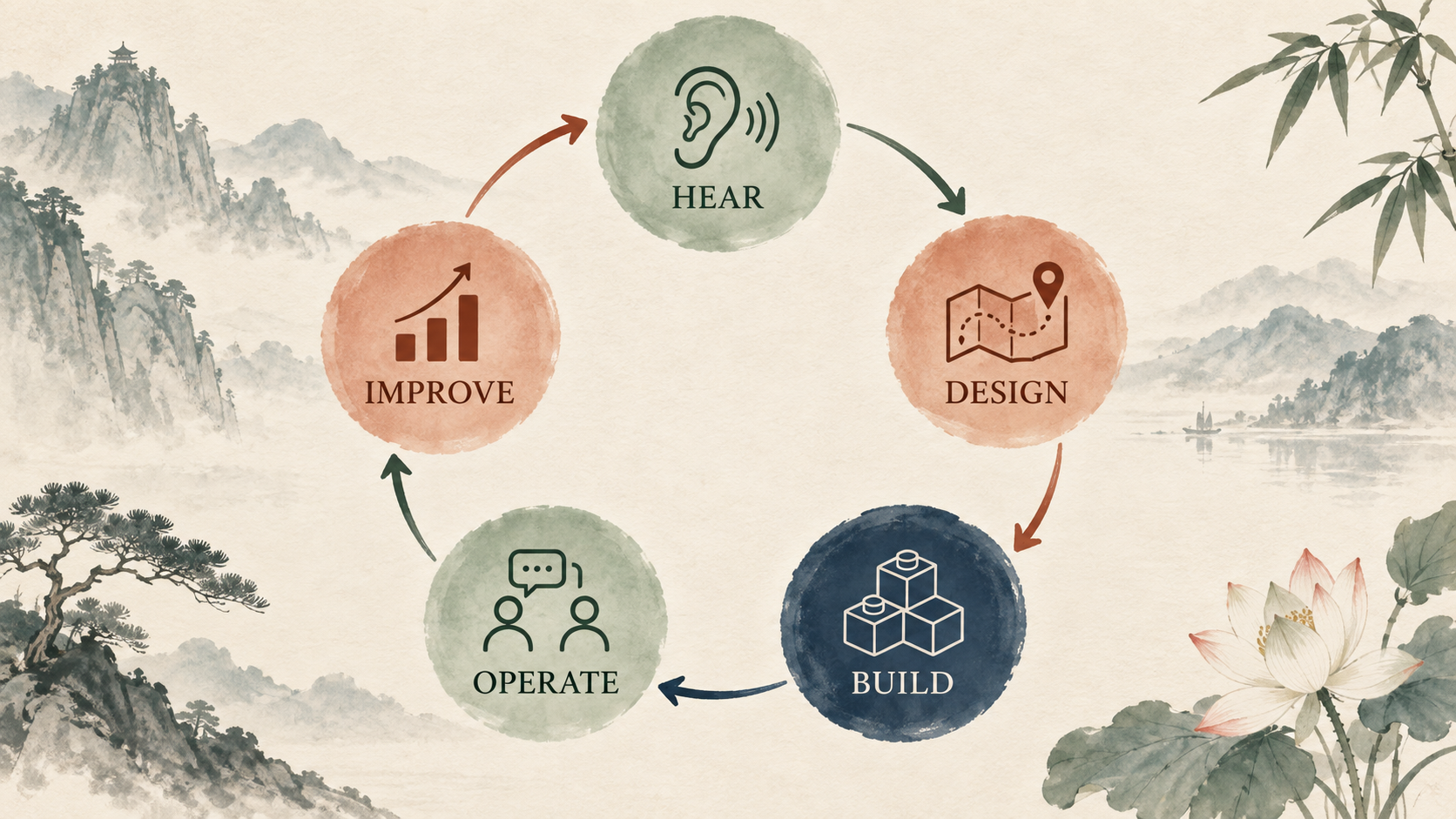
How Lotus builds and operates WeCom with international brands
Lotus approaches WeCom as part of the wider China customer journey—not as a standalone account-opening exercise.
1. Hear
We begin with the brand’s audience, China goals, active marketing, sales setup, customer questions and existing systems. We identify where relationships are being lost, left private or handled inconsistently.
2. Design
We define what WeCom should do, who should connect, where the journey begins, which team owns the conversation and what the customer should receive next.
3. Build
We support the account route, operating structure, profiles, entry points, welcome flows, content, permissions, handoffs and technical requirements within the agreed scope.
4. Operate
WeCom needs regular attention. Lotus can coordinate Chinese content, campaign and event follow-up, customer journeys, team actions and reporting to an agreed rhythm.
5. Improve
We review which contacts were relevant, where response slowed, which questions repeated, what content was missing and what the wider team should change next.
A capable WeCom agency should stay responsible from listening and strategy through creation, execution, regular operations and optimisation. That continuity lets the programme improve as the China team, audience and sales process change—and allows the agency to notice weaknesses that an isolated setup project would miss.
Explore Lotus’s complete WeCom strategy, customer journey and regular operations service.
How should WeCom performance be measured?
The measures should follow the job WeCom is meant to perform.
Useful signals can include:
relevant contacts who enter through a defined source;
percentage of useful enquiries with a named owner;
response and specialist-escalation time;
qualified conversations and sales acceptance;
event leads receiving the intended follow-up;
service questions resolved through the agreed workflow;
repeated buyer questions converted into useful Chinese content;
customer or partner relationships retained through tested handovers; and
movement to the next meaningful sales, service or relationship stage.
Contact volume, group size and message count do not prove commercial value by themselves.
Frequently asked questions
Is WeCom the same as WeChat Work?
Yes. WeChat Work was the earlier international name. The platform is now called WeCom in English and 企业微信 in Chinese.
Is WeCom the same as WeChat?
No. WeCom is an enterprise platform. WeChat and Weixin are consumer-facing services. WeCom can connect with supported Weixin and WeChat customer journeys, but the accounts have different purposes.
Is WeCom only for companies incorporated in mainland China?
Not in every situation. The workable route depends on the applicant, jurisdiction, verification, required features and current platform rules. Confirm the actual requirements before choosing an entity or account structure.
Is WeCom a CRM?
WeCom can support customer relationships and selected workflows, but it does not automatically replace a full CRM. Most international brands need a clear division of responsibility between WeCom and their system of record.
Can overseas employees use WeCom?
Potentially, depending on the account and team setup. The company should define who can communicate externally, how Chinese-language support works, which specialists can join and who remains accountable for the customer relationship.
Can WeCom prevent salespeople from taking customers when they leave?
WeCom can support company ownership and reassignment of customer relationships. The outcome still depends on correct account use, permissions, employee processes, CRM records and a tested handover. Do not assume every historical message or file transfers automatically.
How much does WeCom cost?
Pricing and fees depend on the current account route, verification, applications, service providers, integrations and operating scope. Check the current official requirements and obtain a scope based on the features the brand actually needs.
Does Lotus only set up the account?
No. Lotus can connect strategy, account setup, Chinese content, customer journeys, governance, event and campaign follow-up, regular operations and optimisation. Technical integrations and specialist compliance work are scoped separately where needed.
Build a WeCom system your China team can actually use
WeCom is most valuable when it gives the audience an easier route to the right person and gives the company clearer ownership of the relationship.
For an international brand, that requires more than software. It requires a workable account route, Chinese-language ownership, relevant content, response rules, system handoffs and regular improvement.
Lotus helps international brands connect those decisions into one practical China operating system.
