

A 90-Day WeCom Pilot for Brands Entering China: What to Test Before You Scale
A useful WeCom pilot should prove four things before an international brand scales: the right customers will enter the journey, the ongoing interaction gives them a reason to stay, the local team can operate the workflow consistently, and the value justifies the next investment. Ninety days is not a guarantee of commercial success. It is a disciplined period for replacing assumptions with operating evidence.
For a brand entering China, this approach is safer than launching every possible WeCom feature or building a complex integration before the customer journey has been tested. The first pilot should focus on one audience, one entry route, one primary use case and a small group of accountable staff.
Lotus Social Agency’s WeCom service helps international brands turn that narrow first use case into a practical customer journey, Chinese content plan, operating model and measurement framework.
Why a WeCom pilot should come before scale
Tencent describes WeCom as an enterprise communication and management platform that connects with Weixin and can link with services such as chats, Mini Programs and payments. That range creates opportunity, but it can tempt a new market entrant to buy configuration before it has learned how Chinese customers will actually engage.
A pilot creates a controlled environment to answer questions such as:
Will the intended audience accept this route into a brand relationship?
Which entry message gives people a credible reason to connect?
Can the brand respond in useful Chinese within an acceptable time?
What information is needed to route a conversation correctly?
Which content or service makes the relationship worth keeping?
Can sales, marketing and service teams complete handovers without losing context?
What data is genuinely needed in a CRM or SCRM?
Which metrics indicate operating value rather than superficial activity?
A pilot is a poor fit when the brand has no reachable audience, no local response capacity, no clear customer need or no internal owner. Those gaps should be addressed before technology becomes the focus.
What to decide before day one
Choose one audience
Avoid “all customers in China.” A pilot audience should be specific enough to recognize and serve: for example, qualified exhibition leads, existing distributors, VIP customers from one store group, users of one product line, or customers entering through a defined after-sales route.
Choose one primary use case
Useful first use cases include event follow-up, product consultation, appointment coordination, distributor support, service escalation, onboarding, clienteling or customer-success check-ins. The pilot may reveal adjacent opportunities, but one use case should govern its workflow and measurement.
Choose one entry route
Customers might arrive from a WeChat Official Account, Mini Program, event, website, store, product material, service case or employee outreach. Tencent has described customer-service discovery across parts of the Weixin ecosystem, including Official Accounts, Mini Programs, Channels, Search and payment-related touchpoints. Availability and the right configuration should be checked for the brand’s current setup.
Name the people who will operate it
Assign a pilot owner, platform administrator, content approver, frontline responders, escalation owners, reporting owner and technical contact. State their working hours and backups. A pilot cannot evaluate an operating model if its responsibilities exist only as department names.
Define the boundary
List what the pilot will not attempt. Exclusions might include multiple business units, advanced automation, full CRM integration, every customer segment or nationwide store rollout. A narrow boundary protects learning from uncontrolled complexity.
The 90-day WeCom pilot roadmap
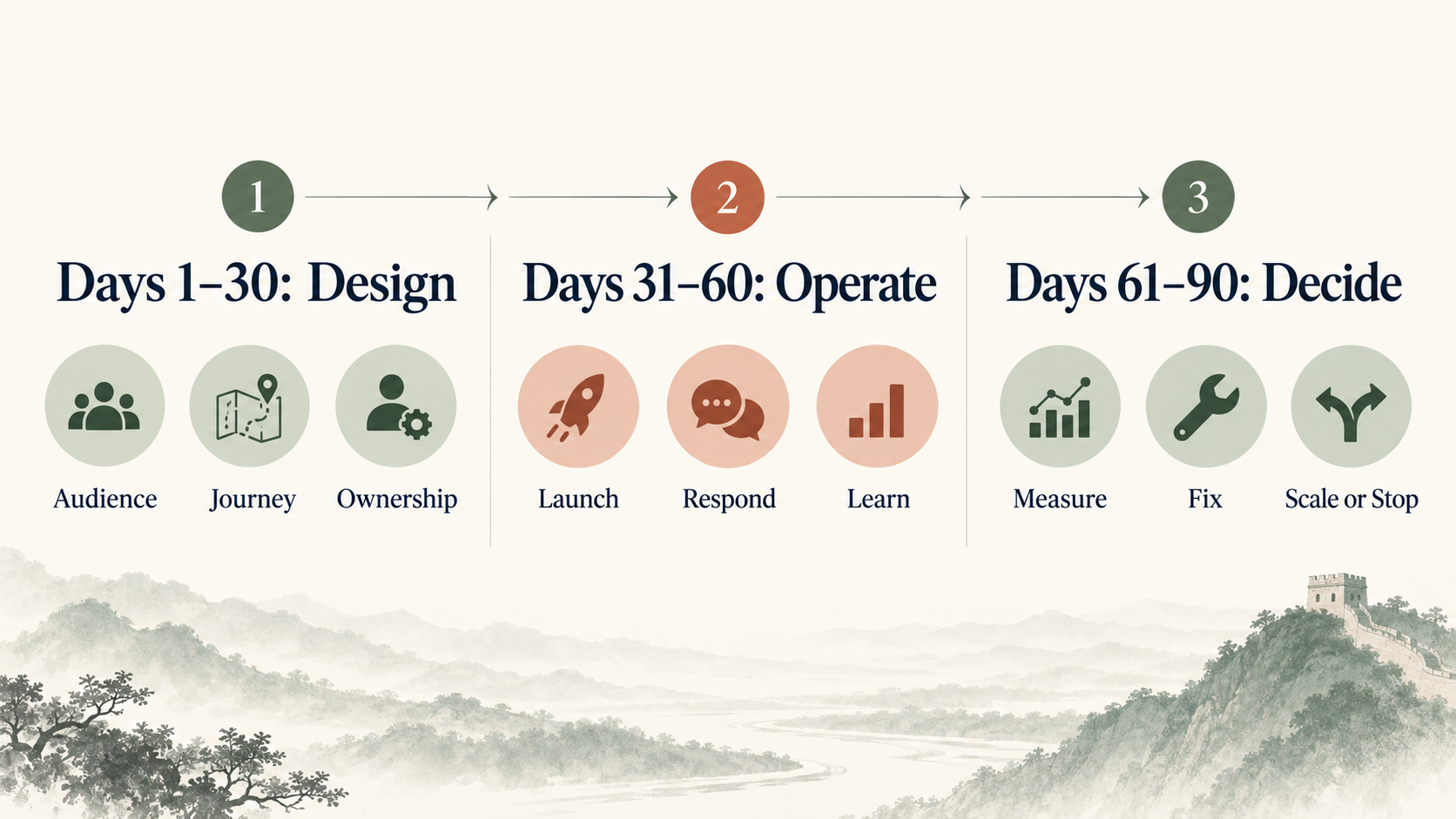
Days 1–30: Design the journey and prepare the team
The first month should produce a testable operating system—not just a configured account.
Week 1: Align the decision makers
Confirm the business goal, audience, primary use case, entry route, executive sponsor and pilot owner. Document the current China presence, existing WeChat and WeCom assets, legal entity and applicant position, administrator access, customer-data systems and agency relationships.
This is also the moment to confirm current eligibility and verification requirements. International structures may have workable routes, but exact documentation and feature availability can vary. A pilot plan should not depend on an unverified assumption about account access.
Week 2: Map the customer journey
Write the path from first prompt to intended outcome:
Where does the customer encounter the invitation?
What promise or service motivates the connection?
What does the welcome interaction say?
What information may the customer reasonably be asked to provide?
How is intent or need identified?
Who takes the next action?
When does the conversation move to sales, service, commerce or another channel?
What happens when no immediate action is appropriate?
The journey should include consent and privacy touchpoints appropriate to the use case. Operational design is not a substitute for legal, privacy or security advice.
Week 3: Build the minimum operating kit
Prepare the Chinese-language content and tools that the team needs to deliver the experience:
invitation and entry messages;
welcome and expectation-setting copy;
qualification or discovery questions;
approved answers for recurring queries;
sales or service support material;
escalation templates;
content for planned follow-up;
response and tone-of-voice guidelines;
a simple issue and learning log.
The first content pack should be useful and manageable. It does not need to anticipate every conversation, but it should cover the most likely questions and protect the brand from improvised claims.
Week 4: Configure, test and train
Configure only what the chosen journey needs. Test every role and transition with realistic scenarios, including an enquiry that does not fit, an unavailable colleague, a delayed response, a staff handover, a data error and an escalation.
Training should cover both platform actions and judgment: what employees may say, what information they should not request, when to escalate, how to record context and how to close a loop with the customer. Before launch, write acceptance criteria for the setup and rehearse the full journey.
Days 31–60: Operate the pilot and learn from real behavior
The second month is the live operating period. The goal is not maximum volume. It is enough relevant activity to observe where the journey and team behave differently from the plan.
Launch to a controlled cohort
Use one campaign, event list, store group, distributor cohort or service channel that the team can genuinely support. Tell customers what they will receive and how the channel should be used. Avoid adding people to groups or messaging programs without an appropriate expectation and basis.
Review operations frequently
During the first two weeks of live operation, review the pilot daily or several times per week. Look at unanswered conversations, response delays, unclear routing, repeated questions, missing content, inappropriate automation, duplicated records and staff confusion.
The most valuable early finding may be a broken handoff rather than a high contact count. Fixing that handoff can improve the eventual system more than increasing acquisition while the operating problem remains.
Change one thing at a time
Keep a versioned learning log. If the team changes the invitation, welcome message, follow-up cadence and qualification method simultaneously, it will be difficult to understand which change mattered. Use small, documented adjustments.
Protect customer value
WeCom should not become a reason to send more generic messages. Each interaction should serve the stated use case: answer a question, progress a decision, coordinate service, supply relevant expertise or help the customer use a product. A customer relationship can be company-managed without being valuable; operational usefulness is what sustains it.
Days 61–90: Measure, correct and make a scale decision
The final month should test whether the workflow is repeatable and whether the next investment is justified.
Stabilize the journey
Update the operating procedure, Chinese content pack, escalation rules, training and reporting definitions based on the live period. Retest important edge cases. Confirm administrator and staff onboarding or offboarding procedures.
Tencent states that customer relationships can be preserved at the enterprise level when an employee moves on. A brand should still test its own transfer workflow and verify what conversation context, records, files and notes remain accessible. Relationship continuity should not be described as automatic transfer of every message or internal record.
Evaluate four dimensions
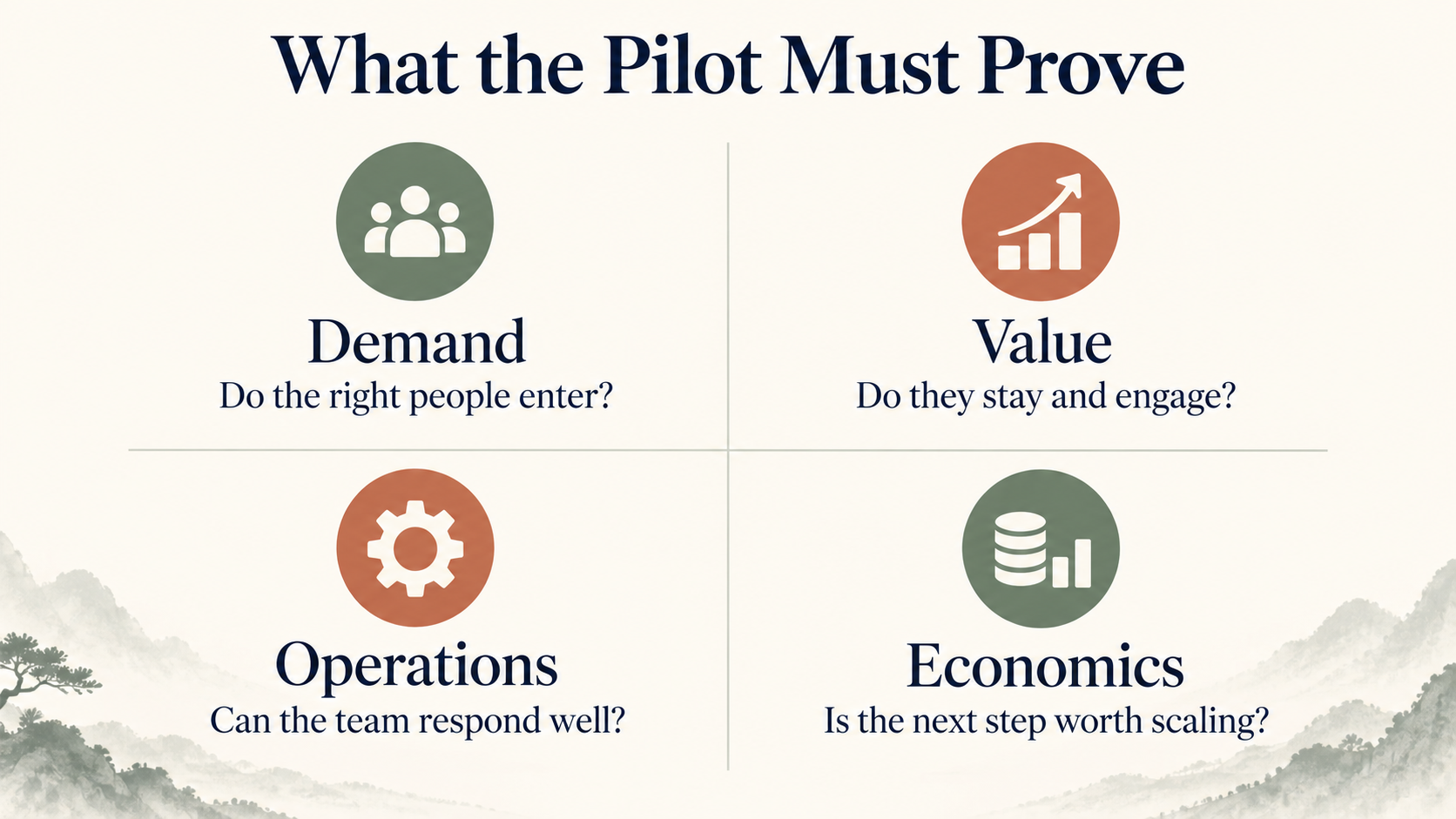
A scale decision needs evidence that the audience, customer value, operating model and economics work together.
Demand: do the right people enter?
Review invitation exposure, acceptance or entry rate where measurable, audience fit, source quality and the reasons people connect or decline. A lower volume of relevant customers can be more valuable than a large, weakly matched audience.
Value: do customers stay and engage?
Review whether conversations address real needs, whether people progress to the intended next step, whether follow-up remains relevant and whether avoidable drop-off occurs. For service cases, examine resolution and repeat contact; for sales or clienteling, examine qualified progression rather than treating every message as intent.
Operations: can the team respond well?
Review response performance, completion, routing accuracy, escalation quality, coverage gaps, content usefulness, staff adoption, governance issues and error rates. Separate a platform limitation from a training problem or an under-resourced team.
Economics: is the next step worth scaling?
Estimate the cost and effort of the present workflow, expected benefit, operational capacity, integration needs and opportunity cost. Do not force a revenue-attribution claim when the path cannot support it. A strong pilot can justify scale through better service, continuity or process control as well as direct commercial progression.
A practical WeCom pilot scorecard
Select a small set of measures linked to the use case. Define each measure before launch so teams do not change the denominator after seeing results.
Audience measures
number of eligible people exposed to the invitation;
number and percentage who enter the journey;
source and segment mix;
proportion matching the intended audience.
Engagement and journey measures
welcome interaction completion;
meaningful replies or qualified conversations;
progression to the intended next step;
repeat engagement or continued usefulness;
opt-out, complaint or inactivity signals.
Operating measures
first-response and resolution performance;
conversations awaiting ownership;
escalation rate and completion;
content gaps and repeated questions;
staff adoption and workflow compliance;
handover and data-quality issues.
Outcome measures
Depending on the use case, outcomes might include completed appointments, qualified opportunities, resolved service cases, distributor actions, onboarding milestones, repeat purchases or retention signals. Report the limits of attribution and avoid presenting association as causation.
Three possible decisions at day 90
Scale
Scale when the target audience uses the journey, customer value is clear, the team can operate it reliably, governance issues are controlled and the next investment has a reasonable case. Scaling may mean a larger cohort, another location, deeper content operations or a carefully scoped integration—not every expansion at once.
Revise and retest
Choose this when the use case remains promising but a specific weakness is fixable: a poor entry message, slow response, missing content, unclear ownership or unreliable data capture. State what will change, how long the retest will run and which threshold will support a decision.
Stop or postpone
Stop when there is no clear audience need, customers do not value the interaction, the organization cannot staff it, a required setup route is unavailable, or the economics do not support the next step. A pilot that prevents a larger unsuitable investment has produced useful evidence.
Common 90-day pilot mistakes
Trying to test several customer journeys, audiences and departments at once.
Launching before the Chinese content and response team are ready.
Treating a contact total as proof of customer value.
Building a full CRM or SCRM integration before the required data is understood.
Automating messages that still need human judgment.
Changing multiple variables without a learning log.
Ignoring administrator access, staff handover and data governance.
Promising sales results or search rankings that a pilot cannot guarantee.
Ending with a presentation but no updated operating procedure, ownership map or next decision.
How Lotus can structure the pilot
Lotus can support the pilot from readiness and customer-journey design through setup guidance, Chinese content, training, customer or community operations, governance, reporting and the final scale decision. The work can also connect with China social media management when the entry point depends on content, a WeChat Official Account or a wider campaign.
The right starting scope depends on the brand’s entity, assets, audience, internal team and technical environment. Lotus does not treat WeCom as a shortcut to demand or an automatic replacement for a CRM, SCRM, help desk, consent process or responsible human team.
Frequently asked questions
Is 90 days always enough for a WeCom pilot?
No. Ninety days is a useful planning frame for many bounded use cases, but low-volume sales cycles, seasonal demand, regulatory review or complex integration may require a different period. The schedule should match the decision the pilot needs to support.
How many customers should be in the pilot?
There is no universal number. The cohort should be large enough to expose real operating behavior and small enough for the team to support well. Audience relevance and sufficient interaction matter more than a vanity target.
Does the pilot need CRM integration?
Only if the primary use case cannot be tested responsibly without it. A controlled manual workflow can sometimes reveal the required fields and handoffs before a larger integration. Where integration is essential, define systems, data direction, testing, monitoring and ownership explicitly.
Can WeCom create demand for a brand entering China?
WeCom can support relationships with customers and external partners, but it does not automatically create awareness or demand. The brand still needs an acquisition or entry route, a relevant value proposition, appropriate Chinese content and a capable team.
What happens to customer relationships when employees leave?
Tencent describes enterprise ownership and preservation of customer relationships when employees move on. The brand should configure and test its transfer process and confirm what information remains available. Do not assume that all historical messages, files or internal notes transfer automatically.
Who should own the pilot?
One business owner should be accountable for the outcome, with named owners for platform administration, Chinese content, frontline response, escalation, data, technical changes and reporting. An agency can operate parts of the model, but the brand still needs an accountable sponsor.
Build evidence before complexity
A 90-day WeCom pilot is valuable because it forces an international brand to learn how customer demand, local content, human response, governance and technology work together. The result should be a clear scale, revise or stop decision supported by documented evidence—not a feature checklist.
If your brand is planning a China launch, talk to Lotus about a focused WeCom pilot. We can help define the use case, prepare the customer journey and Chinese operating model, run the learning cycle and identify what is genuinely worth scaling.
