

The platform decision comes before the content calendar
RED and Douyin can both play a meaningful role in a consumer-product launch in mainland China. That does not make them interchangeable, and it does not mean every launch needs an equal presence on both.
The useful question is not which platform is bigger, trendier or more familiar to the global team. It is which platform is better suited to the job the launch must do first. Some products need to become understandable and credible before they can generate meaningful demand. Others need motion, personality or a strong demonstration to make people stop and care. A coordinated launch can work, but only when each platform has a clearly different role.

This distinction matters because the platform choice changes almost everything downstream: the creator brief, the production rhythm, the type of proof the audience sees, the route from interest to action and the way performance should be interpreted. Choosing the wrong lead platform often produces a familiar result—plenty of activity, a collection of impressive-looking platform metrics and very little clarity about what the launch actually achieved.
For an international consumer brand, the right decision usually comes from six practical tests: how the product is discovered, how much explanation it needs, what the creative team can produce, which creators can make the proposition believable, where the next action happens and how the result will be measured.
RED and Douyin solve different launch problems
RED is often strongest when a person wants to understand a product in context. They may be comparing options, looking for real-life usage, checking whether a claim feels credible, or searching for language that helps them make sense of an unfamiliar category. In that environment, a useful launch asset is not merely attractive. It answers a question, shows a scenario or gives the audience a reason to save, search or revisit the information.
Douyin is often strongest when the product becomes compelling through movement, personality, demonstration or entertainment. A strong video can turn an unfamiliar object into an immediately legible idea. It can show texture, transformation, ritual, scale or emotion in a way a static explanation cannot. That creates an opportunity for discovery, but it also creates a demanding production environment: one good launch film is rarely enough.
These are strategic tendencies, not hard platform rules. RED supports video and paid distribution; Douyin supports search, commerce and deeper information. The point is to avoid reducing the choice to a format comparison. The real difference is the job you want the audience to complete.
If the first task is “help the right person investigate and trust this product,” RED may deserve the lead. If it is “make the product easy to notice, feel and demonstrate at speed,” Douyin may deserve the lead. If the launch needs both, the team must define a handover between discovery and validation rather than publishing the same creative twice.
Choose RED first when the buying decision needs research
A RED-first launch makes sense when uncertainty is the main barrier. This is common for products with unfamiliar ingredients, a new usage ritual, a premium price, a design detail that needs explanation or a value proposition that becomes stronger when shown in a real lifestyle context.
In that situation, the launch should build a body of useful evidence rather than one burst of exposure. Creator and brand content can answer different questions: who the product is for, how it fits into daily life, what makes it different, what people should notice and how it compares with the alternatives already in their consideration set. The best pieces give the audience a reason to spend time with the idea.
RED's official commercial tools connect creator selection, collaboration workflows, promotion and reporting. That makes it possible to plan a launch as a set of content and creator decisions rather than as a collection of disconnected posts. It also means the team should allow for review and approval steps, especially when commercial notes and paid support are involved. That operational lead time belongs in the launch plan from the beginning.
Choose RED first when most of the following are true:
The product benefits from detailed explanation or side-by-side consideration.
Searchable questions are likely to emerge before purchase.
Lifestyle context and peer-like proof matter more than a single dramatic reveal.
The brand can supply credible details, usage scenarios and creator guidance.
The next action can tolerate a considered journey rather than depending on instant response.
The team wants to learn which questions, use cases and messages attract the most qualified attention.
A RED-first approach does not mean every post should read like a product manual. Useful content can still be visual, playful and distinctive. It means the creative idea has to survive the audience's next question.
Choose Douyin first when the product needs motion and momentum
A Douyin-first launch makes sense when the product's value is easiest to understand through action. Beauty transformations, food preparation, tactile products, wearable items, clever mechanisms, before-and-after demonstrations and products with a strong sensory or performance story all have obvious short-video potential.
The key phrase is “video potential,” not “one video.” Douyin's advertising and platform tools span brand-building formats, feed distribution, content heating, search, commerce and measurement. The opportunity is broad, but the creative workload is real. A Douyin-first plan needs repeatable hooks, variations and creator interpretations. It also needs a team that can learn quickly without changing the central product promise every time a clip underperforms.
Choose Douyin first when most of the following are true:
The product creates an immediate visual, emotional or demonstrable payoff.
Several distinct openings can lead to the same proposition.
The team can produce and approve short video at a sustained pace.
Creators can make the benefit feel natural in their own voice and format.
The route from attention to the next meaningful action is clear.
The measurement plan separates exposure, engagement and business response.
Douyin-first is a poor fit when the launch depends on a single globally approved film with no room for iteration. It is also risky when the product requires so much context that every video becomes an overloaded explanation. In those cases, a compelling clip may attract attention while leaving the audience without enough confidence to move further.
Six tests that should decide the lead platform
1. Can the product be understood in motion?
Ask a simple production question: if a viewer saw the product for only a few seconds, would movement make the benefit clearer? If the answer is yes, Douyin has a structural advantage. If the important proof lives in details, comparisons, routines or accumulated context, RED may be better placed to lead.
Do not confuse an attractive product with a demonstrable one. Beautiful packaging can stop a scroll, but it may not explain why someone should care.
2. How many questions stand between interest and action?
List the questions a serious potential buyer is likely to ask. If there are many—about use, fit, ingredients, quality, compatibility, occasions or value—the launch needs a stronger validation layer. RED content can be designed around that question set.
If the proposition is easy to grasp and the main barrier is simply getting noticed, Douyin may be able to do more of the opening work. The question list should come from real category observation and customer-facing teams, not from a translated global FAQ.
3. What can the team produce repeatedly?
Platform strategy is constrained by the weakest production dependency. A brand may like the idea of a Douyin-first launch but lack local video editors, fast approvals or a workable flow of creator briefs. It may prefer RED but have no one who can turn product knowledge into useful, culturally legible content.
The right choice is the one the organisation can operate at the required quality and pace. This is where an experienced China social media management partner can help connect the strategy to an achievable content system.
4. Which creator makes the proposition believable?
Creator fit is not only an audience-size question. On RED, the useful creator may be someone who can explain a routine, compare options or show category fluency. On Douyin, the useful creator may be someone who can perform the benefit, land a hook and keep the product central without making the video feel like a forced advertisement.
The launch platform should match the type of credibility the product needs. A creator who is brilliant at entertaining discovery may not be the best person to resolve detailed objections, and a strong reviewer may not generate the energy required for broad discovery.
5. Where does the audience go next?
A view, save or comment is not the whole journey. Define the next meaningful action before approving the channel plan. It may be a search, a product-page visit, a store visit, a lead, a purchase or simply a qualified interaction that provides evidence for the next decision.
This is also where paid support should be considered. China paid social media advertising can extend useful creative, but it cannot repair an unclear next step or an unconvincing proposition.
6. Can the result be measured without blending unlike metrics?
RED and Douyin reports are built around their own products, placements and user actions. A view on one platform should not automatically be treated as equivalent to a view on another, and raw totals should not be added together as though they represent a deduplicated audience.
Set the measurement logic before the launch: one business outcome, one role for each platform and a small group of indicators that show whether that role is being performed. This produces a more honest read than selecting whichever platform number looks largest afterwards.
Three launch architectures that make sense
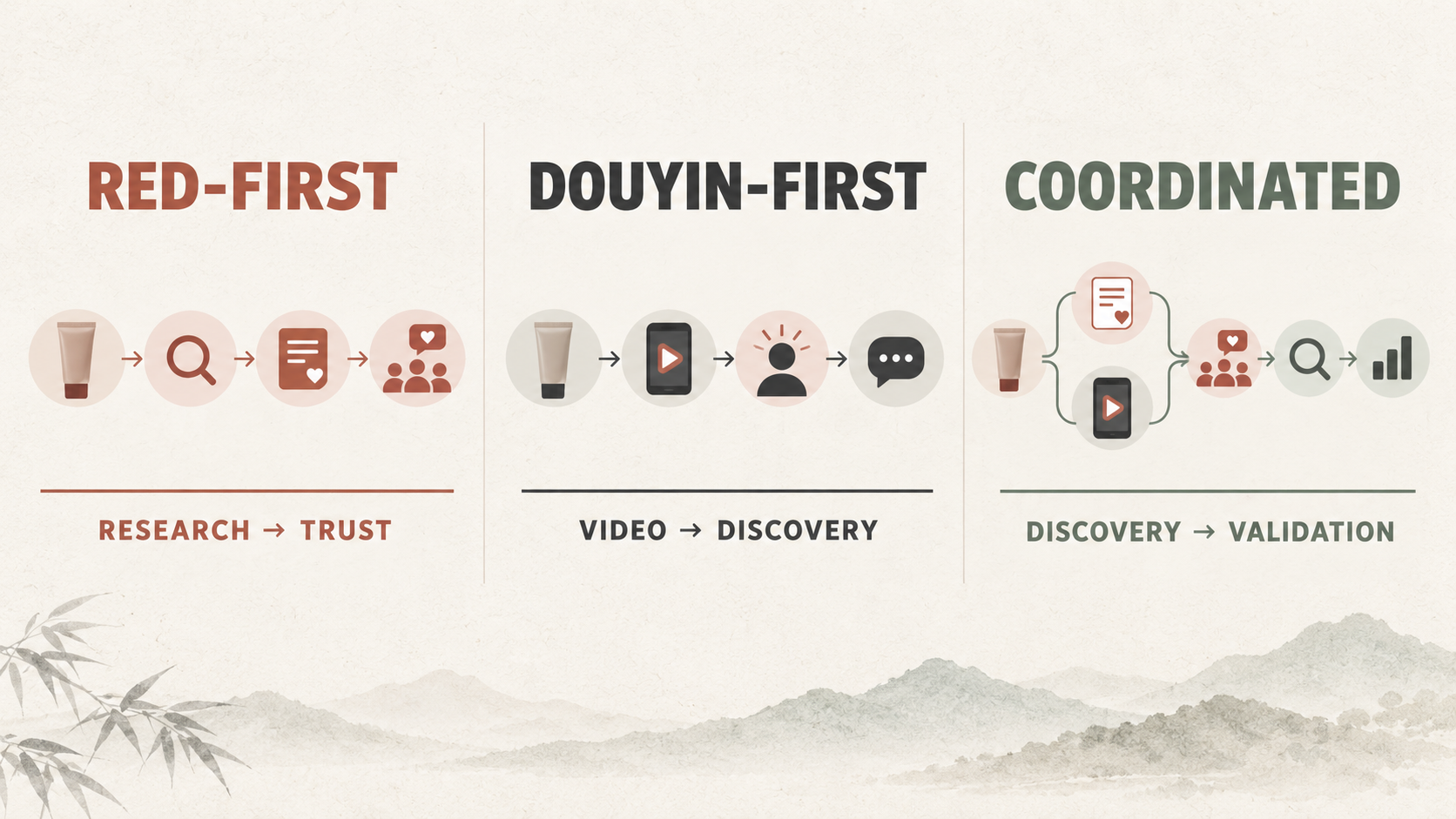
RED-first: research to trust
Use RED to establish the product's language, use cases and proof. The early content should reveal which questions matter, which scenarios resonate and which creator explanations feel credible. Paid support can then concentrate attention around the most useful assets rather than treating every post equally.
This route is suitable when the category is considered, the proposition needs unpacking or the launch must earn confidence before asking for action. It can also give the brand a clearer vocabulary for later video work.
Douyin-first: video to discovery
Use Douyin to make the product immediately legible through demonstrations, transformations, creator performance or a strong visual idea. Build a family of creative routes around one proposition and decide in advance how attention will move toward a meaningful next step.
This route is suitable when the product has an obvious visual payoff and the team has enough production capacity to iterate. The goal is not simply to create a spike; it is to learn which hooks attract the right kind of interest.
Coordinated: discovery to validation
Use both only when the roles are explicit. One common pattern is for Douyin to create discovery while RED answers the research questions that follow. Another is for RED to establish credible language and use cases before Douyin translates the strongest ideas into higher-tempo video.
The handover should be visible in the brief. Each platform needs its own audience action, content job and measurement. Coordination is not simultaneous posting, and it is not a licence to double the content calendar.
The operating cost is content, not only media
International teams often compare platform budgets before they compare operating demands. That reverses the real decision. The most important cost may be the volume and type of content required to make the platform strategy credible.
RED needs useful detail, a clear point of view, culturally fluent visual storytelling and enough category understanding to answer the audience's questions. Commercial collaborations also bring review and confirmation steps that need to be planned into the workflow.
Douyin needs a renewable short-video system: hooks, demonstrations, creators, variations, editing and fast learning. A concept that works beautifully in a global hero film may not generate enough native variations for a sustained launch.
Before selecting either platform, audit the people and decisions behind the content. Who supplies product facts? Who approves local interpretations? How quickly can feedback move? Who protects the core claim while allowing creators to sound natural? Who decides whether a weak result is a creative problem, a targeting problem or a proposition problem?
If those answers are unclear, buying more media will not create the missing operating model.
Measure each platform against its assigned job
A useful measurement plan starts with a shared business question and then gives each platform a narrower role.
For a RED-first launch, early indicators might include the quality of saves and comments, the questions people ask, search behaviour around the product or category, qualified visits and the performance of different use-case narratives. For a Douyin-first launch, they might include whether the opening holds attention, whether demonstrations create meaningful interaction, which creative routes generate qualified response and whether interest continues beyond the video.
These are examples, not a universal scorecard. The exact signals should follow the launch objective and the available data. What matters is keeping three layers separate:
Exposure: Did the intended audience have a reasonable opportunity to encounter the launch?
Platform response: Did people watch, save, search, interact or move to the next step in a way that matches the platform's job?
Business response: Did the launch contribute to the commercial or learning outcome the brand actually cares about?
Cross-platform reporting should acknowledge overlap and differences in definitions. It should not promise a unified person-level view unless the measurement setup genuinely provides one. The cleanest reporting often explains contribution rather than forcing every metric into one total.
Common mistakes international brands make
Choosing from audience size alone. Reach potential tells you little about whether the platform fits the product's decision journey or the team's content capability.
Using the same caption or asset on both platforms. A cut-down global film and a reformatted product image do not become native strategy simply because the dimensions are correct.
Calling “both” a strategy. If the roles, handover and measurement are undefined, a two-platform launch usually creates more output and less clarity.
Underestimating approval friction. Local creators and editors need room to make the idea work, but the brand still needs a fast way to verify product facts and protect the central proposition.
Adding paid media before proving the content job. Distribution can amplify a useful asset. It can also make an unclear message fail at a larger scale.
Reporting platform totals as one audience. Without a valid method for resolving overlap and definition differences, combined views and reach can produce false precision.
Treating early learning as a verdict on China. A weak hook, narrow creator mix or confusing next step can make a reasonable product look uninteresting. Diagnose the launch system before drawing a market-level conclusion.
Make the platform choice before making the calendar
The decision can be made in a short working session if the right evidence is on the table. Bring the product demonstration, the audience's likely questions, the proposed creator types, the real production capacity, the route to action and the measurement constraints. Then decide which platform has the first and most important job.
Choose RED first when the launch must turn curiosity into understanding and trust. Choose Douyin first when motion and creative iteration can make the product instantly compelling. Choose a coordinated model only when discovery and validation are separate jobs with a clear handover.
That choice will not guarantee a successful launch. It will, however, create a more coherent brief, a more realistic content system and a more useful way to judge what happens next.
Discuss the launch decision with Lotus
If your team is weighing RED, Douyin or a coordinated approach for an upcoming China product launch, talk with Lotus. We can discuss the product, the buying decision and the content reality behind the platform choice, then help you turn that decision into a practical mainland China launch brief.
