Douyin and TikTok look familiar enough to invite a costly shortcut. Both are built around vertical video, personalised discovery, sound, creators and fast audience feedback. A global team may therefore assume that its TikTok account plan, creative formats, reporting logic and production workflow can move into mainland China with translation and a different login.
That is the wrong operating assumption. ByteDance runs Douyin and TikTok as separate products for different market environments. The useful comparison is not which app has the better feature list. It is which parts of a global short-video system remain valuable, which parts must be rebuilt for Chinese audiences, and which parts need current platform verification before anyone acts.
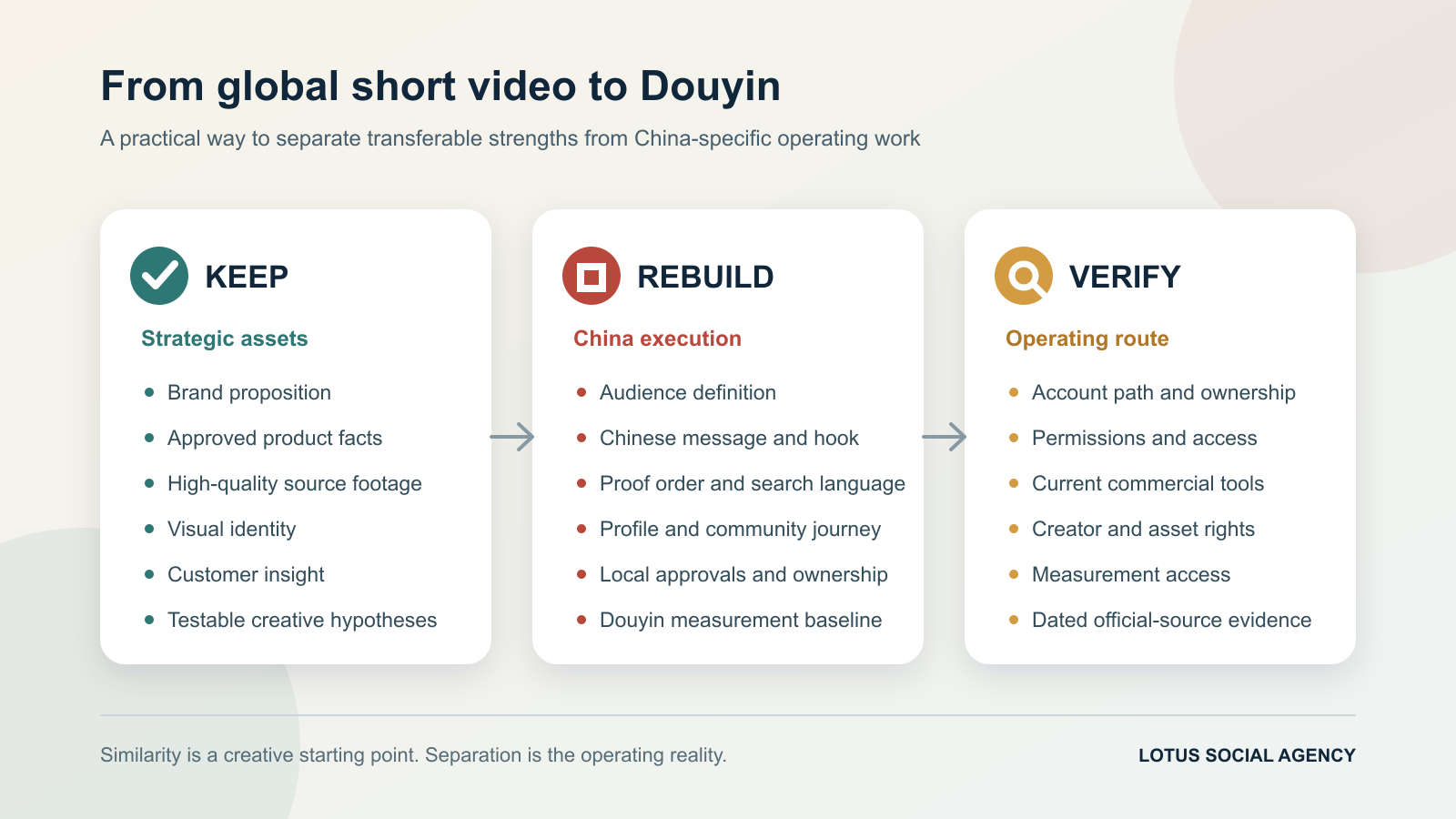
An international brand should carry over its strongest proposition, visual assets and learning discipline. It should rebuild the audience model, Chinese language, search questions, creative execution, account operations, creator relationships, approvals and measurement around Douyin. And it should verify current account, commercial and integration routes instead of treating TikTok settings as a template.
The comparison starts with the product boundary
Douyin is not a regional setting inside TikTok. ByteDance’s own company history identifies Douyin as the short-video product it launched in China in 2016 and TikTok as the product launched outside mainland China the following year. They share a parent company and a recognisable content format, but they do not give a brand one continuous operating environment.
That distinction changes the planning conversation immediately. A TikTok audience is not a Douyin audience segment waiting to be activated. A TikTok business account is not a Douyin account foundation. Historical performance does not become a Douyin benchmark, and an international follower base does not provide a ready-made China community.
The same applies to platform learning. A successful TikTok series can reveal that the brand has a strong visual demonstration, a compelling character or a useful explanation. It cannot prove that the same hook, language, pacing or action will work for people using Douyin in mainland China.
Global evidence is still valuable, but it enters the China plan as a hypothesis rather than a forecast.
What genuinely carries over from TikTok
Starting again does not mean discarding everything the global team knows. Several capabilities remain useful because they are strengths of short-video work rather than claims about a particular algorithm.
A clear audience problem. Content improves when the team knows whose attention it wants and what the viewer should understand, feel or do next.
A demonstrable proposition. Products, places, performances and ideas that can be shown tend to give the creative team more to work with than abstract brand language.
Visual discipline. A recognisable subject, purposeful opening and visible proof help a video make sense without a long introduction.
A repeatable creative system. Recurring series, presenters, settings and proof formats make production more manageable and learning easier to compare.
Community attention. Comments, saves, questions, profile actions and repeat audience behaviour can reveal what deserves a response or a follow-up asset.
Controlled experimentation. Changing one meaningful creative variable at a time produces more useful evidence than replacing the whole idea after every post.
TikTok’s own organic guidance treats objectives, creative lenses, trends, creators, account management and community interaction as connected parts of an operating system. That principle carries over. The specific cadence, trend or tactic does not.
For an international team, the practical move is to preserve the strategic centre of the work: the audience problem, the brand promise, the proof and the role of video. Everything around that centre should be reopened for China.
Discovery looks similar on the surface, but the planning job changes
Both platforms combine recommendation-led discovery with active exploration and search. TikTok publicly describes a personalized For You feed informed by interactions and video information, while its business material also describes swipe, tap and search as different discovery paths.
Douyin should not be reduced to its recommended feed either. Ocean Engine’s official Douyin material positions search across brand exposure, lead collection and product marketing. It describes a common pattern in which viewing creates a question and search follows. Douyin’s open-platform documentation also exposes video and image-text search capabilities, which is a useful reminder that searchable information is not limited to the moving picture alone.
The operating consequence is more important than the feature comparison. A Douyin video has to earn attention, but the account also needs to be ready for the curiosity the video creates. Chinese viewers may search for the brand, product, category, location, artist, use case or question they have just seen.
That makes search readiness part of production rather than an SEO task added at the end. The team needs to align:
the words spoken in the video;
Chinese on-screen wording and subtitles;
the caption and topic language;
product, brand and category terms;
the account profile and pinned content;
the next useful answer when someone continues exploring.
Copying a global caption and adding Chinese hashtags does not create that alignment. The brand has to understand how its Chinese audience names the problem and what evidence they need next.
For a broader view of how these elements connect, see Lotus’s guide to Douyin strategy, setup and measurement.
The business stack has to be remapped
TikTok and Douyin each offer business accounts, analytics, commercial tools and ways to connect organic content with wider activity. The names and interfaces are not the real issue. The mistake is assuming that access, permissions, account structure, data flow and operating ownership transfer between them.
TikTok’s global business environment includes its Business Account, Business Center, Ads Manager and creator or creative tools. Douyin sits within a China-specific environment that can involve a Douyin enterprise account, Ocean Engine, search products, creator tools, lead routes, commerce or local-service products, and measurement tools. The relevant combination depends on the brand, category, applicant, activity and current platform availability.
That means a global screenshot of the TikTok setup is not a China implementation brief. Before deciding how Douyin should work, the brand needs a separate map covering:
who owns the account and core credentials;
which local access and operating roles are required;
what content, analytics and approval permissions each person needs;
which official tools support the intended audience action;
how data and reporting move back to the global team;
which current requirements need direct confirmation before launch.
This is an operating-design task, not a translation task. It is also why this comparison does not offer a universal account-setup answer. Platform functions and access routes change, and any important assumption should be checked against current official guidance for the actual applicant and intended use.
Localisation changes the creative decision, not only the words
The weakest Douyin adaptation often looks competent at first glance. The video is vertical. The edit is fast. Chinese subtitles have been added. The brand colours and product shots are intact. Yet the post still feels imported because the creative decision was made for a different audience environment.
Effective localisation starts earlier. It asks whether the original idea gives a Chinese viewer a reason to care. The team may need to change the opening question, presenter, sequence of proof, examples, humour, soundtrack, visual references, caption and next action. Sometimes the global asset remains useful as raw material. Sometimes only the underlying proposition survives.
Consider a global TikTok that opens with an insider joke before revealing the product benefit. A Douyin adaptation might need to make the category problem visible sooner, use Chinese terminology that matches how people search, and place proof before the brand payoff. That is not because one platform rewards one universal formula. It is because the local audience may need different context to understand the same proposition.
The most useful production question is therefore not “How do we translate this TikTok?” It is “What does this audience need to recognise, believe and explore next?”
Lotus’s Douyin marketing overview for international brands explains how content, search, creators and audience action can operate as one China-specific system.
The team and approval rhythm need a China owner
Douyin work becomes fragile when every decision has to travel through a global review chain that was designed for monthly campaigns. Short-video operations create regular choices: whether a comment deserves a reply, whether a search question should become the next post, whether a local reference is useful or forced, whether an asset has the right rights, and whether a current platform function is available for the intended account.
The solution is not uncontrolled speed. It is clearer decision ownership.
A workable model normally gives a China-side operator room to handle routine Chinese copy, community responses and content adjustments inside agreed brand boundaries. The global team keeps control of positioning, claims, visual identity, risk thresholds and major campaign decisions. Both sides need one shared record of what was approved and why.
This division matters because local fluency is not limited to language. It includes knowing when a literal translation sounds unnatural, when a meme has already peaked, when a comment signals a real information gap and when a proposed trend would make the brand look like an outsider trying too hard.
The approval system should protect the brand while allowing the people closest to the platform to make timely, bounded decisions.
Measurement should begin with a new baseline
Global TikTok history can help the team identify creative questions, but it should not become the performance target for Douyin. The audience, account history, content environment, business tools and downstream journey are different. A view, completion rate or profile action also means little without the objective and the format that produced it.
Define the Douyin decision before choosing the metric. If the goal is category education, the team may examine qualified watch behaviour, saves, relevant comments and follow-on searches. If the goal is to test a product proof, it may compare which demonstration produces clearer questions or stronger profile exploration. If the goal is enquiry, it needs evidence beyond video engagement.
The important discipline is to build a Douyin evidence base over time:
Record the audience question and creative hypothesis.
Note the format, opening, proof, caption, publication conditions and any support.
Review several signals together rather than selecting the most flattering number.
Decide what to keep, change or test next.
Lotus’s guide to testing Douyin content distribution provides a practical way to run those comparisons without pretending to know a secret platform formula.
Use a keep, rebuild and verify framework
When a brand already has a mature TikTok programme, the following framework prevents two opposite mistakes: copying everything or throwing away useful global learning.
Keep the strategic assets
Keep the brand proposition, product facts, approved claims, high-quality source footage, visual identity, customer insight and the strongest evidence about what the product helps people do. Preserve the creative hypotheses that are worth testing again.
Rebuild the China execution
Rebuild the audience definition, Chinese message, hook, proof order, search language, caption, profile journey, content series, community workflow, creator brief, approval route and measurement baseline. Treat the TikTok edit as a source asset, not the default final cut.
Verify the operating route
Verify the current account path, ownership, permissions, commercial tools, creator routes, music or asset rights, measurement access and any feature assumption that affects the plan. Record the source and date for each important platform decision.
This framework also makes global-local collaboration easier. The global team can see what remains controlled, while the China team can explain why specific execution choices need to change.
A global TikTok asset can still be useful
Not every post needs to be produced from nothing. A global asset may provide excellent footage, a recognisable presenter, a product demonstration, an animation, an interview or a clear narrative idea. Reuse becomes sensible when the material can support a locally designed story without forcing the Chinese version to inherit the original assumptions.
Before adapting an asset, ask:
Does the proposition matter to the intended audience in China?
Can the footage support a different opening and proof sequence?
Are the people, locations, claims, music and usage rights suitable for the China version?
Can Chinese on-screen wording be designed rather than squeezed into the original layout?
Is there a useful search or profile journey after the video?
Will the finished post feel complete to someone who has never seen the global campaign?
If the answer is yes, the global asset can reduce production waste. If the answer is no, translation will only make the mismatch more visible.
What brand leaders should decide before approving Douyin
The decision to enter Douyin should not rest on the fact that the brand already knows TikTok. It should rest on whether the organisation is prepared to run a separate China system.
Before giving the green light, leadership should be able to answer six questions:
Which Chinese audience and business decision justify the channel?
What can the brand show, explain or dramatise repeatedly rather than once?
Which global assets are genuinely reusable, and which assumptions must be discarded?
Who owns Chinese content, community decisions, access, approvals and reporting?
What should a viewer be able to search, understand or do after watching?
What evidence will cause the team to continue, refine or stop?
Those answers create a stronger foundation than a side-by-side feature list. Douyin and TikTok share a visual language, but they do not share one market, one audience, one tool stack or one operating history. International brands will make better decisions when they treat similarity as a creative starting point—and separation as the operational reality.
If your team is deciding how much of its global short-video system can travel to China, Lotus can help separate the reusable strategic assets from the Douyin work that needs to be rebuilt locally.