

A customer case study earns attention because somebody else has already faced a recognisable problem and can show what happened next. In mainland China, however, a globally approved story may still be difficult for a buying committee to use. The customer may be unfamiliar, the commercial context may not travel, the metric may lack a clear definition, or the asset may answer a marketing question while technical and procurement colleagues need different proof.
Localisation should make the evidence easier to evaluate without making it bigger. The job is not to rewrite an overseas customer as if it operated in China, sharpen a cautious quote, convert a metric into a more impressive number or invent local relevance. It is to preserve the approved source case, explain its limits and reorganise the material around the decisions Chinese stakeholders actually need to make.
The method below is deliberately case-neutral. It assumes the brand has an approved source asset, current product documentation and a clear internal owner. If permission, confidentiality, customer status or the underlying measurement cannot be confirmed, the case should stop before localisation.
Choose a source case that answers a real buyer question
Start with the decision the case needs to support. A strong global logo is not automatically the best proof for China. The more useful source case may come from a lesser-known customer whose problem, operating environment and evaluation criteria resemble those of the priority buyer. Write the buyer question first, then test the case against it.
A China marketing roadmap for international brands should establish audience, positioning and evidence before channels. Apply the same discipline here. Identify the target sector, use case, product scope, implementation conditions and next decision. A case designed to help an operations leader understand deployment should not be selected only because its headline metric looks impressive.
Use a short suitability gate:
Permission: the brand can confirm what material, quotations, names, visuals and results are approved for this use.
Relevance: the underlying problem and product role are recognisable to the intended Chinese buyer without inventing a mainland deployment.
Traceability: every material fact can be traced to the source case, measurement note or current product documentation.
Usefulness: the story contains enough context to explain why the result matters, not only that it happened.
If one gate fails, choose another case or return the asset to the brand owner. Anonymising the customer does not repair weak permission, missing evidence or a story that depends on confidential context.
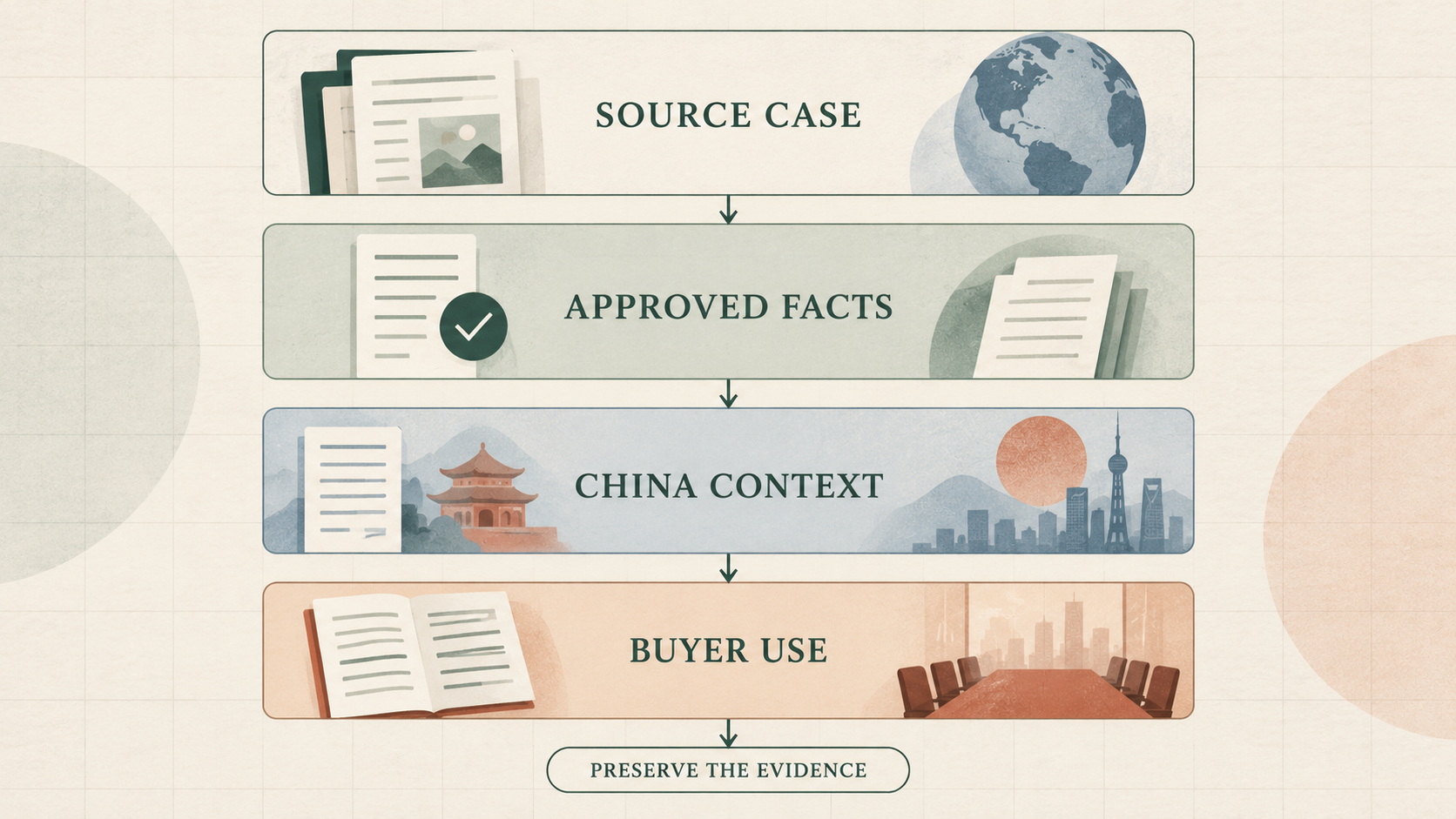
Freeze the evidence before you localise anything
Create a source-of-truth sheet before Chinese writing begins. Separate approved facts from interpretation, proposed context and open questions. This prevents a familiar production failure: each translation, design and sales pass makes a small improvement until the final asset says something the customer never approved.
The evidence sheet should capture the exact customer descriptor, approved quotation, product and version, problem statement, implementation scope, result, metric definition, measurement period, attribution language, visual permissions and known limitations. Record the source location and owner for every item. Use the original wording for quotations; do not translate a quote until its approved meaning and speaker attribution are locked.
Keep three statuses visible:
Approved: may be used within the recorded scope.
Needs confirmation: potentially useful, but blocked until the named owner responds.
Do not use: confidential, out of date, unsupported or outside the permission boundary.
Treat the current product page or technical documentation as a separate source, not permission to update the historical case silently. If the product has changed, state which version the customer used and decide whether a current capability belongs in a separate explanatory note.
Map the buying committee, not an imagined single reader
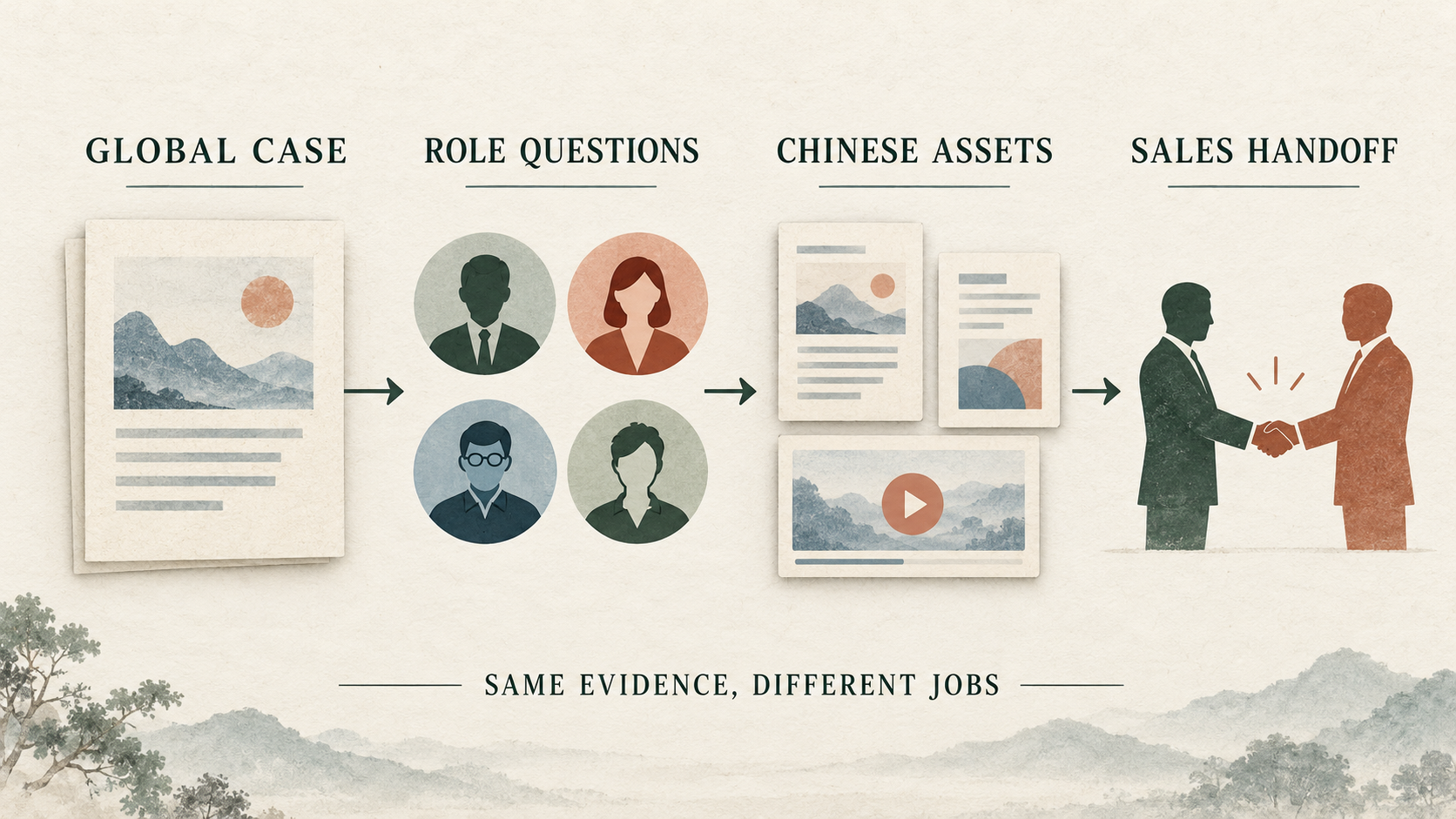
A complex China B2B buying journey rarely depends on one person reading one perfect story. The interested contact may need to explain the case internally to a business sponsor, user team, technical reviewer, procurement colleague or senior approver. The exact group varies by product and organisation, so map roles from the target account rather than copying a generic chart.
For each relevant role, record the decision, question, acceptable evidence and likely objection. The same approved case can then support several conversations without becoming several versions of the truth.
Business sponsor: Is the problem important enough, and does the outcome justify deeper evaluation?
Operational user: What changed in the workflow, and what did the customer have to do?
Technical reviewer: What environment, integration, data flow or implementation dependency shaped the result?
Procurement or finance: What scope, period and baseline sit behind the metric, and what is not comparable?
Executive approver: Why is this proof credible, relevant and proportionate to the proposed next step?
Do not force every role into the public article. Use the map to decide what belongs in the main case, a technical appendix, a demonstration, an executive summary or a sales conversation. The useful output is a connected evidence system, not a longer webpage.
Rebuild customer context without inventing China relevance
International readers may recognise the source customer immediately. Chinese buyers may not. Add neutral context that helps the reader understand the customer’s scale, sector, operating model and starting problem, but only when those facts are approved. Avoid status language such as “market leader” unless the source supports it and the wording remains current.
Then make the transfer boundary explicit. An overseas customer can still provide valuable proof of product capability, implementation discipline or operational change. It does not prove that mainland buyers share the same priorities, that the product is deployed locally or that the same result will occur in China.
A useful localisation distinguishes three layers:
Source fact: what the approved case establishes.
China context: what a mainland buyer needs explained to judge relevance.
Local hypothesis: what the brand still needs to validate through research, sales conversations or a controlled pilot.
This structure lets the writer add market understanding without placing new claims in the customer’s mouth. It also protects the internal champion: when colleagues ask whether the case is truly comparable, the asset has already shown where the comparison holds and where it stops.
Make every metric understandable and bounded
A percentage without a baseline, period or definition is a decoration, not evidence. Preserve the number exactly as approved, then explain what was measured, over which period, against which starting point and within which scope. If attribution is shared, say so. If the source case uses a customer-reported result, retain that description.
Do not convert currencies, time periods, units or business outcomes merely to create a cleaner Chinese headline. A currency conversion may be useful for comprehension, but it should be labelled as a dated conversion and must not replace the approved source number. A global efficiency measure should not become a China ROI claim.
When two cases use different definitions, keep them separate. “Time saved,” “cycle time reduced” and “faster completion” may sound similar while measuring different things. The localisation should clarify the distinction rather than smooth it away.
Visual proof needs the same discipline. A chart should show the approved figure, unit, period and source note. A process diagram may explain the implementation, but it cannot imply that the customer used a feature, integration or local channel that is absent from the source record.
Localise terminology around how buyers evaluate
Literal translation often preserves words while losing the decision. Build a bilingual terminology sheet from the approved product documentation, current Chinese market language and the questions buyers use. Include the Chinese product name, category, use case, role names, technical terms, metric labels and phrases that must remain in English.
The guide to creating Chinese social media content is a useful reminder that localisation changes examples, pacing, proof and context as well as language. For a case study, that means leading with the buyer problem, defining unfamiliar concepts and reducing global corporate language that does not help evaluation.
Search language deserves its own pass. A case title written around an internal product slogan may be invisible to a buyer looking for a category, problem or workflow. Test the Chinese phrasing against the brand’s query research and sales vocabulary, then choose a clear title and section language. Do not add high-volume terms that the case does not answer.
Keep technical review separate from language review. A fluent sentence can still be wrong. Ask the authorised product or solutions owner to verify functionality, architecture, version and implementation wording after the Chinese draft is complete.
Turn one source case into role-specific Chinese assets
The main case should remain the complete reference, but a buying committee may encounter it through several routes. Plan variants by information job rather than copying the same asset everywhere.
Chinese webpage or landing page: the durable, searchable version with context, evidence, limits and a clear next step.
WeChat article: a readable narrative that helps an interested contact share the case inside the organisation.
Short video or WeChat Channels clip: one buyer question, one approved proof point and a route to the fuller explanation.
Bilibili explainer: a deeper demonstration or implementation story when the subject genuinely benefits from video.
Sales one-pager: role-specific problem, evidence, limits and suggested discussion questions.
Technical appendix: approved architecture, workflow, integration or responsibility detail for specialist review.
A minimum viable WeChat stack is more useful than opening every channel. Choose only the variants the team can maintain, distribute and connect to a real response owner. Chinese search and content platforms place value on useful, trustworthy and original material; changing the format does not justify changing the facts.
Create a variant register with the source revision, owner, platform, audience job, approved proof, publication state and expiry trigger. When a product name, customer status or result changes, the team can find every dependent asset instead of leaving inconsistent versions in circulation.
Give the internal champion a usable handoff
A strong case study should help a contact run the next internal conversation. Do not end with a generic request to “learn more.” State what the asset can support: a role-specific demonstration, technical review, implementation discussion or comparison against the buyer’s current process.
Prepare the sales team to continue without improvising. The handoff pack should include the current Chinese case, source revision, approved claims, prohibited claims, common role questions, technical escalation contacts and the date after which product facts must be rechecked.
Good WeCom B2B sales follow-up preserves the source and owner of each conversation. When a case is shared after an event, article or introduction, record what question it was meant to answer and what response followed. This turns the asset into a learning tool without treating a view, share or contact as a commercial result.
Repeated questions should improve future content. If procurement always asks about the measurement boundary, strengthen that explanation. If technical teams need an architecture view, commission one from approved product material. Do not answer a recurring gap by inventing a stronger customer claim.
Run a final evidence and release QA
Before distribution, review the Chinese asset against the source record and the buyer job. The final pass should be independent of the writer where possible and should stop release when a fact, right or owner remains unclear.
Identity and permission: names, logos, quotation attribution, visuals and intended channels match the recorded approval.
Product accuracy: names, features, versions, integrations and implementation language are current and source-backed.
Result integrity: metrics, units, periods, baselines, attribution and limitations match the approved evidence.
China boundary: no sentence implies a mainland customer, deployment or outcome unless the source proves it.
Buyer usefulness: the asset answers a defined stakeholder question and points to a realistic next step.
Variant control: every derivative names its source revision, owner and update trigger.
The same caution applies when evaluating a China digital marketing agency for B2B technology. A credible partner should be willing to preserve the evidence boundary, involve the right product owners and explain where localisation ends and new market validation begins.
Common questions about localising B2B case studies for China
Can we publish an anonymised customer case?
Only when the brand has confirmed that anonymisation and the intended use are permitted. Remove identifying details consistently, keep the evidence traceable internally and check that the remaining combination of sector, location, product and result does not reveal the customer indirectly. Anonymity is not permission by itself.
Does the customer need to be based in China?
No. An overseas case can show product capability, implementation experience or a relevant operating change. The asset must explain why the problem is worth considering while making clear that it is not proof of local deployment, local demand or an equivalent mainland result.
Can we convert a global metric into a Chinese benchmark?
Not without comparable data and a defined method. Keep the approved global result as its own evidence. If the team wants a China benchmark, commission separate research or build one from governed local data rather than relabelling the customer result.
Should the same case appear on every Chinese platform?
No. Use the complete case as the reference and create only the variants that serve a real audience job. The evidence should remain consistent, while the opening, depth, visual form and next action can change to fit the route.
Make the case useful without making it bigger than the evidence
The best China-facing case study is not the one that sounds most local. It is the one a Chinese buying committee can understand, question and use without being misled about the customer, product or result.
Lotus helps international teams connect Chinese localisation, platform content and B2B stakeholder journeys while keeping global owners and source evidence visible. If your team has credible customer proof but needs a China-ready asset system around it, we can help define the evidence boundary, buyer questions, Chinese formats and operating handoff.
