

The Essential WeChat Stack for B2B Growth in China: What to Build First
The most important digital tools for an international B2B company expanding in China are not five unrelated platforms. They are a connected customer path.
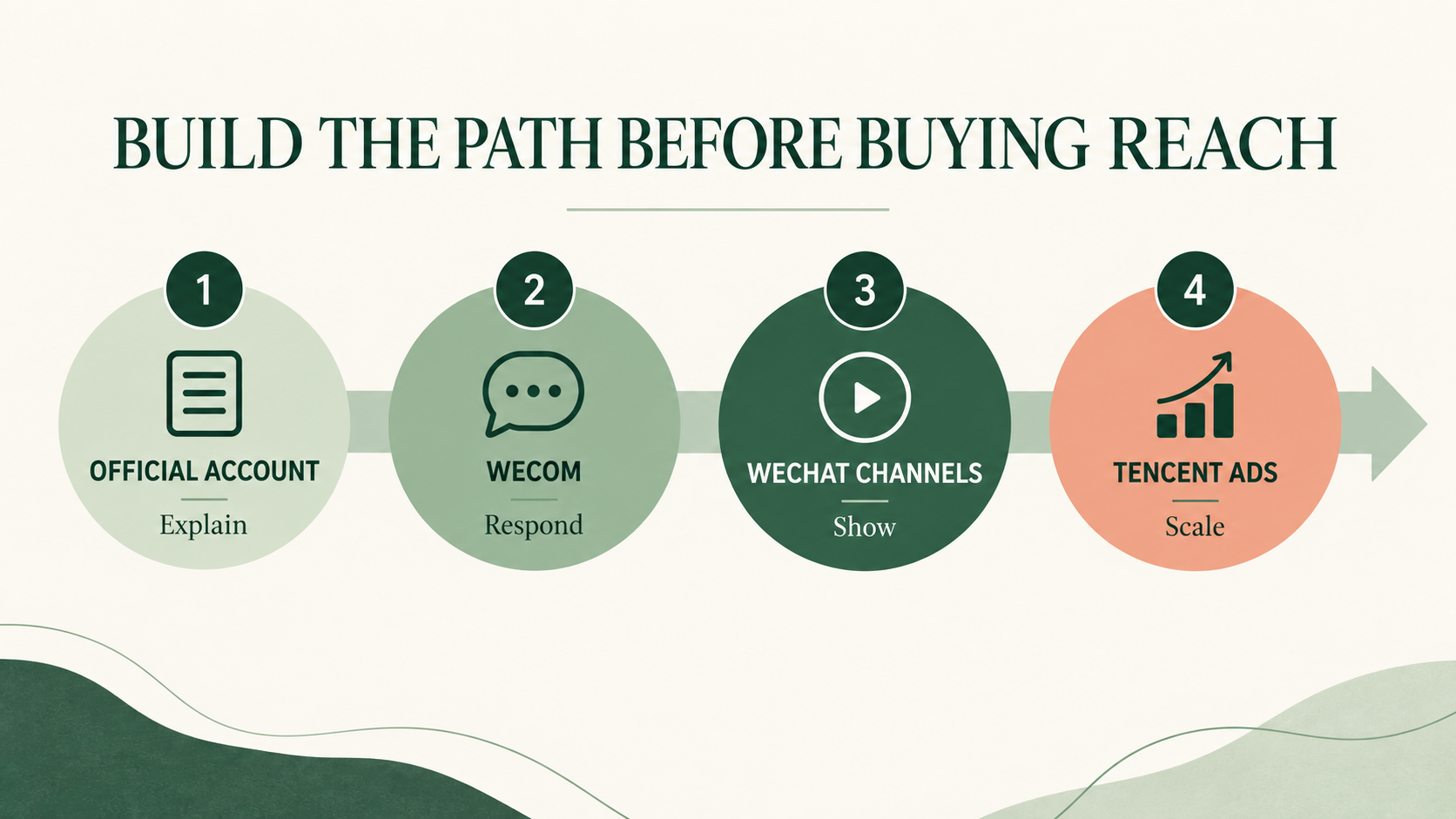
For many brands, that path begins with a WeChat Official Account for credible Chinese information and Weixin Search visibility, adds WeCom when real prospects need a company-managed conversation, uses WeChat Channels when video can make the offer easier to understand, and introduces Tencent Ads only after the content and sales handoff have proved they work.
That order matters. Buying reach before the brand can explain itself, answer in Chinese and follow up properly usually creates more wasted enquiries—not faster growth.
This guide explains what each part of the WeChat ecosystem should do for a B2B company, what to build first at different stages and how to avoid an expensive collection of disconnected accounts.
Which tools matter most for B2B growth in China?
For a serious but practical starting stack, focus on four tools:
WeChat Official Account (微信公众号): the brand’s official Chinese content and information base.
WeCom (企业微信): the company-managed route for conversations with prospects, partners and customers.
WeChat Channels or Weixin Channels (视频号): video for demonstrations, expert visibility, event content and wider discovery inside the ecosystem.
Tencent Ads or Tencent Marketing Solution: paid reach to selected audiences once the destination, offer and follow-up process are ready.
Weixin Search is the connective discovery layer around the content. Mini Programs can become valuable for specific services, tools or transactions, but most early-stage B2B brands do not need to build one before they have proved the user need.
Tencent describes Weixin and WeChat as sister services built around an ecosystem that includes Official Accounts, Channels, Search, Mini Programs, payment and other functions. The combined monthly active user base exceeded 1.4 billion at the end of the first quarter of 2026. The scale is impressive, but scale is not the strategy. The useful question is: what job should each tool perform for your buyer?
Do not begin with a platform list—begin with the buyer’s next question
Imagine a Chinese operations director hears about your company at an industry event in Shanghai. She does not immediately request a proposal. First, she wants to know whether the brand is credible, whether the product fits her situation and whether anyone can answer a technical question in Chinese.
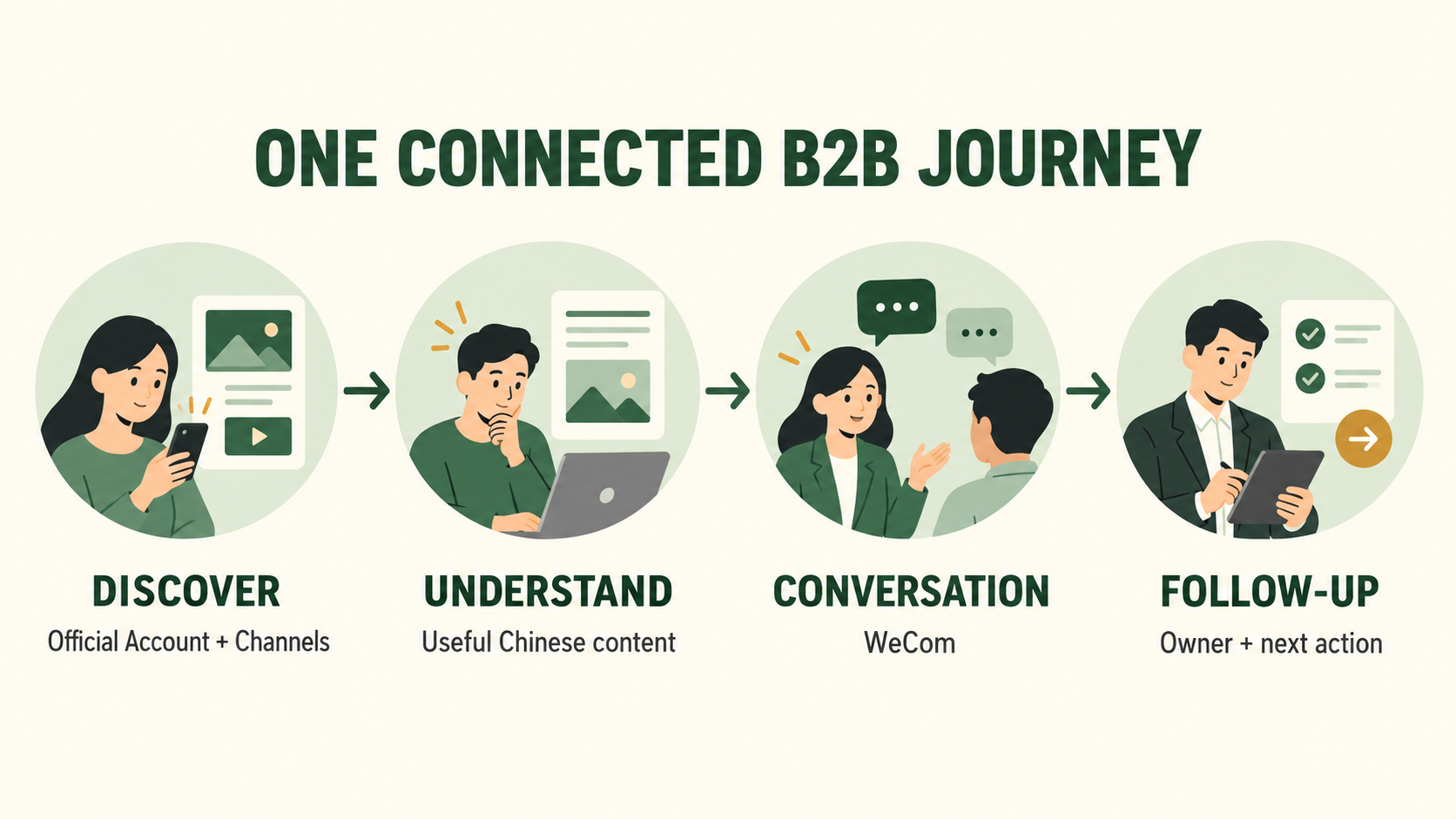
Her path may look like this:
she scans a QR code and opens the company’s WeChat Official Account;
she reads a Chinese article explaining the relevant use case;
she watches a two-minute Channels video featuring a product specialist;
she adds an approved WeCom contact to ask a specific question; and
a Chinese-speaking operator connects her with the responsible overseas salesperson or technical colleague.
Each tool removes a different obstacle. The Wechat Official Account gives her something official to verify and share. Video makes a complex idea easier to absorb. WeCom gives her a real person and the company a managed relationship. The CRM or approved sales record keeps ownership and next actions visible internally.
If those parts do not connect, the buyer experiences four separate accounts instead of one coherent brand.
Tool 1: use a WeChat Official Account as the Chinese information base
A WeChat Official Account is usually the strongest public foundation for an international B2B brand that needs to be understood in mainland China.
It can hold evergreen Chinese information about the company, use cases, product education, industry perspectives, events, proof points and frequently asked questions. Articles can be shared in one-to-one chats and groups, found through Weixin Search and used by salespeople when a prospect needs a clear explanation.
The account should help a Chinese buyer answer five basic questions:
What does this company actually do?
Which Chinese customer or business problem does it understand?
Who is the product or service for?
What evidence, expertise or practical explanation supports the claim?
What should I do if I want to learn more or speak with someone?
That is more useful than treating the Official Account as a noticeboard for translated press releases.
What should a new B2B Official Account contain?
A workable first version does not need dozens of articles. It needs a small set of useful, connected assets:
a clear company and China-market introduction;
two or three priority use-case articles;
one practical guide that demonstrates expertise;
a Chinese FAQ covering buying or implementation concerns;
an event, consultation or WeCom contact route; and
a menu and welcome message that help people find these resources.
The content should use the language Chinese buyers use, not simply translated global slogans. Clear entity names, product categories, use cases and questions also make the material easier for search engines and AI systems to interpret.
When should the Official Account come first?
Prioritise it when the market still needs education, the product is complex, prospects regularly ask for Chinese material, or overseas salespeople need a credible Chinese destination to share after an introduction.
If the business already receives active China enquiries or collects contacts at events, build the Official Account and WeCom process together. Content without a responsible follow-up route leaves the interested buyer to do the work.
Tool 2: use WeCom when interest must become a managed business conversation
WeCom, formerly WeChat Work, is Tencent’s enterprise communication and office platform. For B2B growth, its most important role is not broadcasting. It is helping a company manage direct relationships with known prospects, partners and customers while those people remain in the familiar Weixin environment.
WeCom becomes especially relevant when:
Chinese leads are currently held in employees’ personal WeChat accounts;
a trade show, webinar or campaign generates contacts but ownership is unclear;
headquarters cannot see who is responsible for the next step;
Chinese-speaking operators need to route questions to overseas specialists;
relationships become difficult to continue when a salesperson changes role or leaves; or
the company wants approved welcome messages, content and follow-up rules.
It does not create demand by itself. It also does not automatically replace Salesforce, HubSpot or another CRM. The company still needs to define who owns a lead, which information is recorded, what counts as qualified and how a backup continues the work.
What should the first WeCom workflow look like?
Keep the first version specific. Choose one real entry point—such as an event QR code or the contact button after a WeChat article—and define:
who receives the contact;
what the welcome message says;
which useful question is asked first;
when a salesperson or technical specialist joins;
what information is recorded in the company’s CRM or approved tracker; and
who takes over when the owner is unavailable.
Test that journey with a real but controlled enquiry before adding automation or a complex SCRM layer.
Company-managed relationships can improve continuity, but brands should not assume that every historical message, attachment, note or connected-system record transfers automatically in every reassignment scenario. Test the actual permissions, handover process and connected systems your team will use.
Tool 3: add WeChat Channels when the product needs to be seen or heard
WeChat Channels brings short-form video and livestreaming into the wider Weixin ecosystem. For B2B companies, its value is often explanation rather than entertainment.
Video can show a product working, let a specialist speak directly, turn a webinar into shorter learning clips, capture a trade-show demonstration or make an unfamiliar international brand feel more present in China.
Useful B2B formats include:
a 60-second answer to one buyer question;
a two-minute product or workflow demonstration;
an expert comment on a relevant industry development;
a short customer or partner perspective, where permission allows;
a conference interview or booth walkthrough;
an extract from a Chinese webinar; and
a simple comparison that helps a buyer understand fit.
The goal is not to open another empty channel. A Channels programme needs a repeatable source of useful material, a recognisable presenter or visual style, Chinese subtitles and a next step that connects back to an Official Account, event, WeCom conversation or other appropriate destination.
When is video worth adding?
Add Channels when the brand has already identified recurring buyer questions and can show or explain the answers better in motion. A company with no Chinese content owner, no reliable approval rhythm and no useful footage may get more value from fixing the Official Account and sales materials first.
Tool 4: use Tencent Ads after the customer path works without paid traffic
Tencent Marketing Solution offers advertising tools across Tencent’s applications, including audience insight, creative management, placement strategy and digital asset management. Paid media can help a B2B brand extend relevant content, support an event or place a clear offer in front of more people.
But paid reach should normally come after the basic WeChat journey is working.
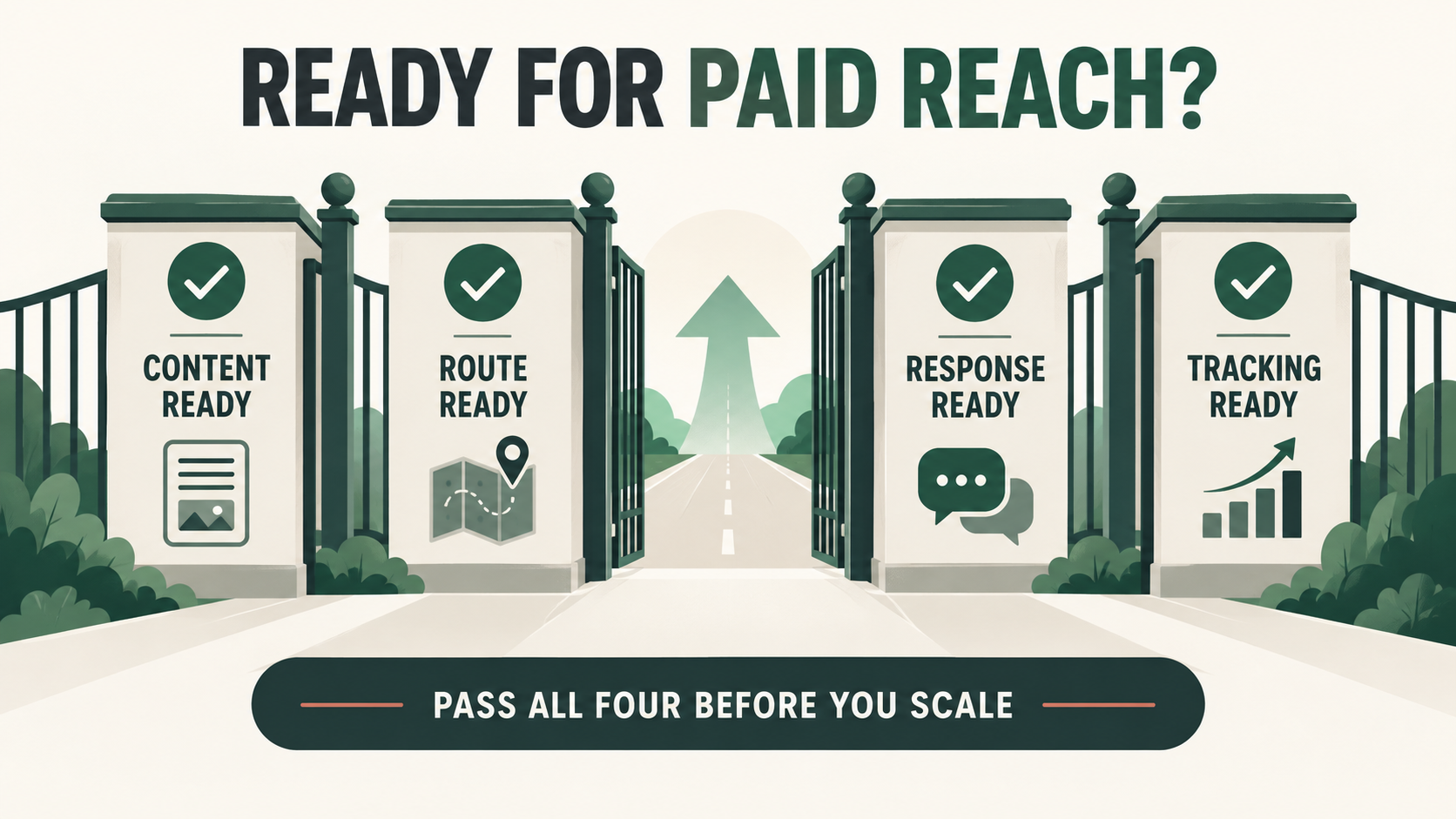
Before spending, check four things:
Content ready: Is there a useful Chinese article, video, landing experience or event proposition?
Route ready: Is the requested next step clear and technically working?
Response ready: Can a Chinese-speaking person reply, qualify and route the enquiry?
Tracking ready: Can the team distinguish useful engagement from low-intent traffic and connect qualified responses to business outcomes?
If one of those answers is no, advertising tends to make the gap larger. More people reach an unclear page. More enquiries wait for a reply. More contacts enter a system without ownership.
What can Tencent Ads support for a B2B brand?
Depending on current eligibility, industry rules, targeting options and available inventory, paid activity may support:
a Chinese report or guide aimed at a defined professional audience;
webinar or event registration;
a product launch or market-education campaign;
selected Official Account or Channels content;
retargeting or continued exposure where the approved setup allows it; or
a specific consultation or demonstration offer.
Do not treat the platform as a machine that guarantees enterprise leads. B2B demand is narrower, buying cycles are longer and targeting signals do not remove the need for a credible offer. Account eligibility, advertising rules and sector restrictions should be checked against current requirements before a plan or budget is approved.
What about Mini Programs, Chinese websites, Baidu and other platforms?
The WeChat ecosystem is powerful, but it is not the whole China market.
A Chinese website and Baidu can matter when buyers actively research the category on the open web. Zhihu or Bilibili may be useful when the subject benefits from detailed answers or long-form video. RedNote, Douyin, industry media, associations, distributors and offline events can create discovery for particular sectors.
A Mini Program can also be valuable inside Weixin when users need a specific service: an event registration tool, product selector, appointment flow, member area, service portal or transactional function. It should solve a real repeated need. It is rarely the first thing a B2B brand should commission simply to appear established.
The practical rule is: build the smallest connected system that supports a real buyer journey, then add tools when evidence shows what is missing.
The recommended build order for three common China-market stages
Stage 1: exploring demand in China
The company has a defined audience and some evidence of opportunity but few active Chinese leads.
Start with:
clear Chinese positioning and priority buyer questions;
an owned Chinese landing presence or WeChat Official Account;
a small set of strong evergreen articles;
account ownership, access and approval rules; and
one realistic enquiry route with a named response owner.
Do not rush into a Mini Program or large advertising plan. First prove that the proposition earns attention and that the team can respond.
Stage 2: active marketing, events or inbound enquiries
The company is attending events, publishing regularly or receiving Chinese questions.
Add:
WeCom contacts and clear lead ownership;
event and campaign QR-code journeys;
approved welcome messages and follow-up materials;
a minimum CRM or lead record;
WeChat Channels content based on real buyer questions; and
a weekly review of enquiries, response quality and next actions.
At this stage the priority is continuity. The company should be able to see what happens after attention is created.
Stage 3: a proven journey ready to scale
The team has useful content, a functioning response process and evidence that certain audiences or offers lead to worthwhile conversations.
Now consider:
targeted Tencent advertising;
a larger Channels programme;
automation for repeated but already-proven work;
CRM or SCRM integration based on defined data needs;
a Mini Program for a specific user task; and
broader Chinese media and platform activity where the buyer journey requires it.
Scale the parts that have earned a reason to grow. Do not add complexity to compensate for weak positioning or slow follow-up.
A minimum viable WeChat stack for an international B2B team
For many brands, the first useful operating system is smaller than expected:
one properly owned and configured Official Account;
six to eight useful Chinese content assets;
a clear menu, welcome and enquiry route;
one primary and one backup WeCom owner for qualified contacts;
a Chinese-language response standard and escalation path;
a simple CRM or approved record with source, owner and next action;
one repeatable video format when the subject benefits from it; and
a monthly review that decides what to improve before adding reach.
This is not a universal package. A company already receiving strong event demand may need WeCom sooner. A specialist consultancy may succeed with deep articles before producing regular video. A business with a transactional service may have an earlier Mini Program case. The sequence should follow real audience behaviour and the team’s ability to operate each part well.
How should B2B companies measure the WeChat ecosystem?
Measure each tool according to its job.
For the Official Account, look at whether the right content is found, read, shared and used by sales—not only total followers.
For Channels, look at relevant viewing, completion, sharing, profile or article actions and whether the format helps buyers understand the offer.
For WeCom, look at qualified contacts, useful response time, agreed next steps, follow-up continuity and progression into meetings, trials, quotations or service outcomes.
For Tencent Ads, connect spend and content response to qualified actions as far as the available data and privacy rules allow. Cheap clicks are not a useful result when the audience, offer or sales outcome is wrong.
The most important cross-ecosystem question is simple: Can the business trace a meaningful Chinese interaction from source to owner to next action?
Why the operating partner matters as much as the tools
An international brand does not only need somebody to open accounts. It needs a partner who can stay with the work from listening and planning through Chinese content, setup, daily operation, follow-up and ongoing improvement.
The useful agency notices where the buyer journey breaks. Perhaps the article attracts the wrong audience. The Channels video explains the product but offers no next step. The WeCom contact receives a question but lacks an approved answer. The overseas salesperson replies, but nobody records what was promised. Paid activity sends more traffic into the same gap.
Lotus Social Agency connects strategy, Chinese content, WeChat and WeCom operations, video and campaign support through one China-based bilingual team. We help international brands choose the smallest useful starting stack, run it consistently and strengthen it as real audience and commercial evidence emerges.
Frequently asked questions
What is the most important WeChat tool for B2B marketing in China?
There is no single answer for every company. An Official Account is usually the best public information foundation. WeCom may be the earlier priority when qualified China contacts already exist but ownership and follow-up are weak. The right starting point depends on whether the immediate problem is understanding, discovery or relationship management.
Should a B2B company launch WeChat Channels immediately?
Only when video makes the offer easier to understand and the team can maintain a credible production and approval rhythm. Channels works best when it extends useful subject matter and connects to a clear next step—not when it is opened simply because video is popular.
Is WeCom the same as a CRM?
No. WeCom can support company-managed customer relationships and connect with third-party systems, but it does not automatically replace the company’s CRM. Define the conversation, ownership, handoff and data requirements before deciding on an integration.
When should an international B2B brand use Tencent Ads?
Use paid reach when the Chinese content, offer, destination, response team and measurement plan are ready. Ads can accelerate a working journey; they cannot repair an unclear proposition or an unowned sales process.
Does every B2B company need a Mini Program?
No. Build a Mini Program when users need a specific repeated service or transaction that an article, menu, website or direct conversation cannot provide efficiently. Avoid making it a prestige project without a demonstrated user need.
Can an overseas company open and verify these accounts?
Some international organisations have workable application routes, but eligibility depends on the applicant, jurisdiction, industry, account type and required features. Platform approval cannot be guaranteed. Confirm current requirements and clarify entity ownership, administrator access, renewals and handover before committing.
Build the path before buying the reach
The essential B2B China marketing stack is not complicated when every tool has one clear job:
the Official Account helps the market understand and verify the brand;
WeChat Channels makes expertise and products easier to see;
WeCom turns genuine interest into a company-managed conversation; and
Tencent Ads expands reach after the journey is ready to receive it.
The strongest system is not the one with the most Tencent products. It is the one a Chinese buyer can move through without confusion—and the international team can operate without losing ownership.
Explore Lotus’s WeChat marketing support, review our WeCom service or contact Lotus to map the right build order for your China market stage.
