

Chinese Social Content for International Hotels: Plan Around the Guest's Decision
A room tour is often the easiest piece of hotel content to make—and one of the least useful to a traveller.
The camera passes through the lobby, bedroom, bathroom and breakfast room. The edit is polished. The music is pleasant. Yet a Chinese guest planning an overseas trip may still be wondering whether a family can fit comfortably, how to reach the entrance with luggage, whether the quoted price includes breakfast, or what happens if their flight lands after midnight.
That gap matters. The hotel has shown what it wants to show; the traveller is still looking for an answer.
This is the central idea behind effective Chinese social media content for international hotels: plan around the decision a guest is trying to make. Photography, video, design and platform tactics then have a clear job. Without that decision, even beautiful work can become background scenery.
Recent travel research supports the need for a connected approach. In a 2025 survey of experienced mainland Chinese outbound travellers, Chinese social platforms were the leading source of destination inspiration, RedNote was particularly important among younger respondents, and Chinese online travel agencies remained central to booking. The same study found that safety, food, accommodation and attractions were among the issues shaping trip planning. The implication is not that every hotel needs every platform. It is that inspiration, verification and reservation often happen in different places.
A beautiful room is not yet a reason to stay
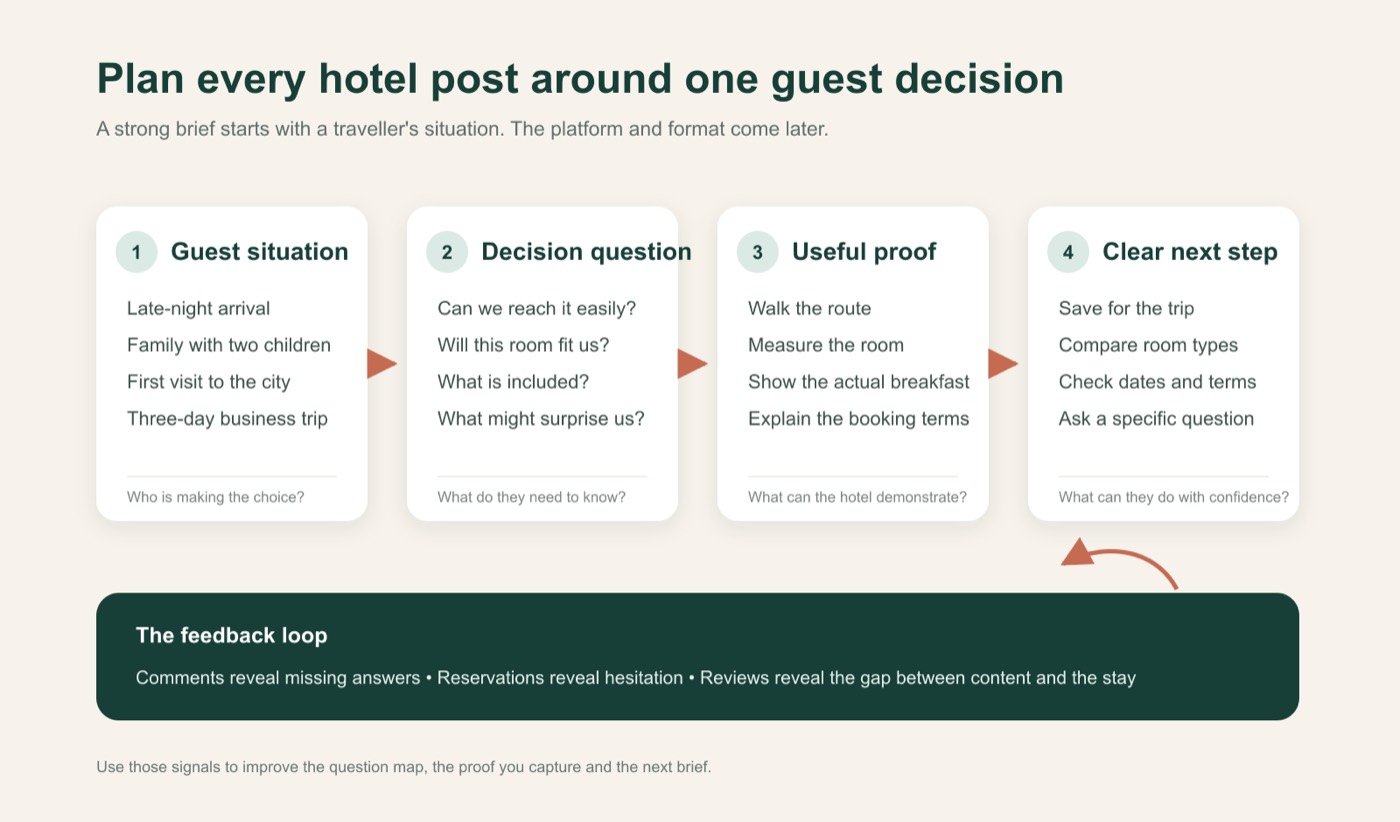
Start with the guest's decision. The platform and format come later.
Hotel teams naturally produce content from the property outward. A new suite, afternoon tea or lobby renovation becomes the subject, followed by a caption and a publishing date.
Guests move in the other direction. They start with a trip, an occasion or a problem:
“We land late. Can we reach the hotel without a difficult transfer?”
“We are travelling with two children. Which room actually works?”
“This is our first visit. Is the neighbourhood convenient after sightseeing?”
“I have three meetings. Can I work, sleep well and leave early?”
“We are celebrating something important. What will feel special without becoming awkward?”
The property only becomes relevant after it fits the situation.
This is why a generic list of “room, restaurant, spa, destination” content pillars is rarely enough. Those are hotel departments, not guest decisions. A useful editorial plan connects what the hotel can prove with what a traveller needs to decide.
Build a question map before a content calendar
Before choosing formats or publishing frequency, build a question map. Use four fields:
Guest situation: Who is travelling, why, and under what constraint?
Decision question: What would stop or enable the stay?
Useful proof: What can the hotel show, measure or explain?
Next step: What should the traveller be able to do with confidence?
The diagram is deliberately simple. Its value is in the discipline it creates. “Promote the family room” is not a brief. “Help two adults travelling with two children understand which room fits, where the extra bed goes and what breakfast will cost” is a brief.
A content team can find questions in several places:
RedNote search suggestions and relevant notes
Ctrip, Dianping and other review themes
questions sent to reservations and the front desk
reasons guests abandon or change a booking
creator comments and direct messages
sales enquiries from families, groups, events and corporate travellers
what overseas guests misunderstand on arrival
RedNote's own commercial insight platform includes search and note analysis tools, which is useful evidence that search language and content behaviour belong in the planning process. It is still a research input, not a machine that supplies the strategy.
Organise questions into five practical territories
The exact question map will differ by property, but most international hotels can start with five territories.
1. Arrival and location
“Central” is an advertising word. A traveller needs something they can picture: which station exit to use, how long the walk takes with luggage, whether the route has stairs, where a car can stop, and what the street feels like after an evening arrival.
Do not estimate from a map. Ask a colleague to make the journey with a suitcase and phone. Record the route, the awkward turn, the recognisable landmark and the entrance itself. A four-minute video is unnecessary; a clear sequence with an honest walking time may be far more useful.

2. Room fit and sleep
Room type names rarely explain how a stay will feel. Show the actual layout, bed configuration, storage, bathroom privacy, cot or extra-bed position, connecting-room arrangement, blackout, desk and likely sources of noise. If photographs show the largest or highest-floor room in a category, say so.
This is not an invitation to make every note defensive. It is a way to remove avoidable surprises. A traveller who chooses the right room is more likely to arrive with the right expectation.
3. Price and reservation terms
Content should help a guest understand what a rate does and does not include. Breakfast, taxes, service charges, deposits, cancellation timing, child policies, extra beds and local charges can be more persuasive than a vague “best available rate” message.
The social post does not need to reproduce every term. It should state the important conditions and lead to a booking route where the current details are clear. If the information varies by date, package or room, say that rather than freezing a temporary offer into evergreen content.
4. Stay experience and service
Show what happens, not just what exists. How early can luggage be left? Is there a quiet place for a call? How does breakfast work at the busiest time? What can the team realistically do for dietary needs? Is Mandarin support available, and at what times? If it is not available, what translated information or escalation route is in place?
Specificity builds confidence. Overpromising creates work for the property and disappointment for the guest.
5. The neighbourhood and the trip
A hotel is part of an itinerary. Useful content can explain which nearby places fit a free morning, where families can eat after a late check-in, how to combine the hotel with a museum or event, or which route works when rain changes the plan.
The hotel does not need to become a destination publisher. It needs a credible point of view from its own doorstep.
Give each channel a clear job
The same guest question may appear on several platforms, but the content should not be copied without thought.
RedNote: discovery and comparison
For many international hotels, RedNote (Xiaohongshu) is the strongest place to begin. Its role is not simply awareness. Travellers use it to form an idea, compare possibilities and look for recent experience.
We normally recommend an official RedNote account when the property is eligible and able to maintain it. The account gives the hotel a stable place to establish its Chinese name, explain room types and policies, answer practical questions and publish updates. Overseas verification is possible only for supported locations and industries, with the required entity and operating documents; approval should never be assumed. RedNote's current professional-account rules set out the applicable principles and can change. Check the current official requirements before applying.
A useful RedNote note usually has one clear promise. For example:
how to reach the hotel after a late flight
which room fits two adults and two children
what a first-time visitor can reach on foot
what is included in breakfast for different ages
where a business traveller can take a call before check-in
what the hotel can and cannot arrange for a celebration
These are starting directions, not title templates. The Chinese wording should come from real search language, and the answer must be true for the property. Repeating location keywords or using a dramatic cover that the note does not fulfil may create a click, but it weakens trust.
Creators and UGC: lived evidence
An official account can state the facts. A creator can show how the stay works for a particular person.
Choose creators by the decision they can credibly help with: family travel, design, food, business trips, accessible travel, cultural itineraries or another relevant occasion. Brief them on the facts that must be accurate, the experience they are free to interpret, filming boundaries, disclosure, fees, usage rights and the current booking route.
Avoid scripting a verdict. “Say the room is spacious and the location is perfect” produces weak content and may be untrue. A better brief is: “Show how your family used the room, how long the station journey took and what you would want another parent to know.”
UGC needs its own rules. A genuine guest post can reveal language and questions the hotel did not anticipate. Ask permission before reuse. Do not invent guest voices, conceal commercial relationships or reward favourable reviews. The aim is useful social proof, not manufactured praise.
WeChat and WeChat Channels: depth and continuity
RedNote can introduce the property; WeChat becomes more useful when there is a reason to keep the relationship.
An Official Account can hold a detailed arrival guide, seasonal itinerary, event information or service article that would be awkward in a short note. WeChat Channels can carry short video through the wider WeChat ecosystem and connect with Official Account content, communities or existing followers. For properties with repeat Chinese guests, group business, events or higher enquiry volume, WeCom may support structured follow-up at a later stage.
Do not open every channel at once. An unmaintained WeChat menu and a silent service contact create less confidence than a smaller system that works.
Ctrip and Dianping: verification and action
The hotel may inspire a stay on social media, but a traveller often checks an OTA or local-life page before reserving. Names, location pins, room descriptions, current photographs, amenities, policies and price information should agree with the social content.
When a RedNote note says the property is “five minutes from the station” and the map pin appears elsewhere, the marketing problem is no longer creative. It is operational. Build a regular listing check into the content workflow, and send repeated review themes back to the editorial team.
Treat the cover as a promise, not decoration
A cover should make the subject clear quickly, but it does not need to shout.
Three approaches often work for hotels:
A real situation: luggage at the station exit, a cot inside the room, or a laptop set up at the desk.
A useful comparison: two room layouts or two arrival routes, labelled accurately.
A practical outcome: “Which room fits four?” or “From the station to check-in,” supported by the note.
The photograph and words should agree. Do not place a generic bedroom behind a title about airport access. Avoid tiny text, exaggerated claims and covers that resemble unrelated travel guides. The cover earns the pause; the note earns the save.
Capture evidence once, then shape it for each platform
International teams often lose time because every post begins from zero. A better system is to run an evidence-capture day around the question map.
For an arrival theme, capture the station exit, taxi point, walking surface, recognisable turn, hotel entrance and front-desk handoff. Record the real journey time under stated conditions. For a family-room theme, capture door width, bed layout, cot, bathroom, storage and breakfast arrangements. Confirm every number and policy with the operating team.
That evidence can then become:
a RedNote carousel answering one search-led question
a short creator brief built around a real stay
a WeChat arrival guide with more detail
a WeChat Channels edit showing the route
corrected OTA or Dianping information
a Chinese reservations reply saved for future enquiries
The idea stays consistent; the opening, pace, depth and next step change with the channel.
A realistic four-week editorial rhythm
Publishing three times a week is not automatically better than publishing once. Cadence depends on the account, season, production capacity and amount of useful material. A hotel starting from scratch could test a four-week cycle like this:
Week 1 — Arrival and location. Answer one high-friction journey question and one neighbourhood question.
Week 2 — Room choice. Explain a room configuration for a defined party, then address one sleep or bathroom concern.
Week 3 — The stay occasion. Create one piece for a relevant segment such as families, couples, business travellers or event guests, using real service evidence.
Week 4 — Booking clarity and learning. Explain one term that often causes hesitation, then review search visibility, saves, qualified questions, reservation feedback and comments.
The next month should not be a copy of the first. Keep the themes that produced useful behaviour, improve weak answers and retire topics that attracted the wrong audience.
Measure whether content made the decision easier
Views are a distribution signal, not a hotel outcome. A useful reporting view separates four layers:
Discovery: Chinese-name search visibility, relevant impressions and non-follower reach
Usefulness: saves, completion, meaningful comments and profile visits
Intent: room-specific questions, booking-path visits and identifiable enquiries
Business and service: confirmed reservations where a source is known, changes or cancellations caused by misunderstanding, and feedback after the stay
Attribution will remain imperfect. A traveller may save a note, ask a friend, compare on Ctrip and reserve later from a laptop. The hotel should still connect what it can: use trackable links where permitted, ask a light-touch “how did you find us?” question, and give reservations a way to log recurring Chinese-language enquiries.
The best content insight may be operational. If three people ask whether a room has a door between the sleeping areas, the response is not merely to answer the comments. It is to correct the room description and plan the next piece of content.
Make content easier for search engines and AI to understand
GEO does not require a separate layer of machine-written filler. Google's current guidance says that established SEO fundamentals still apply to generative search experiences: useful, original, crawlable information in text, supported by relevant images and consistent structured data. There is no special AI schema or file that guarantees inclusion. Google's guidance for AI features is explicit on this point.
For a hotel, that means:
use one consistent Chinese and local-language name across the official site and major platforms
answer specific questions under descriptive headings
publish first-hand facts that only the hotel can confirm
show when policies or guidance were last checked
provide descriptive image text rather than generic filenames alone
link related arrival, room, dining and booking information
keep important answers in accessible text, not only inside a video or graphic
correct outdated details instead of producing near-duplicate pages
This helps a person first. It also makes the hotel easier to retrieve, quote and compare accurately.
What the first 90 days should produce
Days 1–30: build the evidence. Audit Chinese search results, existing platform accounts, OTA and Dianping information, reviews and reservations questions. Agree the Chinese name, priority audiences, account ownership and approval route. Build the first question map and test the booking journey on a Chinese-language phone.
Days 31–60: publish the first answer set. Establish or refresh the official RedNote account where eligible. Produce a small body of useful notes across arrival, room fit, stay experience and booking clarity. Correct inconsistent listings. Brief a limited number of creators only where their experience adds genuine evidence.
Days 61–90: connect content with operations. Compare platform response with reservation and front-desk feedback. Improve weak answers, formalise the reply and escalation process, and decide whether WeChat, WeChat Channels, further creator work or paid support has a clear role. Plan the next quarter from what guests actually needed—not from a generic social calendar.
Questions international hotel teams ask
Should every hotel start with RedNote?
No. RedNote is a strong starting point when Chinese travellers research the destination, location or hotel category there and the property can sustain useful Chinese content. Audience demand, account eligibility, booking readiness and internal resources should be checked first.
Does an international hotel need a RedNote official account?
We normally recommend one when the route is available. It creates a recognisable source for the hotel's facts, naming and regular content. Eligibility depends on the applicant's jurisdiction, documents, industry and the platform's current rules. The hotel should retain ownership, administrator access and recovery control.
How many RedNote posts should a hotel publish each week?
There is no universal number. Start with a cadence the team can maintain without repeating itself. One or two strong answers can be more useful than several generic room posts. Review search visibility, saves, questions and production capacity before increasing frequency.
Can the same hotel content be posted on RedNote and WeChat?
The evidence can be reused; the execution should change. RedNote usually needs a focused, searchable promise and a concise visual answer. WeChat can support more detail, service information and a longer relationship. WeChat Channels needs its own video opening and pace.
What should a hotel ask a Chinese creator to produce?
Give the creator a real guest situation and the facts that must remain accurate. Agree disclosure, filming rules, fees, deliverables, usage rights and the booking route. Leave space for an honest experience. A creator should not be asked to repeat praise they cannot support.
Can a content agency guarantee views or reservations?
No responsible partner can guarantee either. Distribution changes, and reservations depend on price, availability, reviews, destination demand and the stay itself. The agency should explain what it controls, what it will measure and how learning will change the next content cycle.
Start with the question your hotel keeps hearing
You do not need thirty new ideas. Start with the question that appears every week in reservations, reviews or the front desk. Decide who is asking it, gather proof inside the property, answer it in natural Chinese and make the next step clear.
That is how a hotel stops filling a calendar and starts building a useful Chinese presence.
Lotus can connect Chinese audience and platform research, RedNote account and content planning, Chinese content production, KOL, KOC and UGC coordination, and ongoing social media management into one operating rhythm with your hotel team. Tell us about the property, current Chinese presence and the questions guests keep asking. We will recommend a focused starting scope.
