

WeCom CRM in China: The One-Lead Test for International Brands
Many international brands start a WeCom CRM project by comparing platforms, integrations and dashboards. That is understandable—but it is not the fastest way to find out whether the operation will work.
Start with one real Chinese enquiry.
Can your team identify where that lead came from, give it to a named owner, send a useful reply, agree the next step, record the facts the business needs and keep the conversation moving when the owner is unavailable?
If the answer is no, adding more software will not repair the operating gap. If the answer is yes, you have the beginnings of a WeCom CRM process worth scaling.
What does “WeCom CRM” actually mean?
For most international brands in mainland China, WeCom is the customer conversation and relationship layer; the CRM is the commercial record.
WeCom lets employees communicate with Weixin customers through a company-managed environment. Tencent also provides APIs and third-party application connections, so selected customer and activity information can move into other business systems. But WeCom does not automatically replace Salesforce, HubSpot or another CRM, and an integration does not decide how your team should qualify, follow up or hand over a lead.
A useful WeCom CRM setup therefore has three parts:
a Chinese customer-facing conversation that feels natural;
a clear operating process for ownership, response and follow-up; and
a deliberate handoff of the necessary commercial information into the company’s CRM or other approved system.
The one-lead test checks all three before a brand commits to a large technical build.
Is your business ready for WeCom CRM in China?
WeCom becomes relevant when China demand is already real enough to manage.
That usually means your business has a Chinese-speaking salesperson, customer-service colleague or authorised operating partner; receives enquiries from Chinese prospects or customers; and has a genuine next step to offer, such as a consultation, quotation, product trial, store visit, distributor discussion or service appointment.
It is especially useful when one or more of these situations feels familiar:
prospects arrive through WeChat or Weixin content, RedNote, Douyin, a China website, trade shows, webinars, referrals or distributor activity;
salespeople keep Chinese contacts on personal accounts or in private spreadsheets;
headquarters cannot see who owns a China lead or what was promised;
the same prospect receives different answers from marketing, sales and service;
valuable relationships become difficult to continue when an employee changes role or leaves; or
a global CRM contains company names and deal stages, but not enough context for a local colleague to continue the conversation.
WeCom is not a substitute for a China-market proposition or a person who can answer Chinese customers. If there is no meaningful China demand, no Chinese-language response capability and no internal owner, the first priority is market validation and operating responsibility—not a WeCom rollout.
The one-lead test: six gates every China enquiry should pass
Imagine a procurement manager in Beijing discovers your brand after a conference. She scans an approved WeCom contact route and asks two practical questions in Chinese: whether your product supports her technical requirement and whether a local quotation is available.
Your China operator can answer the first part, but the technical specialist and salesperson are overseas. The salesperson then goes on leave for three days.
This is not an edge case. It is the kind of ordinary situation that reveals whether WeCom and your CRM form a working customer process or merely two accounts your company pays for.
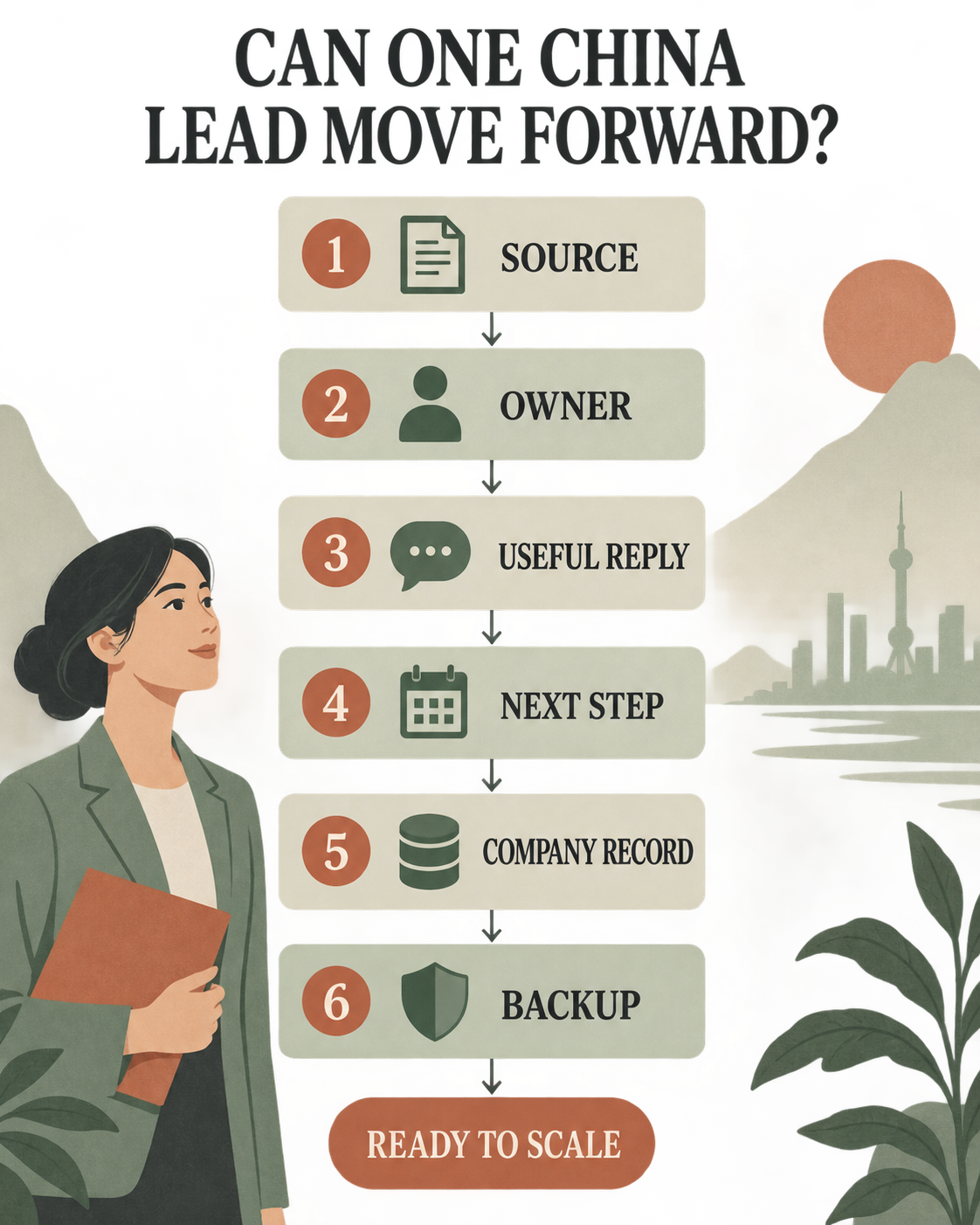
1. Can the team know where the lead came from?
The entry point should carry enough context to distinguish an event lead from a product-page enquiry, a distributor referral or a customer-service request. Otherwise the first reply begins with unnecessary questions and campaign reporting becomes guesswork.
Do not try to track everything. Start with a short, controlled source list that the people handling enquiries will actually use.
2. Is there one named owner?
“China team” is not an owner. The enquiry needs one person accountable for moving it forward and one backup who knows when to step in.
For an international brand, the owner may sit overseas while a Chinese-speaking operator handles the local conversation. That can work well if commercial authority is clear: who can qualify the opportunity, who can approve pricing, who answers technical questions and who closes the feedback loop with the customer.
3. Can the customer receive a useful first reply?
An automatic greeting is not a useful reply. A real first response should acknowledge what the person asked, explain what happens next and set a credible expectation for timing.
For example: “Thank you for sharing the technical requirement. I am checking this with our product specialist and will come back to you by 4pm tomorrow. In the meantime, could you confirm the application environment?”
The message is simple, but it tells the customer that someone understood the question and owns the next action.
4. Is the next step explicit?
Every qualified conversation should end with a visible next action: send a specification, book a meeting, confirm a sample, introduce a distributor, issue a quotation or close the enquiry as not currently suitable.
Without a next action and date, “active lead” becomes a storage category rather than a sales process.
5. Does the company retain the commercial record it needs?
The CRM or approved customer system should hold the minimum information needed to manage the opportunity: source, company, need, owner, stage, agreed next action and date. The WeCom conversation may contain richer day-to-day context, but the company should not depend on one employee’s memory to understand the deal.
Record only information the business genuinely needs, with appropriate access controls and retention rules. Collecting more data does not automatically create more customer insight.
6. Can the backup continue without making the customer start again?
Ask the owner to step away and let the backup take over. Can the backup understand the request, the promise already made and the next action? If the customer has to repeat the whole story, the handover has failed.
WeCom’s company-managed customer relationship features can support continuity, but brands should not interpret this as a promise that every historical message, file, note or connected-system record will automatically transfer in every situation. Test the actual handover process, permissions and connected systems your team will use.
If one real lead passes all six gates, the process is ready for a limited live rollout. If it fails, the failure tells you exactly what to fix.
WeCom and CRM have different jobs
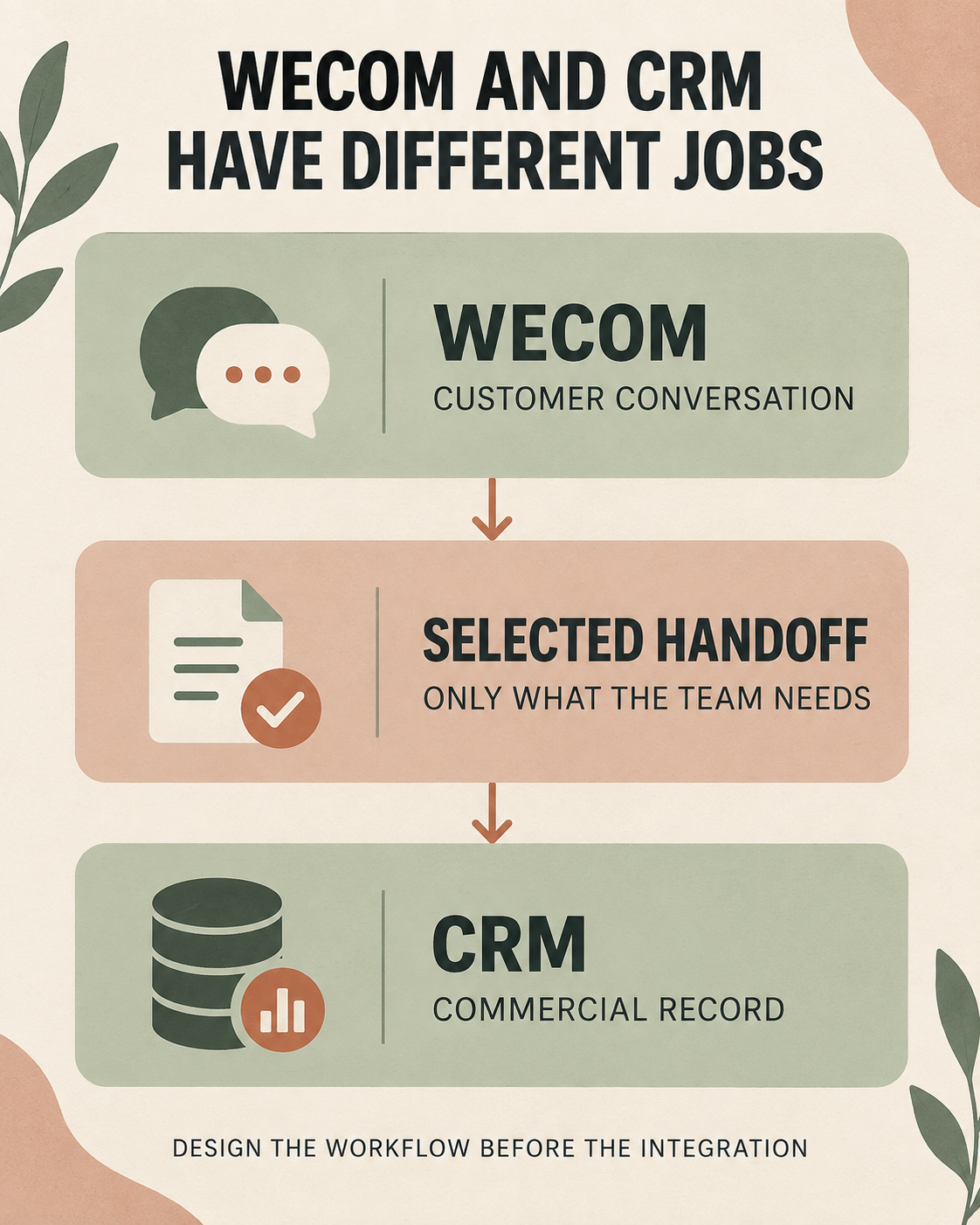
WeCom is where the Chinese customer conversation happens. It is the familiar, responsive front door used to answer questions, share approved material and agree a next step.
The CRM is where the commercial record lives. It is used to manage the account, opportunity, stage, value, next action, reporting and wider sales coordination.
The integration is the selected handoff between them. It should move the information your team needs, at the point when it is useful, without copying every conversational detail into every system.
That distinction prevents two common problems. First, salespeople do not have to turn a natural Chinese customer conversation into constant form-filling. Second, management does not confuse a long contact list with a healthy pipeline.
What should move into the CRM?
For an early-stage process, seven fields are often enough:
lead source;
customer name, company and approved contact route;
the customer’s need in one clear sentence;
lead owner and backup;
current stage;
promised next action and date; and
any consent, access or retention note required by the company’s policy.
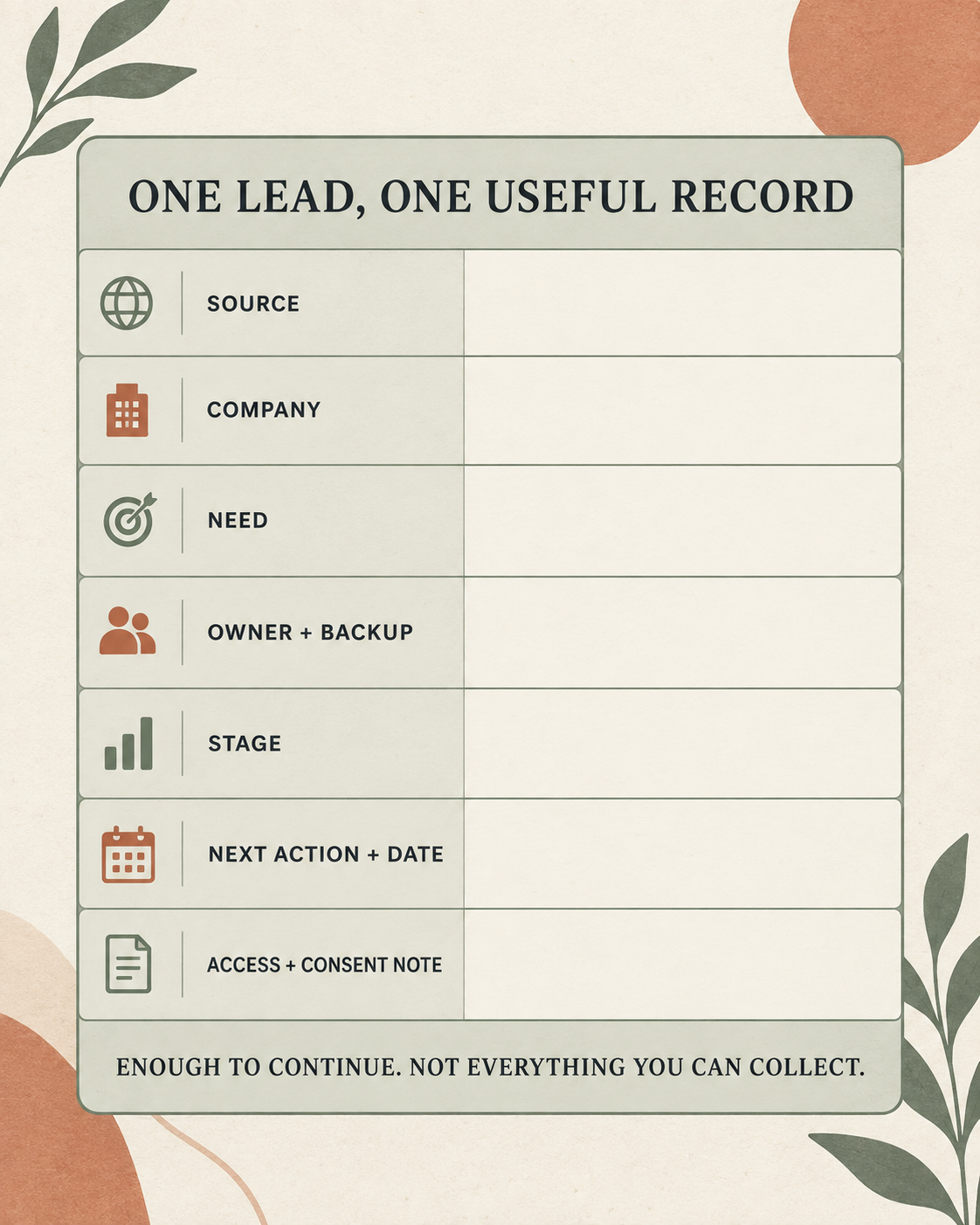
The exact record will vary by sector. A B2B technology company may need application environment and technical fit. A hospitality group may need property, stay date and service-recovery status. A professional-services firm may need market, scope and decision timetable. The principle is the same: capture the facts that help the next colleague serve or progress the customer.
Run the one-lead stress test in one afternoon
International brands often begin with a long integration specification because it feels concrete. A faster diagnostic is a short tabletop exercise using one recent, representative enquiry. Remove or anonymise personal information that is not needed for the exercise, then ask the people who would actually handle the customer to work through the six gates together.
Use the tools and people you have now
Do not create an ideal future workflow for the test. Use the current WeCom setup, current CRM or spreadsheet, current Chinese materials and current approval route. The purpose is to expose the real breaks between marketing, the Chinese-speaking operator, overseas sales and specialist teams.
Introduce one ordinary disruption
Halfway through the exercise, make the owner unavailable. Ask the backup to continue. Then introduce a question that requires an overseas product, legal or commercial colleague. Watch where the team looks for context, which answer needs approval and whether anyone knows who owes the customer the next update.
Write down the breaks, not excuses
Typical findings are practical: the source is missing; two people think the other owns the lead; the Chinese reply needs evidence that has not been localised; the overseas specialist cannot see the question; the CRM has a stage but no promised next action; or the backup can see the contact but not the relevant context.
Fix the smallest useful set first
Choose the three changes that would most improve the next real enquiry. That may be a named backup, one approved Chinese response template, a required next-action field or a simple escalation rule. Only after the manual handoff works should the team decide whether an API connection, SCRM platform or automation will reduce repeated work.
The goal is not to remain manual forever. It is to avoid automating a process that nobody has proved.
What should the weekly WeCom CRM review cover?
A practical review can take 30 minutes. Look at a small set of questions:
How many relevant enquiries entered the selected route?
How quickly did they receive a useful human reply?
How many reached an agreed next step?
Which conversations stalled, and why?
Could the backup continue the work?
Did the CRM reflect the opportunity accurately?
Which Chinese content, answer or proof point was missing?
This is more valuable than celebrating contact growth alone. A large WeCom contact list can still hide slow replies, weak qualification, duplicated follow-up and unowned opportunities.
Who should operate WeCom for an international brand?
The strongest model combines local customer understanding with clear commercial authority.
A Chinese-speaking operator can manage the front line, recognise intent, answer routine questions, share approved material and route specialist requests. The overseas sales or product team retains the authority to qualify, price and make commitments. A named China opportunity owner ensures that the two sides do not leave the customer between them.
An agency is most useful when it stays close to the full operating cycle: listening to wecom users, designing the journey, preparing Chinese-language content, configuring the working process, supporting regular operations and noticing what needs to improve as the brand grows.
Lotus’s role is not simply to open a WeCom account. We help international brands define what WeCom should do, connect it to their China marketing and sales journey, build the Chinese customer-facing layer, support day-to-day operation and improve the process using real enquiries. Complex CRM, SCRM or API implementation can then be scoped with the appropriate technical and legal specialists.
Data and privacy: design the process with restraint
Customer data collected through a mainland China operation may be subject to the Personal Information Protection Law and other data rules. Cross-border access or transfer can introduce additional obligations depending on the organization, data and processing scenario.
Practical design starts with restraint: collect only what is necessary for a defined purpose, explain the use appropriately, control who can access it, set retention rules and involve qualified legal, privacy and security advisers when data may cross borders or include sensitive information.
This article is an operating guide, not legal advice. Platform features, eligibility, APIs and regulatory requirements can change, so the final design should be checked against current official documentation and the brand’s own policies.
Frequently asked questions about WeCom CRM in China
Is WeCom a CRM?
WeCom includes customer-contact and company-management capabilities, but many international brands still need a separate CRM for opportunity stages, forecasting, account history and global reporting. Treat WeCom as the Chinese customer conversation layer unless your requirements assessment shows otherwise.
Can WeCom replace Salesforce or HubSpot?
Not automatically. WeCom can connect with third-party applications and APIs, but the right architecture depends on the data, workflow, permissions and reporting your team needs. The one-lead test should come before a replacement or integration decision.
Do Chinese customers need to install WeCom?
WeCom is designed so employees can communicate with customers using Weixin. The customer can remain in their familiar Weixin environment while the employee operates through the company’s WeCom setup, subject to current platform features and account eligibility.
When is a WeCom CRM integration worth it?
Integration becomes useful when the manual process is clear but repeated work is slowing the team down—for example, when qualified leads must be copied into the CRM, ownership changes need consistent updates, or reporting across several teams is unreliable. Automating an unclear process usually creates faster confusion.
What happens to customer relationships when an employee leaves?
WeCom supports company-managed customer relationships and continuity processes. However, the brand still needs an approved reassignment and handover procedure. Do not assume that every historical message, attachment, note or connected-system record will move automatically; test the actual workflow and document its limits.
How should an international brand begin?
Choose one real enquiry route, one audience, one owner, one backup and one simple record. Run the one-lead test, fix what fails, and scale only after the workflow can survive a normal staff absence.
Turn one China enquiry into a repeatable company process
The best WeCom CRM setup is not the one with the most features. It is the one that helps a real Chinese prospect receive a useful answer, lets the company see what happens next and allows another authorised colleague to continue when circumstances change.
Explore Lotus’s WeCom CRM and private traffic operations service or contact Lotus to map one live China customer journey and test the process before you scale it.
For brands still building the demand side, our China social media management service can connect content, campaigns and Chinese-language community activity to a clearer enquiry route.
