

Chinese Marketing for Michelin Restaurants: From RedNote to the Table
A guest saves a RedNote post about your restaurant while planning a trip. The photograph is lovely. The meal looks like the sort of evening they want to remember. Then they search the restaurant's Chinese name and find three different translations, an old menu, no clear price for the tasting menu and a booking page that will not explain the deposit. The interest is real; the reservation never happens.
That is the problem to solve. For an overseas Michelin-starred or Michelin Guide-listed restaurant, Chinese marketing is not a race to produce the most glamorous food videos. It is the work of making a distinctive meal discoverable, credible and easy to arrange—without flattening everything that makes it special.
The Michelin distinction helps, but be precise. A restaurant selected for the Guide is not automatically starred, and a Star belongs to the restaurant rather than an individual chef. The Guide reassesses distinctions over time. Check the current listing and use only the wording and marks you are entitled to use. The Michelin Guide's explanation of its distinctions is a useful starting point. A social campaign cannot secure or preserve a Star; the cooking must do that.
The meal begins before the guest arrives
Chinese diners may encounter you through a RedNote search, a creator's travel itinerary, a friend's message, the Michelin Guide, or a Dazhong Dianping (often shortened to Dianping) place page. The journey is rarely a neat funnel. Someone may find the restaurant on Dianping first and then look on RedNote for recent photographs. Another may follow a chef for months before deciding to visit the city.
Across those routes, four questions recur: Is this meal worth making room for? Is the restaurant right for our party and budget? Can I secure the table without a surprise? Will the experience match what I was shown? The diagram below is not a mandatory path. It is a check on whether the answers remain consistent wherever a diner starts.
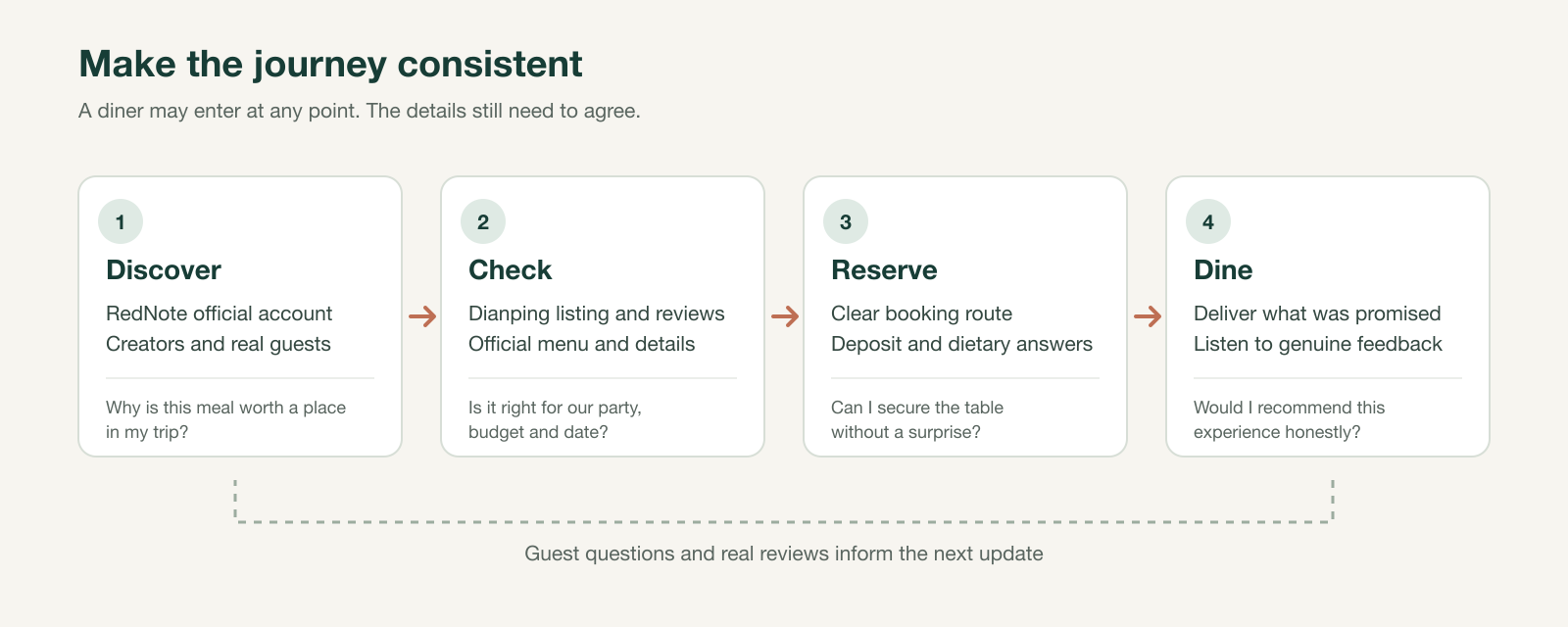
The path is rarely linear. Keep each answer consistent wherever a Chinese diner starts.
Do this before choosing a platform budget: ask a Chinese-speaking colleague to search the restaurant's Chinese and local-language names on a phone. Give them a real date, party size and dietary question. See whether they can find the correct menu, understand the price, reach the official reservation route and tell where the restaurant is. Note every moment when they need to guess.
Let RedNote create interest without spoiling the evening
RedNote (Xiaohongshu) is useful for the questions people ask while building a trip: Which restaurant is worth planning around? What does a particular menu feel like? Is the room formal? Will a solo diner be comfortable? How far is it from the hotel? Content that answers these questions can be more valuable than another close-up of a finished plate.
For a restaurant serious about Chinese guests, we recommend an official RedNote account. It gives the team a recognisable place to explain its own cuisine and practical details. Think in small, useful series: a chef explaining one seasonal ingredient; what a three-hour dinner is actually like; how to reach the entrance; lunch versus dinner; what to tell the team about allergies; and what changes when the menu changes. Write in natural Chinese, use the name people search for, and keep the local-language name visible so guests can find the door.
An official account is an operating commitment, not a badge to obtain and forget. Overseas verification depends on the applicant's location, business category and documents. RedNote's current professional-account rules allow eligible overseas entities in open regions and industries, but approval is not automatic. The restaurant should control the account, administrators and recovery process; Lotus can assess the route and coordinate the application.
There is room for restraint. Research on mystery in Michelin-starred restaurants' social media describes the tension between visibility and preserving a sense of discovery. Our practical reading is simple: keep the creative surprise, remove the logistical mystery. A guest need not see every course before arriving. They do need to know the menu format, approximate commitment, booking terms and any material restrictions.
Creators should show a real meal, not perform a verdict
RedNote KOL and KOC collaborations can help when the creator's audience matches a real dining occasion. A traveller who makes thoughtful city guides may be more useful than a larger account that only posts luxury montages. Brief creators on the story and facts: the cuisine, menu format, filming rules, accurate price and booking route. Agree in advance on the meal, fee, disclosure, photography permission, usage rights and what happens if a seasonal dish changes.
Do not script the reaction. A creator who actually dined can explain whether the experience felt intimate, adventurous, relaxed or ceremonial. That is more useful than a line of identical praise. Keep other guests out of frame without consent and agree whether filming is welcome during service. The restaurant's atmosphere is part of the product; a campaign should not ruin it for everyone else in the room.
UGC is different again. A genuine guest may share a photograph or memory because the evening mattered to them. Make that easy within the restaurant's photography policy, but do not offer a reward for a favourable opinion or write a “guest” post for them. If you want to reuse a guest's image on your own channel, ask permission.
Make Dianping a reliable decision page
Dianping is often closer to the choice of where to dine. A traveller can compare locations, photographs, recent reviews and practical details there. Lotus's Dianping service approach starts with the listing and guest journey, then considers offers or paid visibility only if they suit the business. For a fine-dining restaurant, a routine discount may be the wrong answer. An accurate page and responsive reservations team usually matter more.
Search the restaurant as a guest would. Check for duplicate place pages and an inconsistent Chinese name. Then inspect the pin and entrance, opening days, cuisine category, current photographs, menu description, indicative price, service charge, dress expectations if any, accessibility information and the route to reserve. A Mandarin description should explain the experience, not promise that Mandarin service exists if it does not. If the restaurant is outside mainland China, do not assume that a visible place page gives you merchant control or access to every booking and promotion feature. Ask the platform about the current verification and operating route for your location and legal entity.
Once the basics are right, run a weekly routine. Update the page when the menu, hours or reservation policy changes. Read genuine reviews and questions in Chinese. Reply to a complaint with the specific issue and what the team has checked, without exposing booking details in public. If several guests mention that the entrance is hard to find, fix the directions. If they expected a dish no longer on the menu, correct the content that created that expectation.
This is not a review-manufacturing exercise. Dianping's merchant review-integrity rules explicitly oppose fake or incentivised praise and manipulation of ratings. Lotus can support listening, thoughtful Chinese responses and improvements to the page; we would not plant reviews or use invented diners. The platform also has rules for overseas merchant products, which is another reason to check terms before adding a deal or booking product rather than assuming a mainland setup applies abroad.
Make the reservation as considered as the meal
A saved post is not a reservation. The person still has to choose a date, understand the menu and trust that the booking will be honoured. Work through that path on a phone from the guest's point of view. Can someone using a Chinese-language phone reach your official booking channel? Is the time zone clear? Are menu price, taxes, service charge, deposit, cancellation deadline and refund route understandable? Can they tell you about an allergy and receive a human answer? Does the confirmation include the exact address and arrival instructions?
The aim is clarity, not a promise of Mandarin service if the team cannot provide it. A short, well-checked Chinese confirmation and an escalation route for questions may be enough to start. Give reservations and front-of-house the same fact sheet used by the marketing team. If a creator says a vegetarian menu is available, reservations must know on which dates and under what notice period. If a celebratory table or private room is shown, the content must not imply that every reservation includes it.
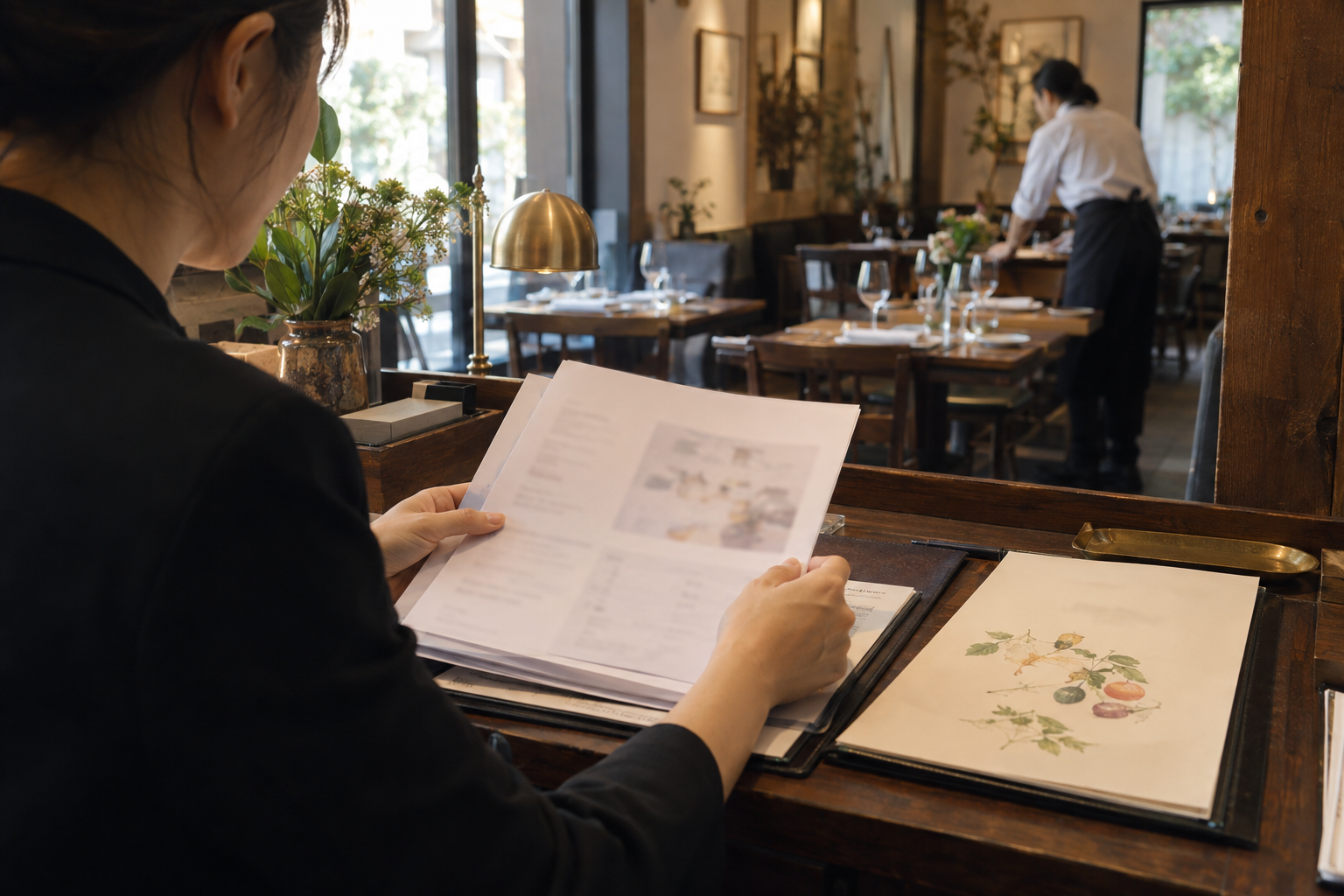
The service team also needs a comfortable answer to photography and filming. Guests may want a memory of the meal; other diners may value discretion. Say what is allowed, explain it kindly, and apply the rule consistently. Good Chinese marketing attracts people to the actual restaurant, not a different experience that exists only online.
Add WeChat when there is a relationship to maintain
RedNote and Dianping are the first priorities for many restaurants. WeChat can become useful once Chinese enquiries, return visits, private dining or event interest justify an owned information channel. A WeChat Official Account could carry a current menu guide, special opening dates, an address card and a clear service contact. For higher-volume enquiries or private-event follow-up, WeCom may help a team keep ownership and response records. Neither is worth launching if no one will maintain it or if the reservation flow is still broken. Lotus can connect WeChat account structure and content with ongoing Chinese social media management when the restaurant has reached that stage.
A sensible first 90 days
First 30 days: fix the facts. Audit the Chinese search results, RedNote conversation and Dianping page. Agree one Chinese name, confirm the current Michelin distinction, collect up-to-date menu and photography, test the booking flow and write a guest-facts sheet with the restaurant team. Clarify who owns each account and listing.
Days 31–60: publish useful evidence. Establish or refresh the official RedNote account where eligible. Publish a small set of notes that answer real questions, not a daily stream for its own sake. Correct the Dianping page through the available route. Invite a limited number of well-matched creators for actual meals, with disclosures and filming boundaries agreed. Put comment and review response rules in place.
Days 61–90: learn from the room. Compare what people saved and asked online with what reservations and staff heard in person. Fix confusing menu or arrival information, review creator content quality and decide whether regular content, further creator visits, an owned WeChat route or paid media has a clear job. Paid exposure should come after the reservation and service checks, not before.
Measure more than reach. Useful signals include Chinese-name search visibility, qualified RedNote saves and questions, Dianping page completeness and review themes, visits to the reservation page, identifiable Chinese enquiries, confirmed covers where source can be recorded, cancellations caused by misunderstanding, and guest feedback after the meal. A diner may save a post, ask a friend and reserve a week later; no single attribution number captures that. Ask how guests found you, but do not pretend every answer is precise.
Questions restaurant teams ask
Does a Michelin distinction mean Chinese diners will find us?
No. It is a strong credential, but diners still need to discover the restaurant under a usable Chinese name, understand whether the meal suits them and reach a working reservation route. Use the exact current Guide status; “selected” and “starred” are not interchangeable.
Can an overseas restaurant open an official RedNote account?
Possibly. The current route depends on the legal entity's region, restaurant category, documents and desired features. Check eligibility before planning a launch date. The account should remain under the restaurant's control, even when an agency operates it.
Can a restaurant outside China manage a Dianping listing?
First find out what already exists. Place-page correction, merchant verification, review response, booking and promotional products may follow different routes. Eligibility and access vary by destination and entity. Do not promise a particular feature until the platform confirms it for the restaurant.
Should we invite creators if we want a discreet atmosphere?
Yes, selectively, if their work fits the room. Set filming boundaries, protect other diners, agree commercial disclosure and choose people who can describe the meal honestly. If the restaurant cannot accommodate filming without disturbing service, start with official content and guest experience instead.
Can Lotus guarantee reservations or a higher rating?
No responsible agency can. Lotus can improve the Chinese-facing information, content, creator coordination, listing operations and response system, then show what changed. Reservations and reviews also depend on the menu, price, availability, service and the meal itself.
Start with one dinner, not six platforms
Choose the kind of Chinese guest you can serve well, and trace one realistic dinner from first search to goodbye. Where does the journey lose confidence? Perhaps the RedNote results are thin, the Dianping page is wrong, the menu price is unclear or the reservation confirmation leaves a guest unsure. Solve that point first.
Lotus can bring Chinese audience and platform research, RedNote account and content work, KOL/KOC and UGC coordination, and Dianping listing and review operations into one practical plan with your restaurant team. Tell us about your restaurant, current Chinese presence and reservation challenge. We will suggest a focused starting scope and the information we need to assess it.
