

Most international B2B companies already possess the raw material for credible thought leadership in China. It sits in the heads of engineers, product leaders, consultants, customer-success teams and regional executives. The problem is not a lack of expertise. It is that expertise often reaches the content team as a slide deck, a translated interview transcript or a list of product claims—none of which automatically becomes useful Chinese content.
The real task is editorial. A brand must identify the decision its Chinese audience is trying to make, extract a defensible point of view from the right specialist, organise the evidence and then express the idea in language and formats that feel natural in mainland China. Translation is part of that process, but it cannot carry the whole job.
This guide sets out a practical system for turning internal technical knowledge into credible Chinese thought-leadership content while protecting accuracy, expert voice and local relevance.
Technical expertise is raw material, not finished thought leadership
An expert knows a subject deeply, but depth alone does not create a useful article. Specialists often think in product architecture, operating constraints, exceptions and accumulated experience. Readers approach the same subject through a question: What should we choose? Why is this problem happening? Which risk matters? What should we do differently?
Thought leadership begins when the brand turns specialist knowledge into a clear judgement that helps a reader understand or decide something. That judgement should reveal how the expert thinks, not merely what the company sells.
This distinction matters in B2B markets because several people can influence a decision. Global B2B research from Edelman and LinkedIn describes both visible and less visible stakeholders who consume thought leadership as they form a view of suppliers and issues. That research is not specific to China, but it reinforces a useful operating principle: the content should help the wider buying group make sense of the problem before it asks them to consider the brand.
For an international company, the strongest starting material is rarely a product brochure. It is more often a decision rule, a counter-intuitive observation, a recurring failure pattern, an implementation trade-off or a clearer explanation of why common practice produces a weak result.

Start with a Chinese buyer question, not a global asset
The wrong starting question is, “Which global white paper should we translate this month?” The better question is, “What does a relevant decision-maker in China need to understand now, and what can our experts genuinely add?”
That shift prevents a common failure: a technically accurate piece that has no clear job. A global asset may assume category familiarity, procurement practices, terminology or commercial priorities that do not map neatly onto the Chinese context. Even where the underlying technology is identical, the reader’s reference points can differ.
Define the audience and decision before choosing the source expert. A useful content brief should name:
the decision-maker or influencer being addressed;
the practical question the content will answer;
what the reader probably understands already;
which misconception or uncertainty needs resolving;
the evidence the brand can responsibly provide; and
the action or next question the reader should be ready for afterwards.
The question should be narrow enough to answer well. “The future of industrial automation” is a theme. “How should a regional operations leader compare centralised and local maintenance models?” is a decision. The second gives an expert something concrete to analyse and an editor something coherent to build.
Choose the expert for judgement, not seniority
The most senior spokesperson is not always the best source. Choose the person who has direct experience with the question and can explain the reasoning behind a recommendation.
A strong subject-matter expert can usually do three things. First, they can distinguish a common assumption from what happens in practice. Second, they can explain the conditions under which their advice changes. Third, they can point to evidence without overstating what that evidence proves.
Sometimes one person is enough. Complex topics may need a small expert group: a product specialist for technical truth, an implementation lead for operating reality and a regional leader for market context. The editorial team should still appoint one lead voice. A committee-generated article tends to average out every useful opinion.
Before the interview, tell the expert what the article is trying to help the reader decide. Share the intended audience, the question, the boundaries and the type of proof needed. Do not send only a blank request to “talk about trends”. Preparation respects the expert’s time and produces better material.
Build the claim-and-proof record before writing
Credible technical content needs an internal evidence layer. This does not mean loading the public article with citations or turning it into an academic paper. It means the team can see which statements are facts, which are expert interpretations and which are brand recommendations.
For every substantial claim, record:
the exact proposition the draft may make;
the expert or source responsible for it;
the supporting data, documentation or example;
the date and market scope of the evidence;
any condition or exception that changes the conclusion; and
the approved wording or qualification.
This record gives the editor somewhere to go when the Chinese draft becomes more confident than the source material. It also makes later updates safer. If a statistic, product capability or platform detail changes, the team can locate the affected wording without reopening the entire argument.
China search guidance provides a useful reminder here. Baidu’s published quality principles emphasise credible producers, coherent topics, clear logic and professionally useful depth, while its algorithm guidance warns against thin, scraped or advertorial-style B2B content. These are not ranking instructions or a guarantee of visibility. They do, however, align with good editorial practice: original expertise must be organised into a focused, substantive answer rather than dressed up as promotional copy.
Localise the argument, not only the language
Word-for-word accuracy can still produce unconvincing Chinese content. Localisation must preserve technical truth while changing the route through which the reader reaches it.
Start with terminology. Decide the approved Chinese term for the category, product type and key concepts. Check how customers, partners, technical teams and competitors use those terms, but do not copy market language uncritically. A term that is common may still be imprecise for the brand’s offer. Record preferred terms, acceptable alternatives and terms that should not be used.
Then examine the argument. A global expert may begin with company history or a high-level market shift. A Chinese editor may decide that the reader needs the operational problem first, followed by the decision criteria and only then the broader viewpoint. The evidence has not changed; the sequence has.
Examples also need local judgement. Replace an unfamiliar analogy if it obscures the point, but never invent a China case that the brand cannot substantiate. When there is no appropriate local example, use a neutral operating scenario and label it clearly. Good Chinese content localisation and production makes the expert’s thinking easier to use without pretending that global experience automatically proves a local outcome.
Interview for decisions, tensions and boundaries
A transcript is rarely the deliverable. The value lies in the moments when the expert explains why one choice is better than another.
Use questions that reveal judgement:
What do customers commonly misunderstand about this issue?
Which two options are most often confused?
What evidence would make you change your recommendation?
Under which conditions does the usual advice stop working?
What failure do you see repeatedly, and what causes it?
Which detail sounds minor but changes implementation?
What can we say confidently, and what should remain qualified?
If a reader remembers one decision rule, what should it be?
Follow vague answers with “What would that look like in practice?” and “How would the reader recognise it?” Ask for the reasoning behind a conclusion, not only a polished quote.
The interviewer also needs permission to challenge jargon. When an expert says something is “more flexible” or “enterprise-ready”, ask flexible in what way, for whom and compared with what. The goal is not to simplify the technology until it becomes inaccurate. It is to replace unsupported adjectives with useful distinctions.
Create one governed core idea before adapting formats
A thought-leadership system works best when each content set has one governed core asset. This might be a substantial Chinese article, an approved narrative outline or a detailed expert Q&A. It contains the main proposition, evidence, qualifications, terminology and CTA direction.
The core asset is not necessarily the first item published. Its purpose is to give every later adaptation a stable source of truth.
From that core, the team can create platform-appropriate expressions: a focused article, a concise executive post, a visual framework, a short expert video, a sales-enablement summary or a sequence of question-led posts. Each format should keep the same technical conclusion while changing structure, pace and level of detail.
Tencent describes Weixin as an ecosystem in which people can encounter content through connected surfaces such as Official Accounts and Weixin Search. Other Chinese platforms create different discovery and interaction contexts. The practical implication is not that every idea belongs everywhere. It is that a strong idea may need more than one expression, and those expressions should remain traceable to the same approved evidence.
This approach also prevents the content team from asking experts for a new interview every time a channel manager needs a post. One good conversation can support several useful assets when the underlying material is governed properly.
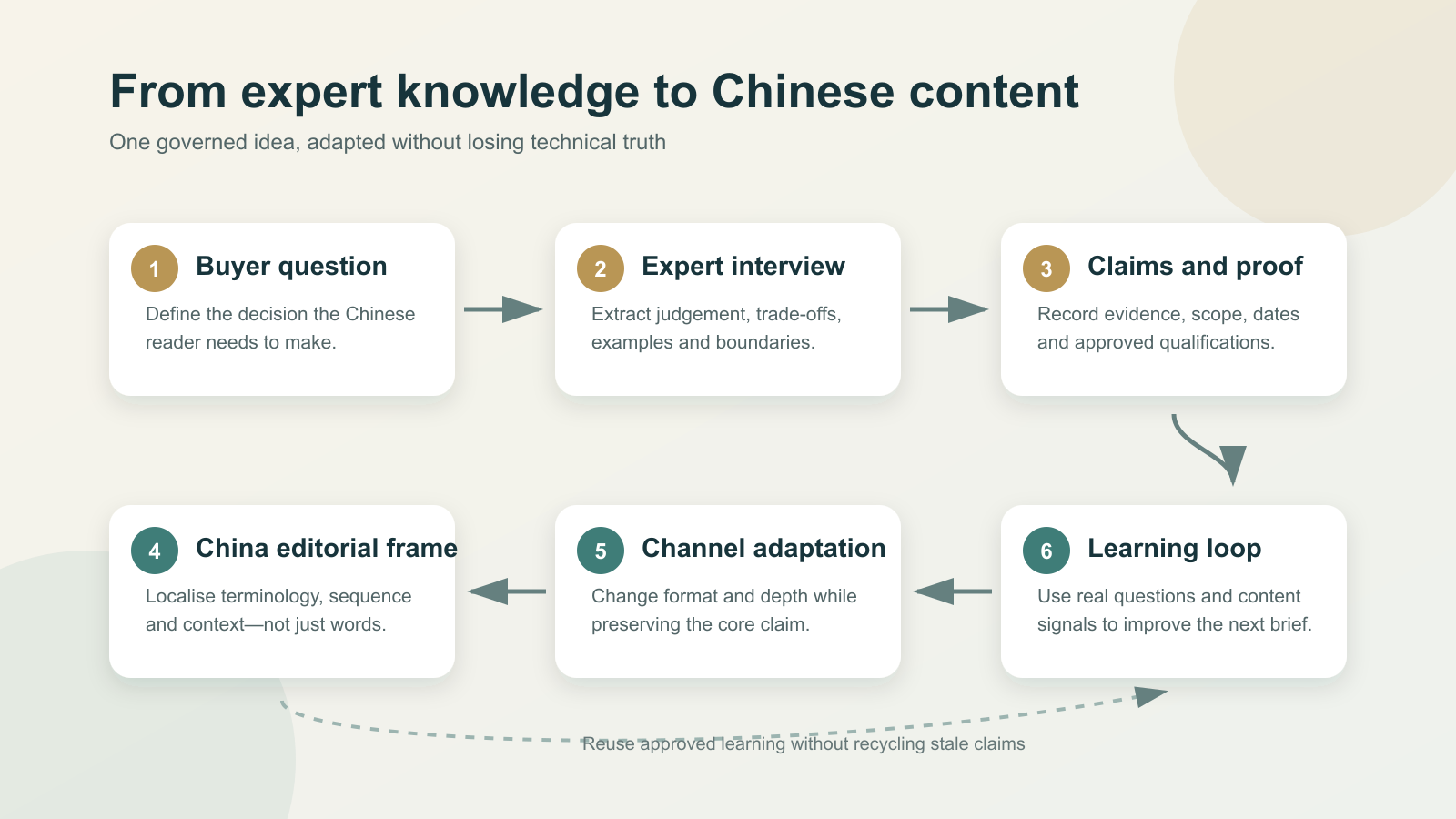
Adapt to the channel without fragmenting the expert view
Platform adaptation should answer three questions: What is the reader doing here? How much context can the format carry? What should the reader understand next?
A long-form owned article can establish the complete argument and remain a stable reference. A social post may isolate one decision rule and invite a more focused conversation. A visual can clarify a process or comparison. A short video can let the expert explain a tension in a human voice. The format changes; the claim does not.
Avoid distributing identical copy everywhere. That may save production time, but it often produces weak content because each channel has different reading behaviour and context. Equally, do not let local adaptation create five conflicting versions of the expert’s position.
Create an adaptation note for every asset. It should list the core claim, evidence that must remain, details that may be shortened, the intended audience action and any wording that requires another expert check. This small control document is especially useful when agencies, regional marketers and global product teams share the work.
Within a broader China B2B technology marketing system, the article, social post, expert video and sales conversation should feel like parts of one point of view. They do not need to repeat each other, but they should not make the reader reconstruct the brand’s thinking from unrelated fragments.
Give each role a clear approval responsibility
Slow approval is often blamed on the number of reviewers. The deeper problem is that reviewers do not know what they own.
The subject-matter expert owns technical truth and the boundary of the claim. The China editor owns clarity, local relevance, structure and natural language. The brand owner protects positioning and voice. A factual reviewer checks evidence, names, figures and current product details. One final approver makes the release decision.
These roles can be held by fewer people, but the responsibilities should remain distinct. Asking every reviewer to rewrite every sentence creates contradictory feedback and drains the expert voice from the piece.
Use staged approval. Agree the question and outline first. Approve the claim-and-proof map next. Then review the Chinese draft for whether it expresses the agreed argument accurately. If the team waits until the fully designed asset to debate the basic proposition, every correction becomes expensive.
Bilingual review also needs a rule for disagreements. When the Chinese copy and the global source appear to diverge, return to the approved claim and reader decision. The winning wording is the version that remains technically accurate and communicates the intended distinction naturally—not automatically the version that follows the source sentence most closely.
Protect the expert’s voice during editing
Credibility is lost when every expert sounds like the same corporate content template. Preserve specific language, clear opinions and real trade-offs. Remove repetition and unnecessary jargon, but do not smooth away the reasoning that makes the piece worth reading.
Three editorial checks help:
Specificity: Could a competent competitor publish the same paragraph unchanged? If yes, the idea probably needs a sharper point of view or more concrete evidence.
Boundaries: Does the copy explain when the advice applies and when it might not? Responsible limits often make technical judgement more credible.
Usefulness: Can the reader use the content to ask a better question, compare options or prepare an internal discussion? If the only takeaway is that the brand is experienced, the draft remains promotional.
Do not manufacture controversy. A confident viewpoint can be careful. The objective is to make useful expertise visible, not to turn every specialist into a provocative personality.
Build a reusable expertise bank
Expert content becomes more efficient when the organisation keeps the valuable intermediate material. Store approved terminology, recurring buyer questions, claim records, interview transcripts, diagrams, examples, objections and update dates in a searchable knowledge bank.
The bank should show provenance. A content producer needs to know who said something, when it was approved, which market it applies to and whether it remains current. Otherwise, reuse becomes a risk rather than an advantage.
Organise the bank around buyer questions and themes, not only campaign names. Campaign folders disappear from view after launch. Questions such as “How should a regional team compare deployment models?” remain useful across articles, events, sales discussions and product updates.
This system also reveals gaps. If the same buyer question appears repeatedly but the bank contains only product claims, the team knows it needs a fresh expert conversation. If several experts give different answers, that disagreement may signal a valuable internal decision before it becomes public content.
Measure whether the content improves understanding
Thought leadership should be measured against its job. Reach and page views can describe distribution, but they do not show whether the content clarified a buyer decision.
Look for a combination of signals:
whether relevant readers reach and spend time with the core material;
which expert questions attract saves, shares or substantive comments;
whether sales and account teams reuse the content in real conversations;
whether enquiries become more informed or reference a specific idea;
which themes generate follow-up questions from partners, prospects or customers; and
whether the content exposes a need for a clearer proof point or local explanation.
Qualitative evidence matters. A modest audience of relevant technical and commercial stakeholders may be more useful than broad but shallow attention. At the same time, do not treat one enthusiastic comment or one sales anecdote as proof of market impact.
Use the evidence to improve the next brief. Measurement should refine topic choice, explanation and format—not simply produce a monthly performance slide.
Watch for the failure patterns that weaken credibility
Several problems recur when international teams build Chinese thought leadership:
Translation leads the process. The team selects a finished global asset before defining the Chinese reader question.
The expert becomes a quote supplier. Marketing asks for approval on lines the expert did not meaningfully shape.
Evidence is separated from copy. Claims are reviewed in isolation, making later updates difficult.
Localisation adds certainty. Nuanced technical language becomes an absolute promise in Chinese.
Every channel receives the same asset. Distribution happens, but the idea is not adapted to how people encounter it.
Review by committee removes the point of view. The final draft is safe, polished and indistinguishable.
The article ends as a brochure. Useful analysis is replaced by a product pitch just when the reader expects a conclusion.
These are workflow failures, not writing quirks. Fixing them requires clearer ownership and better source material, not a more energetic headline.
A practical operating checklist
Before moving an expert idea into production, confirm that the team can answer these questions:
Is there one defined Chinese reader and one decision the content supports?
Does the selected expert have direct knowledge of that decision?
Is the central viewpoint more useful than a product description?
Are the factual claims, evidence and limits recorded internally?
Has the Chinese terminology been agreed?
Does the structure reflect the local reader’s context rather than the source document’s order?
Is there one governed core asset for later adaptations?
Does each channel version preserve the same technical conclusion?
Does every reviewer know which part of the work they own?
Can the team update or withdraw a claim if the underlying evidence changes?
Will measurement help improve the next expert brief?
If several answers are no, the organisation is not ready to scale production. That is useful information. A smaller number of well-governed expert pieces will usually build more confidence than a high-volume calendar of generic translated commentary.
Turning technical knowledge into Chinese thought leadership is not a matter of making experts sound more promotional. It is a process for making their judgement easier to understand, verify and use. When the buyer question, evidence, localization and channel adaptations are governed together, an international B2B brand can build a recognizable point of view without sacrificing technical accuracy.
If your organisation has valuable technical expertise but no reliable way to turn it into useful Chinese content, talk with Lotus. We can help you identify the strongest buyer questions, organise the evidence and shape a thought-leadership system your global experts and China team can operate with confidence.
