

Views are useful, but they are not the decision
A China creator campaign can produce an impressive view count and still leave an international marketing team unsure about what actually changed. A smaller piece of content may do more useful work: explain an unfamiliar product, prompt branded searches, surface an objection, or move the right audience towards an official brand channel.
That does not make views meaningless. Views show that content was delivered. The problem begins when delivery is treated as the final verdict rather than the first layer of evidence.
For international brands, the more useful question is not “Which creator got the most views?” It is “Did the campaign reach the intended people, help them understand or care about the idea, prompt a valuable next action, and teach us something we can use?”
This guide sets out a practical way to answer that question across China’s creator ecosystem. It focuses on content usefulness, audience quality, valuable actions and business learning. It does not cover creator selection, contracts, usage rights or a universal formula for return on investment. Those decisions need their own evidence and commercial context.

Give every creator campaign one measurement job
Measurement becomes confused when a campaign is expected to do everything at once. A creator post cannot be fairly judged as awareness media, product education, community research and direct response unless those roles were designed into the campaign.
Before selecting metrics, give the campaign one primary job. That job might be to:
introduce a new idea to a relevant audience;
explain a product that needs demonstration or context;
create searchable consideration around a use case;
move people towards an official brand page, enquiry route or store;
test which message, format or audience framing deserves further investment.
The primary job should reflect the brand decision that follows. If the decision is whether to keep investing in long-form creator education, completion, saves, search behaviour and the substance of comments will matter more than a single reach number. If the decision is whether a creator can prompt a visit to an official brand destination, the action route and its tracking need to be designed before publication.
Different platforms and formats also perform different kinds of work. A Bilibili explainer may build understanding over several minutes. A Douyin reveal may earn fast attention and repeated exposure. A Xiaohongshu note may continue to surface through search and save behaviour. A WeChat collaboration may support trust within a more established audience relationship. The measurement plan should respect that role instead of forcing every asset into one universal league table.
This is where a clear China influencer and KOL marketing approach matters: creator activity should be designed around a brand objective and a plausible audience journey, not a list of famous names followed by a reporting exercise.
Use a five-layer evidence ladder
A reliable creator report should move from observable delivery towards decisions. The five layers below provide a useful structure.
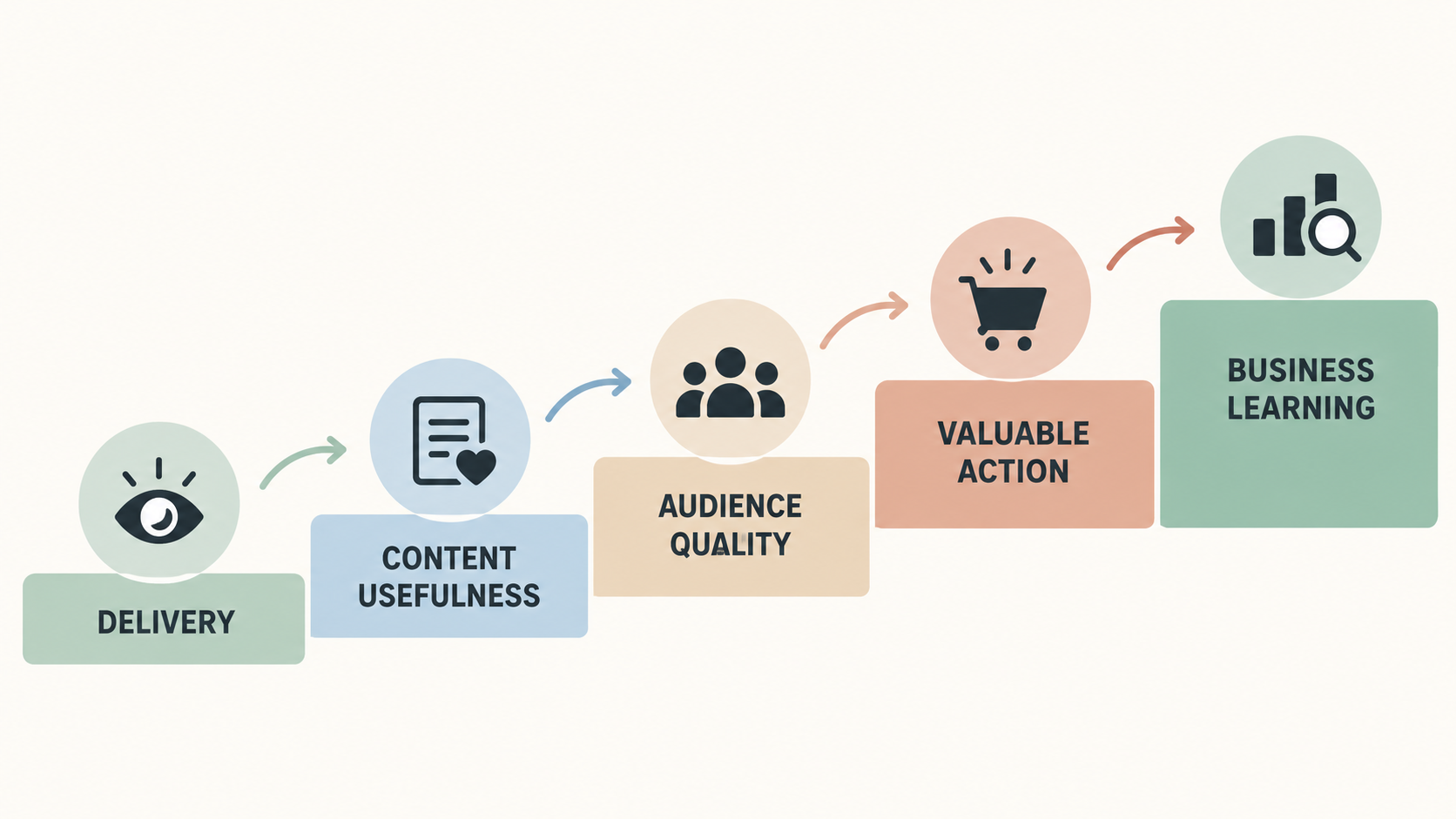
Delivery
Delivery asks whether the content appeared and gained enough exposure to be assessed. Depending on the platform, evidence may include impressions, views, unique reach, frequency, watch starts or the proportion of a video viewed.
This layer matters because an under-delivered post cannot provide the same learning as a post that reached a meaningful audience. It also helps identify inefficient repetition. High frequency among a narrow audience can inflate total impressions without expanding useful reach.
The reporting team should preserve the platform’s exact metric names and definitions. “Views” can mean different things across formats and platforms, and definitions may change. A clean report should not silently combine numbers that were collected under different rules.
Content usefulness
The next layer asks whether people found the content useful enough to continue, save, discuss or revisit. Relevant signals can include completion, average watch time, meaningful comment themes, saves, shares, profile exploration and subsequent search behaviour where those signals are available.
None of these signals is automatically positive. A long watch time may reflect genuine attention, but it may also be driven by confusion or controversy. A high comment count may include repeated questions that reveal a weak explanation. Saves can be valuable for decision-heavy content, yet they do not prove a later purchase.
Read the signals together. For example, a product demonstration with moderate reach, strong completion, repeated saves and specific questions about use may have delivered more strategic value than a high-reach post with shallow reactions.
Audience quality
Audience quality asks whether the campaign reached people who resemble the brand’s intended market. Useful evidence may include platform-provided audience profiles, geography, interest groups, new versus existing audience, search terms, follower overlap or comments that reveal role and need.
The aim is not to claim perfect identity-level knowledge. Platform reports are aggregated, modelled and constrained by privacy and product design. Instead, use them to test whether the campaign appears directionally aligned with the target.
For an international B2B technology brand, a smaller audience containing procurement, operations or technical decision-makers may be more useful than broad entertainment reach. For a lifestyle brand, the quality question may concern use occasion, city tier or interest fit. Define “quality” in terms of the campaign’s audience hypothesis, not a generic premium demographic.
Valuable action
Valuable action is the behaviour the brand wants after exposure. It could include a branded search, an official-account follow, a store visit, a product-page view, an enquiry, a sample request, a registration or a qualified conversation.
Tracking should distinguish actions the platform reports from actions the brand can verify in its own systems. Use consistent campaign parameters, dedicated landing routes, platform-specific codes or controlled enquiry fields where appropriate. Do not treat a platform-reported click and a confirmed business outcome as the same event.
Attribution also needs restraint. A person may see creator content, search later, visit through another channel and convert after further contact. The creator may have initiated or assisted that journey without receiving last-click credit. Equally, a conversion reported after exposure is not necessarily caused by that exposure. State the attribution method, window and limits.
Business learning
The final layer asks what the campaign changes about the next decision. This is the layer most reports miss.
Useful learning may include:
one product problem creates stronger attention than a broader brand story;
expert explanation drives fewer reactions but more qualified questions;
a visual demonstration works better than a presenter-led monologue;
one audience segment responds to proof, while another responds to convenience;
repeated comments reveal a message, service or landing-page gap;
a creator format deserves another test, while another should be paused.
Business learning turns reporting into optimisation. Without it, the team receives a retrospective collection of numbers and must still decide what to do.
Build the measurement design before the posts go live
Creator measurement cannot be repaired completely after publication. A strong design should be agreed while the brief, content role and action route can still be changed.
1. Name the campaign decision
Write down the decision the evidence should support. “Measure performance” is not a decision. “Decide whether expert-led explainers should become a recurring format” is.
2. Define the job of each creator and format
One creator may deliver broad discovery while another offers authority or detailed education. Record those roles before comparing results. A creator assigned to explanation should not be penalised for failing to generate the same reach as an entertainment-led account.
3. Freeze the metric definitions
Create a simple data dictionary. Record the platform, metric name, definition, reporting window, unit and source. If a metric cannot be compared directly across platforms, say so. Consistency is more useful than a polished dashboard that hides mismatched definitions.
4. Design the next action
If the campaign expects a next action, make that action easy and measurable. Confirm that the landing page works in mainland China, the mobile journey is clear, the relevant official account or store is active, and the brand team can distinguish creator-driven traffic or enquiries where possible.
5. Choose the comparison rule
Decide whether the team will compare creators within the same role, compare formats, examine change over time, or assess performance against an agreed range. Avoid choosing the benchmark after seeing the result.
6. Set review windows that match the content
Fast-feed content may reveal most of its distribution pattern quickly, while searchable or long-form content can continue attracting attention. Keep an initial read and a later learning read when the format requires it. Record export dates because some platform reports update with a delay or stop updating after a defined period.
7. Assign a decision owner
Someone must turn the evidence into a choice. The owner should know which result triggers continuation, revision or pause. This keeps reporting connected to the brand’s wider China social media management rather than leaving creator activity as a separate stream.
Compare creators by role, not by one league table
A single ranking looks efficient, but it can reward the wrong thing. Creators operate with different audience sizes, content styles, platform mechanics and campaign roles. Their results should first be compared within comparable groups.
Start by grouping work such as broad discovery, trusted explanation, product demonstration, community conversation or conversion support. Then assess three dimensions within each group.
Efficiency asks what the brand received relative to the agreed investment. Use the denominator carefully. A fee-only calculation may exclude production, paid amplification, product samples, agency work, rights or internal resources.
Quality asks whether the content and audience signals fit the intended role. For an educational creator, strong completion and specific questions may outweigh raw interaction volume. For discovery content, useful unique reach and frequency may matter more.
Learning asks whether the result is strong enough and clean enough to guide the next test. A weak post can still generate valuable learning if the hypothesis and execution are clear. A high-performing post may teach little if several variables changed at once.
Avoid compressing all these dimensions into a synthetic score unless the weighting reflects a real business decision. A score that gives arbitrary points to views, likes, comments and clicks can create false precision. Keep the evidence visible so leaders can see why a creator is considered strong.
Outliers also need investigation. Sudden spikes, unusual audience composition, repetitive interactions or performance that is disconnected from the rest of the campaign should be reviewed before it is celebrated. Official creator platforms provide integrity and audience information that can help, but no single flag replaces judgement.
Read platform reports as evidence, not as the whole truth
China’s major creator platforms offer increasingly detailed campaign reports. Depending on the product and format, these can include dissemination, content performance, audience profiles, search activity, interaction, conversion and project-level reporting. They are valuable because they provide signals close to the content environment.
They are not the whole truth. A brand should use three evidence layers.
Platform evidence shows what happened inside the creator and media environment. Preserve raw exports where available, along with the report date, campaign identifiers and metric definitions.
Owned evidence shows what happened on destinations the brand controls, such as official-account growth, landing-page behaviour, store visits, registrations or enquiries. Ensure the analytics and campaign naming are consistent before the campaign launches.
Business evidence shows whether the actions were valuable. This might include qualified enquiries, sales conversations, distributor interest, trial requests or feedback from customer-facing teams. Business evidence may arrive later and may not map neatly to an individual post.
The three layers should be reconciled, not forced to match. Differences can reveal a broken action route, a poor audience fit, delayed consideration or a gap in tracking.
Platform data also has boundaries. Reports may update on a delay, retain only certain periods, apply minimum sample sizes, or use definitions that differ from the brand’s analytics. Record these limits in the internal report. Do not fill gaps with estimates that appear more certain than the evidence allows.
Avoid five common reporting traps
Treating engagement rate as a universal quality score
Engagement rate depends on the numerator, denominator, platform and content role. A save, a short reaction and a detailed product question are not equally valuable. Always show the definition and read the underlying behaviours.
Calling every comment positive
Comment sentiment without context is unreliable. Separate genuine questions, personal experience, purchase intent, creator-fan reactions, disagreement, spam and repeated phrases. The themes often matter more than the positive-versus-negative label.
Claiming attributed revenue without stating the model
Revenue figures require a clear method. State whether the result uses a direct code, tracked link, platform attribution window, analytics model or manual match. If creator content may have assisted a later action, describe that contribution carefully instead of presenting it as proven causation.
Ignoring the full investment
Creator fees are only one cost. Production, product, logistics, paid amplification, permissions, localisation, measurement and internal time may materially change the efficiency picture. Use the same cost boundary across comparisons.
Ending with numbers instead of a decision
Every report should close with a small set of actions: continue, refine, pause or test. Name the evidence, the confidence level and the next question. If the evidence is inconclusive, that is still a useful conclusion when it prevents a premature scale decision.
What an international CMO should ask to see
An executive creator report does not need every available platform field. It needs a clear line from objective to evidence to decision.
The main view should show:
the campaign’s primary job and intended audience;
the role assigned to each creator or content group;
delivery, usefulness, audience-quality and action evidence;
comparison rules and material data limitations;
total investment using an agreed cost boundary;
the decision supported by the evidence;
the next test, owner and unresolved question.
A detailed appendix can preserve metric definitions, raw exports, content-level data, comment themes, tracking rules and calculation notes. This lets local teams investigate without forcing senior stakeholders to interpret every row.
International teams may also need a bilingual layer of interpretation. Translate not just the words but the platform context: what the behaviour means, why a format works as it does, and which result is actually comparable. When audience responses expose a deeper question, structured China market research and consumer insight can help separate a content issue from a market assumption.
Measure creator work to improve the next investment
The strongest creator measurement system is not the one with the most metrics. It is the one that helps a brand make better choices with appropriate confidence.
Views remain part of that system. They show whether content was delivered and provide context for later signals. But they become meaningful only when connected to content usefulness, audience quality, valuable action and business learning.
For international brands, this approach also creates a common language between China teams and global stakeholders. It explains why a smaller creator can be strategically valuable, why platform numbers should not be compared blindly, and why attribution needs clear limits. Most importantly, it turns creator reporting from a scoreboard into a decision tool.
If your brand wants a clearer way to connect China creator performance with the decisions your international team needs to make, discuss your measurement challenge with Lotus.
