

Competitor benchmarking is useful when it changes a decision. It is far less useful when it becomes a deck of screenshots, follower counts and isolated viral posts. For an international brand considering mainland China, the real task is to understand how other organisations are earning attention, answering audience questions and moving people towards a next step across Chinese platforms.
That evidence is public, partial and time-sensitive. It can show what a competitor publishes, how it presents itself in search, which themes recur and what kinds of visible response appear. It cannot reveal private reach, media spend, attribution, commercial results or the reasons behind every creative choice. A responsible benchmark keeps those boundaries visible.
The method below turns public observations into a small set of research questions and tests. It helps a global team compare competitors without copying them, mistaking popularity for strategy or treating one platform as a complete view of the market.
Start with the decision the benchmark must change
Before collecting posts, state the decision in one sentence. A useful benchmark may help a team decide whether China deserves deeper investigation, which audience problem needs validation, which platforms belong in the first plan, what proof the brand lacks or what content capability must be built. If the decision is unclear, the research will expand until every visible signal feels relevant.
A practical China marketing roadmap begins with positioning and audience evidence before it turns to channels. Use the same sequence here. Write down the current assumption, the uncertainty and the action that could follow. For example: “We believe buyers compare technical reliability before price, but we do not know where that comparison happens or which proof they trust. The benchmark should tell us which search routes, account types and proof formats deserve primary research.”
Set a confidence threshold as well. Public desk research may be enough to reject a weak assumption or identify questions. It is rarely enough to approve a large investment on its own. Record what evidence would require interviews, owned analytics, platform tools, distributor input or a controlled market test.
Build a competitor set that reflects the real choice
A category list is not automatically a useful competitor set. The brands that compete for a buyer’s attention, trust or budget may differ from the brands that appear beside each other in an industry report. Build the set around the decision, then label why each organisation is included.
Direct competitors offer a similar solution to a similar audience in mainland China.
Substitute competitors solve the same audience problem through a different product, service or route.
Attention competitors publish material your audience may choose instead of engaging with your category.
Reference brands demonstrate a capability worth studying, such as product education, creator integration or a strong path from discovery to enquiry.
Four to eight organisations are usually enough for a focused first pass. More can be useful in a fragmented category, but only if the team can apply the same observation rules to every account. Document the inclusion rule, market status and any relationship that could distort the comparison. A global category leader, a domestic specialist and a marketplace-native brand may be valuable for different reasons; they should not be treated as interchangeable.
Do not quietly replace the approved set with whichever profiles are easiest to find. If an official account cannot be verified, keep the gap visible. Uncertainty about identity is a finding, especially when distributors, local entities, product lines or unofficial fan accounts create several possible results.
Fix the observation window before collecting evidence
Competitor content changes with launches, festivals, media support and news cycles. A benchmark needs a dated observation window so that a temporary burst is not mistaken for a normal operating rhythm. A four-to-eight-week window often gives enough material for an initial comparison, while slower B2B or seasonal accounts may need a longer period. The period is a research design choice, not an industry standard.
For every observation, record the platform, account name, profile URL or identifier, access date, login state, query used and post date. Keep a screenshot or source reference internally when rights and platform access allow it, but do not reproduce competitor creative in the public output. If a result changes during the project, preserve both dates rather than overwriting the earlier state.
Use the same cut-off for the whole set. Count original posts separately from reposts, campaign reminders and repeated edits. Note a major launch or celebrity collaboration that could dominate the window. The goal is not to remove context; it is to stop context from becoming an invisible explanation.
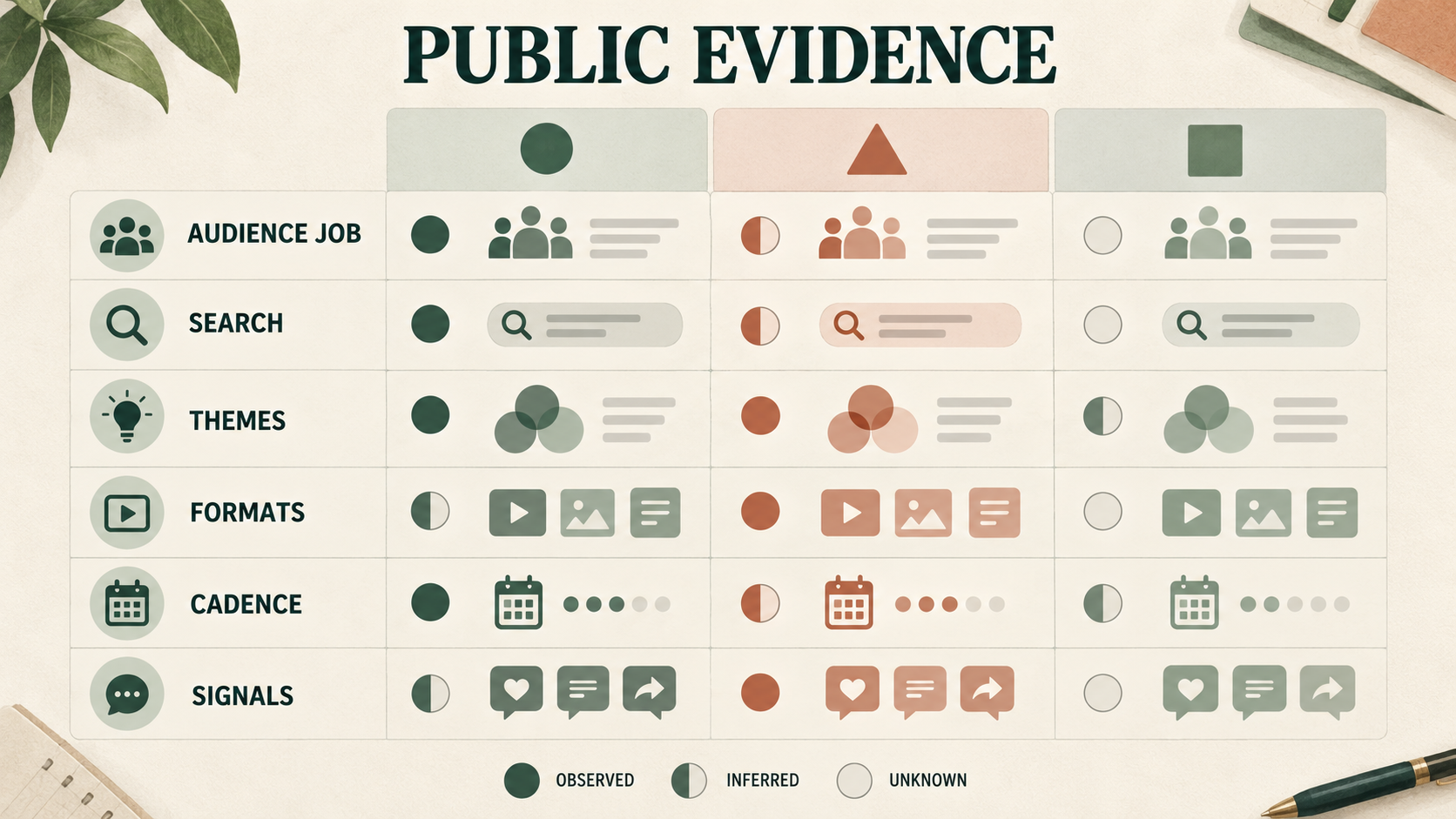
Use one coding sheet across every competitor
Consistency matters more than sophistication. Define the fields before the review begins and apply them to every account in the same order. The sheet should include account identity, platform role, priority audience, content job, theme, format, proof type, creator involvement, next action, visible response, evidence strength and analyst note. Keep raw observations separate from summary scores.
Use controlled labels for recurring fields, but leave room for a short verbatim note. A code such as “product education” makes comparison possible; the note preserves whether the post explains installation, materials, use cases or maintenance. If two reviewers code the same sample differently, reconcile the definitions before expanding the set.
Scores can help a team discuss patterns, provided the rubric is explicit. A simple three-state scale—observed, partly observed and not observed—may be more defensible than a ten-point performance score built from public data. Never convert missing access into a zero. Mark it unknown and state how the gap affects the conclusion.
Finally, preserve the underlying source list. A senior reader should be able to move from a recommendation back to the dated observations that produced it. That traceability makes the benchmark easier to refresh and harder to turn into unsupported certainty.
Map official accounts and search visibility separately
An official profile and a strong search presence are different assets. Start by verifying which accounts the organisation appears to own or authorise, then run a separate query map for the brand, category, problem, product and common comparison language. Record the exact wording and date because results may vary by platform, account state, location, personalisation and current events.
The different jobs Chinese social platforms can perform should shape this map. A brand may use WeChat for official depth and service, Xiaohongshu for searchable consideration, Douyin for discovery, Bilibili for detailed explanation or Weibo for public moments. Do not mark an account “missing” simply because the brand has chosen another route. Ask whether the visible mix supports the audience journey the competitor appears to prioritise.
Look beyond the first profile result. Search for common misspellings, Chinese and English names, product lines, questions, reviews and category terms. Note whether official material, creator content, user discussion, commerce pages or outdated information dominates. This is not a share-of-search calculation unless the data and method support one. It is a structured view of what a prospective customer can encounter.
Compare audience jobs before comparing content volume
Volume is easy to count and easy to misread. A competitor posting every day may be sustaining a campaign, servicing a large catalogue or repeating a weak formula. Another may publish less often but answer high-value questions with durable material. Compare what the content is trying to do before judging how much exists.
For each account, code a small set of audience jobs: introduce the brand, explain the category, demonstrate use, reduce risk, provide social proof, support comparison, announce availability, invite participation, answer questions or move people to service and commerce. The guide to creating Chinese social media content is a useful reminder that localisation changes the example, proof, pacing and context—not only the language.
Then compare recurring themes, formats and proof. Note whether the brand relies on product close-ups, expert explanation, creator demonstration, customer scenarios, behind-the-scenes material, events, long-form articles, livestreams or search-led FAQs. Record the intended audience and next action for each pattern. A beautiful format with no clear audience job is still a weak benchmark signal.
Cadence belongs in the same view, but it should be described rather than worshipped. Identify clusters, pauses, campaign flights and repeatable series. A steady weekly expert format may reveal a stronger operating capability than a month of launch activity that disappears afterwards.
Treat visible engagement as a clue, not a verdict
Likes, comments, saves, shares, views and follower counts are not comparable by default. Platforms expose different metrics, use different definitions and change the visibility of those metrics. A post may have received paid support, creator amplification, offline attention or distribution that is not visible from the profile. Public engagement can indicate where to look more closely; it does not prove effectiveness.
This is why Douyin and WeChat Channels serve different decisions even when both carry video. The surrounding discovery system, relationship path, account permissions and next action matter. Compare a signal only when its definition, period and source view are recorded. Do not calculate engagement rates from incomplete denominators or infer media spend from a spike.
Qualitative response often carries more decision value than the total. Read a bounded sample of comments for repeated questions, objections, product language, misunderstanding and evidence of genuine use. Separate audience response from brand replies and obvious spam. Translate carefully and preserve the original wording internally when a phrase influences the conclusion.
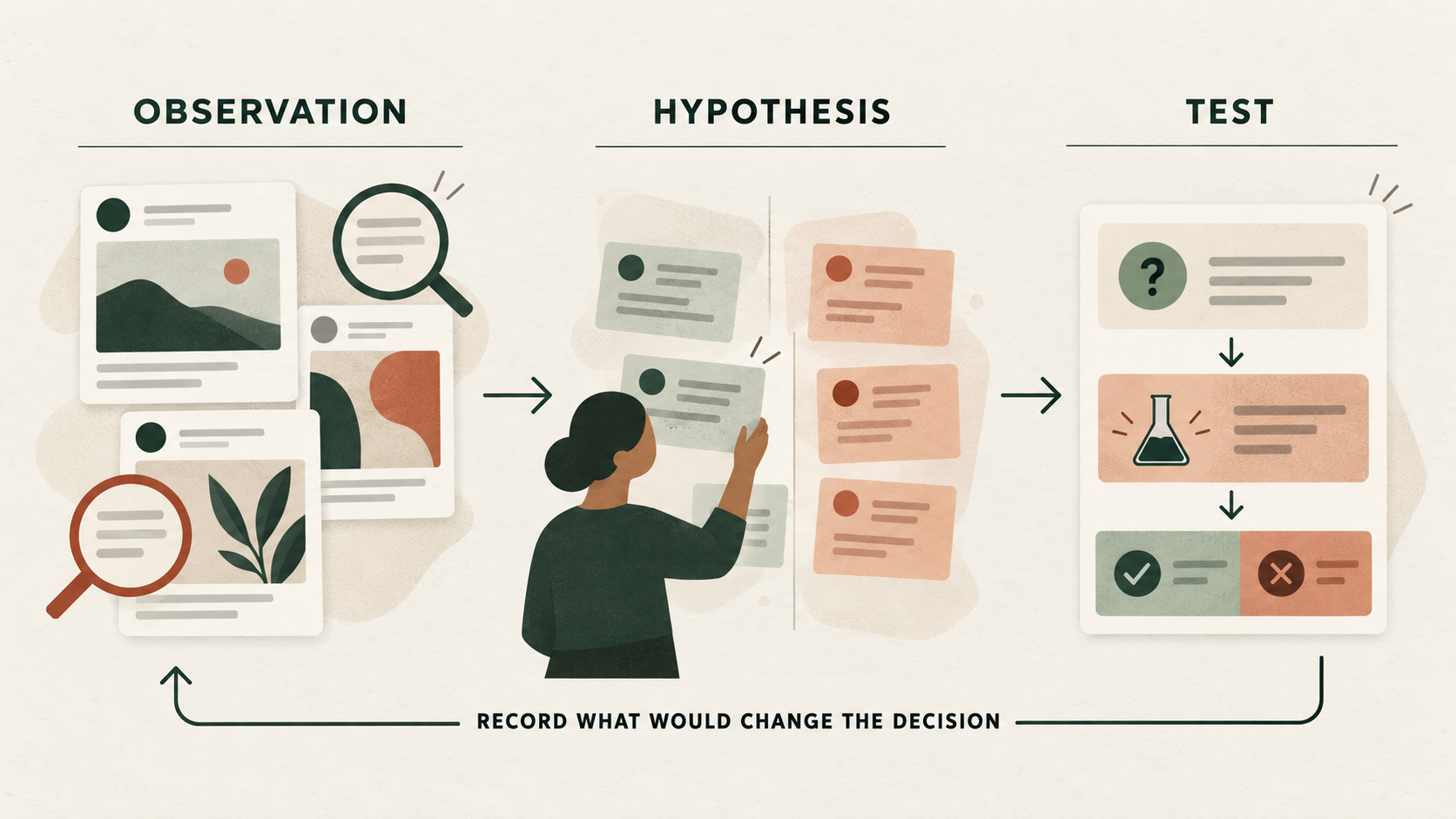
Separate observation, inference and hypothesis
The strongest protection against overclaiming is a three-column discipline.
Observation states what was publicly visible during the defined window.
Inference explains a plausible meaning while naming the limitation.
Hypothesis states what the team would need to test before acting.
Suppose four of six sampled posts from one competitor answer installation or usage questions. The observation is the repeated educational pattern. A reasonable inference is that product understanding may be an important content job for that account. The hypothesis is that prospective buyers need practical reassurance before they consider the brand. The benchmark cannot prove that the content caused sales or that the same approach will work for another organisation.
Add an “unknown” field wherever the evidence stops. Unknowns may include paid distribution, audience composition, conversion, creative cost, internal approval constraints and the commercial role of a distributor. An honest unknown is more useful than a confident story built from public fragments.
Find white space without copying the competitor
White space is not simply a format nobody else uses. It is an audience need, proof gap, journey break or platform role that the current set does not serve well. The opportunity may be a question nobody answers clearly, a segment addressed only in generic language, a product comparison with weak evidence or a useful next step that disappears after discovery.
Review where international brands are finding growth in China with the same caution: a promising platform or content behaviour is not a universal recipe. Ask whether the opportunity fits the brand’s advantage, audience, operating capacity and route to market. If a competitor owns a distinctive creative device, copying it may make your brand less recognisable and raise avoidable rights concerns.
Turn each apparent gap into a bounded hypothesis. “Competitors do not use long video” is only an observation. “Technical buyers lack detailed evaluation content, and Bilibili may offer a workable depth format” is a testable hypothesis. The next step might be search research, interviews, a pilot asset or an analysis of existing sales questions—not an immediate channel launch.
Turn the benchmark into a decision backlog
A final benchmark should be short enough to use. Summarise the evidence by decision, not by competitor. A practical backlog has four groups:
Keep: assumptions or choices that remain defensible after the review.
Investigate: questions that need primary research, owned data or specialist input.
Test: low-risk hypotheses that can be evaluated through a defined content, search or audience experiment.
Stop: ideas that the evidence contradicts or that rely on capability the brand does not have.
Assign an owner, due date and evidence threshold to every next action. If the benchmark recommends a platform, state the role it should play, the content supply it needs and what would make the team reverse the choice. A team preparing to test demand before scaling should be able to explain what it expects to learn before it commits more budget.
Schedule a refresh only when the decision requires it. A pre-entry benchmark may remain useful until the brand’s proposition, competitor set or route changes. A campaign or fast-moving platform review may need a shorter interval. Continuous monitoring is a different workstream from a one-time benchmark and should not be smuggled into the scope.
Common questions about China competitor benchmarks
How many competitors should an international brand review?
Use the smallest set that represents the real decision. Four to eight organisations often works for an initial review, provided the mix includes the relevant direct, substitute, attention and reference competitors. A larger set is valuable only when observation rules remain consistent.
Can follower counts be used as a benchmark?
They can be recorded as a dated public signal, but they should not be treated as proof of reach, relevance or commercial performance. Account age, paid activity, platform history and audience quality can all change the meaning.
How can a team tell whether competitor content was paid?
Use explicit disclosure, platform labels or available media tools where accessible. Otherwise mark paid support as unknown. Do not estimate spend or organic reach from visible engagement alone.
Should a brand copy formats that appear to work?
No. Study the audience job, proof and operating capability behind the format. Recreate the decision logic in a way that fits your brand, rights, resources and customer journey.
Use the benchmark to decide what to learn next
The best competitor benchmark makes the next question clearer. It shows where public evidence is strong, where the team is guessing and which small test can reduce uncertainty before a larger China commitment.
Lotus helps international teams connect China-based research, bilingual interpretation and platform planning with the practical work that follows. If your team needs to replace competitor screenshots with a decision-focused benchmark, we can help define the question, evidence standard and next test without pretending public data can answer more than it can.
