

An expert webinar can look like a ready-made content library. It has a credible speaker, a substantial discussion and enough recorded material to fill a publishing calendar. Yet length is not the same as reusable value. A useful WeChat Channels programme needs individual ideas that remain clear outside the event, matter to a mainland-China audience and can be expressed naturally in Chinese.
The right question is therefore not, “How many clips can we cut?” It is, “Does this recording contain ideas worth rebuilding for this audience?” Sometimes the answer is yes. Sometimes the thinking is strong but the delivery should be recorded again. Sometimes the webinar is best kept as internal research.
For international B2B technology teams, that decision belongs before the first edit. Our assessment starts with the source: is the idea useful here, which treatment fits it, and what must stay true to the expert’s meaning in the mainland-China Weixin environment?
The source decision comes before the edit
Tencent describes Channels as a public, ID-based short-form content product within the wider Weixin ecosystem. That distinction matters. “WeChat Channels” is the familiar English term, but the mainland-China user environment is Weixin, where video sits alongside services such as Official Accounts, Search and Mini Programs.

An overseas webinar was rarely designed for that setting. It may assume the audience knows the company, recognises the speakers or has already read the event description. It may rely on a slide that is never legible on a phone. A good answer may not arrive until four minutes after the moderator asks the question. A product example may be relevant globally but unfamiliar, unavailable or strategically unimportant in China.
Mechanical clipping preserves those weaknesses. It also encourages teams to publish because a recording exists, rather than because a useful idea deserves an audience.
We treat the webinar as source material, not finished content. The source can provide expertise, examples and language. The Channels piece still needs its own premise, opening, evidence, structure and next step. This is an editorial decision before it becomes a post-production task.
Start with the mainland-China audience problem
A reusable segment begins with a question that a real audience member might ask. For an international technology brand, that could concern implementation, integration, adoption, procurement, security operations or the practical consequences of a technical change. The topic needs to be specific enough that the viewer understands why the answer matters without knowing anything about the original event.
Review the webinar transcript and mark every moment where the speaker resolves a meaningful uncertainty. Ignore applause, introductions, host banter and broad positioning. Then rewrite each useful moment as an audience question. If the question still makes sense for the brand’s priority audience in mainland China, the segment is a candidate. If it only makes sense to attendees of that particular event, it probably is not.
That audit separates a successful webinar from useful source material. A webinar can work because of the relationship between host, speakers and attendees. A short public video has to carry its value without that relationship. The stronger the idea is on its own, the less context the viewer must reconstruct.
Do not force every internationally relevant topic into a China angle. Add local context only where it changes the audience’s decision, interpretation or next action. A gratuitous reference to China makes content feel translated. A well-chosen local premise makes it feel commissioned for the audience.
Five tests for a webinar worth repurposing
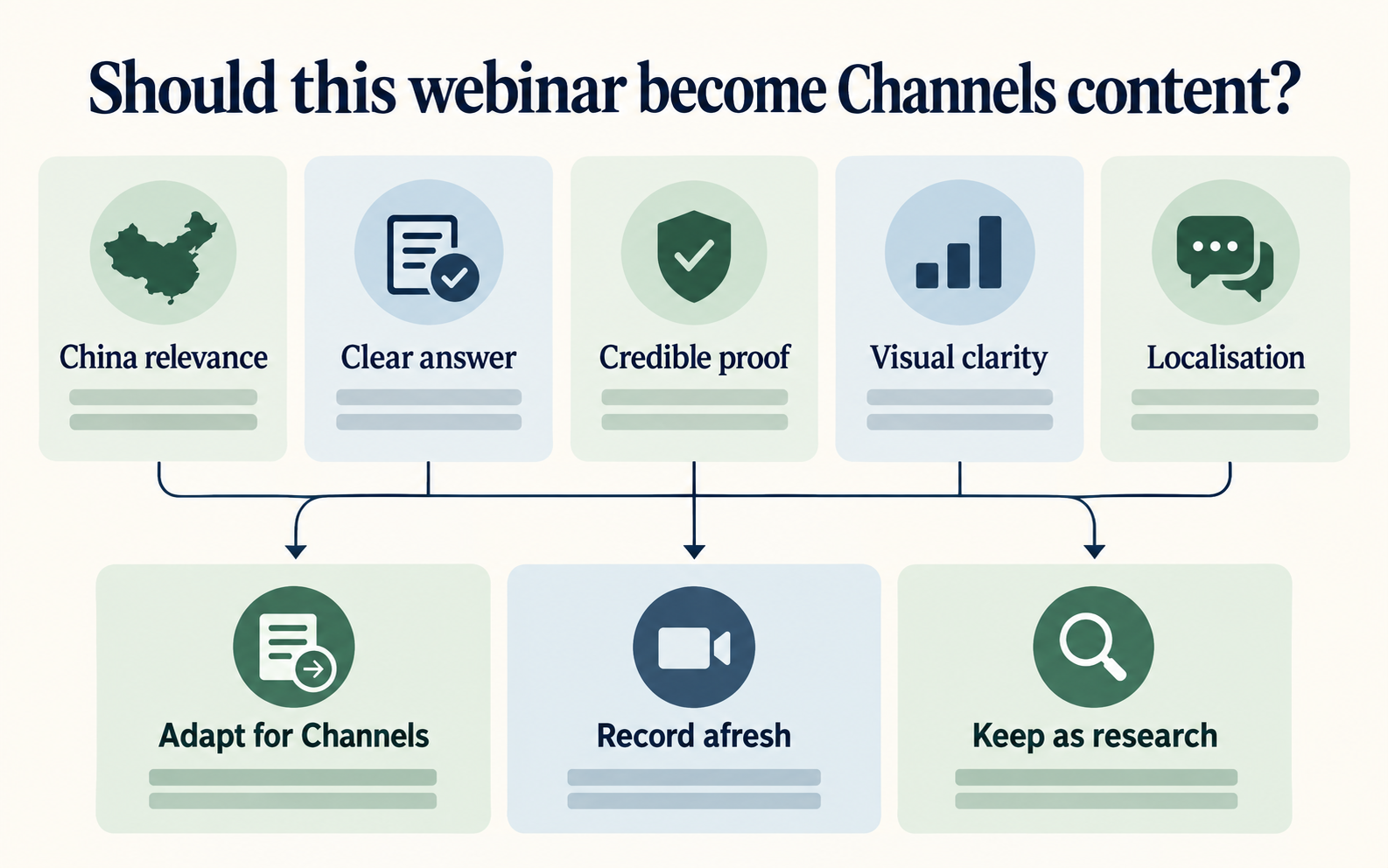
Before recommending adaptation, we test the source against five questions. The recording does not need to score perfectly, but one serious weakness can change the treatment.
1. The underlying question is still current
The first test is relevance. Confirm that the issue remains active, the product information is current and any examples still support the expert’s conclusion. Remove time-sensitive claims that cannot be checked. If a platform feature, statistic or market condition carries the argument, verify it from a current primary source before the segment moves into production.
This is especially important when a webinar has performed well in another market. Past engagement proves that the original audience found the session useful at the time. It does not prove that the same question is current in mainland China or that the same evidence still applies.
2. The expert gives a self-contained answer
Look for a clear proposition followed by an explanation. The viewer should be able to understand what the speaker believes, why they believe it and what the audience should consider next. A lively sentence is not enough if it depends on the previous ten minutes.
Useful answers often include a distinction, a decision criterion, a mistake to avoid or a short sequence. Weak candidates trail off, refer repeatedly to unseen slides or answer a different question from the one shown in the opening. Heavy editing can hide some gaps, but it should not manufacture certainty the speaker never expressed.
3. The claim has credible support
Expert authority helps, but the piece still needs substance. The support might be a product demonstration, an observable process, an appropriately anonymised operational example, a comparison or a precise explanation of cause and effect. The source should make clear which parts are fact, which are experience and which are judgment.
Be cautious with unsupported superlatives, broad market claims and results presented without context. If the central promise requires a disclaimer or specialist interpretation, stop the item at the risk gate rather than using short-form editing to make it sound simpler than it is.
4. The idea can become visually clear
Some webinar moments are valuable in audio but flat on screen. That does not automatically disqualify them. It means the production team needs a visual plan: concise on-screen labels, a diagram, a product view the brand has the right to show, or a deliberately recorded explanation.
The test is whether visuals can clarify the argument without overwhelming it. Dense slides shrunk into a vertical frame usually fail. So do decorative stock sequences that have no relationship to the expert’s point. If the only viable edit is a long talking head with tiny subtitles and no visual movement, a new recording may be more efficient and more useful.
5. Localisation improves the piece without rewriting the evidence
The fifth test is how much localisation the idea can absorb without losing its truth. Names, terminology, examples, units, product availability and audience assumptions may all need adjustment. The speaker’s underlying claim, however, must survive intact.
If natural Chinese wording can preserve the idea while making its relevance obvious, adaptation is viable. If the premise has to be replaced, the examples have to be invented or the conclusion has to be softened beyond recognition, the webinar is research rather than reusable footage.
Thoughtful Chinese content localisation and production is not a cosmetic layer. It is the work of deciding what meaning must remain stable and what expression must change for the content to feel native to the audience.
Choose one of three honest outcomes
The audit should end with a production decision, not an optimistic clip count.
Adapt for Channels when the recording contains a complete, current and locally relevant idea; the expert’s delivery is clear; rights are in place; and Chinese adaptation can preserve the evidence. One webinar may produce several pieces, but each should earn its place independently.
Use the thinking and record afresh when the expertise is strong but the original footage is weak. Typical reasons include poor audio, unreadable slides, an event-dependent opening, answers that are scattered across the session or a speaker composition that does not work in a concise edit. The transcript becomes a research asset for a new script or guided recording. This is not a failed reuse project. It is often the better creative decision.
Keep it as research when the question is outdated, the evidence cannot be verified, the topic falls outside the brand’s China priorities or the value depends on a confidential or highly sensitive context. Some recordings should inform the team without becoming public content.
These options also protect the expert relationship. Speakers are more likely to support repurposing when the edit respects their reasoning, avoids accidental claims and presents them in a context they recognise.
Define a WeChat Channels-ready content unit
Tencent’s own description of Channels includes informative and educational public video. That does not prescribe a creative formula, but it supports a simple working principle: the unit should teach one useful thing clearly enough to stand alone.
Several formats suit expert webinar material when the source supports them:
A decision answer opens with a real choice, then explains the criteria that should shape it.
A misconception correction names a common assumption, shows why it is incomplete and offers a more useful way to think.
A framework walkthrough turns a speaker’s method into a small number of visible, well-explained parts.
A question-led sequence uses related audience questions across several posts without pretending that one answer covers the whole subject.
An annotated demonstration combines the expert’s explanation with a product or process view the brand is authorised to show.
These are editorial structures, not templates that every recording must fill. The best choice follows the source. If the webinar contains a sharp comparison, preserve the contrast. If the value is procedural, show the procedure. If the important idea is a caveat, do not turn it into a universal promise for the sake of a stronger hook.
Each unit needs a clear opening, but the opening must be earned by the answer. “Three things every company must do” is a weak frame if the speaker only discusses one company’s situation. A precise question is often more credible and more useful.
Localisation changes the editorial logic
Subtitles alone do not create a China-ready piece. The editor has to decide what the audience knows, which terms require explanation and where the original story order should change.
Start by separating the source into meaning blocks: question, claim, evidence, implication and next step. Translate and localise those blocks, then rebuild them in the clearest order. The finished piece does not have to preserve the webinar’s chronology. It does have to preserve the expert’s position.
For Chinese-language delivery, review professional terminology with someone who understands the subject rather than relying on literal translation. A technically correct word can still sound unnatural to a buyer, practitioner or manager. Product names and English acronyms may need a Chinese explanation at first use. On-screen wording should be shorter than the spoken explanation, not a full duplicate of it.
Also examine the visual evidence. Replace an irrelevant overseas screenshot with an authorised neutral diagram if the screenshot is not essential. Reframe slides so the hierarchy is readable on a phone. Remove attendee names, private chat messages, email addresses and other event artefacts. Confirm that the brand has permission to reuse the speaker’s image, voice, slides and any third-party material visible in the recording.
A well-localised piece should feel as though the expert answered this audience’s question directly. It should not pretend the webinar was originally recorded in China, and it should not erase useful international perspectives. The goal is relevance without false provenance.
Build an extraction brief before post-production
Once a source passes the audit, create a brief for each proposed unit. This gives editors, translators, subject experts and brand reviewers one stable reference.
Record the audience question, the speaker’s exact proposition, the approved evidence and the point at which the original footage starts and ends. Add the China relevance in one sentence. Specify which terminology requires review, which visuals are available and which claims need rechecking. Define the intended viewer action, such as reading a deeper explanation, saving the framework or discussing a specific question with the brand.
The brief should also state what the piece must not imply. For example, an expert may describe a practice that worked in one operating environment without claiming it will work everywhere. Preserving that boundary is part of good editing.
Then prepare a transcript-based paper edit. Read it without the source video. If the sequence is not coherent on the page, more cuts will not solve the problem. Rewrite the connective wording or choose a new recording. Only after the argument works should the team design captions, graphics, crops and sound.
For brands building a broader WeChat marketing system, the brief should identify how the video relates to the rest of the ecosystem. A useful expert answer may lead to an Official Account article, a service page or another appropriate destination. The relationship should be intentional; adding a generic call to action after every clip is not a strategy.
Review the first pieces for quality of response
Views can show that a piece was seen, but they do not explain whether it helped the right audience understand or decide. Review a small set of signals together.
Look at whether viewers stayed long enough to reach the explanation, whether the comments and questions came from people relevant to the topic, whether the piece was saved or shared in a meaningful context, and whether the next-step destination received qualified activity. Compare the actual audience response with the question written in the extraction brief.
Qualitative feedback is particularly useful early on. A comment that asks the natural next question may reveal a strong follow-up topic. Repeated confusion about a term may show that the localisation assumed too much knowledge. A high view count accompanied by irrelevant responses may mean the opening attracted attention that the answer could not convert into understanding.
Use those observations to make the next editorial decision: sharpen topic selection, improve the explanation or fix the handoff. They are not proof of a universal platform rule. No single clip can guarantee reach, enquiries or commercial outcomes.
Make the webinar earn its second life
Repurposing is worthwhile when it uncovers expert value that can travel: a current audience question, a defensible answer, clear evidence and a format that works without the event around it. It is not worthwhile merely because the company has a long recording and an empty content slot.
For international B2B teams, the practical discipline is to separate source value from production convenience. Audit the thinking first. Localise for the mainland-China audience. Choose adaptation, a new recording or research-only status without forcing a quota from the footage. Then connect each published piece to a useful place in the wider Weixin journey.
Lotus helps international brands evaluate existing expert material, shape it into natural Chinese content and build a coherent production path for mainland China. If you are deciding whether a webinar deserves adaptation or a fresh recording, discuss the source material with Lotus.
