

Kuaishou is a fit when the channel has a clear job
Kuaishou can be a valuable part of an international consumer brand’s China growth strategy, but it should not be added simply because it is a large platform. The stronger case is operational: your priority audience is genuinely active there, the product makes sense in everyday short-form video, and the team can sustain the kind of direct, useful content that gives people a reason to keep watching and responding.
That makes Kuaishou a channel-fit decision, not a reach decision. A brand may find a convincing role for it in product education, creator-led demonstration, community learning or demand development. Another brand may discover that the same investment would be better concentrated on platforms already doing a clearer job.
The practical question is therefore not “Is Kuaishou important?” It is “Can Kuaishou contribute something specific to our audience journey, and can we operate it well enough to learn?”

Why Kuaishou deserves a separate evaluation
Kuaishou is easy to misunderstand when it is treated as a substitute for another short-video platform. The formats may look familiar, but channel behaviour is shaped by more than format. Recommendation systems, creator communities, audience expectations and interaction patterns all influence what people consider worth watching and sharing.
The platform is large. Kuaishou reported an average of 412.3 million daily active users and 797.3 million monthly active users in the second quarter of 2026. It also describes itself as a content community and social platform, a useful clue for planners: the relationship around the content can matter as much as the content asset itself.
Independent analysis also points to a recognisable content environment. One large-scale study of Kuaishou videos found strong representation of life-related content and a mix in which ordinary creators could still produce breakout posts. That does not mean every everyday-looking video will perform, nor does it prove a universal audience profile. It does suggest that polished campaign logic alone is a weak basis for platform fit.
For an international brand, the implication is straightforward. Evaluate Kuaishou on its own operating logic. Do not assume that a video created for another channel can be reposted with a new caption and deliver the same meaning.
Five signals that point to a credible fit
1. Your audience evidence is specific enough to act on
Start with evidence that connects Kuaishou to the people you actually need to influence. Platform scale is useful context, but it does not answer the audience question for a beauty brand, a home product company, a food business or a lifestyle service.
Useful evidence can come from social listening, creator-community observation, search behaviour, retail conversations, customer interviews and the brand’s own campaign data. The goal is to understand situations, not just demographics. What is the audience trying to learn? Which product questions appear repeatedly? Who influences the decision? What language do people use when they describe the problem?
Avoid using broad labels such as “lower-tier users” as a strategy. City tier can be one planning dimension, but it is not a substitute for motivation, category behaviour or purchase context. A sensible Kuaishou case should still make sense when the stereotype is removed.
2. The product’s value is visible in ordinary life
Kuaishou becomes more interesting when a product can be understood through use. That might mean showing how an item solves a practical problem, how it fits into a routine, how two options differ or what someone notices after using it.
This is especially helpful for categories where context adds credibility. A kitchen tool is clearer when it is used in a real kitchen. A travel product becomes easier to assess when viewers see the journey around it. A personal-care item benefits from texture, application and routine. A piece of technology is more accessible when its function is shown without turning the video into a specification sheet.
The product does not need to be simple, but its benefit needs to be made observable. If every useful explanation depends on a highly produced brand film or a long sequence of abstract claims, the content system may struggle to feel native.
3. The team can sustain a native short-video rhythm
One strong video does not prove channel fit. The real test is whether the brand can build a repeatable set of stories: demonstrations, comparisons, questions, creator interpretations, user situations, behind-the-product explanations and responses to recurring audience concerns.
This does not require careless production. It requires a different production judgement. The video should be clear enough to trust, direct enough to follow and varied enough to avoid repeating the same sales point. Useful beats glossy when gloss removes the human reason to keep watching.
International approval processes often become the hidden constraint. If every post must pass through a long chain of global review, even a good creative idea can arrive too late or feel overworked. Before choosing the platform, confirm that local teams can adapt language, examples and pacing while staying inside the brand’s approved boundaries.
4. Community response is part of the operating model
Kuaishou should not be planned as a one-way publishing outlet. Comments, repeated questions and creator feedback can reveal whether the audience understands the product, which proof points matter and where the brand’s language is missing the mark.
That creates work. Someone needs to listen, classify recurring signals, respond appropriately and feed the learning back into future content. A brand that posts regularly but never turns response into better decisions is leaving much of the channel’s value unused.
This is also why creator selection should go beyond follower count. The useful question is whether the creator has a believable relationship with the topic and can express product value in language their community recognises. A smaller, well-matched voice may teach the brand more than a broad placement with weak category relevance.
5. Kuaishou adds a role that other channels do not already cover
Every platform in the mix should earn its place. Kuaishou might be the channel where the brand develops relatable product proof, learns from creator communities or reaches a valuable audience in a context the current plan misses. Those are plausible roles. “We need another short-video account” is not.
Define the job in one sentence. For example: “Kuaishou will help first-time buyers understand how the product fits into everyday use.” That sentence guides content, creator selection and measurement. It also makes a stop decision possible if the evidence stays weak.
This discipline matters because international teams already manage complex channel systems. Our overview of how China’s major social platforms play different roles can help frame that wider mix without treating every platform as interchangeable.
What a good Kuaishou role can look like
A good role is narrow enough to operate and important enough to matter. It does not need to carry the entire funnel.
Everyday product proof
The channel can help turn a brand promise into something visible. Demonstrations, use cases and common mistakes give viewers a practical reason to watch. This is particularly useful when awareness exists but understanding is shallow.
The content should answer a real question rather than merely display the product. “Here is the feature” is weaker than “Here is the situation in which the feature becomes useful.” The second version gives the audience a decision context.
Creator-led category translation
A creator can bridge the gap between global brand language and local audience language. The value is not just distribution. It is interpretation: what deserves emphasis, which comparison feels relevant and how the product fits into a recognisable routine.
This works only when the brand allows room for the creator’s voice. A word-for-word global script performed by a local creator may satisfy a process, but it rarely produces the strongest explanation.
Community-informed content development
Kuaishou can also serve as a learning environment. Repeated questions can become future videos. Misunderstandings can reveal where product education is weak. Strong reactions to a particular situation can shape the next creator brief.
The goal is not to chase every comment. It is to build a reliable loop between audience response and content decisions. That loop can improve the channel even when the early output is still uneven.
Signs that Kuaishou is probably a weak fit for now
The honest answer may be “not yet.” That is a useful decision if it protects focus.
Kuaishou is a weaker choice when the team cannot show evidence that a priority audience is active, cannot express product value through native short-form video or cannot give the channel a job that differs from the rest of the mix. It is also risky when the operating plan depends on copying videos from another platform without adaptation.
Another warning sign is a measurement brief built only around fast reach. A new channel needs learning goals as well as exposure goals. Without them, the team may see fluctuating view counts but learn very little about audience fit, content quality or the role the platform should play.
Finally, consider organisational readiness. If local teams lack access to products, creators, timely approvals or community response, the strategy may be sound on paper but impossible to execute. Closing those gaps can be more valuable than opening the account immediately.
Build the operating model before committing to regular delivery
Channel fit is partly a content question and partly an operating question. The strongest planning work connects both.
Create a content spine, not a list of random ideas
Choose a small number of repeatable content territories. A homeware brand might use practical demonstrations, buyer questions, material explanations and real-room situations. A lifestyle service might focus on preparation, expectations, common choices and human stories around the experience.
Each territory should connect to the channel job. If an idea cannot explain, demonstrate, reassure or generate useful learning, it may be entertaining but strategically loose.
Design for variation without losing recognition
Repeated formats can make production more efficient, but repetition should not become sameness. Vary the scenario, speaker, question, opening and proof while keeping the brand’s core point recognisable.
This is where a local content system matters. A brand needs enough structure to protect tone and accuracy, plus enough flexibility to respond to what people actually care about. Our guide to China social media strategy for lifestyle brands explains why demand context should come before platform habit.
Give local teams real decision rights
Clarify what the China team can approve, what requires global review and what should never be improvised. This prevents ordinary editorial decisions from becoming a bottleneck while protecting the areas that genuinely need control.
The aim is not speed for its own sake. It is keeping the content close enough to current audience language that it still feels relevant when published.
Establish a simple learning loop
After each content batch, review which situations held attention, which questions appeared repeatedly, which creator styles felt credible and where viewers seemed confused. Translate the findings into the next briefs.
Do not let the review become a report that nobody uses. A good loop produces a small number of clear changes: strengthen the opening, show the product earlier, answer a missing question or narrow the audience scenario.
Run a bounded pilot with a real decision at the end
When the five signals are reasonably strong, test the role before committing to a large ongoing programme. A bounded pilot should have enough content variety to reveal patterns, but it does not need an elaborate calendar.
Start with a written hypothesis. State who the content is for, what job Kuaishou is expected to do and why the product should make sense in this environment. Then choose a focused set of formats that test the hypothesis from different angles.
For example, the pilot could include direct product demonstrations, a creator interpretation, a response to a common buyer question and an everyday scenario. The purpose is not to declare a winning format after one post. It is to see whether a coherent pattern begins to form across content, audience response and operational effort.
Measure the evidence at three levels:
Audience response: Are the right questions and reactions appearing, or is the content attracting attention with little category relevance?
Content learning: Which situations, explanations and voices consistently make the product easier to understand?
Operating reality: Can the team create, approve, publish and learn at a quality level it can sustain?
Views matter, but they are not the entire decision. Completion behaviour, meaningful comments, profile actions, qualified traffic and useful creator feedback may give a better picture of whether the channel is doing its assigned job. Choose the measures that match the role rather than building the role around the easiest metric.
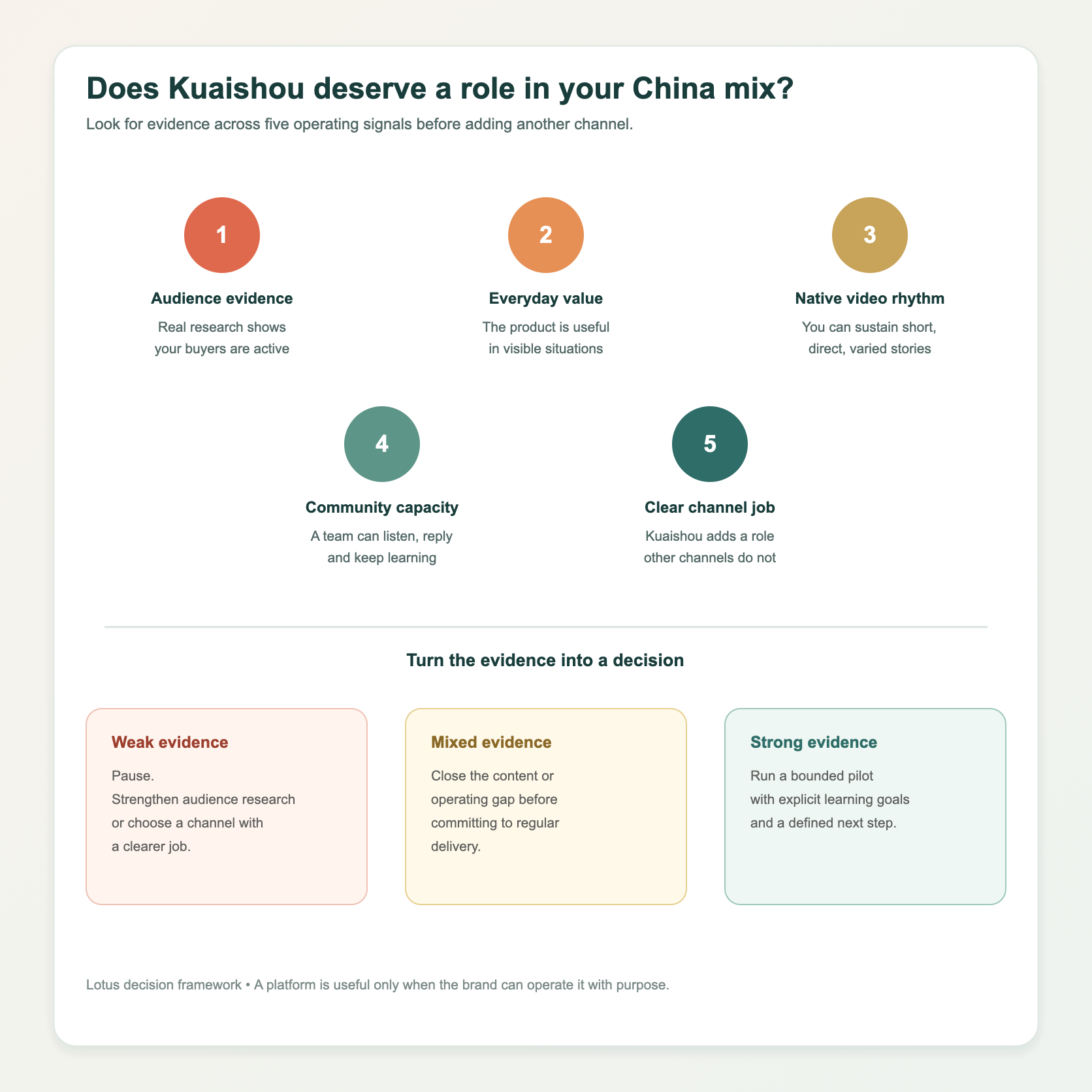
At the end of the pilot, make one of three decisions. Continue when the audience, content and operating evidence reinforce each other. Adjust when the audience case remains credible but one content or workflow gap is clearly holding the work back. Pause when the strategic role stays vague or the operating cost is out of proportion to the learning.
None of those decisions is a failure. The failure is maintaining a channel nobody can explain because the account already exists.
Place Kuaishou inside the wider China channel mix
Kuaishou should connect to the rest of the customer journey without duplicating it. A brand may use one platform for discovery, another for deeper consideration and owned channels for ongoing relationship management. The exact architecture depends on the category, audience and growth stage.
That means the planning conversation should start with customer decisions, not a platform checklist. If Kuaishou improves a weak part of the journey, it may deserve investment. If it merely repeats work already being done well elsewhere, focus is usually the better choice.
The operational design also needs shared standards for content, creators, community response and learning. Lotus’s approach to China social media management is built around that connected view rather than treating each channel as an isolated posting calendar.
The final decision is about fit, not fashion
Kuaishou can be a strong growth channel for an international consumer brand when five things line up: real audience evidence, visible everyday product value, a sustainable native-video rhythm, genuine community capacity and a distinct job in the wider mix.
If several of those signals are missing, pause and strengthen the foundation. If they are present, a bounded pilot can turn assumptions into evidence without forcing the brand into an open-ended commitment.
If your team is weighing whether Kuaishou deserves a place in the mix, discuss the decision with Lotus. We can help you turn audience evidence, content reality and operating capacity into a channel role that makes sense for your brand in China.
