

Guide to China's 2026 Cosmetics Import & Export Rules
Chinese marketing and market entry strategies are evolving fast — and so is the regulatory landscape that underpins them. Starting December 1, 2026, a major overhaul of China's cosmetics import and export regulations officially takes effect. Known as Decree No. 284, the new rules replace the long-standing Decree No. 143 (and its three subsequent revisions), reshaping how cosmetics are inspected, registered, and cleared at the border.
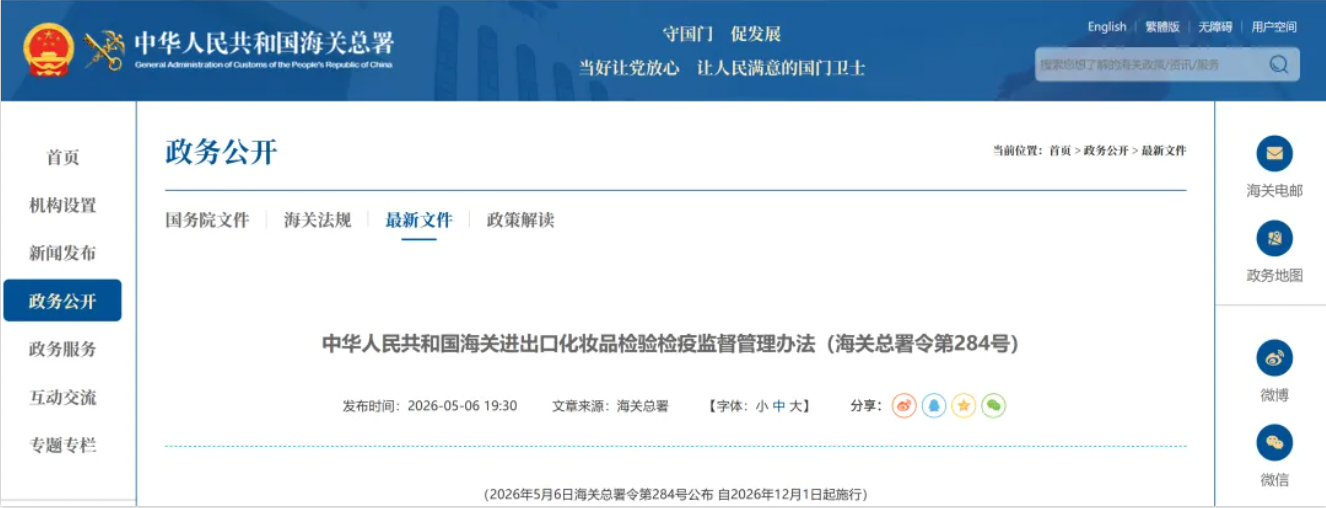
For international brands operating in or planning to enter the Chinese market, this isn't just a bureaucratic update — it's a signal of where the industry is headed. The reforms reflect a deliberate shift from box-ticking compliance toward a smarter, risk-based regulatory framework. Understanding what's changed — and acting on it before December — could mean the difference between smooth clearance and costly delays.
What's Actually Changing: The Key Differences at a Glance
The most meaningful changes introduced by Decree No. 284 touch on six core areas:
Inspection location (imports) shifts from port-of-entry customs to the destination declared by the consignee or their agent. This is a significant logistical change — products no longer need to be inspected the moment they arrive at the port, which reduces bottlenecks and gives importers more flexibility over where and when inspections occur.
Inspection location (exports) moves primarily to the production site, with the General Administration of Customs retaining the right to designate additional locations as needed. This streamlines the process for manufacturers by consolidating inspections closer to where goods are made.
Record-keeping requirements have been tightened and clarified. Under the old rules, records simply needed to be kept for a minimum of two years and accurately reflect product movement. Under Decree No. 284, records must be genuine, complete, and traceable — retained for at least one year after the product's expiry date, or a minimum of two years for products with a shelf life under one year. This is a notable upgrade in documentation expectations.
Import market access has been fundamentally restructured. Previously, cosmetics without a sanitary permit or filing could still be imported by submitting a safety assessment. Under the new rules, all imported cosmetics must have completed either special cosmetics registration or general cosmetics filing through China's National Medical Products Administration (NMPA) before customs clearance. Customs will verify compliance automatically through electronic data matching — no manual submissions, no workarounds.
Re-inspection restrictions have been codified more explicitly. Requests for re-inspection will no longer be accepted in cases of microbial contamination, expired products, or situations where re-inspection is technically impossible. This closes a loophole that some parties used to delay enforcement on non-compliant goods.
Labelling management has been simplified. Rather than detailing exact label templates, translation requirements, and format reviews, the new rules defer to separate General Administration of Customs regulations. This should reduce the administrative burden on importers while still ensuring labelling standards are met.
Legal liability has been streamlined. Specific penalty clauses from the old rules (such as fines of up to RMB 30,000 for unauthorized relocation of goods, or warnings/fines of up to RMB 10,000 for failure to comply with return or destruction orders) have been removed, with offenses now handled under higher-level laws and regulations. Crucially, criminal liability can now apply where violations constitute criminal offenses — a stronger deterrent than the previous fixed-penalty model.
The Logic Behind the Reform: Four Themes
To understand why these changes matter for Chinese social media strategy and broader market positioning, it helps to understand the philosophy driving them. The 2026 revision can be summarized in four words: loosen, improve, align, and enforce.
Loosen unnecessary burdens. Several mandatory filing requirements have been removed, sample import procedures have been simplified, and restrictions on semi-finished goods imports have been eased. For smaller importers, emerging beauty brands, and contract manufacturers, these changes meaningfully reduce the time and cost of getting products into China. The goal is to lower the barriers to legitimate market entry and let more players compete on a level field.
Improve regulatory targeting. The old approach treated every shipment with roughly the same level of scrutiny. The new system uses risk tiering and credit classification to focus inspection resources on high-risk product categories and companies with a history of non-compliance. Compliant, well-established companies can expect faster clearance; those with red flags on their record will face closer examination. This is a more sophisticated model — and one that rewards businesses that invest in getting compliance right.
Align with the broader regulatory ecosystem. Decree No. 284 is designed to integrate seamlessly with the Regulations on the Supervision and Administration of Cosmetics (the overarching framework governing the sector), breaking down the information silos between the NMPA's registration and filing systems and customs inspection data. The result is a more unified, end-to-end traceability system — relevant not just for import/export, but for any brand building a China marketing strategy that depends on regulatory credibility.
Enforce accountability more effectively. While the reform simplifies some processes, it simultaneously strengthens corporate responsibility. Brands are now more explicitly required to maintain accurate import/export ledgers, track sample flows, retain inspection certificates, and properly handle non-compliant goods. The shift away from fixed administrative penalties toward prosecution under higher-level law also means that serious violations carry heavier consequences.
What This Means for International Brands
For international brands considering or actively developing a presence in the Chinese market, Decree No. 284 contains both good news and important warnings.
The good news: if your compliance house is already in order, the new rules are largely a tailwind. Fewer mandatory filings, streamlined sample imports, and faster electronic clearance mean less friction at the border. Brands that have completed NMPA registration or filing — and kept their documentation current — are well positioned to benefit from the new system's efficiency gains.
The warning: the new rules remove several of the informal escape valves that companies sometimes used to navigate gaps in compliance. The requirement for all imported cosmetics to have completed NMPA registration or filing before entry is now absolute and automatically verified. There's no longer a submission-of-safety-assessment workaround for products that haven't gone through the proper channels. Brands that have been operating in grey areas — or that have been slow to complete required filings — face real risk of goods being held, returned, or destroyed at the border.
This is also worth noting in the context of Chinese social media and consumer-facing brand building. In China's beauty market, where platforms like Rednote, Douyin, and WeChat amplify both brand credibility and consumer complaints, a border incident or compliance failure can cause reputational damage that far outweighs the cost of getting ahead of the regulations. International brands that invest in proper compliance are also investing in the trust architecture that underpins their long-term market position.
A Practical Compliance Roadmap
With around six months remaining before Decree No. 284 takes effect, there's still meaningful time to prepare — but that window is narrowing. Here's what brands should be doing now:
Audit your product portfolio. The new rules apply differently depending on product category — finished goods, semi-finished goods, soap, toothpaste (which is now brought under the same management framework as cosmetics), and sample products are all handled under distinct provisions. Make sure you know exactly which category each of your products falls into and what requirements apply. Misclassification is a common source of compliance errors.
Strengthen your documentation systems. The upgraded record-keeping requirements mean that vague or incomplete internal tracking systems are a liability. Implement processes to ensure that import/export ledgers, sample movement records, and inspection certificates are all maintained accurately and for the correct retention periods. Your records should be able to withstand scrutiny at any point — not just when an inspection is imminent.
Get NMPA registration and filing completed. If you have products that haven't yet completed the required registration or filing process, this is the most urgent priority. The December deadline is firm, and the new system will automatically flag unregistered products at customs. Begin the process early — NMPA timelines can be long, especially for special-use cosmetics categories.
Take your corporate credit rating seriously. China's regulatory system increasingly uses credit classification to determine how closely businesses are monitored. Companies with strong compliance records benefit from lighter-touch inspection; those with compliance issues face more intensive scrutiny. Maintaining accurate declarations and dealing proactively with any issues is the most effective way to protect your credit standing — and the clearance efficiency that comes with it.
Establish a clear protocol for non-compliant goods. If a shipment fails inspection, the new rules require specific remediation steps — including return or destruction of the goods. Having a pre-established response protocol, including who in your organization is responsible and what your logistics partner will do, can significantly reduce the time and cost of dealing with a compliance incident.
Looking Ahead
The transition from Decree No. 143 to Decree No. 284 reflects a broader evolution in how China governs its beauty and personal care sector — moving from process-oriented enforcement to a risk-and-accountability framework that is simultaneously more efficient and more demanding. For international brands that are serious about building a sustainable presence in this market, the message is clear: compliance is not a cost to be minimized, it's a foundation to be built.

The brands that use the coming months to complete their regulatory groundwork, tighten their documentation, and align their operations with the new framework will enter December 2026 with a genuine competitive advantage. Those that don't will find that China's border controls are no longer a system that rewards improvisation.
Chinese marketing success in the beauty sector is ultimately built on trust — with consumers, with retail partners, and with regulators. Decree No. 284 is China's way of raising the floor. The brands that rise with it will be better positioned for everything that comes next.
Interested in exploring bespoke marketing tips and localized strategies for the Chinese market? Feel free to reach out to us!
