

A compliant China marketing lead journey is not created by adding a checkbox to a form. It is built around six operational controls: a clear notice and reviewed processing basis; purpose-specific minimum fields; governed vendor and CRM handoffs; retention and personal-rights procedures; an audit-ready evidence trail; and early escalation of any cross-border access.
This checklist helps marketing, CRM and operations teams find gaps before a campaign goes live. It follows a lead from a Chinese platform, landing page, event or QR code through agency handling, SCRM or WeCom, a CRM and sales follow-up—and eventually to suppression, deletion or another approved outcome.
China’s Personal Information Protection Law, or PIPL, defines processing broadly. Collection, storage, use, transfer, provision, disclosure and deletion can all be part of the same regulated journey. PIPL can also apply to certain processing outside China when an organization offers products or services to people in China or analyses their behaviour.
This article provides practical marketing-operations guidance, not legal advice. The correct processing basis, consent requirements, sensitive- or important-data classification, contractual structure and cross-border mechanism depend on the actual entities, systems, information and data flows. Obtain current advice from qualified legal, privacy and security specialists before launch.
What does “marketing data compliance” mean in practice?
For marketers, the useful question is not “Does our CRM comply?” It is “Can we explain and evidence the complete journey of this person’s information?”
That journey starts before submission. It includes what the person sees, which fields are collected, what happens after they click, which organisation decides the purpose, which operators can access the record, whether a platform or agency exports it, whether headquarters can view it, how sales follows up and what happens when the purpose ends.
Marketers can own much of the operational work: the data map, field dictionary, form configuration, notice version, campaign approvals, access register, retention triggers and change log. Legal, privacy and security specialists should decide or validate matters such as the correct processing basis, separate-consent requirements, sensitive or important data, entity roles, cross-border mechanisms, security design and the handling of unusual requests or incidents.
First, draw the one-page marketing data map
Create the map before configuring automation. A compact example might look like this:
Xiaohongshu or another platform lead form → agency/operator → SCRM or WeCom → CRM → assigned salesperson → nurture, suppression or deletion
This is not a hypothetical edge case. Xiaohongshu’s official Spotlight documentation describes a Marketing API that can connect an advertiser’s own system with the advertising platform, including customer-lead collection and reporting functions. The platform feature describes mechanics; it does not establish a lawful basis for the brand’s processing.
On one page, record:
Every entry point: platform form, landing page, event scanner, webinar registration, QR code or direct message.
Every identifier and signal: name, contact route, company, job role, stated interest, campaign source and submission time.
Every recipient: platform, agency, SCRM provider, CRM, marketing automation, support desk, sales team and reporting tool.
Every location and access route: primary storage, downloads, dashboards, backups, support access and overseas users.
Every exit: conversion, inactivity review, opt-out, correction, suppression, deletion or restricted retention.
Give each box an owner. If no one owns a handoff, that handoff is already a control gap.
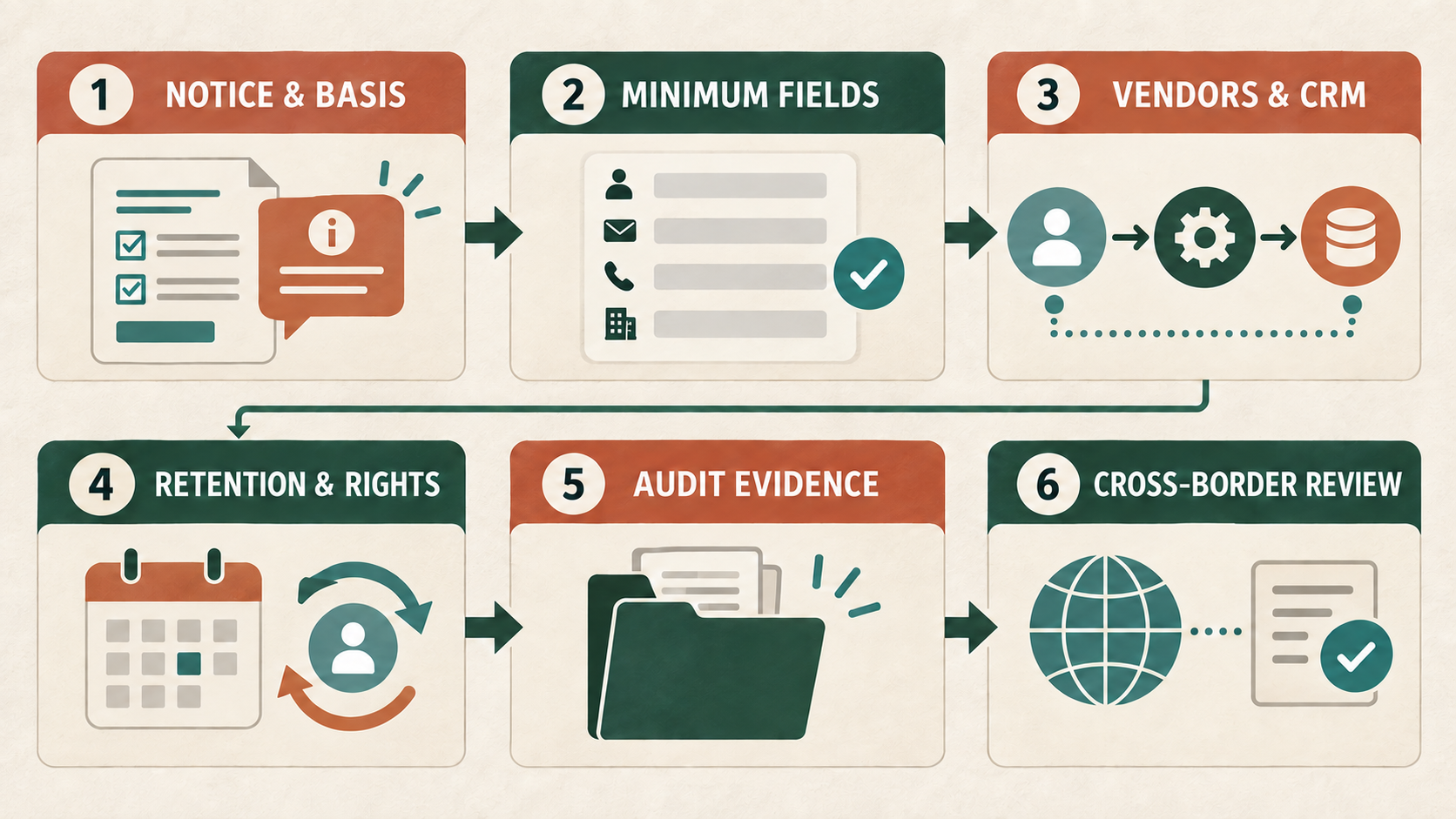
Gate 1: Make the notice and processing basis match the real journey
Before a person submits information, the visible explanation should match what the team will actually do. PIPL requires clear disclosure of matters including the processor’s identity and contact details, purpose and method, information types, retention period and route for exercising rights. China’s Network Data Security Management Regulations add that public-facing processing rules should be conspicuous, easy to access and clear.
A generic privacy-policy link may be useful, but it cannot rescue a form whose visible promise conflicts with the actual workflow. If the form says “we will contact you about this enquiry” but the record is also copied to a global marketing database for unrelated campaigns, the notice and system design need review.
Consent is one possible processing basis under PIPL, not a universal answer. The law lists several bases. Where consent is used, it must be informed, voluntary and explicit, and withdrawal must be convenient. A change in purpose, method or personal-information types may require renewed consent. Separate consent can apply in specified situations, including some sensitive-information and overseas-transfer scenarios.
Keep as evidence: the approved notice, a screenshot of the live form, the applicable basis decision, the consent wording and version where relevant, and a tested refusal or withdrawal route.
Stop and escalate if: the notice is hidden or generic; the real recipients are missing; the campaign changes after approval; or the team cannot explain why each form field and follow-up activity is necessary.
Gate 2: Collect the smallest useful field set
PIPL requires an explicit and reasonable purpose, direct relevance to that purpose and collection limited to the minimum scope necessary. For a marketer, the practical test is simple:
Is this field necessary for the next action we have promised to take?
Start with a field dictionary rather than copying the last campaign’s form.
Name or preferred form of address — Identify and respond to the enquiry. Is a full legal name really needed?
Contact route — Deliver the promised response. Which one channel is sufficient?
Company and role — Qualify a B2B enquiry. Can this be optional until sales needs it?
Stated interest or question — Route the person correctly. Can a short choice replace free text?
Source and date — Preserve campaign context. Can the system capture this automatically?
This field set is illustrative, not a universal list of “permitted identifiers.” The right minimum field set depends on the campaign’s purpose and design.
Separate required fields from optional enrichment. “We might use it later” is not a useful purpose. Escalate any plan to collect identity documents, precise location, financial, health, biometric, minors’ or other potentially sensitive information. PIPL permits sensitive personal information only for a specific purpose, with sufficient necessity and stricter protective measures .
Public contact details are not a free marketing list. PIPL allows processing of lawfully public information within a reasonable scope, subject to further limits and the person’s express refusal. Scraping, enrichment and high-volume outreach need specialist review.
Keep as evidence: the field dictionary, required/optional settings and one written reason for every required field.
Stop and escalate if: sensitive or children’s information appears; hidden enrichment is introduced; free-text boxes invite excessive disclosure; or the team cannot defend a required field.
Gate 3: Control the agency, platform, SCRM and CRM handoffs
A clean form can still feed a poorly governed system. Identify every organisation and tool that receives, stores, enriches, exports or reports on the record.
Name the system of record and the relationship owner. Define who may access the lead, for which task, for how long and through which account. Avoid personal accounts, shared credentials and unmanaged spreadsheets. If the journey uses WeCom, connect the contact to company-controlled ownership and a documented handover process rather than an individual employee’s private account. Our guide to WeCom CRM and customer handover explains the operating model in more detail.
PIPL requires the organisation entrusting processing to agree matters such as the purpose, term, method, personal-information types, safeguards and responsibilities, and to supervise the processor. The Network Data Regulations similarly require contractual controls for providing or entrusting personal information or important data and at least three years’ retention of related processing records. Providing information to another independent processor can trigger different requirements, so roles should be assessed, not guessed.
Review integrations and exports, not just named vendors. A reporting connector, downloaded CSV, cloud-support session or onward subprocessor can change the journey. After every material change, retest whether the notice still describes what happens.
Keep as evidence: the data-flow diagram, entity and role map, approved vendor list, relevant contract/control summary, permissions register, export log and review date.
Stop and escalate if: a recipient or onward provider is unclear; an integration sends more fields than expected; a former employee still has access; or nobody can identify the authoritative record.
Gate 4: Set retention and personal-rights procedures before launch
“Keep it in the CRM forever” is not a retention schedule. PIPL states that personal information should generally be kept for the shortest time necessary for the processing purpose unless another law or regulation provides otherwise.
Give each lead state a review or deletion rule:
New or unreviewed enquiry.
Active conversation.
Accepted opportunity or customer record.
Approved nurture relationship.
Inactive record with no current purpose.
Opted out or objected.
Correction or deletion request.
Restricted record retained for a separately reviewed legal or contractual reason.
Do not use “opt-out,” “suppression” and “deletion” as synonyms. A suppression record may be necessary to prevent future marketing, while a deletion request concerns removal of personal information under the applicable process. Document which minimum record, if any, must remain restricted and why.
People have rights including access and copy, correction and deletion in specified circumstances, and processors should provide a convenient request mechanism. Test whether a correction, withdrawal or deletion request can propagate through the platform download, SCRM, CRM, marketing tool and agency copy—not merely the main database.
Keep as evidence: a retention schedule by lead state, named owner, review date, request route, suppression/deletion procedure and completion log.
Stop and escalate if: requests cannot be propagated; backups and exports sit outside the process; retention has no end point; or operational and legally required records are mixed together without access limits.
Gate 5: Build an audit-ready campaign record
The test of governance is whether the team can reconstruct what happened six months later. Keep a compact campaign evidence pack containing:
Approved purpose and brief.
One-page data map and field dictionary.
Dated form and notice versions.
Processing-basis approval and consent records where applicable.
Platform settings and screenshots.
Vendor, permission and access records.
Retention and rights-handling procedures.
Export and integration log.
Material-change history.
Cross-border specialist decision.
Incident and escalation record, if relevant.
PIPL requires internal rules and procedures, classification, technical safeguards, appropriate access controls, training and incident preparation. Specified higher-risk processing requires a personal information protection impact assessment, and the assessment and processing record must be retained for at least three years.
China’s Personal Information Protection Compliance Audit Measures, effective 1 May 2025, require regular audits and say a processor handling more than 10 million individuals’ personal information must conduct one at least every two years. That volume rule is not the only audit trigger or reason to maintain evidence.
Keep advertising-claim evidence separate from the personal-information file. A claim such as “number one,” “35% faster” or “preferred by 8 in 10 buyers” needs its own substantiation: source, methodology, geography, time period, validity date and qualifying wording. SAMR’s 2026 Advertising Citation Content Enforcement Guide says cited data, surveys and quotations should be true, accurate, lawful and verifiable, should match the source, and should identify the source and relevant scope or validity period.
Stop and escalate if: the team cannot show what the person saw, what entered each system, who approved a change or where a public marketing claim came from.
Gate 6: Escalate cross-border access before connecting the global stack
Overseas CRM storage is not the only possible cross-border flow. An overseas headquarters user, global dashboard, cloud administrator, support team, automation vendor or onward provider may also access information collected in China.
PIPL sets conditions for providing personal information outside China and includes notice, separate-consent and protection requirements in relevant circumstances. The 2024 Provisions on Promoting and Regulating Cross-Border Data Flows adjusted security-assessment, standard-contract and certification rules and created specified exemptions.
Those exemptions and thresholds are specialist-review inputs, not blanket permission. A non-CIIO processor’s export of fewer than 100,000 individuals’ non-sensitive personal information from 1 January of the current year may be exempt from specified filing, contract or certification routes under the 2024 Provisions. That does not erase PIPL duties or settle whether the data is sensitive, important, lawfully collected or covered by another rule.
Before connecting the global stack, prepare:
Responsible and recipient entities.
Collection purpose and every onward purpose.
Data categories and possible sensitivity.
Approximate annual number of individuals.
Storage and access locations.
Transfer frequency and method.
Onward recipients.
Retention period.
Proposed security and management controls.
Existing notices, consent records and impact assessments.
Pseudonymised or de-identified information may still be personal information. Do not call it anonymous without a defensible technical and legal basis.
Stop and escalate if: overseas access exists but was not mapped; the team is relying on a threshold alone; entity roles are unclear; or important-data, CIIO or sensitive-information questions remain unresolved.
Run the ten-question preflight before launch
Answer each question with yes, revise or specialist decision required.
Can we show the complete route from collection to final deletion or restricted retention?
Does the visible notice match every actual purpose, recipient, system and follow-up channel?
Has the processing basis—and any consent or separate consent—been reviewed for this journey?
Is every required field necessary for the next promised action?
Have sensitive information, children’s information and free-text risks been removed or escalated?
Are the system of record, relationship owner, permitted users and vendor responsibilities documented?
Can an opt-out, correction, withdrawal or deletion request be completed across every connected copy?
Does each lead state have a retention, review, suppression or deletion rule?
Can the team reproduce the approved form, notice, settings, exports and material changes?
Has every overseas storage, access, support or onward-transfer path received the required specialist decision?
If all ten are “yes,” the campaign is ready for operational QA—not a legal guarantee. Any “revise” result should return to the owner before launch. Any “specialist decision required” result should pause the affected workflow until that decision is documented.
How Lotus supports responsible China marketing operations
Lotus helps international teams turn an approved compliance position into workable campaign operations: mapping the lead journey, coordinating Chinese platforms, configuring purpose-specific forms, maintaining access and approval records, defining agency handoffs and running change-controlled campaigns.
Our China social media management and WeCom marketing and operations services can support that operating layer. We can also help brands establish company-controlled platform access through Chinese social media account setup and verification.
Lotus does not replace legal, privacy or security advisers. The correct processing basis, consent requirements, sensitive- or important-data classification, contractual structure and cross-border mechanism depend on the actual entities, systems, information and data flows. Obtain current advice from qualified specialists before launch.
Frequently asked questions
Does PIPL apply to overseas brands collecting leads in China?
It can. PIPL applies to processing inside China and can also apply to certain processing outside China when the purpose is to offer products or services to people in China or analyse their behaviour. Confirm the entities, activities and data flow with qualified counsel rather than relying on company location alone.
Can leads collected in China be stored in a global CRM?
Potentially, but “global CRM” is not a self-answering category. Map where information is stored, who can access it, which data types and volumes are involved, which entities participate and which transfer route or exemption may apply. Obtain a documented cross-border decision before connecting the system.
Does submitting a platform lead form automatically permit promotional follow-up?
No automatic rule should be assumed. The visible notice, the actual processing purpose, the applicable basis, the follow-up channel and any consent or separate-consent requirement must align. A request for one call should not silently become unrelated, indefinite nurture.
How long should a business keep an inactive China marketing lead?
There is no universal marketing-retention number in this checklist. PIPL generally requires the shortest period necessary for the purpose unless another law or regulation provides otherwise. Define lead states, purposes, review points and deletion or restricted-retention outcomes with appropriate specialist input.
Who is responsible when an agency, SCRM provider or CRM vendor processes campaign data?
Responsibility depends on the actual role and decisions of each party. The brand should not assume outsourcing removes its duties. Map the entities, agree the purpose and controls, restrict access, supervise relevant processors and document onward providers and deletion responsibilities.
Discuss your China marketing data workflow with Lotus
If your lead journey crosses a Chinese platform, an agency, WeCom or SCRM, a global CRM and several teams, the fastest way to find risk is to map one real lead end to end. Lotus can help your marketing and operations teams turn an approved compliance position into a workable form, handoff, access and change-control process. Talk to us about your China marketing data workflow.
