

From Cute Character to Emotional Utility: How Animation IPs Build Everyday Relevance in China
A character becomes more valuable on Chinese social media when audiences know what to do with it. They may borrow its expression to answer a friend, use its personality to describe themselves, return to it after a difficult day, or bring it into a conversation through stickers, short video and fan-made content. This is emotional utility: the character is not only liked; it becomes useful in everyday communication.
For an international animation IP, that is an important distinction. Chinese audiences may already be sharing clips, reaction images and unofficial merchandise long before the rights holder has an official account. The opportunity is not to manufacture emotion or chase every popular phrase. It is to understand which existing character truths people recognize, then create a local content system that lets those truths travel—consistently, safely and in the IP’s own voice.
This article explains how animation studios, character owners and licensing teams can think about that system. It draws on public cases such as Zanmang Loopy, Sanrio and Chiikawa, but it is not a template to copy. Every IP needs its own cultural, rights and audience decisions. Lotus supports those decisions through China marketing for international animation and character IP.
Cute earns attention. Emotional utility earns a place in conversation.
Cute design can make a character instantly legible: soft shapes, expressive faces and distinctive silhouettes work across languages. Yet visual appeal alone rarely explains why one character becomes a daily reaction image while another remains a collectible logo.
Research offers a useful clue. A 2022 study in the Journal of Business Research found that self-image congruence, emotional value and symbolic meaning influenced attitudes towards cute characters; self-image congruence and emotional value were also associated with purchase intention in its sample. That does not provide a guaranteed commercial formula, and it should not be treated as one. It does support a practical observation: audiences respond not only to what a character looks like, but to what the character helps them feel and express.
The most socially useful characters often perform several jobs at once:
A mirror: “That is exactly how I feel.”
A mouthpiece: “The character can say this more naturally than I can.”
A comfort object: “This familiar world gives me a small emotional reset.”
A social signal: “People who recognise this character understand something about me.”
A participation prompt: “I can answer, remix, collect, vote or play along.”
Those jobs turn an audience from passive viewers into active carriers of meaning. They also explain why an animation IP’s Chinese social presence should be more than a translated release calendar.
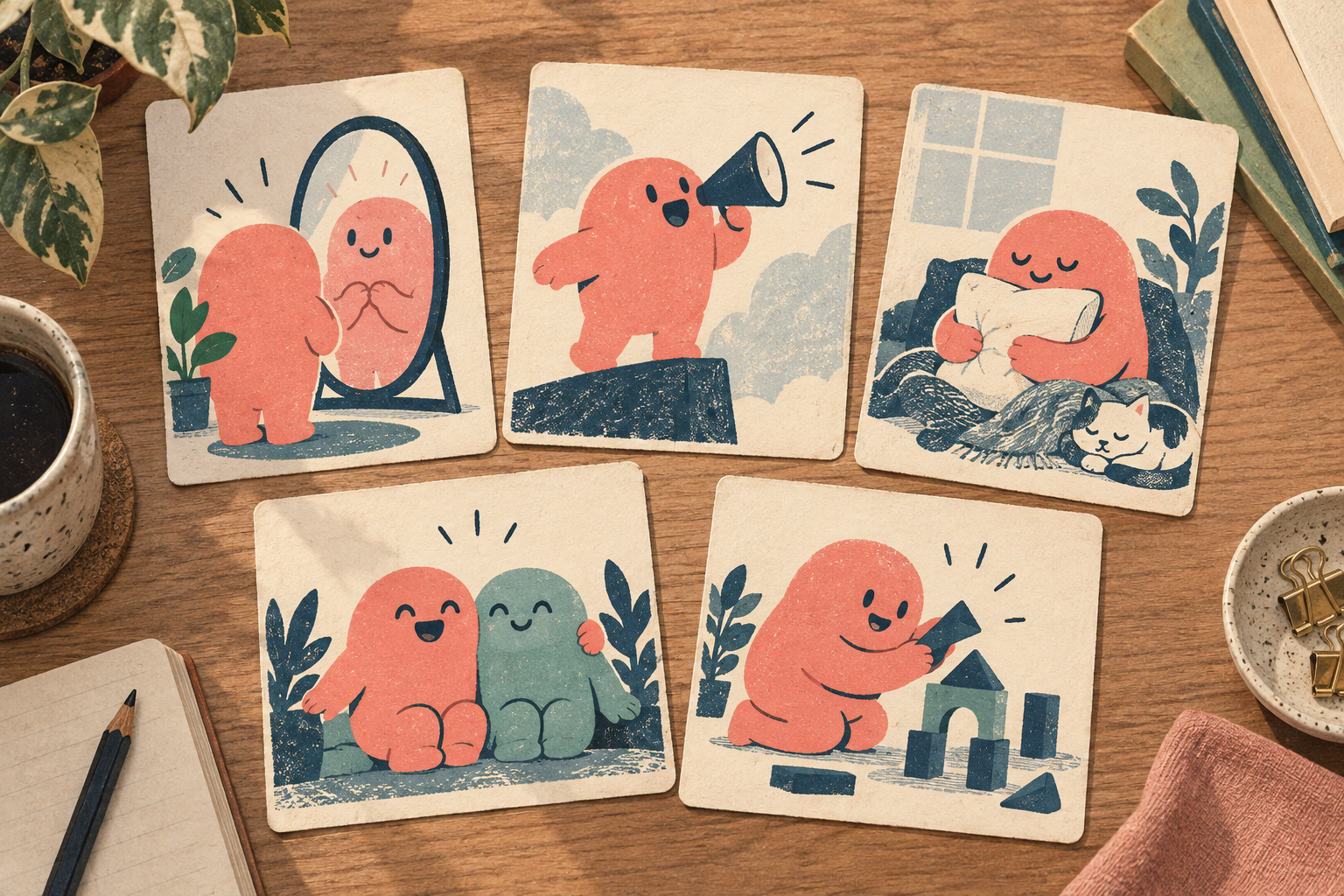
Original editorial illustration: five practical roles a character can play in everyday communication.
Zanmang Loopy: from supporting character to everyday alter ego
Zanmang Loopy is a helpful case because its growth shows how a character can acquire a new social role without losing the underlying personality.
On its official website, rights holder ICONIX now describes Zanmang Loopy as a comedy, slice-of-life and parody property for women aged 20–35. Its character list includes Office Loopy, Student Loopy, Intern Loopy, Developer Loopy and Foodie Loopy—recognisable adult roles that create repeatable situations while keeping one coherent character world. ICONIX calls the property “relatable,” and that word matters more than the costume changes.
A 2024 report published through the Korea Creative Content Agency’s WelCon platform describes how young Chinese users shared Loopy through WeChat stickers to express feelings. It also reports that the IP opened an official Xiaohongshu account in 2023 and portrayed familiar moments such as dreading work, enjoying food and dancing after work. In other words, the character did not merely arrive with products. It arrived with situations in which audiences could recognise themselves.
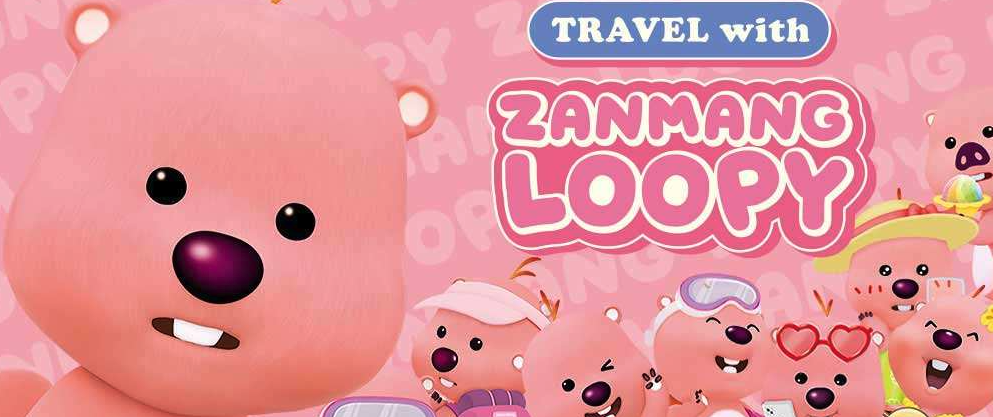
Zanmang Loopy’s travel-themed artwork shows how a consistent character can move into an everyday lifestyle context without losing recognisability. Image supplied for editorial reference; character artwork belongs to its respective rights holder.
Official corporate history shows what became possible around that relevance: ICONIX records a Shanghai pop-up in 2023, further China pop-ups and MINISO flagship stores in multiple Chinese cities in 2024, as well as brand collaborations. These events do not prove that a social account automatically produces licensing success. They illustrate a more credible sequence: a character language becomes familiar, official activity gives that interest a home, and a wider ecosystem of experiences and partnerships can develop around it.
The emotional-utility map for animation IP
For an international rights holder, emotional utility can be planned through five connected layers.
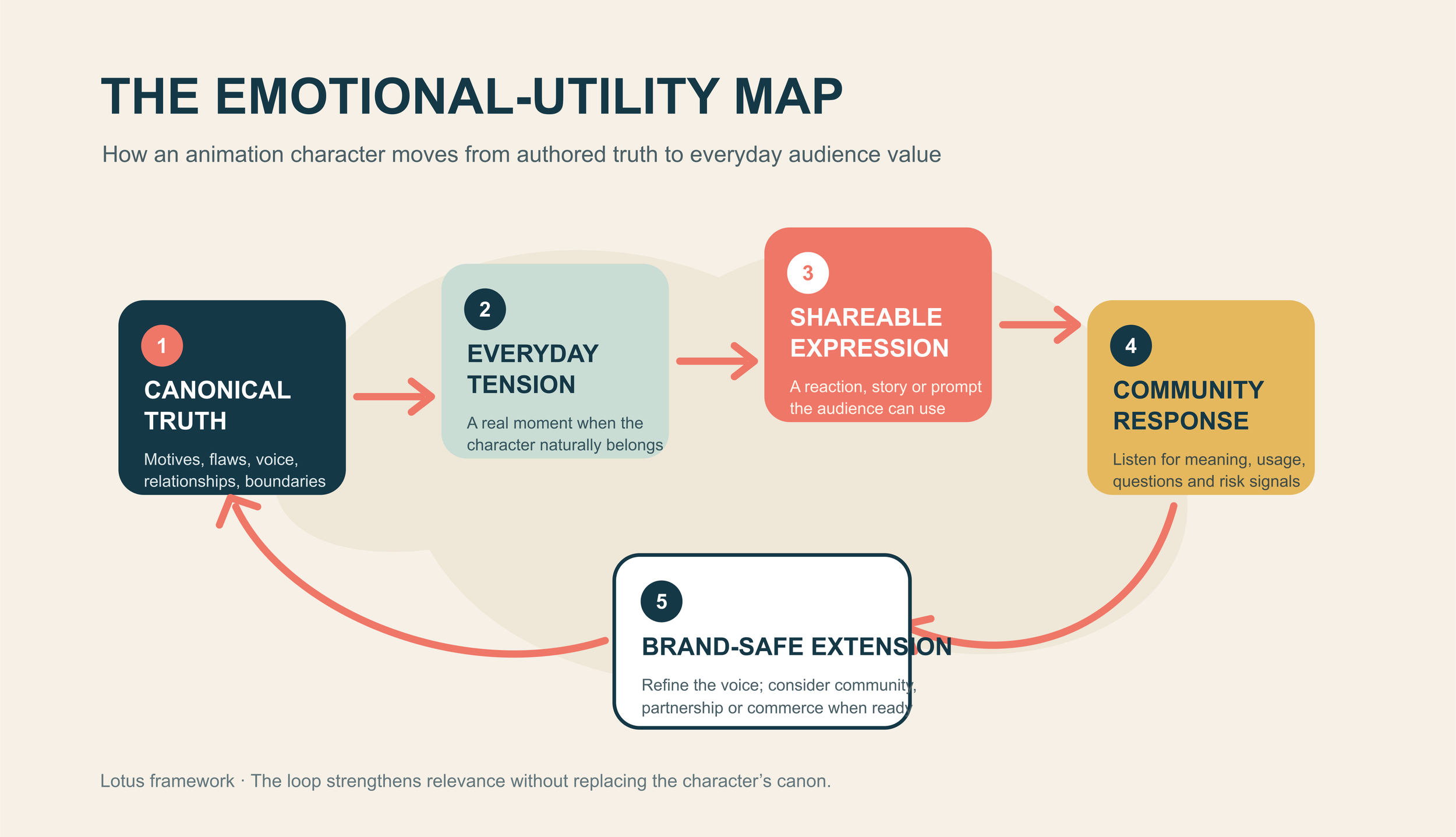
1. Start with canonical character truth
Define the qualities that remain true regardless of platform or market: the character’s desire, flaw, coping style, relationships, speech rhythm and ethical boundaries. A character may be optimistic but easily overwhelmed; competitive yet secretly caring; brave in public and anxious in private. These tensions produce content. A list of adjectives does not.
The local team also needs to know what it cannot change. Which relationships are fixed? Which jokes are unsuitable? Can the character discuss school, work, romance or current events? Which assets and music are cleared for organic posts, creator activity and paid use? Clear boundaries make culturally responsive work safer and faster.
2. Connect that truth to an everyday tension
Do not begin with “What is trending in China?” Begin with “When would someone naturally need this character?”
A perfectionist character may fit the anxiety of sending a final piece of work. A sleepy character may speak to Monday mornings. A loyal pair may help friends celebrate a small success. A dramatic villain may turn a minor inconvenience into a humorous overreaction. The Chinese reference, wording and format should feel current, but the emotional behaviour should still belong to the character.
This is the difference between localisation and costume. Adding a festival prop or a fashionable phrase does not automatically create relevance. Lotus’s Chinese content localisation and production work focuses on adapting the situation, humour and audience invitation while preserving the original IP.
3. Make the expression shareable
Emotional utility needs a format people can use. Depending on the property and permissions, that might be:
a reaction-image set built from canonical expressions;
a short video with a recognisable emotional turn;
an interactive “choose the character’s next move” story;
a WeChat sticker or community response;
a “which character are you today?” prompt;
a sound, line or movement that creators can reinterpret; or
a fan question answered in character.
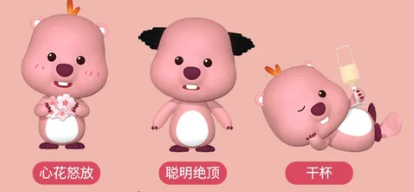
A compact expression set turns one consistent character into multiple usable emotional cues—from celebration to confidence and social connection. Image supplied for editorial reference; character artwork belongs to its respective rights holder.
The best prompt makes participation easy without making the IP generic. It provides enough structure for recognition and enough room for the audience to add themselves.
4. Read community response as evidence
An official Chinese account creates a direct listening point. The comments beneath a post can show whether the emotion landed, but the useful evidence extends further: search terms, saved posts, private-message questions, repeated nicknames, creator interpretations, partner enquiries and the situations in which fans reuse an asset.
That evidence can answer questions a global team may not see from outside China:
Which character is unexpectedly becoming the audience favourite?
Which scene is being used as a shorthand for work, friendship or study?
Are fans reading a relationship differently from the intended canon?
Which Chinese name or line feels most natural?
Where are unofficial sellers, impersonating accounts or unsafe adaptations appearing?
What are potential distributors, retailers or brand partners trying to understand?
This is why Chinese social media management should connect publishing, moderation, cultural interpretation and reporting. Listening is not a monthly screenshot of comments; it is an input into editorial and commercial decisions.
5. Extend carefully into community, partnership and commerce
When a character has a stable social role, merchandise can feel like a continuation of the relationship. A desk item may carry encouragement into the workday. A plush may function as a comfort object. A collaboration may let fans bring the character into fashion, beauty, food or travel.
Sanrio’s public strategy offers a useful reminder that character value can span layers. Its medium-term plan discusses expanding IP portfolios and monetising across multiple layers, while its corporate philosophy centres on connection. The business model is broad, but the audience experience still needs to feel like a meaningful character encounter.
For an international IP entering China, social commerce should therefore be treated as an option, not the opening demand. First establish authenticity, rights control, customer service and partner readiness. Then test whether an authorised product, event or collaboration answers a real fan behaviour. Lotus can support China creator and KOL programmes when a property is ready to extend its story through selected partners.
Each Chinese platform gives emotional utility a different shape
An IP does not need to launch everywhere. It needs a platform mix matched to its audience, assets and operating capacity.
WeChat and WeChat Channels can support stickers, official information, longer stories, mini-program or service connections, and closer community touchpoints. A WeCom-supported private fan group can provide direct interaction and first-party community insight when the team has the consent, moderation and data practices to manage it responsibly.
Douyin is suited to movement, sound, performance and repeatable short-video participation. The character needs a clear visual or emotional beat that survives fast viewing.
Bilibili can give more space to animation clips, lore, production craft, long-form interpretation and fan-made video culture.
Weibo can support public announcements, entertainment conversation, launches and visible fandom moments when the team can maintain an active rhythm.
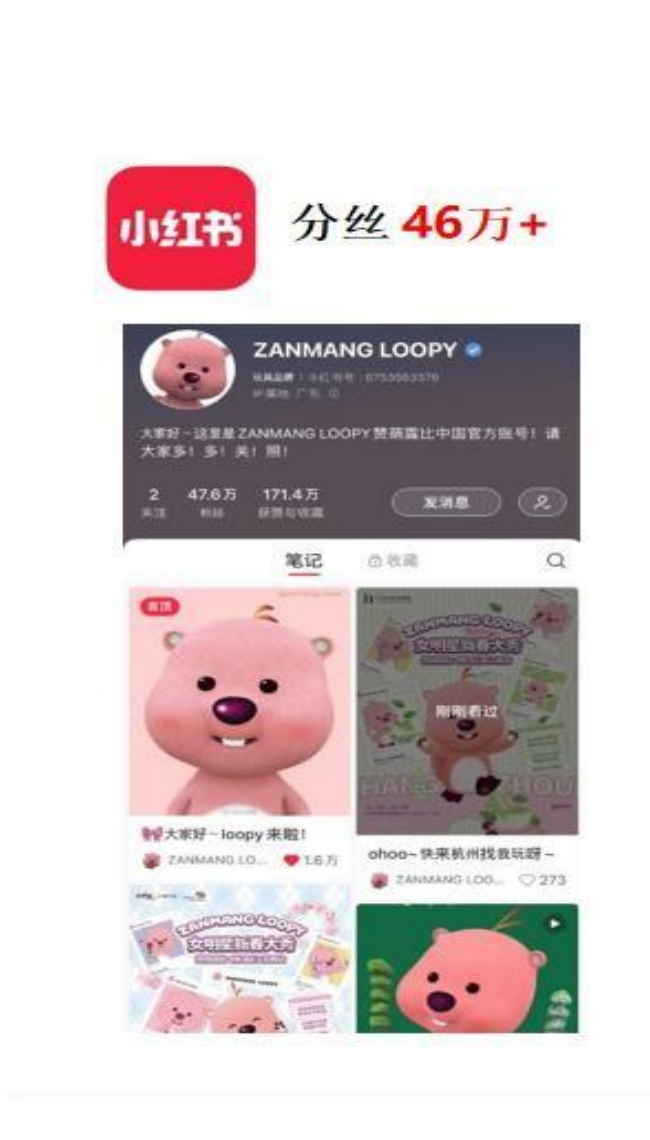
Xiaohongshu (RedNote) can connect the IP with searchable daily-life contexts: collections, desk setups, outfits, gifts, cafés, travel, events and emotional routines.
The same canonical character should be recognisable across all chosen channels, but its job on each channel should be different. Lotus’s guide to choosing Chinese social media platforms provides a broader comparison.
What emotional utility is not
It is not permission to turn a character into an endless anxiety meme. It is not an excuse to trivialise mental health, appropriate fan language or manufacture intimacy with children. It is not a promise that every community interaction will lead to a sale.
Several guardrails are especially important:
Do not flatten the character. A single viral expression should not erase the wider personality and story.
Do not exploit vulnerability. Comfort content should acknowledge feelings without diagnosing, pressuring or making commercial access feel like emotional care.
Do not appropriate fan work. Obtain permission, credit creators and separate inspiration from licensed commercial use.
Do not confuse loudness with representativeness. A viral comment can be useful without representing the whole Chinese audience.
Do not over-promise internally. Social relevance can support awareness, insight and opportunity, but distribution, licensing and sales still require their own expertise.
A readiness check for international animation IP
Before building a China content system, ask:
Can we describe the character’s emotional contradictions in one paragraph?
Do we know where Chinese audiences already mention, watch or trade the IP?
Are Chinese names, terminology and rights rules approved?
Do we have enough editable assets to create local moments without redrawing the canon?
Can our global team review sensitive issues without slowing every everyday post?
Who will answer fans, flag rights risks and route qualified partner enquiries?
What forms of participation are safe for the property and its audience?
If several answers are unclear, the first step may be a China presence and conversation audit—not an account launch.
Frequently asked questions
What does “emotional IP” mean?
It usually describes a character or story world that audiences use to recognise, express or regulate feelings. For strategy, the term is most useful when it leads to specific audience behaviours and clear brand guardrails, rather than simply meaning “cute and relatable.”
Can a children’s animation IP also speak to adults in China?
Sometimes, if the existing character truth supports it and the rights holder clearly separates age-appropriate contexts. Zanmang Loopy demonstrates one possible adult-facing spin-off route, but it should not be copied blindly. An IP may instead use nostalgia, parent-child viewing, craft or behind-the-scenes content.
Should we create WeChat stickers before opening an official account?
Stickers can make a character useful in conversation, but the rights, design, approval, distribution and community-response plan should be considered together. If attention grows, audiences and partners should be able to find an authentic official destination.
How can an official account support licensing or distribution?
It gives potential partners a credible place to see the IP’s local voice, audience response and authorised activity. It can also route enquiries and reduce confusion around unofficial accounts. It is supporting evidence, not a substitute for rights packaging, negotiation or due diligence.
Which signals matter before commerce?
Look for repeat use, substantive comments, saves, shares, branded search language, community-created associations and qualified questions—not only follower count. The point is to learn whether the character has a durable role in people’s lives.
Make the character useful without making it generic
The most promising China opportunity is rarely “become more cute.” It is to help audiences recognise when the character belongs in their day: the moment before an exam, the relief after work, the joke shared with a friend, the quiet reassurance of a familiar face.
Lotus is a China-based bilingual team helping international animation studios, character owners and entertainment rights holders understand existing Chinese traction, choose the right social platforms, localise the character voice, build recurring content, manage fan interaction and turn local insight into clearer global decisions.
Talk with Lotus about the emotional role your animation IP could play in China.
