

WeCom for Retail and DTC Brands in China: After-Sales, VIP Service and Repeat Purchase
Retail and direct-to-consumer brands should use WeCom to manage the relationship after a customer buys: delivery questions, product advice, returns, care, replenishment and relevant VIP follow-up. The commercial opportunity comes from solving real post-purchase needs well enough to earn repeat engagement—not from adding every buyer to a broadcast list.
This article is for international beauty, fashion, wellness, consumer goods, food, home and lifestyle brands building retention in China. Lotus Social Agency’s WeCom service helps connect WeChat and commerce entry points with Chinese content, customer operations, governance and measurement.
Why post-purchase is the strongest starting point
Many international brands approach WeCom as an acquisition channel. Yet a new customer may have a clearer reason to connect after purchase: confirm delivery, understand a product, solve a problem, arrange a return, receive care guidance or plan replenishment.
That service value gives the brand permission to build a longer relationship. It also exposes the operational problems that determine retention:
order questions have no visible owner;
store, ecommerce and service teams provide different answers;
product education is not adapted to Chinese customers;
returns are handled outside a traceable process;
VIP outreach is based on spend alone, not relationship context;
customers receive promotions while an unresolved issue remains open;
staff turnover breaks follow-up;
CRM, commerce and conversation records do not agree.
Tencent describes WeCom as enterprise communication integrated with Weixin chats, Mini Programs and payments. Tencent has also published retail examples involving product and after-sales consultation through WeCom-supported customer operations. These examples demonstrate possible patterns, not guaranteed outcomes.
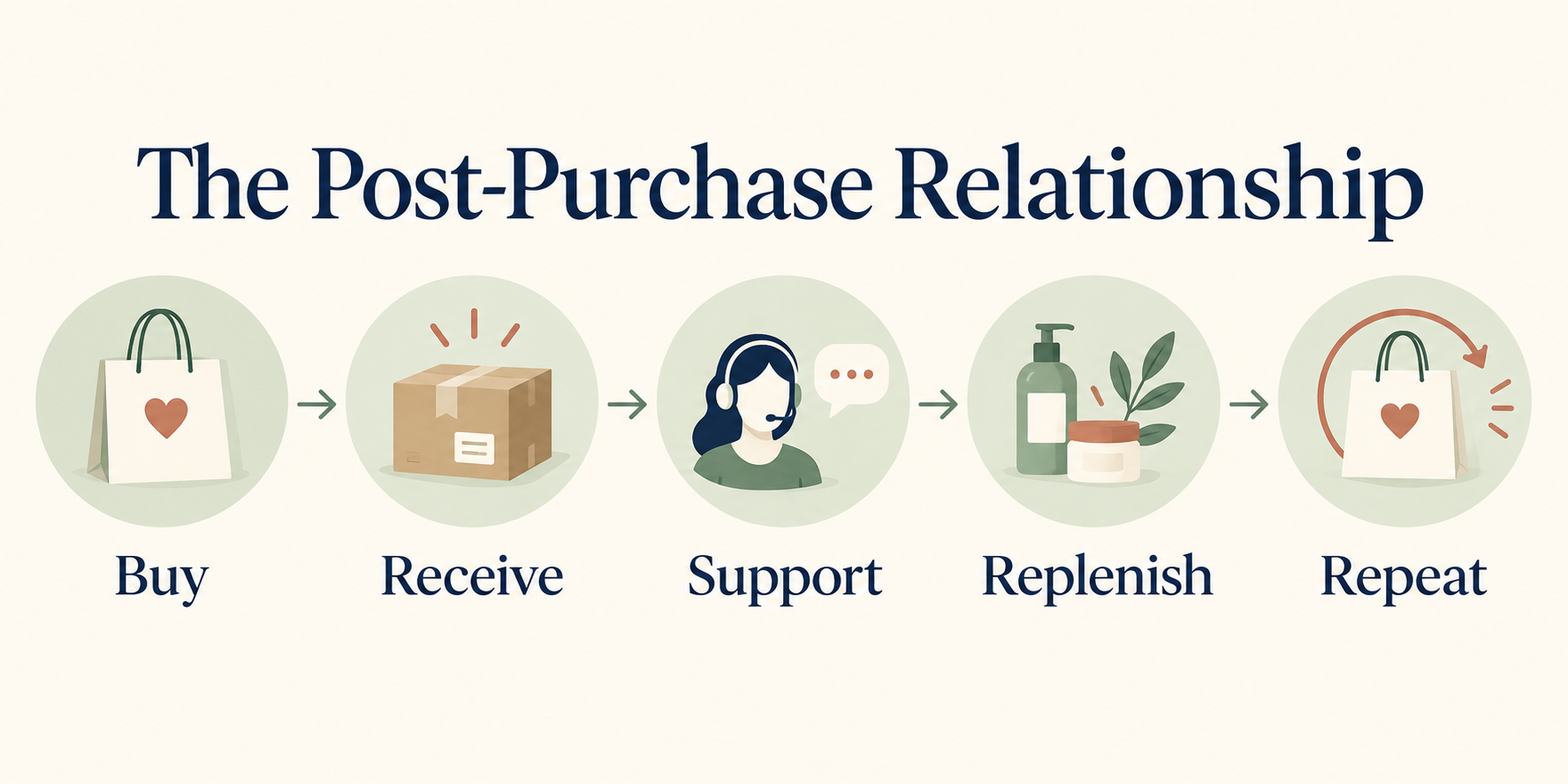
The post-purchase relationship
Buy: set the expectation at the right moment
Invite a customer into WeCom only when there is a clear service or relationship benefit. The invitation may appear in a store, Mini Program, order confirmation, packaging, event or customer-service interaction, subject to current platform and business requirements.
State:
who the customer will be speaking with;
what help or content is available;
whether the relationship is one-to-one, group-based or service-queue based;
how the customer can change communication preferences;
which transactions or records remain in other systems.
A generic “join our private traffic” invitation describes the brand’s objective, not the customer’s value.
Receive: prevent delivery uncertainty from becoming churn
After purchase, customers may need status, address correction, delivery coordination or damaged-package support. Route each question to an owner and draw status from the authoritative order or logistics system where possible.
WeCom should not become a place for staff to manually invent delivery dates or accept uncontrolled address changes. Define which actions can happen in chat, which require identity or order verification, and which must continue in the commerce or support system.
Support: combine speed with resolution
Fast acknowledgement matters, but the useful measure is whether the customer reaches the right next step. Separate order help, product advice, returns, care and complaint escalation.
Build a Chinese response library with:
product use and care guidance;
sizing, compatibility or ingredient information where appropriate;
order and delivery explanations;
return and exchange routes;
warranty or repair boundaries;
escalation triggers;
language for delays, uncertainty and correction.
Regulated, medical, safety-related or legally sensitive claims should go to qualified specialists. An agency or frontline operator should not improvise them.
Replenish: use timing and context, not blanket frequency
Replenishment can be useful for consumable or repeat-use products, but the appropriate timing varies by product, purchase size and actual customer need. Use a conservative rule and let customers adjust preferences.
A helpful reminder might include practical guidance, an easy path to ask a question and a relevant purchase route. Avoid implying that the brand knows consumption or personal circumstances it cannot reliably infer.
Repeat: earn relevance across the relationship
Repeat purchase may follow good service, product satisfaction, useful content, a considered invitation or an advisor relationship. The journey should recognize open problems before promotion. A customer with an unresolved return should not receive a generic sales push from another team.
Segment by service and relationship context as well as transaction history:
new customer needing onboarding;
active service or return case;
likely replenishment window;
category interest based on reliable behavior;
VIP relationship with a defined service promise;
inactive customer needing a respectful review;
customer who has reduced or withdrawn communication preference.
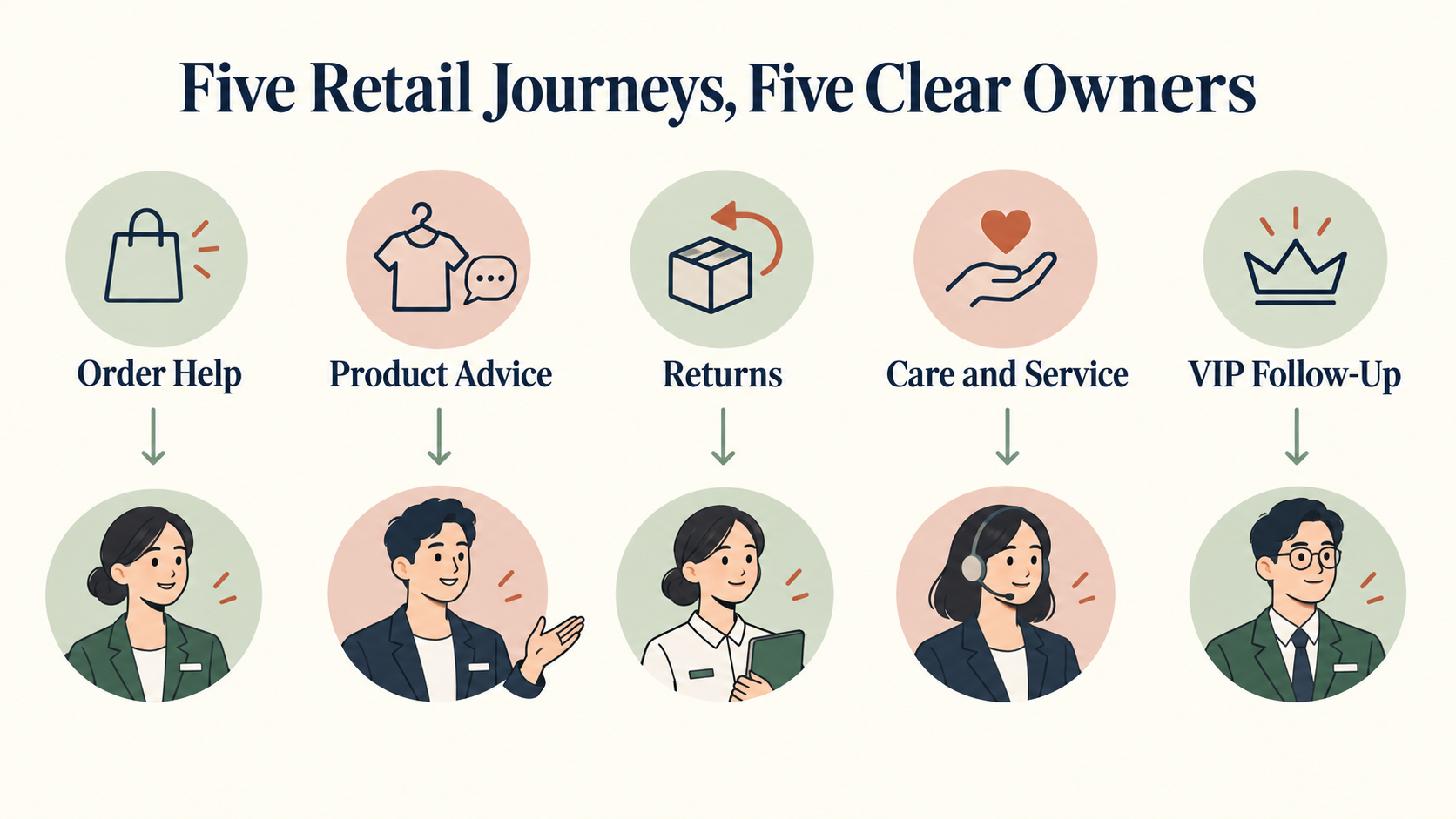
Customers experience one brand, but the operation still needs distinct owners for different kinds of work.
Five journeys need five clear owners
Order help
Owner: ecommerce operations or customer service. Source of truth: order and logistics system. Measure: correct status and completed next action.
Product advice
Owner: trained advisor or product specialist. Source of truth: approved product knowledge. Measure: useful answer and appropriate next step.
Returns
Owner: returns or customer-service process. Source of truth: commerce or case system. Measure: eligibility decision, communication and completion—not message count.
Care and service
Owner: qualified service team. Source of truth: service record and controlled guidance. Measure: resolution, recurrence and customer effort.
VIP follow-up
Owner: assigned advisor or clienteling team. Source of truth: defined customer relationship record. Measure: relevant engagement, appointment or repeat value where attribution is reliable.
Connect WeChat, WeCom and commerce deliberately
The Weixin ecosystem may include Official Accounts, Mini Programs, Channels, Search, payments and messaging. WeCom can support employee-to-customer communication within that wider journey. Each touchpoint should have one purpose:
content creates discovery and product understanding;
commerce records product, order and transaction activity;
WeCom supports human relationship and service;
CRM or SCRM may coordinate profiles, segmentation and workflows;
support tools may hold authoritative cases;
analytics combines defined evidence.
WeCom does not automatically replace CRM, SCRM, commerce or support platforms. Integration must define identity, fields, data direction, errors, access and ownership.
Measure retention without forcing attribution
Entry and audience
eligible purchasers invited;
connection or journey-entry rate;
source, product and cohort mix;
customer-stated reason for contact.
Service and operations
time to correct owner;
first useful response;
resolution and completion;
repeat contact for the same issue;
escalation and complaint patterns;
unresolved cases before promotion;
handover completion.
Relationship and commerce
useful repeat engagement;
replenishment or appointment progression;
repeat purchase where matching is reliable;
retention or reactivation signals;
opt-out, inactivity and message-fatigue signals.
Do not claim that WeCom caused repeat revenue because it appeared in the journey. State the identity and attribution method, and report blind spots.
Governance and customer choice
Define enterprise ownership, administrator access, frontline roles, content approval, data handling, service escalation and employee offboarding. Tencent states that customer relationships can be preserved at the company level when employees move, but brands should test the transfer process and not assume every message, attachment or internal note moves automatically.
Personal information, transaction data and customer preferences require purpose, access and retention controls. Use qualified legal, privacy and security specialists for the actual design, including third-party and cross-border data questions.
Common retail mistakes
Adding every customer without a clear service promise.
Sending promotions while a service problem is unresolved.
Measuring contacts and messages instead of completed journeys.
Letting stores, ecommerce and customer service give conflicting answers.
Treating VIP as a discount segment rather than a service model.
Using purchase data for outreach without appropriate expectation and governance.
Building CRM/SCRM integration before defining the workflow.
Allowing personal accounts to hold critical relationships.
Assuming relationship continuity transfers all message history.
Automating sensitive product or complaint responses.
How Lotus supports retail and DTC WeCom operations
Lotus can help international brands map post-purchase journeys, design WeChat-to-WeCom entry, support setup and governance, create Chinese product and service content, establish routing and escalation, operate customer or community programs, coordinate CRM/SCRM requirements and report on retention.
This can connect with China social media management when acquisition content, campaigns and post-purchase relationships need one coherent plan.
Frequently asked questions
Is WeCom useful after an ecommerce purchase?
Yes, when the customer receives clear value such as delivery help, product guidance, service, replenishment or relevant follow-up. It should complement the commerce system, not replace authoritative order records.
Should retail brands create customer groups?
Only for a defined purpose and audience that the brand can manage. One-to-one or service-queue journeys may be more appropriate for order, return or sensitive cases.
Can WeCom replace a CRM or loyalty platform?
Not automatically. WeCom supports communication and may integrate with other systems. Profiles, transactions, entitlements, segmentation and loyalty logic still require an explicit source of truth.
How does WeCom support repeat purchase?
It can help employees provide useful post-purchase service, education, replenishment support and relevant personal follow-up. Repeat purchase still depends on product, experience, price, availability and wider marketing.
What happens when a store advisor leaves?
Transfer active relationships, appointments, service cases and promised actions to a named owner. Confirm what conversation context is available and do not assume every historical message or file transfers automatically.
Make retention a service outcome
WeCom gives retailers a way to maintain customer relationships after purchase, but the relationship must remain useful. Clear ownership, Chinese content and connected commerce and service workflows turn communication into retention value.
If your brand wants to improve post-purchase service and repeat engagement in China, talk to Lotus about a retail WeCom operating model. We can help design the first journey, content, routing and measurement before you scale.
