

WeCom for Industrial Manufacturers in China: Distributor and Service Communication
WeCom can help an international manufacturer in China create a managed communication loop between the manufacturer, distributors, customer sites and service teams. The highest-value use is not generic lead broadcasting. It is routing technical and commercial requests to accountable owners, preserving follow-up, supporting partner enablement and feeding recurring field issues back into the business.
This article is for industrial equipment, automation, components, chemicals, materials and other B2B manufacturers expanding through China distributors or field-service networks. Lotus Social Agency’s WeCom service can connect partner and customer journeys with Chinese content, daily operations, governance and measurement.
Why industrial communication breaks as the channel grows
Manufacturers often enter China with a small direct team and several external partners. As the channel expands, important context becomes scattered across personal messages, email, spreadsheets, CRM records, calls and distributor groups.
Typical problems include:
a product question reaches sales but not the right engineer;
a customer site receives conflicting answers from a distributor and manufacturer;
quote or order status is not visible to the person who must act;
warranty and service requests are mixed with sales conversations;
technical documents circulate without clear version control;
headquarters cannot see recurring field issues;
a departing employee or partner takes relationship context with them;
distributors receive content but not a reliable escalation path.
WeCom can provide an enterprise communication layer for employees and external contacts who use Weixin. Tencent also describes address-book and external-connection capabilities for suppliers and distributors. However, the platform does not decide channel policy, certify technical answers or replace ERP, CRM, service management or responsible engineering teams.
The industrial communication loop
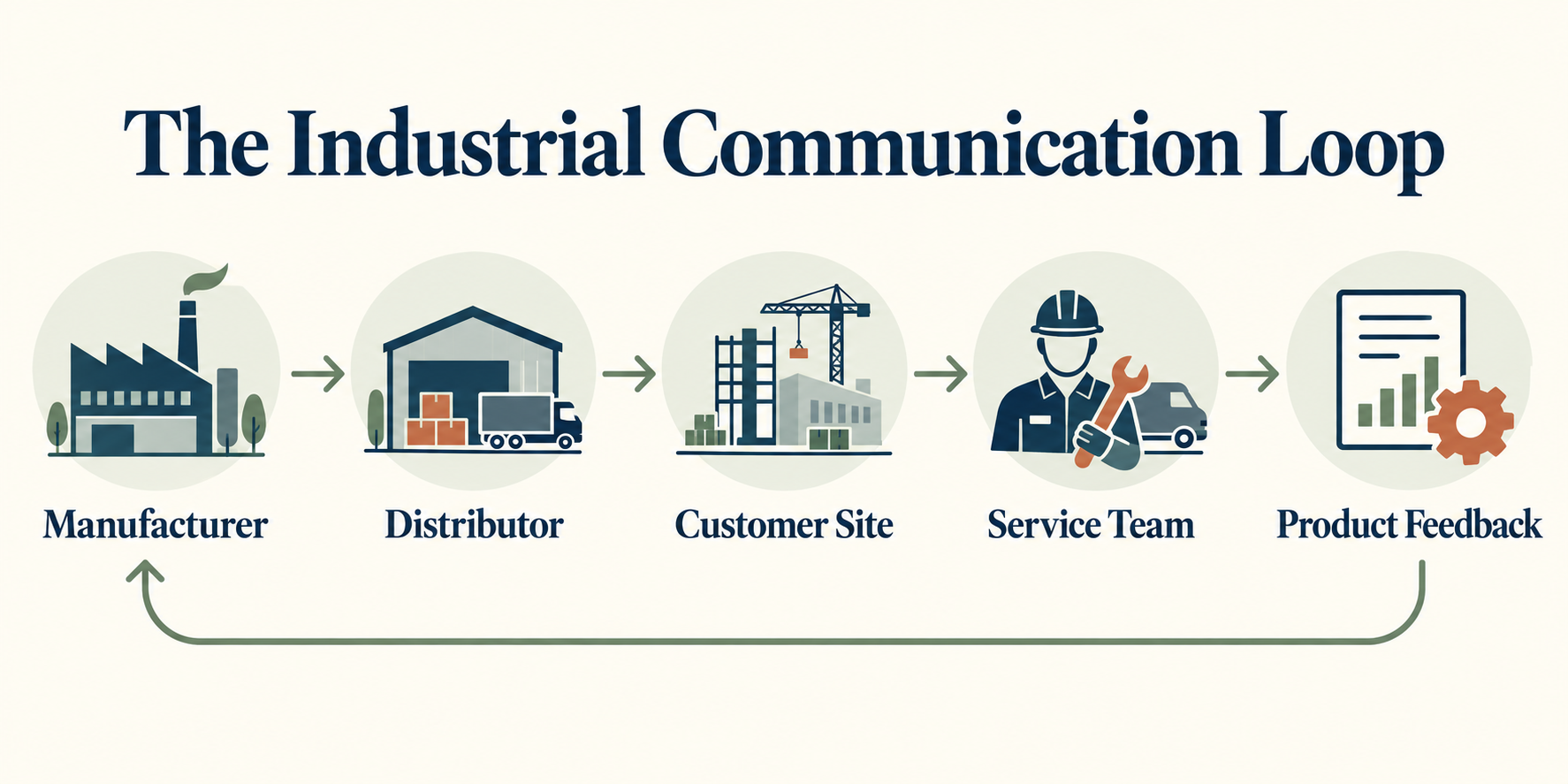
1. Manufacturer to distributor: enable the channel
A manufacturer can use defined WeCom groups or one-to-one relationships to support product updates, campaign coordination, training, documentation and escalation. The goal should be partner capability, not message volume.
Build a distributor enablement kit with:
approved Chinese product summaries;
current technical and sales documents;
qualification and application questions;
rules for pricing and quote requests;
training schedule and learning material;
named commercial and technical escalation owners;
change notices and withdrawn-document procedure;
response expectations and urgent-case route.
Different distributor roles need different information. Salespeople, application engineers, service technicians and owners should not automatically receive the same content or access.
2. Distributor to customer site: keep the route transparent
The distributor may own the day-to-day relationship while the manufacturer supplies specialist support. Define when the manufacturer is introduced, who remains the commercial owner and what the customer should expect.
Avoid silent handoffs in which a customer asks one person and receives an unexplained reply from another. A clear introduction builds trust and reduces duplicate questioning. Record the responsible organization and next action in the system chosen as the source of truth.
3. Customer site to service team: capture what is needed
A service journey should guide the customer to provide enough context for triage without requesting unnecessary or sensitive information. Depending on the equipment and policy, the minimum may include site, product or asset reference, symptom, urgency, operating conditions, safety status and contact availability.
WeCom can support the conversation and the movement of approved material, but safety-critical, regulated or contractual decisions must follow the manufacturer’s formal process. A chat exchange should not bypass emergency procedures, warranty terms or qualified engineering review.
4. Service team to product feedback: make field learning usable
Recurring questions and faults should not disappear after individual resolution. Create a governed feedback process that distinguishes:
documentation gaps;
training needs;
installation or operating error;
product quality concerns;
feature requests;
channel-policy problems;
cases needing formal quality or regulatory handling.
Tencent has published a manufacturing case describing service engineers using WeCom-based workflows for training, product feedback and issue resolution, alongside integration with enterprise systems. It illustrates a possible pattern, not a guaranteed result or a universal architecture.
Route every request to an owner
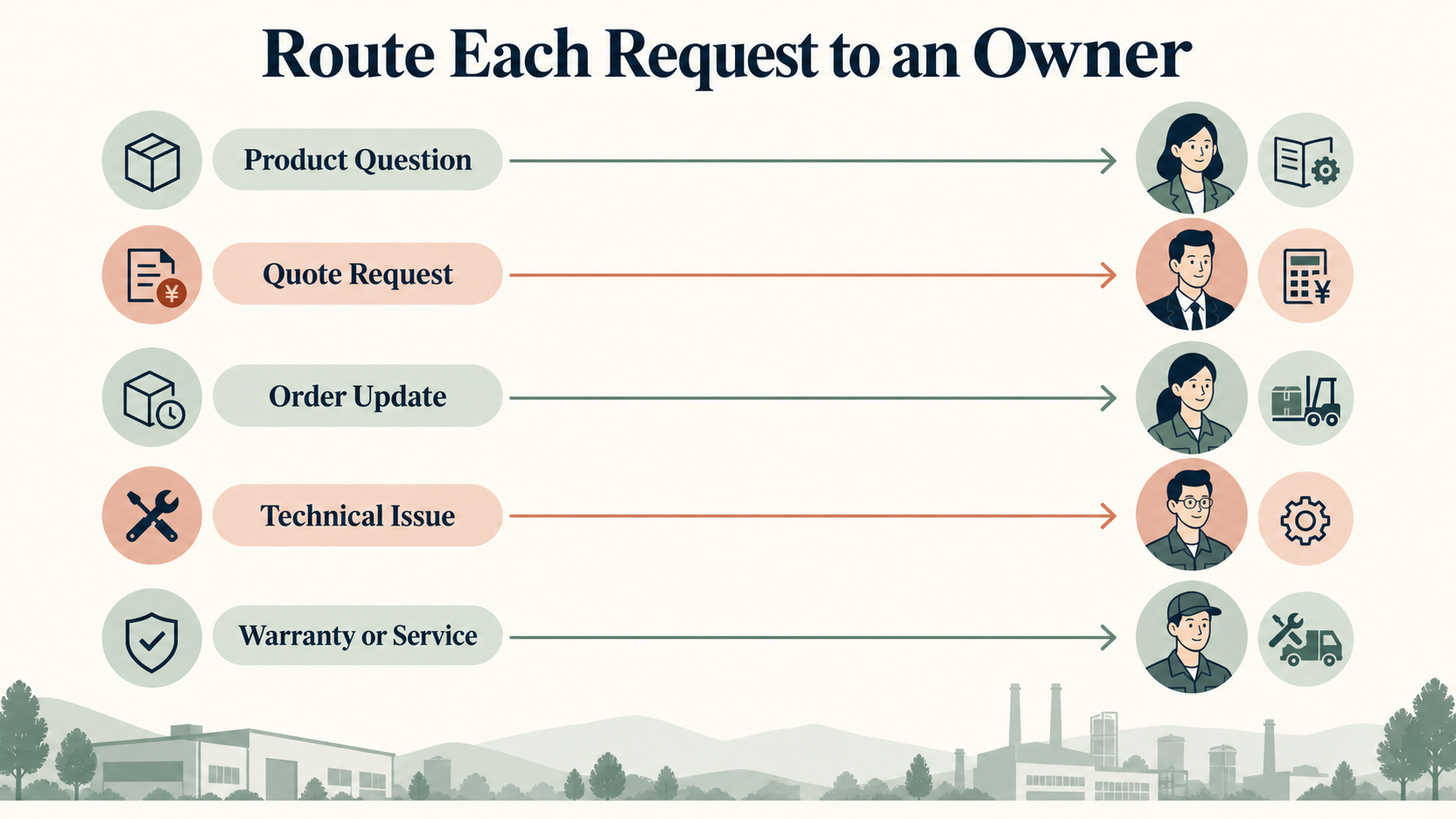
Product question
Route general product and application questions to an approved commercial or application resource. Define which claims need engineering or regulatory confirmation.
Quote request
Route to the commercial owner while recording distributor, customer, product, quantity, timing and opportunity context in the appropriate system. Do not allow chat to become the only quote record.
Order update
Route to order management or the distributor owner. Use authoritative ERP or fulfillment data where available, and avoid manually promising dates that have not been confirmed.
Technical issue
Route according to product, site, severity and required expertise. Acknowledge quickly, but distinguish acknowledgement from diagnosis or resolution.
Warranty or service
Route through the formal warranty and service process. Capture entitlement, evidence, safety considerations and next action without making informal commitments outside policy.
Design the ownership model
For each journey, define:
business owner;
frontline responder;
distributor contact;
commercial escalation;
technical escalation;
service owner;
content or document owner;
data and system owner;
platform administrator;
backup for every critical role.
A group name such as “China Technical Support” is not an ownership model. State which person or queue is responsible, the expected next action and when a case becomes overdue.
What belongs in WeCom—and what does not
Good contact
customer and partner communication;
qualification and triage;
appointment and site-visit coordination;
links to current approved documents;
training reminders and follow-up;
escalation acknowledgement;
status communication drawn from an authoritative system;
feedback capture and routing.
Keep authoritative elsewhere
final contracts and controlled commercial approvals;
ERP order and inventory records;
formal quality, safety and regulatory records;
complete CRM opportunity history where CRM is the source of truth;
service-management records required by policy;
technical drawings and documents under formal version control;
sensitive data not necessary for the conversation.
A 60- to 90-day industrial pilot
Choose one product line, distributor cohort, region or service use case.
Prepare
Audit current groups, personal accounts and system handoffs.
Choose one measurable communication problem.
Map five to ten common request types.
Assign routing and escalation owners.
Prepare Chinese content and controlled documents.
Confirm account, access, data and legal requirements.
Test joiner, mover and leaver procedures.
Operate
Launch to a controlled group.
Review unanswered and misrouted requests frequently.
Track repeated questions and document gaps.
Sample response accuracy and handover quality.
Record where ERP, CRM or service-system context is missing.
Change one workflow element at a time.
Decide
Scale only when the journey reaches the right partners or customers, routing is reliable, technical answers are controlled, the team has capacity and the next integration or cohort has a clear case.
Measure what the channel can act on
Useful measures include:
relevant partners or customers entering the journey;
request mix by product, distributor, region and source;
time to correct owner;
first useful response, not only first reply;
quote, service or technical next-step completion;
unresolved and overdue requests;
repeat issues and root-cause category;
document or training gaps;
distributor participation and coverage;
transfer completion when staff or partners change.
Commercial outcomes may include qualified opportunities, quote progression and sales where attribution is reliable. Service outcomes may include resolution, downtime-related milestones or repeat-issue reduction where the required data is available. Do not promise a benchmark or treat correlation as causation.
Governance for manufacturer–distributor programs
Distributor communication involves more than one organization. Document account and group ownership, administrator access, approved participants, confidentiality expectations, content approval, customer introductions, data responsibilities and exit handover.
Tencent states that customer relationships can be company-owned and preserved when employees move. The manufacturer should still test what transfers and what remains accessible; this should not be described as automatic transfer of every message, file or internal note.
Personal-information, confidential-business-information and cross-border data questions require appropriate legal, privacy and security review. Collect only information needed for the use case and do not place controlled technical material in channels that lack the required access rules.
Common industrial WeCom mistakes
One large group mixes sales, service and technical support.
Distributors receive promotional content but cannot escalate a real issue.
Engineers answer outside an approved claim or document process.
Chat becomes the only record for quotes, orders or warranties.
Everyone has broad access “for convenience.”
The CRM or ERP integration is described without fields or ownership.
Service acknowledgement is reported as resolution.
Personal accounts retain critical customer relationships.
Employee or distributor exits have no handover.
The program measures message activity rather than closed loops.
How Lotus supports industrial WeCom operations
Lotus can help an international manufacturer audit its partner and customer journeys, design routing and escalation, support account setup and governance, create Chinese enablement content, establish operating procedures, train teams and build an actionable reporting framework. Lotus can coordinate with ERP, CRM, SCRM, service, legal, privacy, security and engineering specialists without pretending that a marketing agency replaces them.
The program can also connect with China social media management when product education, events and demand generation need a structured handoff to distributors or sales teams.
Frequently asked questions
Can WeCom be used with distributors in China?
Yes, WeCom can support communication with external partners and customers, subject to current platform capabilities and the organization’s configuration. The manufacturer must define channel ownership, approved participants, information boundaries and escalation.
Does WeCom replace a distributor portal?
Not necessarily. It can make communication more immediate, while a portal or controlled repository may remain authoritative for documents, orders, entitlements and formal records.
Can WeCom connect with ERP or CRM?
Tencent describes an ecosystem of applications and APIs, but feasibility depends on the systems, permissions, data model and current technical requirements. Integration should be designed and tested; it is not automatic.
Who should respond to technical questions?
Use a routing model based on product, issue and risk. Frontline teams can handle approved questions, while complex, safety-critical, regulatory or contractual matters go to qualified owners.
What happens when a distributor or employee changes?
Transfer active relationships, groups, open requests, promised actions and relevant records before removing access. Verify the actual workflow and do not assume all chat history or internal context transfers automatically.
Turn communication into a managed service loop
Industrial WeCom programs create value when a partner or customer can reach the right person, receive a reliable next step and help the manufacturer learn from the field. The operating loop matters more than the feature list.
If your China channel has fragmented follow-up or unclear service ownership, talk to Lotus about an industrial WeCom pilot. We can map the partner journey, Chinese content, routing, governance and reporting before the program scales.
