

WeCom for Franchise and Multi-Location Brands in China: Local Service With Central Control
WeCom can help franchise and multi-location brands in China give customers a local human relationship while central teams maintain enterprise ownership, approved content, data rules, escalation and reporting. The operating principle is simple: centralize standards and learning, localize service and accountability.
This article is for international retail, food and beverage, fitness, automotive, beauty, healthcare-adjacent, education-adjacent and service brands expanding across locations. It focuses on the organization model, not on any single industry’s regulated advice. Lotus Social Agency’s WeCom service can help design location journeys, governance, Chinese content, operating procedures and measurement.
Why multi-location WeCom programs become inconsistent
Customers experience one brand, but the operation may involve headquarters, a China office, regional managers, franchisees, stores, service teams and agencies. Without clear design, each location creates its own account habits, content, response rules and data records.
Common problems include:
customer invitations use different promises at each location;
one location responds quickly while another leaves enquiries unowned;
staff use personal accounts because enterprise roles are unclear;
local teams improvise pricing, product or policy claims;
a customer moving cities cannot transfer the relationship smoothly;
central campaigns ignore local stock, capacity or service reality;
headquarters sees total contacts but not local quality;
a franchisee or employee exit leaves access and records unresolved.
Tencent describes WeCom as an enterprise communication platform integrated with Weixin and states that customer relationships can be owned by the company. Those capabilities can support consistency, but central control still depends on ownership, configuration and daily management.
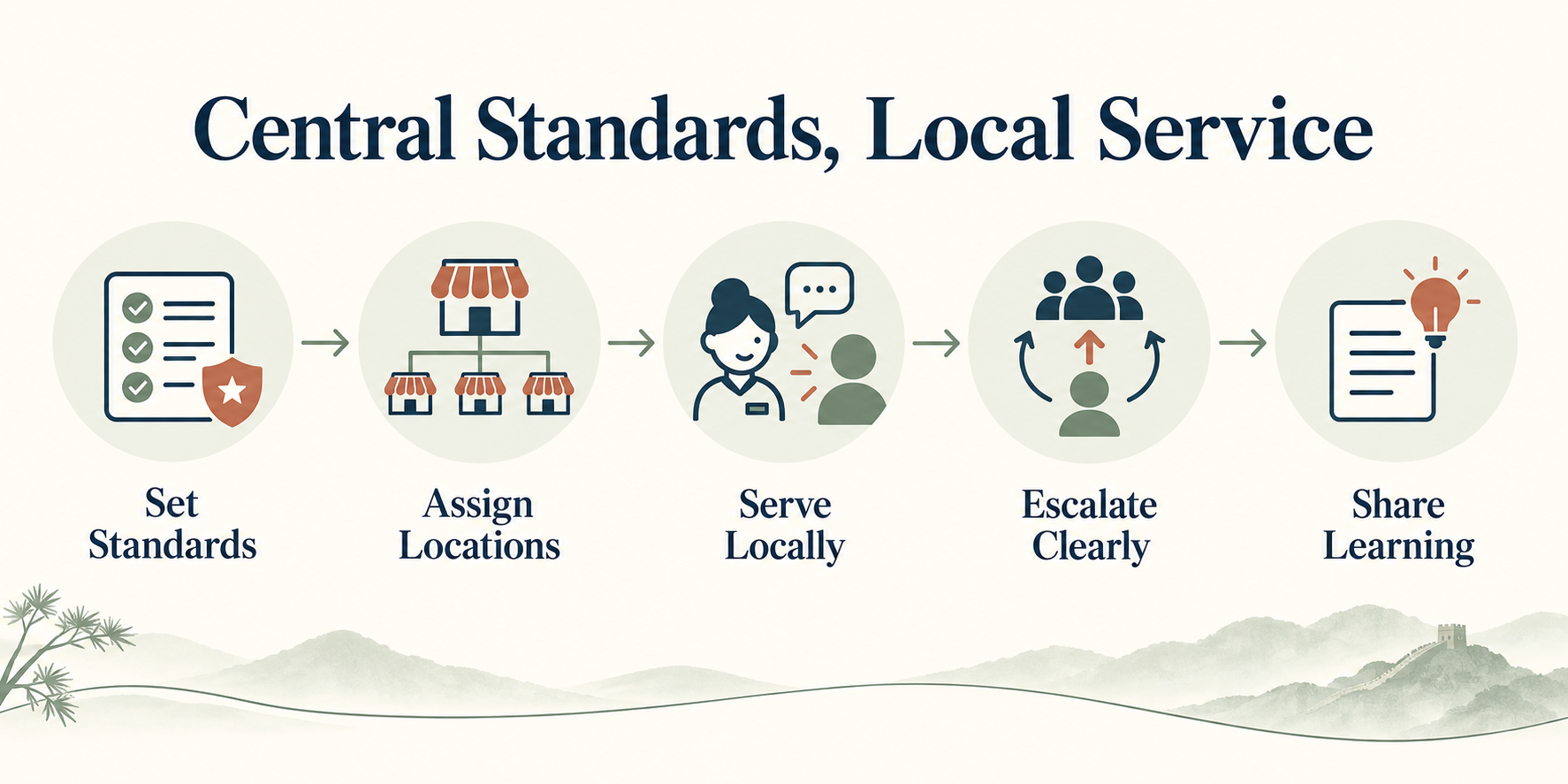
Central standards, local service
Set standards
The central team should define the non-negotiable parts of the customer experience:
enterprise and administrator ownership;
approved customer-entry language;
brand identity and employee profiles;
service categories and escalation rules;
Chinese content system and approval states;
privacy, security and data-handling principles;
access and employee-lifecycle procedures;
common measurement definitions;
franchise or agency responsibilities;
handover and exit requirements.
Standards should be specific enough to guide action and short enough for frontline teams to use. A long policy without operational examples will be replaced by local improvisation.
Assign locations
Decide how customers, conversations, groups and campaigns are associated with a store or service location. Assignment can reflect the customer’s choice, geography, purchase, appointment, service case or existing relationship.
Avoid automatic geographic assumptions when the customer may prefer another location or needs a specialist. Provide a route for reassignment and an introduction to the new owner.
For each location, record:
responsible manager and backup;
authorized employees and agency users;
business hours and response coverage;
products or services supported;
local entry points and campaigns;
escalation contacts;
open capacity constraints;
approved local content variations.
Serve locally
Local teams understand appointments, inventory context, staff availability, events, neighbourhood patterns and recurring customer questions. Give them an approved response framework rather than forcing every interaction through headquarters.
Local discretion can include:
arranging an appointment;
answering an approved common question;
sharing location-specific information;
acknowledging and routing a service issue;
selecting relevant content from an approved library;
following up on a promised next action.
Local discretion should not include unapproved legal, medical, financial, safety, product-performance or contractual claims. Define when the employee must stop and escalate.
Escalate clearly
Escalation should reflect issue type and urgency, not organizational politics. Map common categories such as product information, complaints, service, returns, pricing, technical issues, safety, privacy and media enquiries.
For each category, define:
first owner;
information needed;
response expectation;
receiving specialist;
who updates the customer;
authoritative case or record;
completion criteria.
An escalation is not complete when a message is forwarded. It is complete when the receiving owner accepts responsibility and the customer receives a clear next step.
Share learning
Central teams should review recurring questions, local workarounds, complaints, content gaps, capacity and successful practices. Learning should improve standards, content and training without erasing useful local differences.
Create a simple monthly loop:
locations submit repeated issues and missing content;
central owners categorize and prioritize them;
specialists correct facts or processes;
the approved library and training are updated;
locations receive a concise change notice;
reporting checks whether the issue recurs.
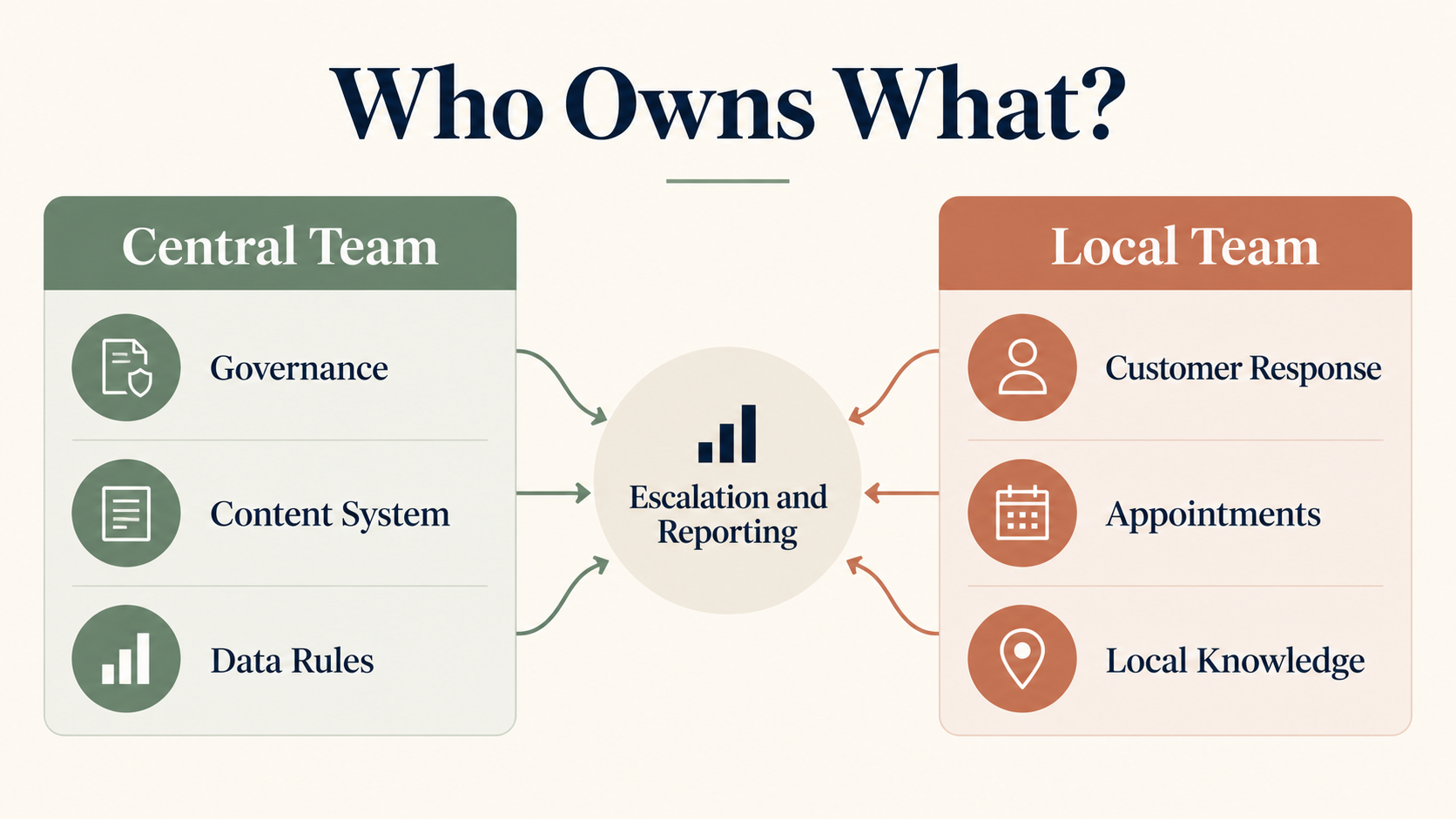
Who owns what?
Central team
Governance: enterprise ownership, administrator policy, agency and franchise access, joiner–mover–leaver controls and material risk decisions.
Content system: brand voice, approved Chinese assets, core FAQs, prohibited claims, campaign toolkits and expiration or withdrawal.
Data rules: purpose, minimum fields, source of truth, system access, retention, third-party roles and cross-border review.
Local team
Customer response: timely, accurate conversation within approved boundaries and a named next action.
Appointments: location capacity, confirmation, changes, arrival information and handoff to the responsible employee.
Local knowledge: opening details, events, service context, local demand and recurring customer needs.
Shared
Escalation and reporting: correct ownership, customer update, root cause, performance definitions, learning and resource decisions.
Choose the right account and group structure
Do not copy the organization chart directly into WeCom. Design around customer journeys.
Possible patterns include:
one centrally governed enterprise with location-based teams;
named location advisors for high-touch journeys;
service queues for general enquiries;
temporary groups for events or programs;
specialist groups for approved use cases;
central overflow or escalation coverage.
Exact configuration and eligibility depend on current product rules and the brand’s entity and operating model. Confirm the appropriate setup before promising a national design.
Build a location launch kit
Each location should receive:
role and access checklist;
employee profile standard;
customer invitation and welcome messages;
current Chinese FAQ and content library;
local-edit rules and approval route;
response and escalation procedure;
appointment and service templates;
incident reporting route;
data and privacy guidance;
training scenarios;
performance definitions;
staff handover checklist.
Require a short readiness test before the location launches. A checkbox confirming “training completed” is less useful than role-play of a real customer journey and escalation.
Pilot before national rollout
Choose locations that expose meaningful variation—perhaps one high-volume site and one smaller site—without making the pilot unmanageable.
Test:
invitation and customer entry;
location assignment and reassignment;
response and backup coverage;
appointment or service completion;
content use and local adaptation;
central escalation;
CRM/SCRM or other system handoff;
employee change and relationship transfer;
reporting quality;
franchise or agency exit scenarios.
Scale only when the operating model survives real absences, busy periods, edge cases and handovers.
Measure consistency and local value
Customer and journey measures
relevant entries by location and source;
time to correct location or owner;
appointment, service or next-step completion;
customer complaints and repeated contacts;
useful repeat engagement.
Operating measures
response and escalation performance;
conversations without an owner;
location and shift coverage;
use of expired or incorrect content;
unresolved actions and capacity constraints;
handover completion.
Network measures
variation across comparable locations;
recurring issues shared by several sites;
training and content gaps;
locations needing support rather than blame;
customer transfers between locations;
central changes that improve local outcomes.
Avoid league tables built from contact totals alone. A location handling complex service cases may look weaker than a promotion-heavy location unless the measures reflect the journey.
Franchise, agency and data governance
Multi-party operations need written responsibility. Document which entity controls the account, which organization communicates with the customer, who processes information, which staff may access it, what a franchise or agency can export, and what happens when a contract ends.
WeCom does not automatically replace a CRM, SCRM, booking, commerce or service system. Define the source of truth and test integration. Personal information and cross-border data questions require appropriate legal, privacy and security review.
Tencent’s company-ownership statement should not be read as automatic transfer of every historical message, attachment or internal note. Test the specific handover and confirm accessible context.
Common multi-location mistakes
Every site creates its own content and naming.
Headquarters controls messages but not service capacity.
Local staff can respond but cannot escalate.
Customers receive overlapping outreach from several locations.
Franchise access continues after a relationship changes.
Central reporting compares incompatible journeys.
The CRM/SCRM design ignores location ownership.
Staff offboarding removes access without transferring work.
A national launch begins before two locations can operate consistently.
Automation spreads an error across the network faster.
How Lotus supports multi-location WeCom programs
Lotus can help international brands audit location journeys, design central and local responsibilities, support setup and governance, create a reusable Chinese content system, train teams, establish escalation and reporting, and pilot before scale. Lotus can coordinate with franchise, CRM/SCRM, booking, privacy, legal, security and integration stakeholders without replacing their specialist roles.
The same model can connect with China social media management when central campaigns need accurate local handoffs and service follow-up.
Frequently asked questions
Should every location have a separate WeCom setup?
Not automatically. The structure should reflect enterprise ownership, entities, teams, customer journeys and current product rules. Design governance and reporting before choosing a technical pattern.
Can headquarters approve every customer message?
That is usually too slow for service. Headquarters should approve facts, assets, rules and escalation boundaries; trained local staff should respond within those boundaries.
How should customers be assigned to locations?
Use explicit customer choice and reliable journey context such as appointment, purchase, service need or geography. Provide reassignment when circumstances change.
Can a franchisee own the customer relationship?
The commercial, contractual and data answer depends on the franchise model. Define enterprise account ownership, customer expectations, processing roles, access and exit handover with qualified specialists.
What happens when a location closes?
Create a controlled transition for customers, open cases, appointments, staff, groups, content, access and records. Confirm what data and conversation context moves and tell customers the new route where appropriate.
Scale standards and service together
WeCom can help a multi-location brand act locally without becoming fragmented. The result depends on central standards that frontline teams can use, local ownership that customers can trust and a feedback loop that improves the entire network.
If your China locations are growing faster than their operating model, talk to Lotus about a multi-location WeCom framework. We can define governance, location journeys, Chinese content, escalation and reporting before inconsistency becomes the brand experience.
