

WeCom for Professional Services in China: Managing High-Trust Client Relationships
WeCom can help an international professional-services firm in China maintain responsive, enterprise-owned client relationships from insight and consultation through proposal, delivery and review. Its value is not informal chat. It is a governed communication layer that keeps expertise, ownership, follow-through and continuity visible.
This article is for consulting, accounting, engineering, architecture, research, recruitment and other advisory firms. Regulated professions must apply their own professional, confidentiality and recordkeeping obligations. Lotus Social Agency’s WeCom service can help design the China client journey, Chinese thought-leadership content, operating rules, governance and measurement.
Why professional-services relationships need WeCom in place
Professional services are purchased through trust in expertise, judgment and delivery. A client may interact with a relationship partner, subject-matter specialist, project manager, analyst, finance team and external collaborator. When those interactions move across email, personal messages, meetings and shared files, ownership can disappear.
Common problems include:
a promising content enquiry is never qualified;
a client receives quick replies but no accountable next action;
specialists join conversations without a clear introduction;
proposal and project messages mix with informal discussion;
sensitive information is shared in the wrong channel;
a relationship depends on one employee’s personal account;
delivery issues are hidden from the relationship owner;
the firm cannot distinguish visibility from qualified demand.
Tencent describes WeCom as enterprise communication integrated with Weixin and supporting external customer relationships, applications and APIs. That makes it potentially useful for China relationship management, but the firm must still decide what belongs in the channel and what requires formal systems and records.
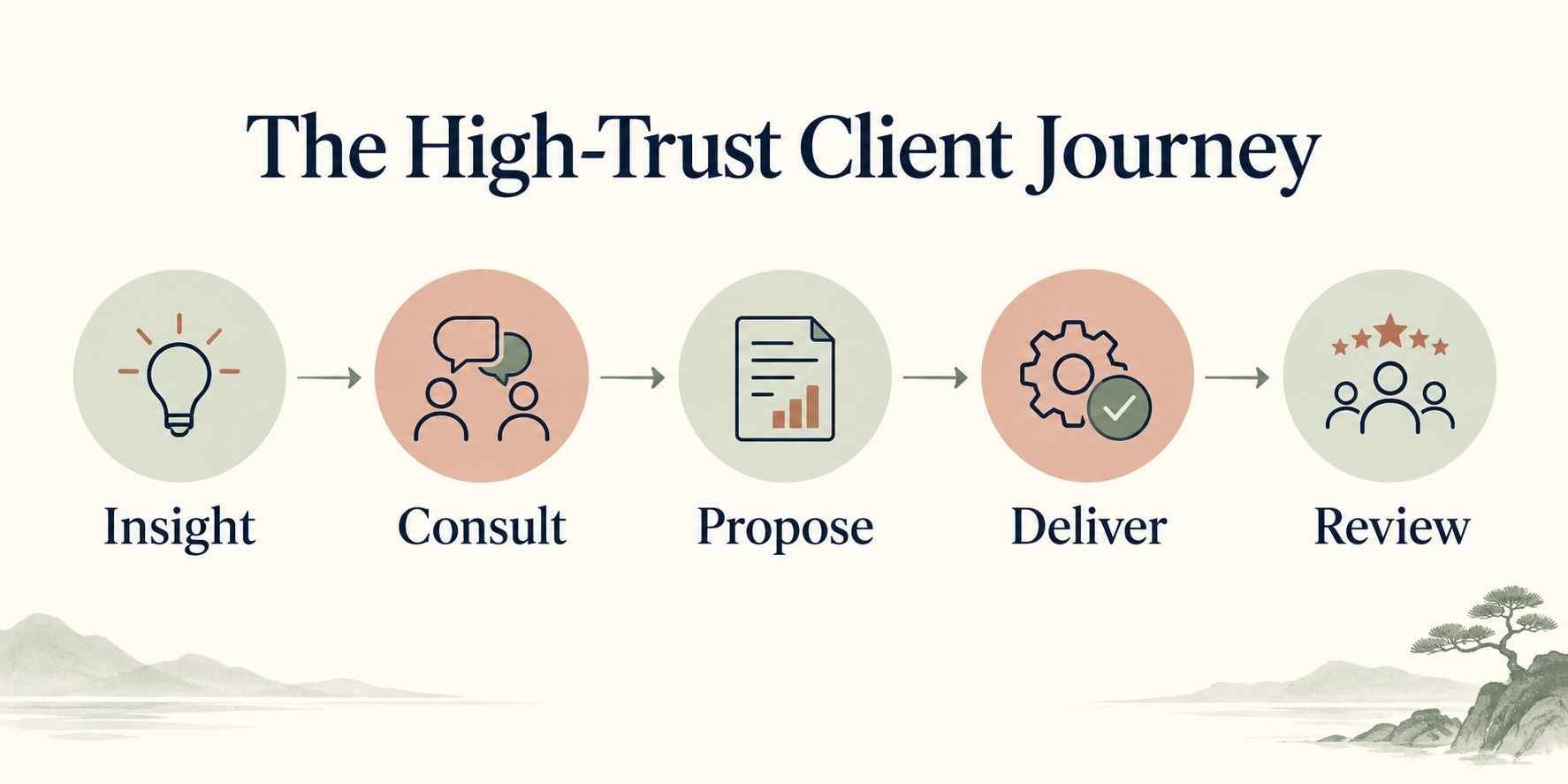
The high-trust client journey
Insight: earn attention through useful expertise
A client may enter from an article, event, report, referral, WeChat Official Account or other campaign. The first WeCom interaction should continue the value of that source.
Offer a clear reason to connect:
discuss a specific China-market question;
receive a relevant checklist or briefing;
coordinate an event follow-up;
speak with an appropriate specialist;
arrange a consultation;
continue an existing client matter through an agreed route.
Avoid turning every reader into a sales target. Qualify relevance and ask only for information needed to determine the next step.
Consult: match the client with the right expertise
The first conversation should clarify context, need, timing, stakeholders and the type of expertise required. It should also set boundaries: what the discussion can cover, whether formal advice is being provided, and what information should move to a secure or official channel.
Create a triage map for common enquiries:
market or business question;
potential project scope;
existing client request;
media or partnership enquiry;
recruitment or candidate matter;
complaint or conflict concern;
regulated or specialist question;
information that should not remain in chat.
The frontline operator does not need to answer everything. The professional response is often a clear handoff to the right person.
Propose: separate relationship dialogue from formal commitments
WeCom can help coordinate scope questions, meetings and next steps. The authoritative proposal, terms, conflict checks, pricing and approvals should follow the firm’s formal process.
Define:
who can discuss scope;
who can estimate or approve fees;
what language does not constitute a commitment;
where proposals and agreements are stored;
how client identity and authority are verified when needed;
when legal, compliance or professional review is required.
Do not treat a message thread as the only record of the agreed work.
Deliver: keep responsibility visible
During delivery, clients may value responsive coordination, but project governance still matters. Use WeCom for appropriate communication, updates, scheduling, approved materials and issue escalation. Use the formal project or document system for authoritative deliverables, versions, decisions and records.
Every significant request should have:
an owner;
a due date or expected next step;
a project or matter reference where applicable;
an escalation route;
a clear completion message to the client.
When a specialist joins, explain their role. When a question moves elsewhere, tell the client who owns the follow-up. Silence after forwarding damages trust.
Review: turn delivery into a longer relationship
An engagement review should examine the client’s objective, delivered value, unresolved issues, new risks and future needs. WeCom can support follow-up, but relationship development should remain relevant and respectful.
Useful review actions include:
confirm completion and remaining obligations;
capture feedback and service issues;
identify recurring questions that need content;
agree future contact preferences;
share relevant insights, not generic promotion;
update the relationship owner and system of record;
close inactive groups or access when the purpose ends.
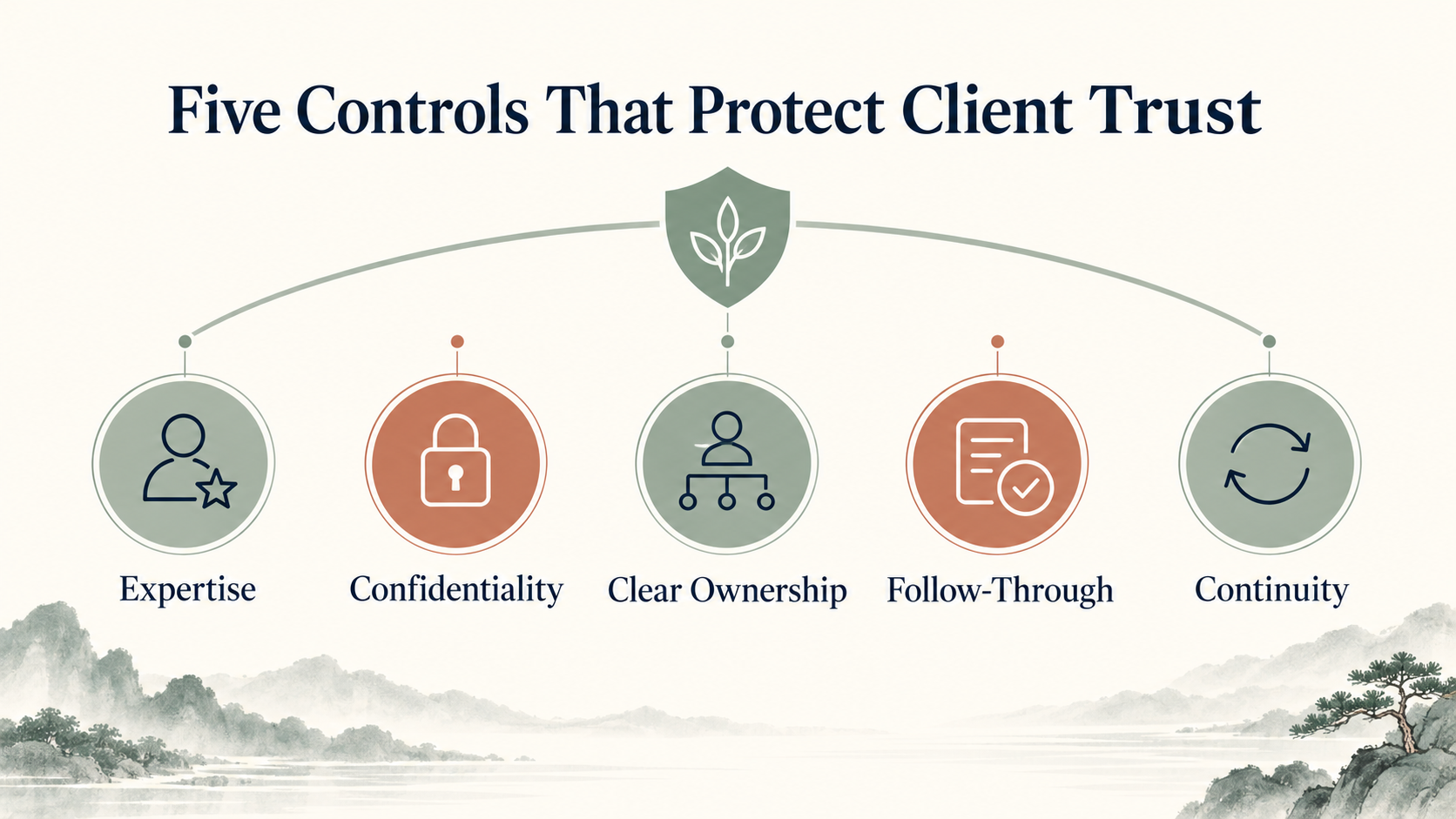
Five controls that protect client trust
Expertise
Match questions to qualified people. Maintain approved Chinese insight, service descriptions and recurring answers. Distinguish general information from formal professional advice.
Confidentiality
Define what information may be discussed, who may participate, where documents belong and when a more controlled channel is required. Platform security features do not remove the firm’s confidentiality and professional obligations.
Clear ownership
Assign a relationship owner and a delivery owner. They may be the same person for a small engagement, but both responsibilities should be explicit.
Follow-through
Record promised actions, deadlines, open questions and handoffs. An immediate reply that never reaches completion is not good service.
Continuity
Maintain enterprise ownership, backups and employee transition procedures. Tencent states that WeCom customer relationships can be company-owned and preserved when an employee moves. The firm should still test the handover and not assume every historical message, attachment or internal note transfers automatically.
Decide what belongs in each system
WeCom
relationship communication;
qualification and routing;
meeting and event follow-up;
appropriate status updates;
approved insight and content;
escalation acknowledgement;
coordination around next steps.
CRM or business-development system
authoritative contact and organization records;
opportunity stage and ownership;
interaction summary under the firm’s policy;
pipeline and relationship reporting.
Project, matter or document system
authoritative scope, deliverables and decisions;
controlled documents and versions;
work plans, approvals and formal records;
access appropriate to the engagement.
Finance and contract systems
approved pricing, terms, invoices and payment status;
commercial authority and audit trail.
WeCom does not automatically replace CRM, SCRM, document management, project management or professional recordkeeping. Integrations require defined purpose, data, permissions, testing and ownership.
A practical content-to-consultation journey
1. Publish a specific insight
Answer a real question for a defined industry or growth stage. Show limits and date the research.
2. Offer a relevant next step
Invite the reader to discuss the specific challenge, request a framework or join an appropriate briefing—not simply “add us on WeChat.”
3. Qualify with restraint
Understand organization, need, role and timing without demanding a full project brief in a first conversation.
4. Route to expertise
Introduce the specialist and explain the next interaction. Record the relationship owner.
5. Move formal work into formal process
Use the firm’s proposal, conflict, contract, project and record systems. Keep the client informed through the agreed channel.
This is where China social media management and WeCom can work together: insight creates qualified attention; the relationship layer provides a responsible next step.
Measure trust-building without inventing attribution
Entry and qualification
relevant enquiries by source and topic;
proportion matching the intended client profile;
time to correct owner;
consultation acceptance.
Relationship and operations
first useful response;
promised-action completion;
handover and escalation completion;
repeated questions and content gaps;
conversations without an owner;
client feedback and complaints.
Commercial and delivery
qualified opportunity progression;
proposal and engagement progression;
delivery issue resolution;
repeat engagement or referral where evidence is reliable;
relationship coverage beyond one employee.
Do not credit WeCom with an engagement solely because it was one communication touchpoint. State the attribution method and blind spots.
Governance for high-trust work
Document enterprise ownership, administrators, employee and agency access, client group membership, approved content, information boundaries, data systems, retention, incident response and offboarding.
Personal information, confidential business information and cross-border flows may require legal, privacy, security and professional review. Collect and share only what the use case needs. A blog framework is not legal or professional advice.
Common professional-services mistakes
Using thought leadership as a pretext for generic sales messages.
Allowing unqualified staff to answer specialist questions.
Sharing formal advice or controlled documents in an unsuitable channel.
Treating message speed as the only service metric.
Letting a relationship depend on one personal account.
Mixing proposal approval with informal discussion.
Failing to assign actions after a consultation.
Assuming CRM/SCRM integration solves data quality.
Treating company-owned relationships as transfer of all history.
Keeping client groups open after their purpose ends.
How Lotus supports professional-services WeCom programs
Lotus can help international firms define content-to-consultation journeys, WeChat-to-WeCom handoffs, setup and governance, Chinese thought-leadership and enablement content, qualification and routing, customer or community operations, reporting and agency handover.
Lotus can coordinate with CRM/SCRM, legal, privacy, security, professional-risk and integration stakeholders. It does not replace them or promise that communication alone creates qualified pipeline.
Frequently asked questions
Is WeCom appropriate for confidential client work?
It may support appropriate communication, but the firm must assess the actual information, participants, professional obligations, platform configuration and alternative systems. Sensitive work may need a more controlled process.
Can WeCom replace a professional-services CRM?
Not automatically. WeCom can support relationships and may integrate with other tools; the CRM or another approved system may remain authoritative for contacts, opportunities and reporting.
Should every content lead be added to WeCom?
No. Offer a relevant choice and qualify fit. The firm should not turn a low-intent reader into an unwanted direct-marketing relationship.
Who should own a client relationship?
Assign a named relationship owner and backup, separate from delivery ownership where needed. Maintain enterprise control and document transitions.
What happens when a relationship partner leaves?
Transfer active clients, open commitments, groups, relevant records and internal context before access removal. Verify what WeCom retains and do not assume every message or file transfers automatically.
Make responsiveness accountable
WeCom can make a professional-services firm easier to reach in China, but availability is not the same as trust. Expertise, discretion, ownership, follow-through and continuity must be designed into the journey.
If your firm wants to turn China thought leadership into well-managed client relationships, talk to Lotus about a professional-services WeCom model. We can help connect Chinese content, qualification, client operations and governance without weakening professional standards.
