

WeCom for Luxury Brands in China: Clienteling Without Losing Brand Control
WeCom can support luxury clienteling in China when it extends a defined advisor-led service journey: discovery, personal consultation, boutique or remote appointment, purchase support and aftercare. It should not become a mass-messaging shortcut. The value comes from relevant human attention delivered within enterprise ownership, approved content and a controlled handover process.
This article is for international luxury, premium beauty, jewellery, watches, fashion, automotive and lifestyle brands that want closer customer relationships in China without sacrificing discretion or consistency. It focuses on the operating model behind clienteling rather than a catalogue of platform features.
Lotus Social Agency’s WeCom service helps international brands design this model across customer journeys, setup, Chinese content, advisor workflows, governance and measurement.
What WeCom clienteling means for a luxury brand
Luxury clienteling is an ongoing, permission-aware service relationship in which an advisor uses relevant customer context to provide personal guidance before and after a purchase. In China, WeCom can give employees an enterprise-facing environment for communicating with customers who use Weixin, while connecting to a wider brand journey that may include Official Accounts, Mini Programs, Channels, campaigns and stores.
Tencent describes WeCom as integrated with Weixin chats, Mini Programs and payments and states that employees can serve Weixin customers through a professional enterprise interface. Tencent also describes customer relationships as company-owned and preservable when employees move. These capabilities are useful foundations, but they do not create luxury service automatically.
A clienteling program still needs:
a reason for the customer to connect;
trained advisors with clear portfolios and service standards;
relevant Chinese content and product knowledge;
discretion about what is asked, recorded and shared;
coordination between digital and store teams;
a tested process for advisor changes and absences;
measurement that values customer experience as well as sales.
When WeCom fits a luxury customer journey
WeCom is a strong candidate when a named or clearly assigned advisor relationship improves the experience. Examples include personal styling, product discovery, appointment preparation, launch or event access, customization, reservation, delivery coordination, care guidance, service updates and thoughtful re-engagement.
It is a weaker fit when the brand plans only generic promotional broadcasting, has no advisor capacity, cannot maintain accurate product information, or has no process for protecting customer choice and data. A customer should not be pushed into an ongoing relationship simply because the technology makes follow-up possible.
The luxury clienteling journey
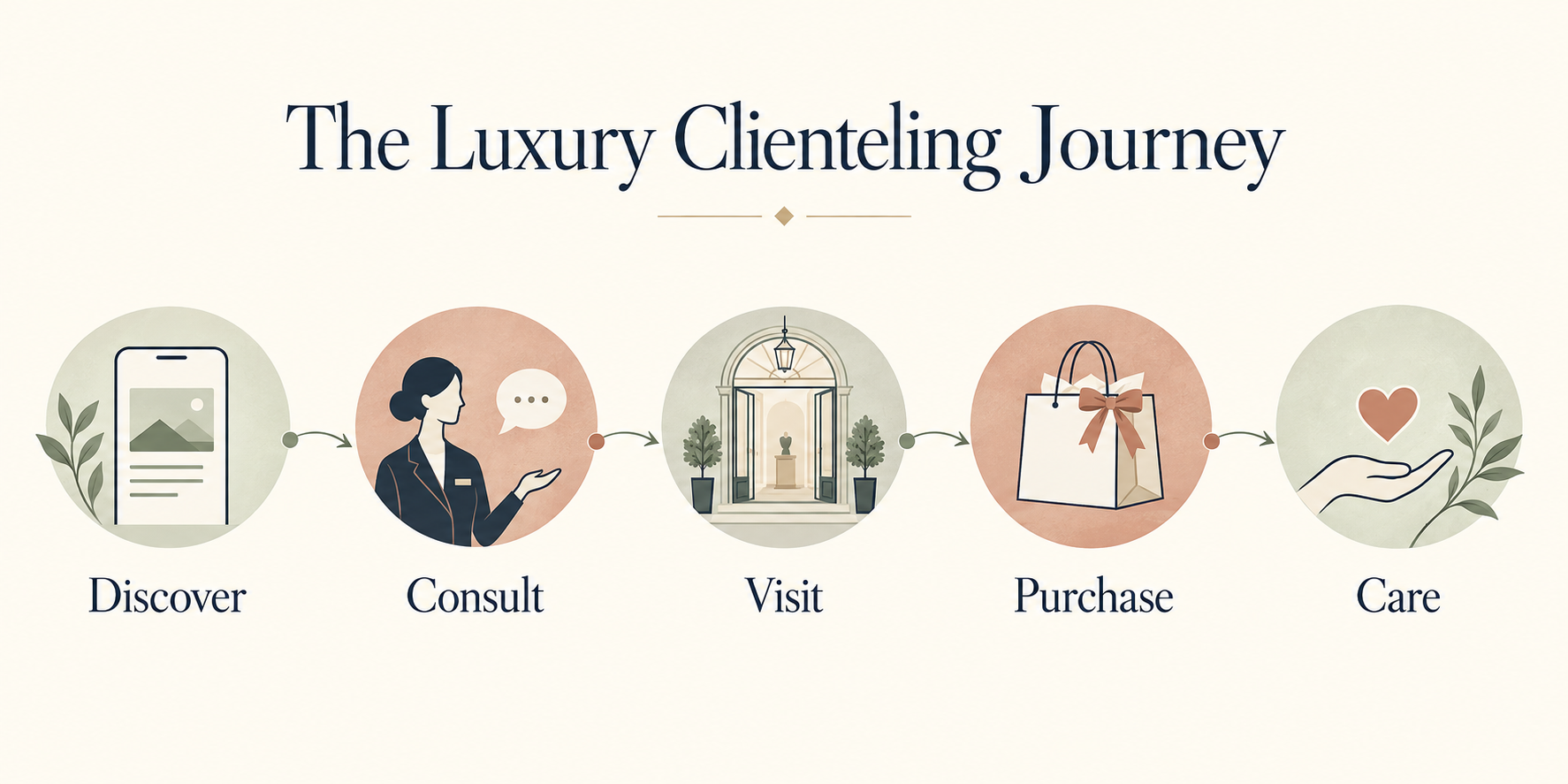
1. Discover: create a credible reason to connect
Discovery may begin with brand content, a campaign, a Mini Program, a boutique visit, an event, a service interaction or an existing advisor relationship. The invitation should state what the customer receives: personal consultation, appointment access, product care, a specialist answer or another clear service.
Avoid using exclusivity as an empty claim. “Add our advisor for VIP benefits” is less credible than a specific promise such as appointment coordination for a new collection or post-purchase care guidance for a product category.
Tencent’s luxury-market materials describe the Weixin ecosystem as supporting direct customer interaction, personalized engagement, product launches and after-sales service. Those publisher case examples show possible patterns, not guaranteed results for another brand.
2. Consult: make the interaction genuinely personal
The advisor should know what can be asked, what should remain optional, which content is current, and when a specialist is required. A useful consultation might clarify style, size, use occasion, service need, timing or boutique preference without turning the conversation into unnecessary data collection.
Prepare a Chinese content and knowledge set that supports judgment:
brand and collection stories;
product and material facts;
care and service guidance;
appointment and availability language;
approved responses to common questions;
boundaries for pricing, claims and future availability;
escalation paths for authenticity, repair, complaints and regulated topics.
The goal is not for every advisor to send identical sentences. It is to give them accurate building blocks and a tone framework so personalization remains on-brand.
3. Visit: connect digital context with the boutique
An appointment should reduce friction, not make the customer repeat the entire conversation. Define what information can be transferred to the receiving boutique or advisor, how the customer is introduced, who confirms the visit and how late changes are handled.
Useful pre-visit steps can include:
confirming location and time;
understanding the purpose of the visit;
preparing relevant products or expertise;
noting accessibility or service preferences where appropriate;
assigning a responsible advisor and backup;
sending concise, useful arrival information.
Do not assume that all WeCom conversation history or internal context should or will be available to every employee. Access and data sharing should follow the brand’s purpose, policy and applicable requirements.
4. Purchase: support the decision without pressuring it
Clienteling can help answer final questions, coordinate approved payment or commerce routes, manage customization and clarify fulfillment. It should not create ambiguous personal payment arrangements or promises outside brand policy.
Where WeCom connects with Mini Programs, CRM, SCRM or commerce systems, define which system records the transaction and customer status. WeCom does not automatically replace those systems. Integration should have named fields, data direction, testing and ownership.
5. Care: earn the right to remain connected
Post-purchase care is where luxury clienteling becomes a relationship rather than a campaign. The brand can provide product-care guidance, service coordination, thoughtful updates and relevant invitations. Frequency should reflect the customer’s context, not a universal messaging calendar.
Different customers may value different forms of follow-up. A new client may need practical care and delivery support. A collector may value informed previews. A service customer may want status clarity and a single owner. Segmentation should improve relevance, not label status without operational purpose.
Five guardrails that protect luxury brand control
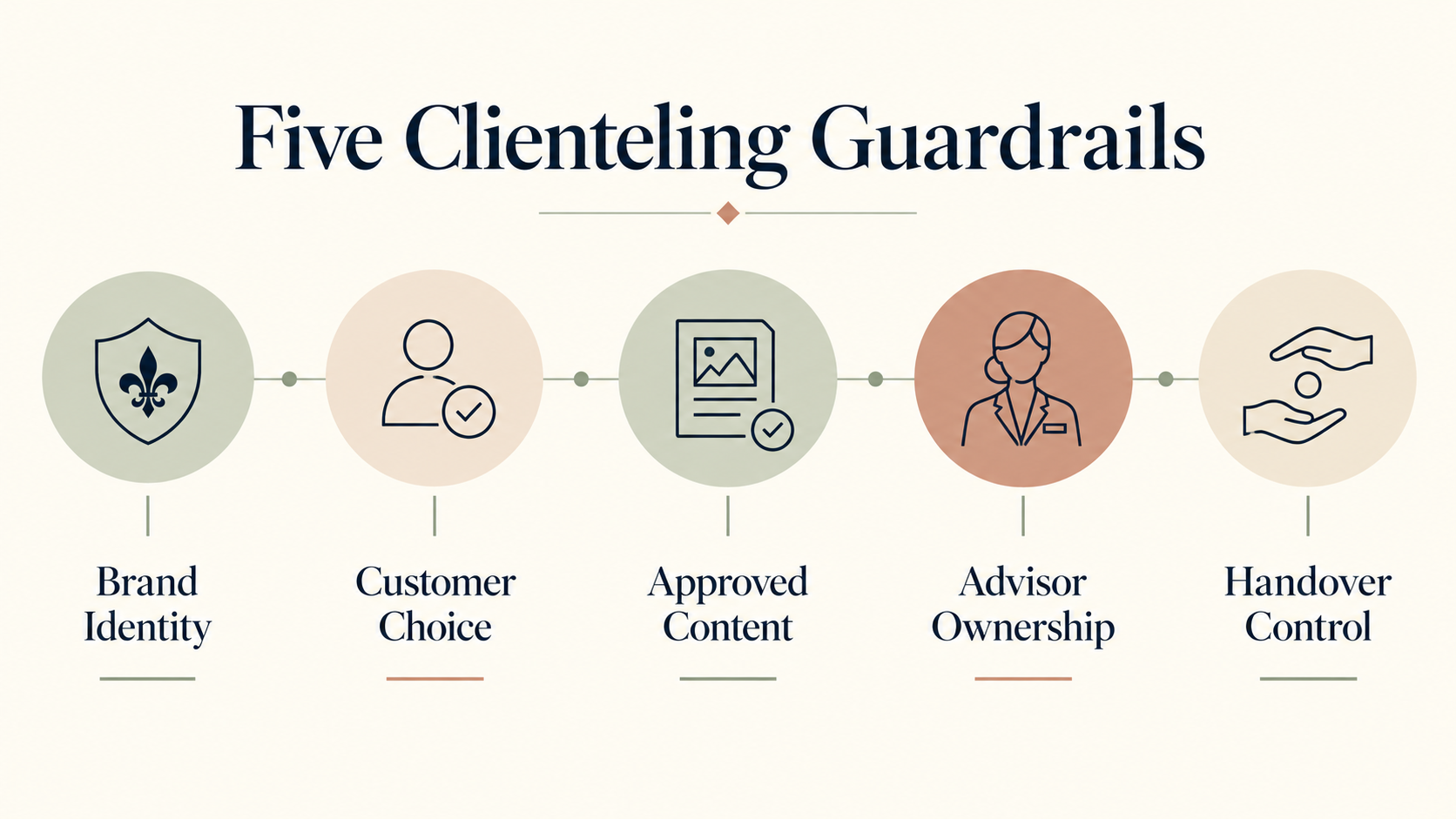
Brand identity
Use enterprise-approved profiles, naming, imagery, tone and service language. Make it clear who the advisor represents and how the customer can access official support. Personal warmth should not require an unofficial brand identity.
Customer choice
Explain the purpose of the relationship and respect preferences about contact, content and continuation. Avoid adding customers to groups or campaigns without an appropriate expectation and basis. Provide a practical way to reduce or stop irrelevant communication.
Approved content
Maintain a current Chinese content library with product facts, claims, care guidance, campaign terms and escalation notes. Withdraw outdated assets promptly. For sensitive or high-value decisions, identify the people qualified to verify the answer.
Advisor ownership
Assign each active relationship to an advisor or queue with service expectations, backup coverage and a next-action discipline. Prevent customers from being contacted by several teams with conflicting messages.
Handover control
When an advisor changes role or leaves, transfer active appointments, promised follow-ups, open service cases and relevant context. Tencent’s company-ownership statement should not be interpreted as automatic transfer of every historical message, attachment or internal note. Test the actual workflow and confirm what the next advisor can access.
Design advisor portfolios before automating outreach
Before creating recurring communication, define how customers are assigned and reviewed. Portfolio rules can consider boutique, geography, language, product expertise, customer request, prior relationship and current service need.
Automation may help with routing, reminders or approved acknowledgements. It should not imitate personal judgment or send sensitive recommendations without review. A “personalized” message generated from weak or outdated data can feel less premium than a simple human check-in.
Create a portfolio health view that shows:
active customers with a defined service reason;
open appointments, requests and promised actions;
relationships waiting for an owner;
customers receiving overlapping communication;
inactive profiles that need review rather than automatic promotion;
advisors at or beyond practical capacity;
relationships affected by an upcoming staff change.
A practical luxury clienteling playbook
Define the service promise
Write one sentence explaining what the customer gains. Then define what advisors can and cannot promise, typical response expectations and where service moves outside WeCom.
Map the moments that matter
Prioritize a small number of moments: first consultation, appointment, purchase follow-up, product care, service case, relevant launch or a long-gap re-engagement. Not every campaign deserves direct advisor outreach.
Build the Chinese advisor kit
Provide approved but flexible content, product facts, conversation examples, pronunciation or terminology guidance where needed, appointment templates, care answers and escalation contacts.
Train for judgment
Role-play ambiguous questions, unavailable products, sensitive requests, complaints, delayed service and cross-boutique handovers. Training should assess both platform action and customer experience.
Pilot with one cohort
Choose one boutique group, customer segment, category or service moment. Observe the full journey before scaling to more advisors and automations.
Review conversations and outcomes
Where governance permits, sample successful, stalled and escalated journeys. Look for relevance, tone, accuracy, ownership and completion—not only activity.
Measuring luxury WeCom clienteling
Customer-entry and relationship signals
eligible customers invited and connected;
stated reason for connection;
audience and source fit;
continuation, inactivity and opt-out signals.
Experience signals
response and completion performance;
appointment preparation and attendance;
unanswered or repeated questions;
service escalation and resolution;
qualitative feedback and complaints.
Commercial signals
qualified consultation;
assisted purchase or sales progression where attribution is reliable;
repeat purchase or reactivation;
category exploration and appointment outcomes.
Control signals
overlapping ownership;
use of expired content;
handover completion;
access or data incidents;
advisor capacity and training gaps.
Do not force direct-revenue attribution where the customer journey spans content, store, advisor, Mini Program and other channels. State the method and its limitations.
Common luxury clienteling mistakes
Treating WeCom as a broadcast list rather than a service relationship.
Using “VIP” language without offering a distinct experience.
Asking for more customer data than the service needs.
Letting advisors create unverified product or availability claims.
Sending the same campaign message across every portfolio.
Failing to coordinate digital advisors and boutique staff.
Assuming WeCom automatically replaces a CRM or SCRM.
Allowing one employee or agency to become the only administrator.
Treating company-owned relationships as automatic transfer of all history.
Measuring message volume instead of customer value and completion.
How Lotus supports luxury WeCom programs
Lotus can help luxury brands define the clienteling journey, WeChat-to-WeCom handoffs, setup and governance, Chinese advisor content, operating procedures, portfolio and escalation rules, campaign coordination and performance reporting. The program can connect with China social media management when discovery content and advisor relationships need one editorial direction.
Lotus can also coordinate with the brand’s CRM/SCRM, retail, privacy, legal, security and integration specialists. Those responsibilities should be explicit; a marketing agency should not quietly substitute for specialist advice or engineering.
Frequently asked questions
Is WeCom only for mass private-traffic marketing?
No. It can support managed one-to-one and group communication between employees and external users. For luxury brands, the strongest use is often a clearly assigned, service-led relationship rather than high-frequency broadcasting.
Can WeCom connect online and boutique experiences?
It can support communication and handoffs around discovery, appointment, purchase and care. The brand must design how context moves, who owns the next step and which systems hold authoritative records.
Does WeCom replace a luxury CRM?
Not automatically. WeCom can be a customer-communication layer and may connect with CRM or SCRM systems. Customer identity, preferences, transactions, consent and reporting still require a defined data model and source of truth.
Who owns the customer relationship?
Tencent describes WeCom customer relationships as enterprise-owned and preservable when an employee moves. Brands should establish their own administrator, portfolio and handover controls and verify what information remains accessible.
How often should an advisor contact a customer?
There is no universal frequency. Contact should follow the customer’s preferences, relationship context and a genuine service or brand reason. More messages do not automatically create a stronger relationship.
Can an agency operate luxury clienteling?
An agency can support strategy, content, training, customer or community operations and reporting, depending on the agreed model. The boundary between agency operators and brand advisors should be transparent, with defined permissions, service rules and escalation.
Make personal service operationally credible
WeCom gives luxury brands a way to organize customer communication within an enterprise environment, but the prestige of the experience still comes from useful human attention, accurate content, discretion and continuity.
If your brand wants to design or draft a China clienteling program, talk to Lotus about a luxury WeCom operating model. We can help connect discovery, consultation, boutiques and aftercare without turning a premium relationship into generic messaging.
