

How to Choose a WeCom Agency in China: A Buyer’s Guide for International Brands
The best WeCom agency for an international brand is not necessarily the provider with the longest feature list. It is the partner that can translate a defined China business goal into a workable customer journey, clarify what the brand and agency each own, build the right level of technical setup, and operate the program in Chinese after launch.
For most brands, the practical decision is not simply “Which agency knows WeCom?” It is “Which partner can connect strategy, account setup, Chinese content, daily operations, governance and measurement without hiding the gaps between them?”
This guide is for international marketing, sales, customer-experience and China-market leaders evaluating a WeCom partner. It is especially useful before a first pilot, during a vendor review, or when an existing WeCom account is technically live but not producing a consistent operating rhythm.
Lotus Social Agency’s WeCom service is designed around that operating question: how WeCom should support a real customer journey, who should run each part, and what must be true before scaling, also what’s the capability of standing by to help resolve all of your internal wecom user’s questions.
Start with the operating problem, not the platform
WeCom is Tencent’s enterprise communication and office-collaboration platform. Tencent describes it as connecting enterprises with Weixin users, while also offering enterprise communication, productivity tools and an ecosystem of integrations and APIs. Those capabilities can support customer contact, community operations, sales follow-up and service workflows—but a WeCom account alone does not create demand or define a useful customer journey.
A brand should first identify the operating problem it wants to solve. Examples include:
leads collected at exhibitions are not followed up consistently;
customers are moved between personal accounts when employees change roles;
Chinese-language enquiries do not have a clear owner or response standard;
distributors and service teams need a shared escalation path;
VIP customers receive inconsistent follow-up across stores;
WeChat traffic reaches a landing point but has no managed next step;
headquarters lacks visibility into local activity and results.
These are business and operating problems. WeCom may be part of the solution, but the platform does not automatically supply the audience, content, staffing, governance, CRM logic or measurement model.
When an international brand needs a WeCom agency
An agency is most useful when the brand needs more than a one-time technical setup. A credible partner can bring China-market context, Chinese content, customer-journey design, operating procedures and ongoing optimization into one program.
Consider agency support when:
there is an active sales & marketing team working for China market, and need regular support on Wecom;
Regular and active Chinese sales development activities happening in China market
Companies want to secure partner or customers contact after sales member left the companies
global stakeholders need a structured plan before approving local investment;
WeCom needs to be connected with WeChat Official Accounts, Mini Programs, campaigns or offline acquisition;
several departments disagree about lead ownership, service ownership or data handling;
the brand needs a content strategy and execution for Wecom to maximize the usage of Wecom
Wecom data analysis and reporting
the business needs a partner to coordinate local execution with global brand standards.
Company lack of Wecom experts to support on-going Wecom usage.
An agency may be unnecessary for the business has no defined China audience, no customer-entry point, no response capacity and no reason for Chinese contact to remain connected.
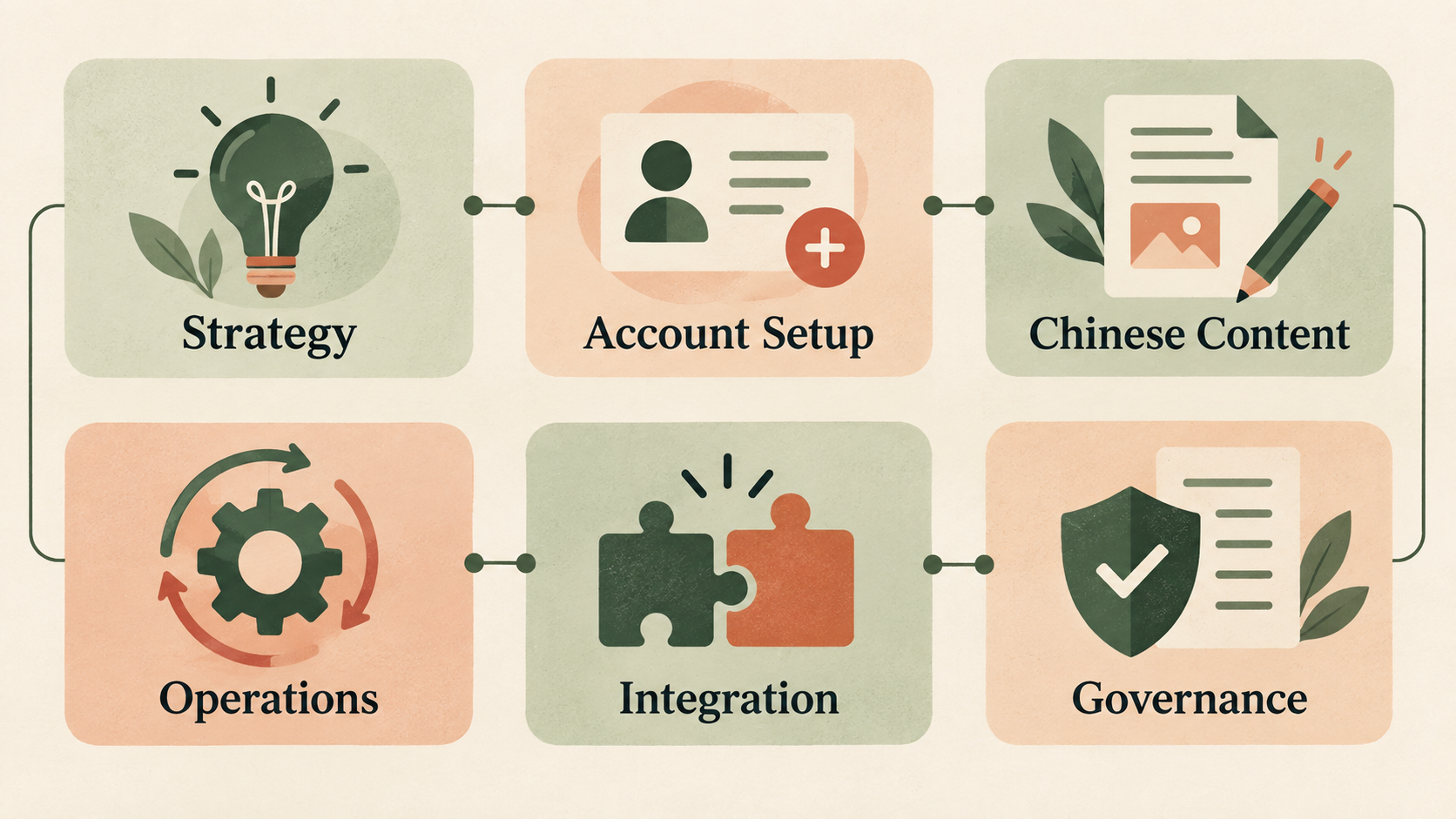
The six workstreams every WeCom proposal should separate
1. Strategy and customer journey
The agency should define the audience, entry point, value exchange, desired action and follow-up path. “Use WeCom for private traffic” is not a strategy. A useful plan states who will add the account, why they will do so, what happens next, and how the relationship supports a commercial or service objective.
2. Account setup and configuration
Setup can include eligibility review, applicant and administrator planning, verification support, organizational structure, permissions, staff profiles and basic application configuration. Exact setup routes and documentation can vary by entity, geography and Tencent requirements, so a provider should confirm the current path rather than promise universal eligibility.
3. Chinese content and assets
Customer-facing work needs appropriate Chinese copy, welcome messages, FAQs, campaign assets, sales-enablement material and community content. Translation alone is often insufficient: the material must fit local customer questions, channel behavior and the brand’s operating capacity.
4. Customer and community operations
Someone must own response times, qualification, tagging, escalation, follow-up, community rhythm and quality control. Ask whether the agency performs this work, trains the brand team, or supplies a hybrid model. A technically complete deployment can still fail when daily responsibilities are vague.
5. Integration and data design
If WeCom needs to connect with a CRM, SCRM, help desk, Mini Program or reporting system, the proposal should define the systems, fields, data direction, triggers, testing and failure handling. WeCom does not automatically replace a CRM or SCRM. Complex integration may require a specialist technical provider as well as a marketing or operations agency.
6. Governance and continuity
Governance covers administrators, roles, access reviews, account ownership, staff onboarding and offboarding, content approval, data handling and incident escalation. Tencent describes enterprise-managed customer relationships that can be retained when employees move; buyers should not interpret that as an automatic transfer of every historical message, attachment or internal note. The exact continuity workflow and accessible records should be confirmed during design and testing.
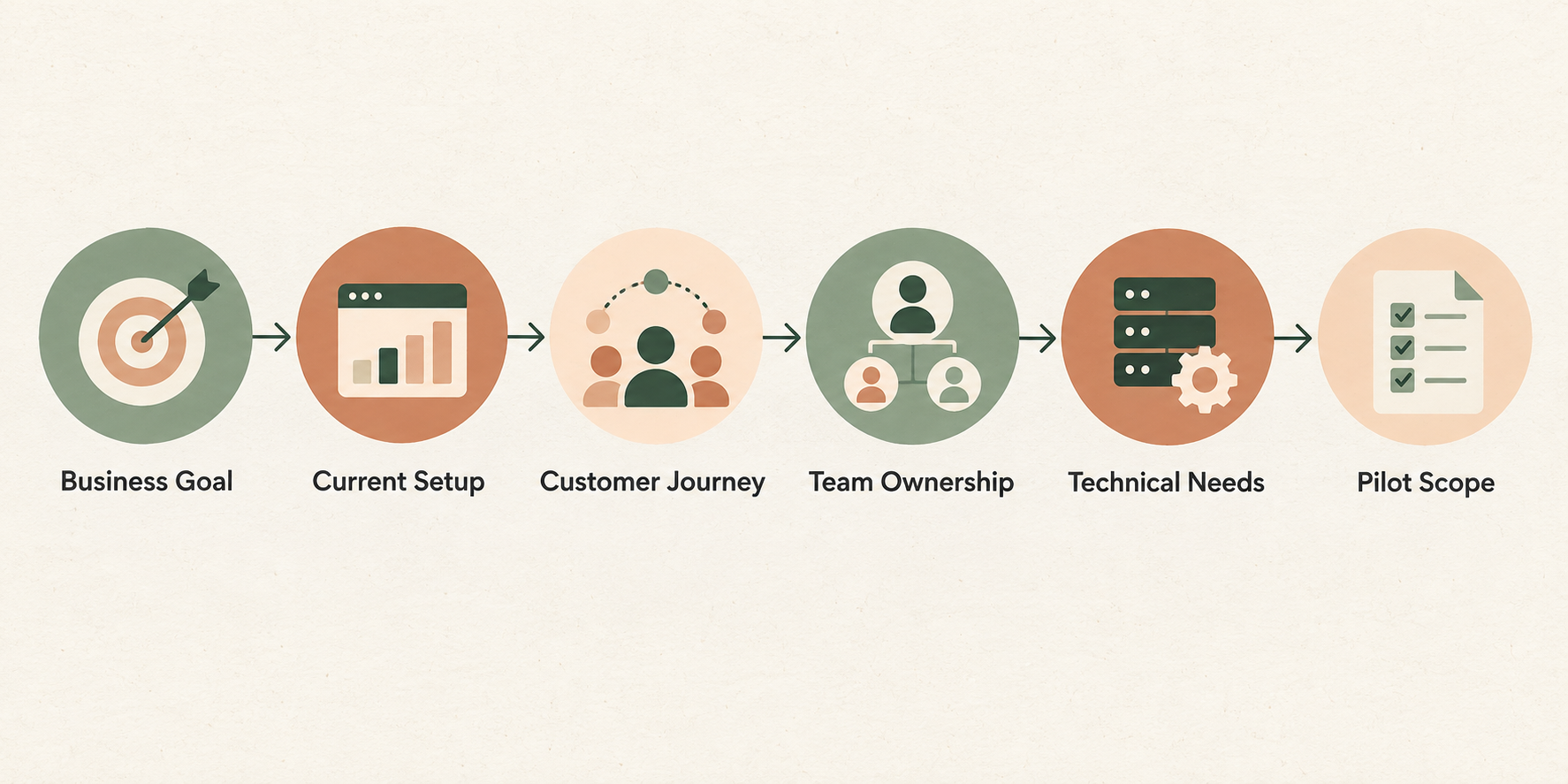
A six-step process for choosing the right scope
Step 1: Name one primary business goal
Choose a leading objective such as event-lead follow-up, distributor communication, customer service, VIP clienteling, customer-success adoption or repeat purchase. A pilot can support secondary outcomes, but it should have one organizing goal.
Step 2: Audit the current setup
Document the legal entity and applicant situation, existing WeChat and WeCom assets, administrators, Chinese-language staff, CRM or SCRM, website and Mini Program touchpoints, current lead sources, and any existing agency responsibilities. This prevents vendors from pricing against different assumptions.
Step 3: Map the customer journey
Show how a person enters the journey, what consent and context are provided, who responds, how the contact is segmented, what value the person receives, which actions matter, and what happens when a case must move to sales, service or another system.
Step 4: Assign team ownership
Create named owners for the platform, content, customer response, escalation, technical changes, data review and performance reporting. “The China team” or “the agency” is not specific enough. A responsible individual and backup should exist for every critical step.
Step 5: Define technical needs
Separate requirements that are essential for the first use case from those that can wait. A focused pilot may need a controlled manual workflow and reporting template; a scaled operation may require systems integration, automated routing and more formal data architecture.
Step 6: Write a bounded pilot scope
Specify audience, use case, channels, staff group, content volume, service hours, configuration, integration, training, reporting, acceptance criteria and review date. A bounded pilot helps the brand learn without pretending that every feature and department must launch at once.
Ten questions to ask a WeCom agency before appointment
1. What business problem are you solving first?
A strong agency should restate the problem in operational terms and explain why WeCom is appropriate. Be cautious if the response immediately becomes a generic tour.
2. What assumptions are you making about our account and eligibility?
Ask the agency to list the assumed applicant, entity, administrator, verification route and required documents. Eligibility and setup requirements can change, and international structures may need case-by-case review.
3. Does the scope cover setup, operations or both?
“WeCom implementation” can mean account registration, technical configuration, operating design, content production, daily user handling—or only one of these. Require a deliverables list for each workstream.
4. Where will customers enter the journey?
The agency should explain the planned entry points, such as a WeChat Official Account, Mini Program, event, website, store, customer-service interaction or sales outreach. It should also explain the value exchange that makes adding or staying connected worthwhile.
5. Who creates and approves Chinese content?
Clarify who writes, reviews, localizes, publishes and updates welcome messages, sales material, service answers and ongoing content. Confirm the approval timeline and what happens when urgent content is required.
6. Who responds, and under what service rules?
Ask for operating hours, response targets, tone of voice, qualification rules, escalation paths, backup cover and quality-review methods. If the agency will interact with customers, define the boundary between agency staff and brand employees.
7. What is the source of truth for customer data?
The answer might be a CRM, SCRM, service platform or a defined WeCom-centered workflow. What matters is clarity. The proposal should state which records live where, which information is synchronized, and how duplicates or failed updates are handled.
8. How will governance, consent, privacy and security be handled?
Request a responsibility map for administrator access, staff changes, data use, consent language, retention, exports, third-party tools and incident handling. Agencies can provide operational guidance, but the brand should obtain legal, privacy and security review appropriate to its situation.
9. What exactly will be accepted at the end of the pilot?
Acceptance can cover configuration, tested journeys, content packs, operating procedures, staff training, reporting templates and documented issues. Avoid projects that define success only as “account launched.”
10. How will performance be reviewed and improved?
Reporting should connect operational signals to the use case: qualified conversations, response performance, progression to the next step, repeat engagement, service resolution or revenue-associated outcomes where measurement is reliable. Follower or contact counts alone rarely show whether the operating model works.
Four common WeCom agency scope models
Focused pilot
Best for a brand entering China or testing one use case. The scope usually includes journey design, minimum configuration, a small content set, staff training, a controlled operating period and a decision report. It should be narrow enough to learn but real enough to expose operating issues.
Foundation and setup
Best when the brand has an internal China team that will run the program. The agency focuses on eligibility and setup support, governance, customer-journey design, configuration, templates, training and launch documentation. Daily execution remains with the client.
Managed operations
Best when the brand needs continuing Chinese content, customer or community operations, campaign support and reporting. The scope should define working hours, content volume, approval rights, response boundaries and how agency staff coordinate with sales or service owners.
Technical Support
Best for established programs that need reliable connections to CRM, SCRM, commerce, service or analytics systems. The buyer should confirm architecture, API responsibilities, environments, testing, monitoring and maintenance. A marketing agency may lead the journey and operating model while a specialist integration partner delivers the technical layer.
Red flags in a WeCom agency proposal
The provider promises one setup route for every international company without checking entity and eligibility details.
The pitch promises guaranteed leads, sales or search rankings.
The proposal lists features but does not map a customer journey.
Account ownership, administrator access and handover responsibilities are unclear.
Chinese content and day-to-day response work are absent from the operating plan.
“CRM integration” is included without naming systems, data fields, direction, testing or maintenance.
Success is measured only through contact volume or group size.
The agreement has no documentation, training or exit handover.
Privacy, security and legal questions are treated as marketing checkboxes rather than specialist responsibilities.
What different growth stages should buy
Exploring China
Buy a readiness assessment and use-case workshop before a large build. The result should be a clear audience, business goal, current-state audit, risk list, ownership model and pilot recommendation.
Preparing to launch
Buy a bounded pilot with setup support, customer-journey design, Chinese content, operating procedures, training and a review framework. Keep nonessential integrations out of the first phase unless the use case depends on them.
Scaling an established operation
Buy stronger segmentation, reporting, governance, content operations and carefully scoped integration. Expansion should follow demonstrated workflow value, not pressure to activate every available feature.
Recovering an underperforming program
Buy an operational audit. Review entry points, contact quality, welcome flow, response behavior, content usefulness, team incentives, data structure and handovers. Reconfiguration alone will not fix a missing audience or an unowned process.
How Lotus approaches WeCom agency work
Lotus Social Agency supports international brands with WeCom strategy and customer-journey design, setup and verification guidance, governance and team structure, WeChat-to-WeCom handoffs, Chinese content and assets, customer and community operations, and coordination of CRM or SCRM requirements.
The starting point is commercial and operational fit. WeCom is most useful when the brand has a defined audience, a clear reason for customers to connect, an accountable team, relevant Chinese content and a measurable next step. Where a project requires legal advice, security assurance or specialist systems engineering, those responsibilities should be named rather than hidden inside a broad agency label.
International brands can also combine WeCom with China social media management when acquisition, content and community activity must work as one program.
Frequently asked questions
What does a WeCom agency do?
A WeCom agency can help define the use case, design the customer journey, support account setup and configuration, produce Chinese content, establish governance, train teams, operate customer or community workflows, coordinate integration requirements and report on performance. The exact combination varies, so buyers should require a workstream-by-workstream scope.
Does an international brand need a local Chinese entity to use WeCom?
The answer depends on the current product rules, applicant structure, desired features and verification path. Some international structures may be possible, but eligibility and documentation should be checked for the specific case. Avoid treating a general online statement as approval for a particular entity.
Is account setup enough for a successful WeCom program?
Usually not. Setup creates the operating environment, but the brand still needs an audience, entry point, useful content, trained people, response rules, governance and measurement.
Who should own the WeCom account and customer relationships?
The brand should establish clear enterprise ownership, administrator control and employee lifecycle procedures. Tencent describes customer relationships as company-managed and capable of continuity when employees move, but the brand should test the actual handover flow and not assume every part of message history or internal context transfers automatically.
Can WeCom replace a CRM?
Not automatically. WeCom can support customer communication and may connect with CRM or SCRM systems, but the right source of truth depends on the use case, data model, integrations and governance requirements.
What should a WeCom agency proposal include?
It should include the business goal, audience, customer journey, assumptions, deliverables by workstream, client and agency responsibilities, timeline, content and operations plan, technical boundaries, governance, measurement, acceptance criteria, fees, exclusions and handover.
How long should an international brand evaluate a WeCom partner?
Evaluate the partner across discovery, design and a bounded operating period—not only a sales presentation or launch day. The necessary duration depends on the customer journey and volume, but the evaluation should be long enough to observe real response, handover, content and reporting behavior.
The decision to make
Choose a WeCom agency that makes the operating model visible. The strongest proposal will not pretend that one platform solves acquisition, content, customer service, sales, governance and CRM by itself. It will show how the parts fit together, who owns each part, what the pilot will prove, and which claims still need technical or specialist validation.
If your international brand is evaluating WeCom, discuss your WeCom scope with Lotus. We can help assess fit, define the first customer journey and build a practical China operating plan before you commit to unnecessary complexity.
