

From RedNote and Douyin to WeCom: Where Should China Enquiries Go?
A buyer finds your product on Rednote and asks a practical question in the comments. Someone watches your Douyin video and wants a quote. A WeChat article brings a service enquiry. They are not the same moment, and they should not all receive the same “add us on WeCom” reply.
For an international brand marketing in mainland China, the right next step depends on what the person wants, how much help the team can provide, and what the source platform currently permits. WeCom is valuable when a Chinese-speaking sales or service owner can continue a useful conversation through a company-managed contact. It is usually the wrong answer to a simple public question or a purchase that should go straight to an approved store.
The short answer: when should a Chinese social enquiry move to WeCom?
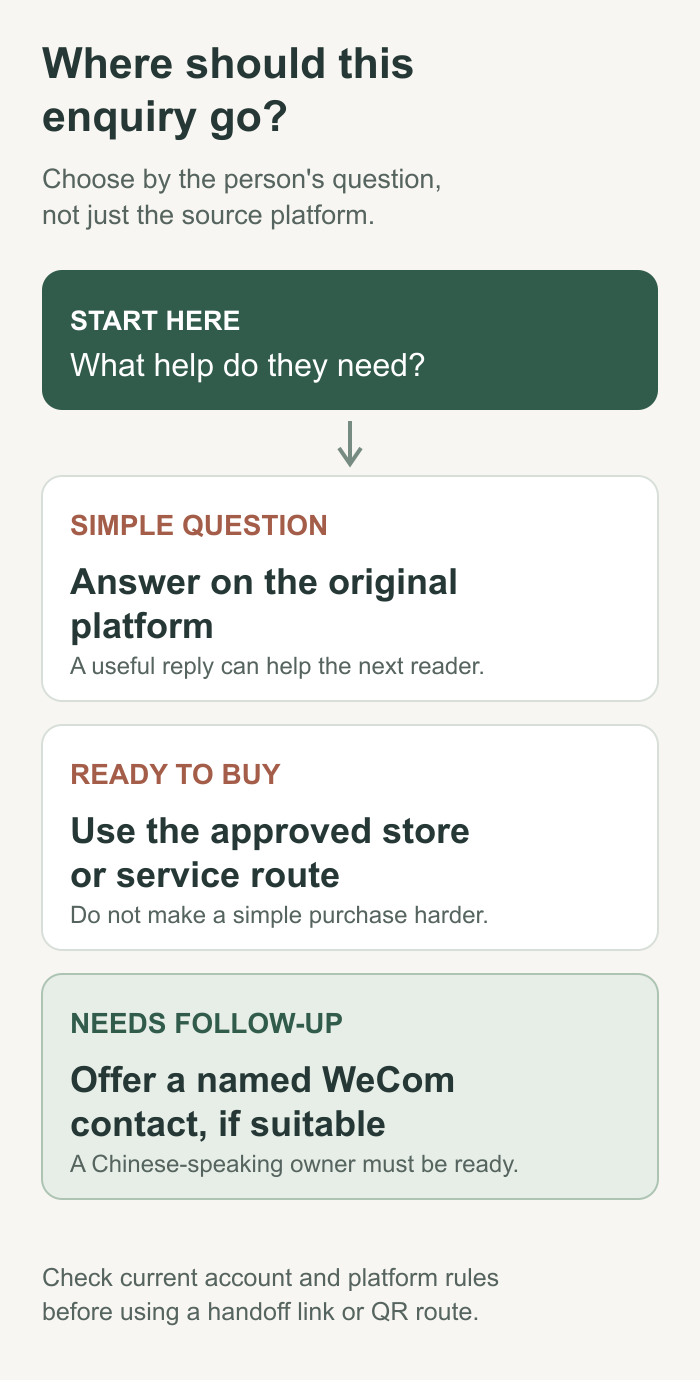
Use WeCom when the enquiry needs a named person, more than one exchange, and reliable company ownership—for example, a B2B product assessment, a tailored travel request or a service issue likely to require follow-up. First answer what you can on the original platform. Offer a clear, permitted way to continue if the customer wants it. Then assign an owner and record the important next action outside the chat.
WeCom is not a universal destination for every social click. Tencent says WeCom lets employees communicate with Weixin users through a company identity; it does not make RedNote, Douyin and WeChat one interchangeable inbox. Account eligibility, linking options, QR placement, direct-message behaviour and category rules should be checked on the current platform and the brand’s own accounts before a campaign goes live.
Give each platform a job before designing a handoff
Lotus works across RedNote, Douyin, WeChat and WeCom. These channels can support one customer journey, but the job of each touchpoint is different.
RedNote: help people compare and decide what to ask
A Chinese prospect may use RedNote to look for experiences, product detail and credible answers. If someone asks an ordinary question under a post, a useful public answer can help them and the next reader. Move to a private conversation only when the question needs personal details, a tailored recommendation or a next step that the brand can actually deliver. Do not treat a comment as automatic consent for off-platform marketing.
Douyin: turn attention into an appropriate action
A short video may create interest before the viewer is ready to speak to sales. The next step might be another explanation, a native enquiry or commerce route, or a human contact for a high-consideration question. A “message us on WeCom” instruction pasted under every video is likely to feel abrupt. Match the invitation to the video’s promise and verify what the live Douyin setup allows.
WeChat and WeChat Channels: give interested people more context
An Official Account article, menu, event or WeChat Channels video can explain an offer and point towards a more specific action. Depending on the account and current feature route, that could be a service option, a form, a Mini Program, an event registration or a WeCom contact. The path should be tested from the customer’s phone, not inferred from a slide deck.
WeCom: continue the conversation with an accountable team
When the question genuinely needs follow-up, WeCom can provide a recognisable employee contact and a company-managed relationship with a Chinese-speaking owner. It still needs a useful welcome, response coverage, approved content and a route into the CRM or service record where appropriate. Lotus’s WeCom service covers those operating details, not only the account opening.
The right destination changes with the customer’s question. A store, public answer or service route can be better than a new WeCom contact.
Three real-world routing decisions
These are illustrative situations, not claims about a specific Lotus client or guaranteed platform features.
A consumer brand: “Where can I buy this size?”
The question appears under a RedNote post. The first useful reply is a clear sizing answer and an approved purchase route. If the customer needs a tailored fitting appointment or ongoing service and the brand has staff to support it, a more personal contact may make sense. Sending every shopper to a salesperson would create work without improving the buying experience.
A B2B supplier: “Will this work with our plant’s existing system?”
The prospect sees a Douyin explainer and asks a technical question. A Chinese-speaking operator can acknowledge the question on the originating channel, confirm the basic use case, and offer a permitted company contact for a specialist follow-up. In WeCom, the owner can arrange a call with the overseas engineer. The technical requirement and agreed next step belong in the sales record; they should not live only in a chat thread.
A travel brand: “Can you help our group with three cities?”
An itinerary article leads to a request for dates, group size and accessibility needs. If the team offers tailored planning, a named service conversation could help. If the brand only supports standard online booking, the clearer route may be the booking service. The brand should not ask for more personal information in a social comment than is needed to point the customer to the right channel.
The principle is simple: send a person where their request can be handled well, not where the brand wishes its “private traffic” dashboard to grow.
Build a handoff your Chinese team can actually run
1. List the five questions people already ask
Read recent public comments, direct enquiries, event questions and service tickets. Group them by intent: information, price, product fit, purchase, account support, complaint. Do not start with a complicated funnel diagram. Start with the words customers use and the answers the team is authorised to give.
2. Decide the best first response for each question
Can the answer be public? Is a platform-native private reply enough? Does the person need checkout, a form or a service queue? Only route to WeCom when a continuing relationship adds value and a real person can own it. Check the source platform’s live account features and current rules before putting a link, QR code or instruction into content.
3. Name the owner and the promise
For every WeCom route, identify the Chinese-speaking owner, backup, service hours and escalation point. Write the first response as a helpful continuation of the original question. For example: “You asked whether this system works with your existing line. I’m Mei from the China team. If you share the model and your key constraint, I can ask our engineer and come back with a clear answer.” The exact customer-facing Chinese copy should be written by the local operator, reviewed for the product and tested in the channel.
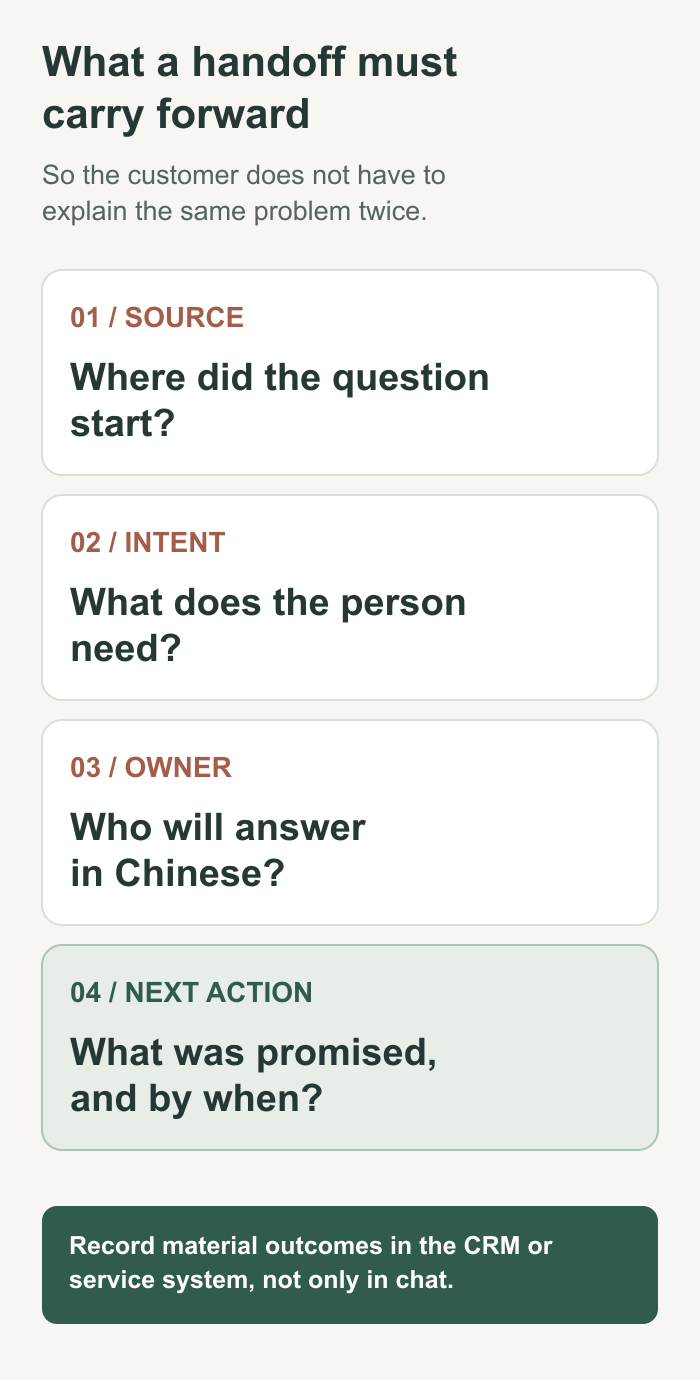
4. Carry the source and next action forward
The receiving colleague should know whether the enquiry came from a RedNote comparison, a Douyin video, a WeChat article or an event. That can be captured through a permitted campaign route or a simple manual source field. Do not promise perfect cross-platform attribution or collect unnecessary personal data. Record the business-critical need, owner and next step in the appropriate CRM or service system, with privacy and access rules reviewed by the brand.
5. Test the whole journey on a phone
Ask someone outside the project to follow a real post or video to the next step.
Can they understand why they are being asked to change channels?
Does the contact route work on the devices and accounts your customers use?
Does a human reply?
Does the owner have enough context to avoid “How can I help?” after the customer already explained the problem?
Measure better conversations, not only more contacts
Review the sources that produce questions your team can actually help with. Useful measures include the number of relevant enquiries, the share receiving a substantive answer, the share reaching the right owner, the time to the next promised action, resolved service issues and qualified commercial outcomes. Look at opt-outs, repeated questions and dead-end handoffs too. They may reveal that the content or route is wrong.
There is no universal WeCom conversion benchmark for all international brands. A B2B industrial enquiry and a consumer-product sizing question should not be judged by the same contact-addition target. Read a sample of actual journeys alongside the numbers before deciding what to change.
Frequently asked questions
Should RedNote and Douyin leads always be moved to WeCom?
No. First match the person’s question to the best service or purchase route. WeCom makes sense when a company-managed human relationship improves the answer and current platform rules permit the proposed handoff.
Can WeCom replace customer service across every China platform?
No. Public replies, platform-native messages, store service tools and formal support queues may still be needed. WeCom can be one conversation layer, but it does not automatically replace a help desk or consolidate every platform message.
What if our overseas sales team handles the commercial decision?
That can work if a named Chinese-speaking colleague or authorised operator can respond locally, understand the question and coordinate the next step with the overseas specialist. Do not send Chinese enquiries into WeCom if nobody can own the response.
How should we track a lead’s source?
Use the simplest reliable method the platform and your systems support: an approved campaign route, a source field or a manual note. Test it. The goal is to learn which content creates useful conversations, not to claim perfect cross-app tracking.
Make the next step feel natural
China social media works better when a brand answers the question in front of it. Sometimes that means a public reply, sometimes a store, and sometimes a named WeCom conversation that can continue over time. The work is choosing well, training the team and fixing the handoff when customers show you it is awkward.
Lotus can review your current Chinese social enquiries, map the right route for each intent, create the Chinese responses and assets, set up the workable WeCom layer, and operate and improve the journey with your team. Talk to Lotus about your China customer journey.
