

From Personal WeChat to WeCom: A Practical Plan for China Sales Teams
Your China salesperson has done exactly what the business asked: answered enquiries, built trust and kept customers close. The problem is that many of those conversations now sit in a personal WeChat account. Telling the team to “move everyone to WeCom” sounds simple until a long-standing customer asks, “Why should I add another account?”
The sensible approach is a customer introduction, not a bulk migration.
Give people a good reason to connect with a recognizable company contact, keep an accountable human in charge, and record the important commercial context in the right company system. You can change the route for future conversations without pretending that an old private chat has magically become a company record.
Who should consider this change?
This guide is for an international brand that is already receiving real enquiries from mainland China, has Chinese-speaking sales or service capacity, and relies on personal WeChat for some valuable customer conversations. It is especially relevant when the company is hiring a larger China team, dividing accounts between staff, or trying to make customer service less dependent on one person.
If there is no China demand, no one authorized to answer in Chinese or no agreed next step for a customer, opening WeCom will not solve the underlying problem. Start with those basics. If the team already has a well-run, company-controlled alternative, compare the actual gaps before changing channels.
Tencent describes WeCom as an enterprise communication platform that lets staff speak with Weixin users under a professional identity and supports company ownership of customer relationships. That is a useful foundation. It does not mean that adding a WeCom account automatically imports personal WeChat contacts, past messages, files, promises or CRM notes. The right setup and feature route must be checked for the brand’s entity and operating situation.
Start with the customer, not the contact list
Picture a Chinese buyer who has spent six months discussing a technical specification with your salesperson. A sudden, impersonal message asking them to scan a new code makes the brand look less organised, not more. The buyer needs to know three things: who is contacting them, why the route is changing, and whether their current request will still be handled.
For that reason, begin with a small review of work relationships, not an export of somebody’s private phone. Ask each salesperson to identify the customers and prospects who need ongoing company support, the next meaningful action, and any commitment that must be checked with a manager. Separate active deals, current customers, dormant contacts and purely personal relationships. A private friendship does not become company data simply because a brand would like a bigger database.
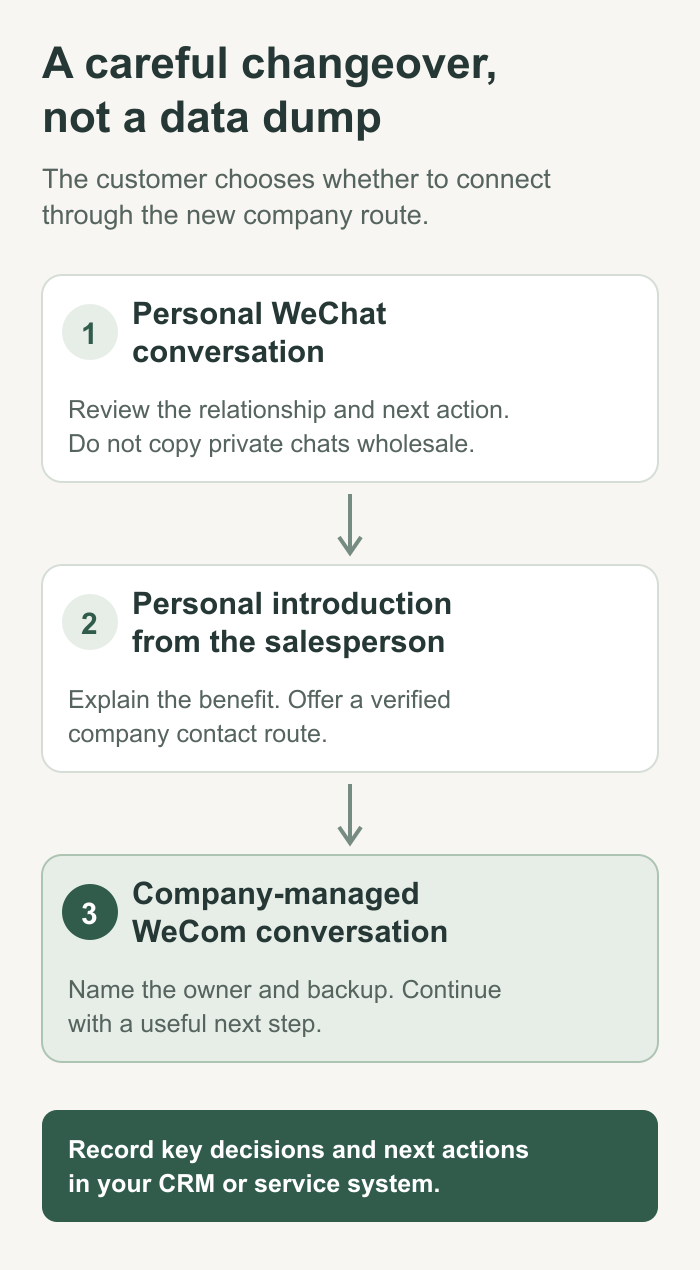
A six-step move from personal WeChat to WeCom
1. Pick one team and one customer journey for a pilot
Choose a manageable group—for example, one China account manager and the customers receiving ongoing technical support. Decide what WeCom is meant to improve: response continuity, visibility of next actions, safer handover, or all three. Name the sales owner, the backup and the person who will maintain the account settings. Do not roll out a company-wide rule before this small journey works.
Before inviting customers, confirm the applicant, verification route, employee access and specific customer-contact features available to the live account. International brands should not assume every function, fee or eligibility rule is identical across entities or regions. Lotus’s WeCom team can help define this operating structure and the customer journey before setup turns into a technology project.
2. Prepare the new contact before asking anyone to move
The WeCom profile should make the brand and employee recognisable. Agree how a first message will explain the service, when the account is monitored, where urgent issues go, and who steps in during leave. Give staff an approved answer to common product, pricing and service questions. A new channel is useful only if the customer gets a better experience when they use it.
Do a test with a colleague’s account. Can the customer see the right identity? Does the invitation reach the intended person? Can the backup actually take over a query? Does the relevant information reach the CRM or service system through the agreed process? Resolve the awkward parts before using a real customer as the test.
3. Let the existing salesperson make the introduction
The person who earned the relationship should usually make the first approach. Keep it short and relevant to the customer’s current need. For example:
“Hi Ms Huang, I’m still your contact for the equipment review. We’re setting up a company WeCom contact so my colleague can help when I’m travelling and our team can keep the project moving. If you’re comfortable, you can add me here: [verified contact route]. I’ll send the revised specification through our agreed channel on Thursday.”
That is more credible than “Please add our new account.” It identifies a benefit, preserves the named relationship and gives a concrete next step. The Chinese wording should be written and checked by the local team for the brand, sector and relationship—not copied mechanically from a template. Do not claim the old conversation or all history will be transferred.
4. Run a controlled overlap rather than a hard cut-off
Some customers will connect promptly; others will not. During the pilot, keep a clear rule for where each active conversation is handled and how the salesperson avoids sending conflicting updates in two places. If a customer prefers the existing route, the team should understand why and consider a workable alternative. The goal is continuity, not a forced contact-count target.
For each invited customer, note whether the invitation was accepted, whether a useful first exchange happened, and who owns the next action. This can be a small, access-controlled tracking sheet during a pilot; it does not require a complex SCRM purchase. Avoid storing unnecessary personal chat material.
5. Put the business decision somewhere other than chat
WeCom is the conversation layer, not automatically the company’s complete CRM or service record. At minimum, decide where the team records the customer organisation, source, owner, current need, agreed next step and date. A technical requirement, quotation approval or service escalation may belong in a different system. Specify who updates that record and what happens when they are absent.
This is also the point to check privacy, access and retention with the brand’s responsible specialists. Do not treat a change of messaging app as permission to collect, monitor or export more customer information than the business needs. The Personal Information Protection Law is relevant to personal information handling in China; implementation details require case-specific review.
6. Rehearse the handover before someone leaves
Ask a colleague to act as the backup while the account manager is away. Can they identify the customer’s open question, find the approved answer, and continue without asking the customer to repeat everything? Test the actual WeCom and CRM configuration. Tencent says company-managed customer relationships can remain with the enterprise when an employee moves on, but the exact reassignment route and what context remains available should be confirmed in the live setup. Never assume every historical message, attachment or note transfers.
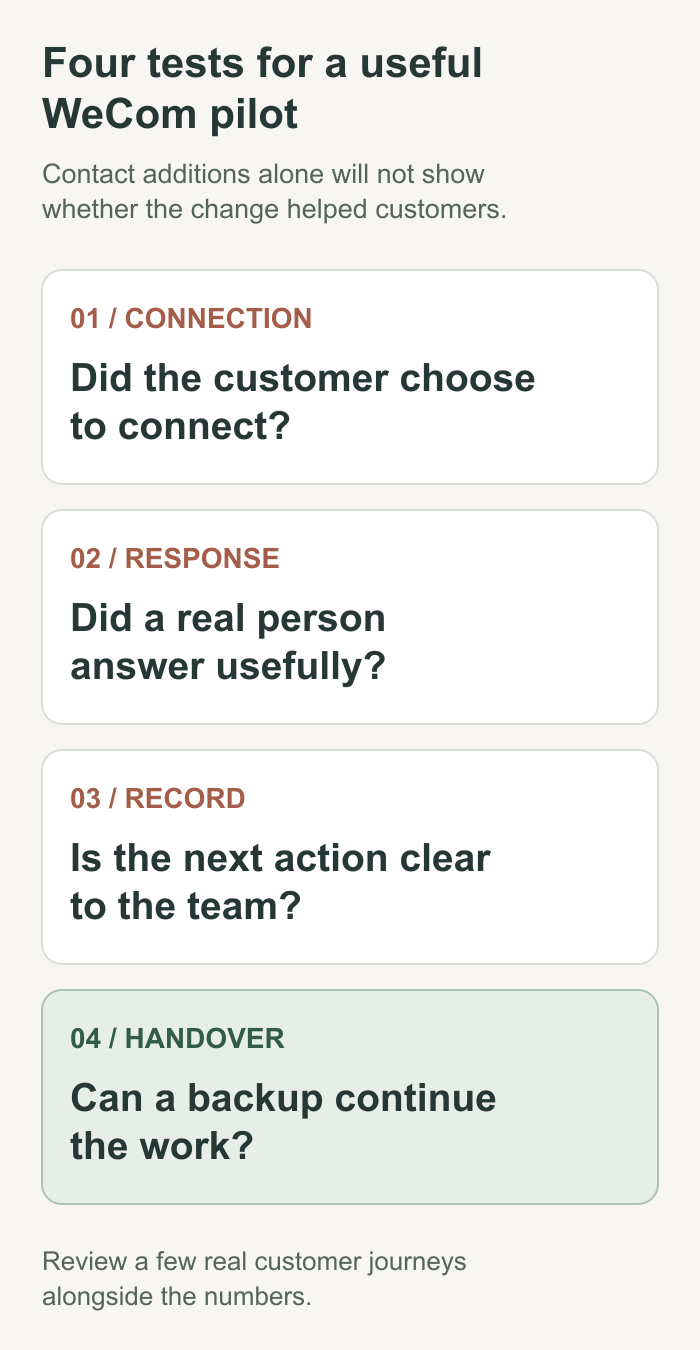
What should you measure during the pilot?
Do not judge the work by the number of invitations alone. Review a few signals together:
How many relevant customers were invited, and how many chose to connect?
Did they receive a useful reply and the next promised action?
Are important opportunities assigned to a named owner and backup?
Can another authorised colleague find the current need and next step?
Were there duplicate messages, complaints or contacts who preferred another route?
Did a real absence or practice handover work without a service gap?
No universal “good conversion rate” applies to every industry or customer relationship. A five-person pilot that solves a difficult handover may be more valuable than a hundred silent additions.
Common questions from international teams
Can we automatically move personal WeChat contacts into WeCom?
Do not plan around automatic migration. Validate any available account-specific route with current Tencent guidance, and treat a customer-facing introduction as the default planning assumption. Personal conversations, files and notes should not be assumed to follow the new contact.
Should every customer be asked to add WeCom?
No. Prioritise relationships where a named team can provide useful ongoing sales or service. A one-off question might be answered on the original platform; a transaction may be better handled in an approved store or service channel. Respect customers who do not want another contact.
Will WeCom stop a salesperson taking customers when they leave?
It can support a more company-managed relationship than a purely personal account, but it is not a guarantee against every people or process risk. Account ownership, access, customer communication, CRM records and tested handover all matter.
Do we need to replace our CRM or buy an SCRM platform first?
Not necessarily. Decide the few fields and decisions the team must record, then see whether a simple process works for the pilot. Scope integration or SCRM only when a specific operating need justifies it.
Make the change feel useful to customers
A successful move does not begin with a technology announcement. It begins with a customer who still trusts the person helping them—and now also knows the brand can keep helping when that person is unavailable.
Lotus can map your current Chinese customer conversations, write the practical introduction and follow-up materials, set up a workable WeCom route, train the people using it and improve the operation after launch. If your team is ready to make that change, talk to Lotus about your China sales journey.
