

A global product page changes. A feature name is retired, an inclusion is removed, a specification is corrected or a service route is simplified. The source update may be small, but the old fact can remain scattered across Chinese landing pages, WeChat articles, short videos, sales decks, creator briefs, automated replies and saved screenshots. Customers then meet several versions of the same product, while local teams are left to decide which one is current.
This is not primarily a translation problem. It is a change-control problem. The safest practical response is to confirm one authoritative source, describe the exact fact delta, find every affected China-facing asset, choose the right action for each asset and verify the public result. The aim is not to rewrite everything. It is to make the smallest complete set of changes that restores a recognisable, trustworthy product story.
The workflow below is for ordinary, verified product-information changes. It does not cover recalls, safety notices, legal or regulatory changes, compliance issues, crisis response or disputed facts. If the change touches any of those areas, stop the normal content workflow and escalate it to the appropriate specialist owner before publishing, editing or retiring anything.
Start with one authoritative change notice
Do not begin with the first screenshot or forwarded message that reaches the China team. Begin with the approved source of truth: for example, a signed-off global product page, release note, product-owner instruction, current catalogue record or formally approved terminology update. The source should state what changed, when it became effective, which products or markets it affects and who can answer questions.
Record the source URL or document ID, version or date, approving owner and effective date. If several global pages disagree, resolve that disagreement before asking local operators to choose between them. A China content team can adapt a verified fact; it should not be expected to invent the fact.
This distinction protects speed as well as accuracy. Once the source is clear, the team can move through the inventory without repeatedly reopening the underlying product decision. It also gives reviewers a stable reference when they compare an old Chinese claim with the proposed replacement.
Define the fact delta in operational language
Write a two-column before-and-after statement before touching any asset. “Product information updated” is too vague. A usable delta says, for example, “Before: the standard plan includes Feature A. After: Feature A is available only in the advanced plan from 1 December.” It should separate the factual change from the team’s interpretation of what to say about it.
Add the approved Chinese term, any retired term, affected variants and a short reason for the change. If the global source uses internal language that will not make sense to a customer, keep the source wording in the record and add a separate customer-facing explanation. Do not blur the two. Reviewers need to see which part is verified fact and which part is local communication judgement.
This is where good Chinese content localisation earns its place. Localisation is not permission to alter the product claim; it is the work of making the approved fact clear, natural and useful for the audience and platform. A shared delta keeps that judgement anchored.
Build an affected-asset inventory
The inventory should follow where the fact travelled, not the organisation chart. Search the current Chinese product name, previous name, feature term, model number, translated benefit and any distinctive sentence used in earlier campaigns. Include assets that are live, saved for reuse or still used by customer-facing teams.
Check at least:
Chinese website and landing pages
WeChat articles, menus, service messages and saved replies
Xiaohongshu, Douyin, Bilibili, Kuaishou and Weibo posts where relevant
video captions, subtitles, voice-over, thumbnails and on-screen text
downloadable brochures, comparison charts, FAQs and event materials
creator briefs, partner toolkits and paid-media variants
WeCom content libraries, sales decks and customer-service macros
screenshots embedded in later posts or presentations
search snippets and other public pages that repeat the old wording
A useful Chinese social platform map helps the team search by customer journey rather than by habit. The fact may first appear in discovery content, then reappear in official explanation and finally in a sales conversation. Missing any one of those layers can preserve the contradiction.
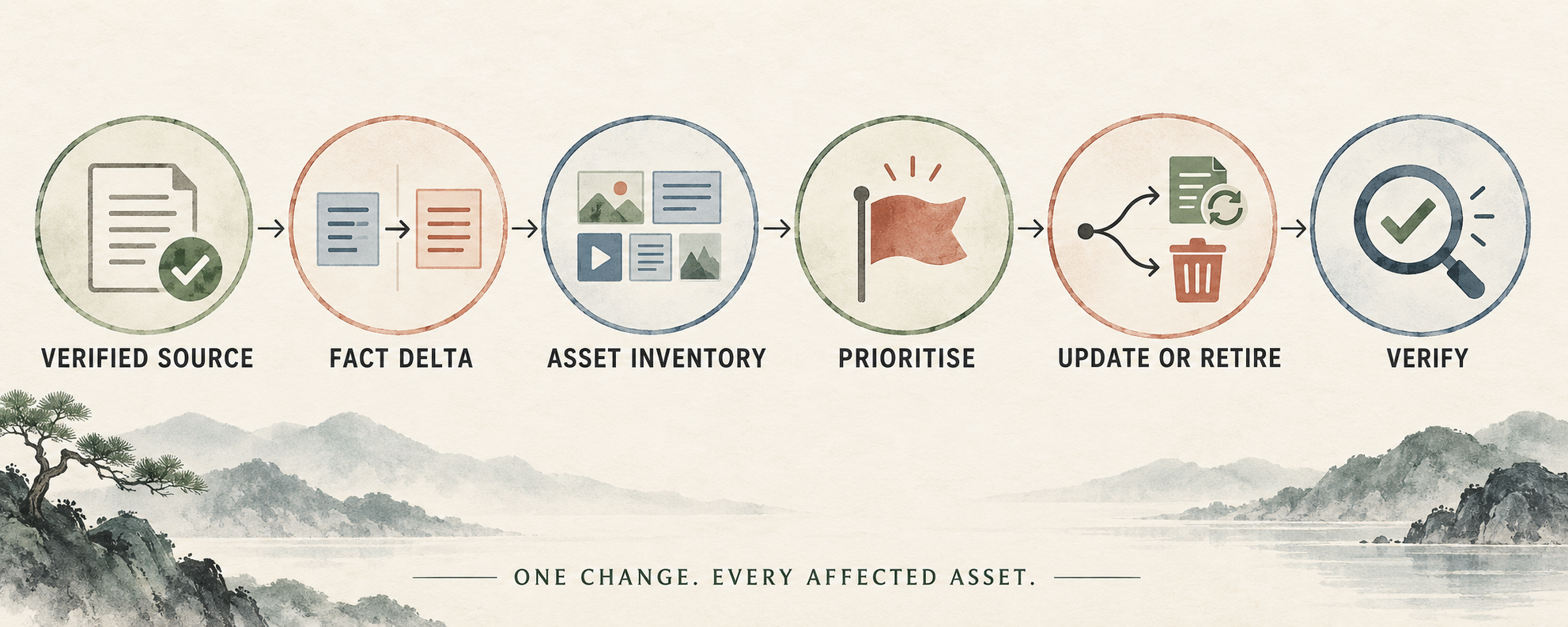
Prioritise by visibility and decision risk
Not every occurrence needs the same response time. Score each asset against two practical questions: how many people are likely to encounter it, and how much could the old fact influence a decision? A high-traffic product page and a sales comparison sheet usually deserve attention before a low-visibility historical post that no longer shapes a current journey.
Use a simple priority order:
Priority 1: current purchase, enquiry, onboarding or service decisions
Priority 2: highly visible discovery and comparison content
Priority 3: reusable sales, creator, partner or internal materials
Priority 4: low-visibility historical content with little decision impact
Priority is not the same as deletion. A well-ranked historical article may need a clear correction or replacement route even if it cannot be edited in place. Conversely, a low-reach internal template may be easy to fix but still dangerous if sales teams reuse it every week. Combine exposure with reuse risk.
Choose update, retire, replace—or leave unchanged
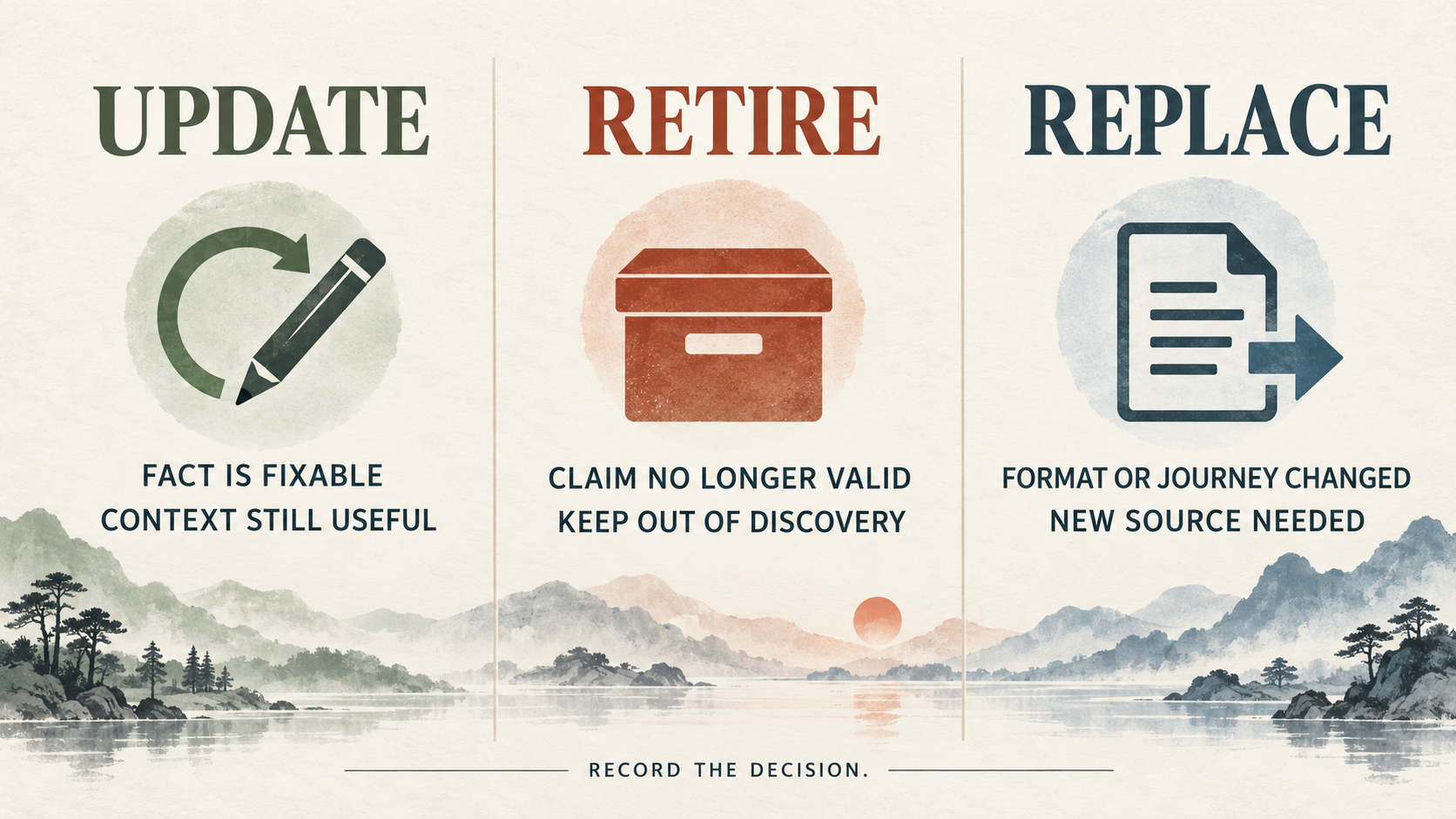
Update an asset when the incorrect fact can be corrected cleanly and the surrounding context remains useful. Retire it when the central claim is no longer valid, the platform does not support a clear correction or continued discovery would mislead. Replace it when the product journey, format or source has changed so much that a new asset is more useful than a patch.
Leaving an asset unchanged is also a valid recorded decision. The product term may appear only as historical context, or the asset may describe an unaffected market or version. The important point is to document why it is out of scope rather than silently skipping it.
For every asset, record one action, one owner, one target date and one verification method. Avoid the ambiguous instruction “refresh content.” A reviewer should be able to see whether the team will edit a paragraph, replace a graphic, unpublish a page, add a visible note, redirect to a current source or make no change.
Respect platform-specific editing limits
Do not assume that a published item can be edited simply because the team can still see it. Capabilities vary by platform, account type, content format, publishing route, permissions and the age or state of the post. Some routes support creation, deletion, data retrieval or managed publication without offering the same post-publication controls in every interface.
Before assigning an action, the operator should check the live account and current official platform guidance. Record what the actual route allows: edit, delete, hide, add a comment, publish a correction, replace the destination page or create a new asset that supersedes the old one. A platform capability listed for an authorised API should not be treated as proof that every end-user post can be edited.
If the old item cannot be changed, reduce confusion through the next best controlled surface. That may mean retiring the item, publishing a clearly linked replacement, updating the profile or menu destination, correcting the owned landing page and preparing an approved response for questions. The choice should be visible in the change log.
Update the source, not only the translation
A Chinese wording fix will not hold if teams continue copying from an outdated global slide, product database or campaign brief. Correct the upstream source used for future localization, and label or archive superseded files so they are not mistaken for reusable master assets.
Then update the terminology bank. Record the approved Chinese product name, feature name, prohibited legacy term, market or version qualifier and the date the wording changed. If a claim needs more context in Chinese, add the approved explanation without changing the underlying fact.
This is also the moment to check naming consistency across the wider China marketing roadmap. A product should remain recognisable as a customer moves from search or social discovery to an official page, a WeChat conversation and a purchase or enquiry route. Consistency does not mean identical copy; it means the same current product is identifiable at every step.
Notify sales, service, creators and operating partners
Public pages are only one part of the content system. Sales representatives, service agents, creators, distributors and media operators often hold downloadable files or saved copy outside the main publishing calendar. A change is incomplete until those teams know what stopped being true and which source replaces it.
Send a concise operator note containing:
the verified fact delta and effective date
the approved Chinese term or replacement sentence
the affected product, market and version
what to stop using
the current source link
who owns exceptions or questions
when the readback will be completed
For teams using WeCom, update the approved resources that customer-facing staff can share. Do not assume that a message in a general group will remove an old PDF from someone’s desktop or content library. Ask each responsible owner to confirm the asset they replaced or retired.
Check screenshots, video, downloads and automated replies
Text search finds only the visible words that systems can index. Product facts also live inside screenshots, comparison tables, subtitles, voice-over, downloadable PDFs, thumbnail text and templated replies. These assets need a visual and operational check.
Watch video through rather than checking only the caption. Open PDFs and presentation exports rather than trusting the source filename. Test automated replies with the phrases customers actually use. If an old screenshot is retained to explain a historical workflow, label the context so it is not mistaken for the current product.
Creator and partner content needs a bounded response. The brand may not control every third-party post, but it can correct its own brief, stop distributing outdated material, notify active partners and update the official pages people should use for verification. Record what the team controls and what it does not.
Verify search and AI consistency without promising refresh
After publication, search the old and new Chinese terms across the brand’s public surfaces. Check the product name, feature term, model number and one or two distinctive phrases from the retired claim. Confirm that important results lead to the current owned source and that no high-risk contradiction remains in the customer journey.
Search engines, platform search and AI answer systems refresh on their own schedules. A brand can improve the clarity, consistency and accessibility of its public information, but it cannot guarantee when a result or generated answer will change. Treat visibility as a verification field, not a promise.
The right questions are practical: can a person find the current fact, do official sources agree, does a prominent old page still contradict them, and is there a clear route from discovery to the latest information? The same discipline that closes booking-confidence gaps in travel also protects product understanding in other sectors.
Keep a source and version record
The change log is the memory of the system. For each item, keep the asset URL or ID, previous wording, approved wording, action, owner, completion time, reviewer and verification result. Link the record to the authoritative change notice and preserve the previous version where the platform or document system allows.
This record helps with the next update. The inventory becomes a map of where product facts tend to travel, while recurring misses reveal which templates, partner routes or team handoffs need stronger controls. Over time, the organisation can reduce the search burden because it knows which assets depend on which facts.
A complete record also prevents covert editing. Reviewers can see what changed and why, while local teams retain enough context to explain the decision later. The goal is not paperwork for its own sake; it is a usable chain from source to public readback.
Run a verification readback
A readback is more than marking tasks complete. A second person should open the current assets, compare them with the approved delta and test the audience journey. Use the published URL or live file, not only the editor preview.
Confirm that:
the approved Chinese terminology appears correctly
the old fact is removed, clearly contextualised or intentionally retained
linked pages and downloads open the current version
visible dates, prices, plans, specifications and screenshots agree
sales or service resources match the public source
the action log contains evidence for every in-scope asset
unresolved items have named owners and stop conditions
If the team cannot verify an important asset, keep it open rather than declaring the change complete. Accuracy is established by the final readback, not by the number of edits made.
Common questions
Do we need to delete every old post?
No. Delete or retire content when its core claim is no longer valid and continued discovery would mislead. If the old fact is peripheral, a correction, contextual note or current destination may be enough. Record the decision and check what the platform actually permits.
What should we do with screenshots of the old product?
Replace screenshots that are being used as current instructions, comparisons or proof. A historical screenshot can remain when its context is explicit and it cannot be confused with the current experience. Check cropped images carefully because the outdated fact may sit outside the visible caption.
What if a discontinued feature appears in a creator post?
Correct the brand’s own brief and official source first. Notify active creators or partners using the old material, ask for the feasible platform-specific correction and record the outcome. Do not imply that the brand can edit or remove content it does not control.
What if the platform will not let us edit the post?
Verify the live account’s available actions. Depending on the route, the team may retire the post, publish a replacement, add a visible clarification, update the linked landing page or prepare an approved response. Make the replacement easy to recognise and record the limitation.
Turn product change into a controlled content habit
International brands do not need a complex system to keep China content accurate. They need a visible chain of ownership: one verified source, one precise fact delta, one searchable asset inventory, a recorded decision for every affected item and an independent readback of the live result.
The broader operating model matters. Chinese content production, platform operations, sales enablement and service communication should share the same current product source while adapting the format to each audience and channel. That makes updates faster because local judgement starts from an agreed fact, not from a hunt for the latest slide.
If your global product information changes faster than your China-facing content can follow, Lotus can help map the affected surfaces, create the Chinese change-control workflow and keep localisation, publishing and operating teams aligned as the product evolves.
