

WeCom Governance for International Teams: Ownership, Access and Handover Checklist
Good WeCom governance gives an international brand clear enterprise ownership, limited and reviewable administrator access, a controlled employee lifecycle, approved customer-facing content, defined data responsibilities and a tested incident response. The objective is not paperwork. It is to keep customer relationships and operational knowledge dependable as people, agencies and systems change.
This guide is for regional and global marketing, sales, customer-experience, IT, security and legal stakeholders who need local China execution without losing organizational control. It is particularly useful before launch, during an agency transition, after rapid team growth or when a key employee is leaving.
Lotus Social Agency’s WeCom service includes governance and team-structure design alongside customer journeys, Chinese content and operations, because platform access and daily behavior must be managed as one system.
What WeCom governance means
WeCom governance is the set of decisions, owners, permissions, procedures and evidence that determine how the brand operates the platform. It answers six questions:
Who owns the enterprise account and associated assets?
Who can administer users, applications, customer contact and integrations?
What happens when an employee joins, changes role or leaves?
Who approves customer-facing messages and operational changes?
Which customer and operational data is handled, where and for what purpose?
How will the team detect, escalate and respond to an incident?
Tencent describes WeCom as an enterprise communication and management platform that connects with Weixin. Tencent also states that customer relationships are owned by the company and can be preserved when an employee moves on. That enterprise model can improve continuity, but it is not a complete governance policy. A brand still needs configured responsibilities, tested transfer procedures and clarity about what messages, files, notes and data remain available in each workflow.
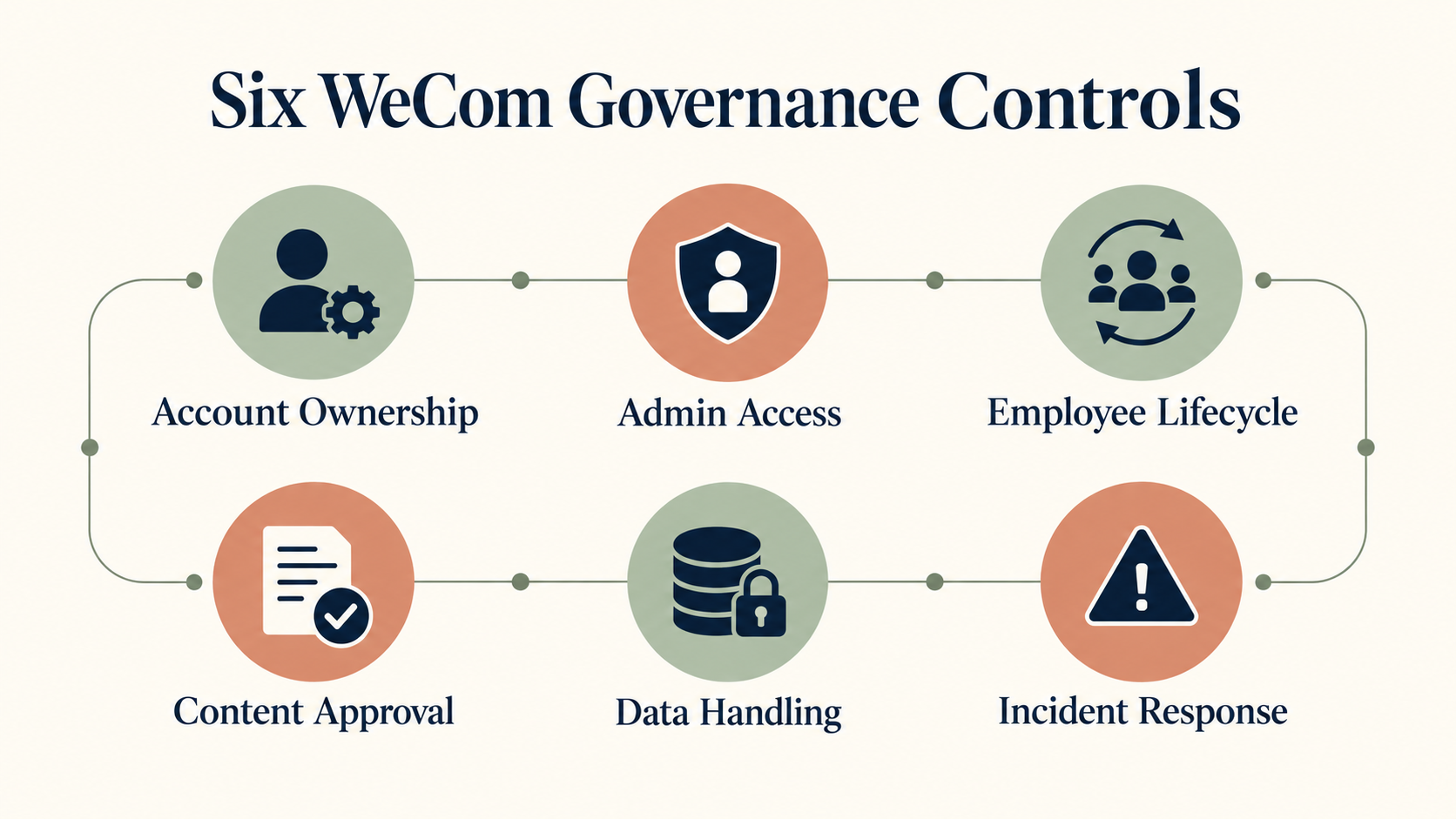
WeCom governance works when ownership, access, people, content, data and incident controls reinforce one another.
1. Establish durable account ownership
The enterprise account should sit within a structure the brand can continue to control when employees or suppliers change. Document the applicant entity, verification status, primary administrator, backup administrator and responsible business owner. Keep critical registration, verification and contract records in a company-controlled repository.
The business owner and administrator are different roles. The business owner is accountable for the use case, operating performance and customer experience. The administrator controls platform access and configuration. Both need named backups.
Account-ownership checklist
Applicant and verified entity documented.
Business owner and executive sponsor named.
Primary and backup administrators named.
Administrator contact methods controlled by the organization where possible.
Verification and supporting documents stored in an approved location.
Related WeChat Official Accounts, Mini Programs, websites and systems mapped.
Agency access documented separately from brand ownership.
Exit procedure written for employees and vendors.
International eligibility and verification routes can change. Some structures may be possible, but the brand should confirm its current case rather than rely on a general claim made for another entity.
2. Apply least-necessary administrator access
Administrator privileges should match actual responsibilities. Avoid giving broad access merely because it is faster during launch. Maintain an access register showing the person, employer, role, scope, approval, start date, review date and removal date.
Separate duties where practical. The person who approves a sensitive integration or data export should not always be the only person who configures and verifies it. High-impact changes can require a second review under the brand’s own policy.
Administrator-access checklist
Each privilege has a named business reason.
Agency and contractor access is time-bounded and reviewable.
Backup access does not depend on one departing employee.
Authentication methods follow the company’s security policy.
High-impact changes have an approval and change log.
Access is reviewed after role changes and at a defined cadence.
Unused, duplicate and legacy accounts are investigated.
Emergency access and recovery responsibilities are documented.
The brand’s security team should confirm the appropriate controls for its risk profile. Product certifications and platform safeguards do not remove the organization’s responsibility to configure and operate access correctly.
3. Control the employee and vendor lifecycle
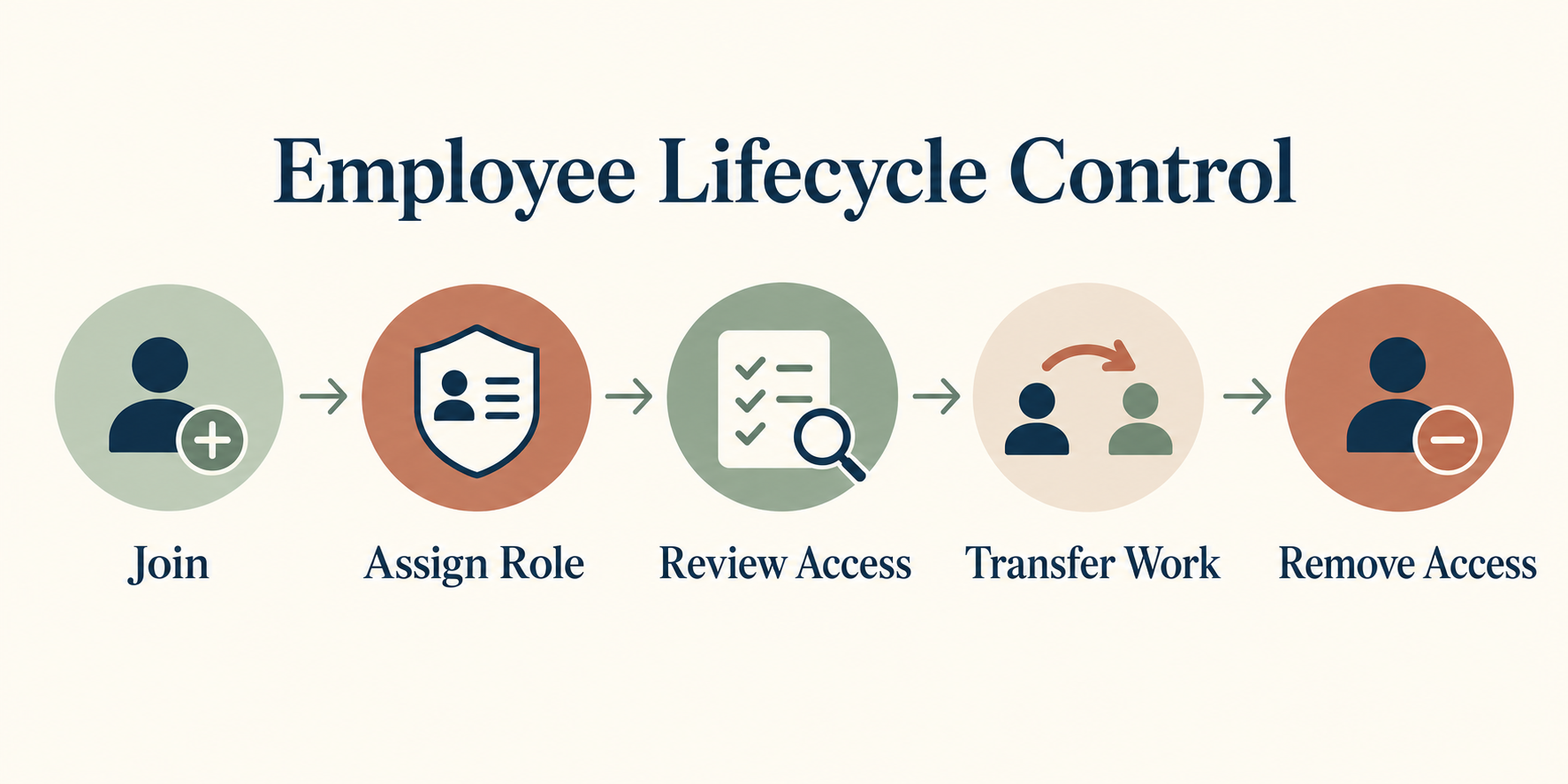
A reliable lifecycle connects onboarding, role changes, handover and offboarding instead of treating access removal as the entire process.
Customer continuity is most likely to fail during a people change. A lifecycle process should begin before someone receives access and end only after work, records and responsibilities have been transferred and access has been removed.
Join
Confirm employment or supplier status, manager, role, required access, training and approval. Explain permitted use, content rules, customer-data responsibilities, escalation paths and the difference between personal and enterprise communication.
Assign role
Give only the permissions, contacts, groups, applications and operating queues required for the role. Record who approved the access and what must happen if the assignment changes.
Review access
Review access when responsibilities change and on a regular schedule. Confirm that the employee’s customer portfolio, group responsibilities, applications and reporting rights still match the job.
Transfer work
Before departure or reassignment, identify active customer conversations, promised follow-ups, open service cases, groups, content schedules, approvals, records in connected systems and unresolved issues. Assign a receiving owner and confirm that the customer experience will continue.
Remove access
Remove unnecessary access promptly according to the company’s policy, then verify completion. Update administrator registers, distribution lists, integrations, vendor permissions and recovery contacts where relevant.
Tencent’s statement that company-owned customer relationships can be preserved when employees move is important, but a governance checklist must go further. Do not assume that every historical message, attachment, file or internal note moves automatically. Test the relevant handover method and confirm the accessible context before depending on it.
4. Govern customer-facing content and conversation
WeCom content includes more than campaigns. Welcome messages, employee profiles, FAQs, service answers, sales material, group rules, automated replies and escalation messages all shape the customer experience and may create compliance or reputational risk.
Create a content-responsibility map:
The content owner maintains the calendar and asset library.
The Chinese-language editor ensures local clarity and cultural fit.
The brand approver protects product, legal and tone requirements.
The operator uses only current, approved material.
The subject-matter owner verifies technical or regulated claims.
The escalation owner decides how exceptions are handled.
Fast-moving customer conversations cannot send every sentence through a long approval chain. The solution is an approved response framework: clear facts, allowed claims, prohibited claims, escalation triggers and examples of appropriate judgment. Operators need both reusable content and permission to respond within defined boundaries.
Content-control checklist
Current Chinese templates are stored in one approved library.
Each asset has an owner, approval state and review date.
Product, pricing and eligibility claims have a verification source.
Automated or bulk communication has a documented purpose and audience rule.
Customers have a reasonable expectation of the interaction.
Regulated or sensitive questions go to qualified specialists.
Outdated content can be withdrawn quickly.
Complaints and corrections feed back into the content library.
5. Define data handling before integration
WeCom may sit within a wider environment that includes WeChat touchpoints, CRM or SCRM, customer service, commerce, analytics and agency tools. Governance should state the purpose of each system, the minimum information it needs, which system is authoritative and how information moves between them.
China’s Personal Information Protection Law sets rules for personal-information processing, and official materials emphasize lawful, justified and necessary handling, informed consent in applicable situations, processor responsibilities and protective measures. Network-data rules also address personal information, important data, cross-border provision and third-party providers. A blog checklist cannot determine the legal basis or transfer mechanism for a specific brand; qualified legal, privacy and security teams should assess the actual data flow.
Data-governance questions
What customer information enters through the WeCom journey?
Why is each field necessary for the stated purpose?
What notice, consent or other basis applies?
Which organization is the personal-information processor or other responsible party?
Does an agency or technology provider process information on the brand’s behalf?
Where is each record stored and which system is authoritative?
Who can view, correct, export, synchronize or delete information?
Is information provided to an overseas party or system?
What retention and deletion rules apply?
How are customer requests, complaints and incidents routed?
Do not label a project “compliant” merely because it uses a particular platform or because a vendor supplies a template. Governance needs to reflect the brand’s purposes, people, contracts, systems and actual operations.
6. Prepare an incident and escalation response
An incident can be technical, operational, reputational, privacy-related or security-related. Examples include an unauthorized administrator, a message sent to the wrong audience, a lost device, an unapproved claim, inaccessible customer records, a failed integration or suspected disclosure.
The response plan should say:
what staff must report;
how urgent cases are recognized;
who receives the first escalation;
who can pause messages or access;
how evidence and decisions are documented;
which internal specialists assess legal, security or customer impact;
how customers or authorities are addressed when required;
how the root cause and corrective action are reviewed.
Operators should not need to interpret legal notification duties during an incident. Their job is to recognize the trigger, preserve relevant information and escalate promptly to the people authorized to decide.
A workable headquarters–China governance model
International teams often fail at one of two extremes: headquarters tries to approve every local interaction, or the local operation grows without visible control. A better model separates principles from execution.
Headquarters or regional responsibilities
Set brand, security, privacy and risk principles.
Approve enterprise ownership and accountable executives.
Define integration and cross-border data review requirements.
Confirm which claims need specialist approval.
Review material incidents and investment decisions.
China team responsibilities
Translate principles into local workflows.
Operate customer conversations and communities.
Maintain Chinese content and recurring answers.
Detect issues, escalate exceptions and record learning.
Report operational performance and capacity needs.
Shared responsibilities
Customer-journey design.
Administrator and access reviews.
Employee and agency transitions.
Material platform or integration changes.
Measurement definitions and scale decisions.
Periodic governance review.
An agency can support design and execution, but it should not make the brand invisible from its own governance model. The client needs durable ownership, records and decision rights.
The quarterly WeCom governance review
A regular review should be short enough to complete and broad enough to catch drift. The appropriate cadence depends on the brand’s risk and activity; quarterly is a useful operating example, not a universal rule.
enterprise, applicant and administrator records;
active employees, agencies, vendors and permissions;
role changes and completed or pending offboarding;
active customer journeys, groups and entry points;
current content library and expired approvals;
data flows, integrations and source-of-truth decisions;
outstanding incidents, complaints and corrective actions;
operational measures and capacity;
planned product, campaign or system changes;
documentation, training and backup coverage.
End with named actions, owners and dates. A review that only records “no issues” does not show whether controls were actually checked.
Warning signs that governance is weak
Only one person can administer or recover the account.
A former employee or agency still has access.
Customer ownership depends on personal accounts or informal spreadsheets.
No one can list active integrations or exported data.
The team assumes every message and file transfers during employee handover.
Chinese content is published from unapproved personal copies.
Headquarters receives vanity metrics but cannot see unresolved operational issues.
The agency contract does not define data, access, records and exit handover.
“Compliance” is claimed without review of the actual customer journey.
Staff do not know where to report an incident.
How Lotus supports WeCom governance
Lotus can help international brands define the customer journey, team structure, access and handover responsibilities, Chinese content workflow, customer or community operating procedure, reporting and agency transition plan. This governance work can sit alongside China social media management so content and customer operations follow the same standards.
Lotus can coordinate requirements with internal IT, security, privacy, legal and integration specialists. It does not replace those specialists or promise that a generic configuration will meet every legal or technical need. The purpose is to make responsibility visible and executable.
Frequently asked questions
Who should be the primary WeCom administrator?
Choose a suitably authorized person within the organization’s operating model, with a documented backup and recovery process. The exact person depends on entity, team and policy. Avoid relying on an agency or a single employee without durable brand-controlled records and transition rights.
Does company ownership mean all message history transfers when an employee leaves?
No such blanket assumption should be made. Tencent states that customer relationships can be preserved at the company level, but the brand should test the specific transfer workflow and confirm what conversation history, files, notes and connected-system data remain accessible.
Can an agency administer WeCom for the brand?
An agency may perform approved administrative or operating tasks, but scope, permissions, duration, oversight, data responsibilities and exit handover should be documented. The brand should retain durable ownership and accountable internal decision makers.
Is WeCom itself the system of record?
It can be part of the operating record, but it does not automatically replace a CRM, SCRM, help desk or other authoritative system. The brand should define its source of truth by use case and integration design.
How often should access be reviewed?
Review after joiner, mover and leaver events and at a recurring cadence suited to the risk. Higher-impact privileges and vendor access may need closer review. The company’s security and compliance policies should set the final schedule.
Does this checklist guarantee compliance with Chinese data law?
No. It is an operational governance framework, not legal advice. Compliance depends on the actual entity, purpose, data, customer journey, systems, transfers, contracts and current law. Obtain qualified legal, privacy and security review.
Make continuity a designed outcome
WeCom can support enterprise-managed customer relationships, but continuity is not created by a product claim alone. International brands need people, permissions, content, data rules and handovers that work when the organization changes.
If your brand is preparing a WeCom launch, reviewing an existing operation or changing agencies, talk to Lotus about a WeCom governance and operating review. We can help turn global requirements into a practical China responsibility model and a tested handover process.
