

From Watching to Participating: What International Brands Can Learn From China's Best Brand Experiences
There's a shift happening in how the most effective brand campaigns are being designed — not just in China, but visibly accelerating on Chinese social media platforms where the bar for consumer attention is exceptionally high. The direction of that shift is away from brands telling stories and toward brands creating conditions in which consumers participate in those stories directly. Five recent cases from Chinese marketing illustrate what this looks like in practice, and the underlying logic is directly applicable to international brands thinking about how to connect with Chinese consumers in ways that go beyond a single campaign moment.
Saucony: A Podcast That Made Running a Way of Life, Not Just a Sport
Athletic brands have traditionally built credibility through performance metrics, event results, and professional athlete endorsements. These signals prove product capability, but they don't necessarily address what serious runners think about over the long term: the discipline, the solitude, the emotional rhythms of training, and the relationship between running and the rest of their lives.
Saucony's new podcast, titled "First Awake Zone" (先醒时区), shifts the conversation from footwear to the runner's internal experience. "First awake" doesn't just mean early rising — it refers to the person who chooses to begin their day before the city does, treating that window of time as something personally claimed rather than passively received. To make this feel real rather than aspirational, the first episode was recorded not in a studio but on location at a major Chinese trail relay race, capturing the ambient sounds of the course, conversations between runners, and the genuine fatigue and energy of competition. The people speaking in the episode aren't distant athletic icons — they're runners whose training habits and emotional experiences closely mirror those of the audience listening.
For international brands in the Chinese market, the lesson here isn't specifically about podcasts. It's about the kind of ongoing, low-key presence that creates genuine connection over time — content that enters the user's daily life through their earphones during morning runs, commutes, or wind-down periods, rather than reaching them through a campaign moment they'll scroll past. Long-form audio is particularly effective for building the sense of accompaniment that drives deeper brand association than visual advertising typically can.
Sushiro × Dungeon Meshi: How a Collaboration Turned Diners Into Adventurers
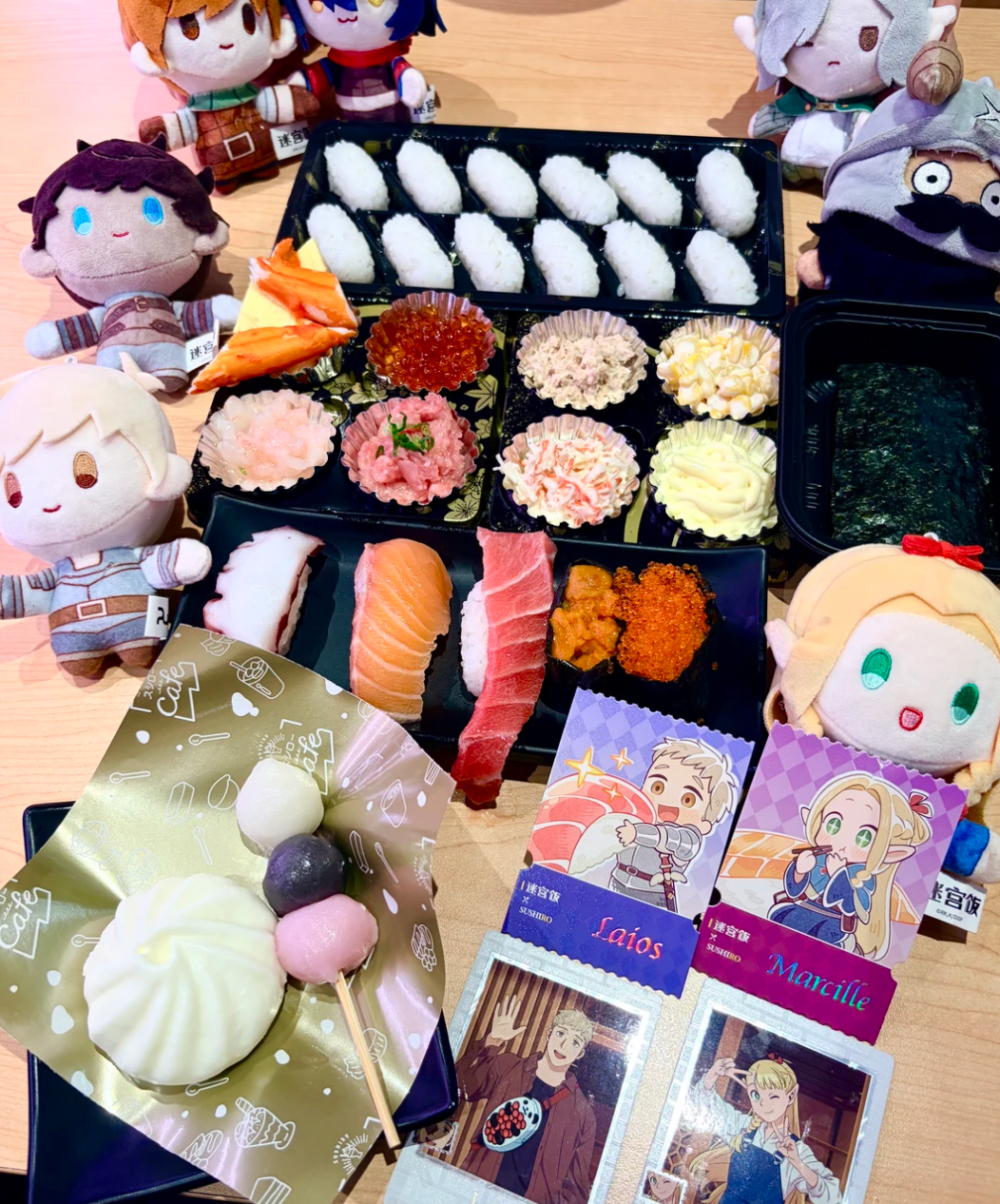
IP collaborations have become standard in the restaurant industry, but most follow a predictable template: character imagery on packaging, a limited-edition menu item, some exclusive merchandise available with purchase. Consumers encounter a familiar face, consume an essentially standard product, and move on. Sushiro's collaboration with Dungeon Meshi (Delicious in Dungeon) chose a different approach — one grounded in a much more careful reading of why the IP works as source material for a food brand.
The premise of Dungeon Meshi is specific: characters surviving a dungeon adventure by cooking the monsters they defeat, with food functioning not as decoration but as the actual mechanism of survival and storytelling. This is an unusually strong foundation for a restaurant collaboration, because the IP's own logic is built around the experience of preparing and eating food. Sushiro mapped this logic onto multiple touchpoints: a "Hero's Feast" featuring diverse ingredients, a maze hand-roll DIY kit that consumers assembled themselves, themed desserts, limited drinks, character merchandise, and a custom store environment. The result was that visiting the restaurant became an act of participating in the collaborative world — not just eating a meal with branded packaging, but progressing through a series of small interactions that built toward a coherent "adventurer's meal" experience.
For international brands, this case illustrates the difference between surface-level IP licensing and genuine experiential co-authoring. The question worth asking before any collaboration isn't "which IP has high recognition right now?" but "what does this IP's actual content logic have to do with what our brand does, and how can we create a moment of participation around that connection?"
Porsche × Toy Story 5: When Luxury Meets Mass IP, the Craft Has to Do the Work
When premium brands collaborate with widely accessible intellectual property, a familiar concern arises: will the IP's populist, entertainment-driven associations dilute the sense of exclusivity and expertise the luxury brand has built? Porsche's approach to working with Toy Story 5 answered this concern not by limiting the scope of the collaboration, but by using its most distinctive capability — bespoke craftsmanship — as the medium through which the collaboration was expressed.
Rather than applying character decals or releasing co-branded merchandise, Porsche developed three fully customized 911 models built around the personalities and visual signatures of Woody, Jessie, and Buzz Lightyear. The design language didn't place characters on the vehicles — it extracted elements from each character's identity (color palette, clothing details, iconic accessories) and translated those elements into automotive design decisions: paint finishes, wheel designs, interior materials, performance specifications. The Woody-themed car used a denim-textured paint finish and western-inflected interior details. The Buzz Lightyear model expressed its source material through a space-suit color scheme, lightweight components, and a prominent rear wing. Each car was completed by Porsche's bespoke division in over 350 hours of handwork, without vinyl wrapping, meaning the collaboration's value was grounded in the same skills that define Porsche's brand at its core.
The collaboration concluded with a charity auction — transforming the nostalgic emotional value of Toy Story into a connection between craft, collectibility, and public benefit. The practical takeaway for international brands is this: when the goal is a high-integrity collaboration rather than a trend-riding moment, the brand's most irreplaceable capability needs to be the thing that does the most work. Luxury and popular culture can coexist credibly when the collaboration is built on what only the brand can do.

Rednote's Community Market: How a Slice of Cake Became a Social Ritual
Platform anniversary campaigns often default to one of two modes: promotional events emphasizing what users can buy at a discount, or brand retrospectives celebrating the platform's history in ways that position users as an audience rather than participants. Rednote's 66th month anniversary took a different approach with a campaign built around a deceptively simple mechanic: anyone who sends a message with the number six in it during the live broadcast receives a slice of anniversary cake.
The entry barrier was as low as possible. No complex sign-up, no purchase required, no elaborate reward structure. Because the rule left so much room for interpretation, users filled that space themselves. Some brought six items related to their personal interests. Others incorporated the number six in ways that referenced their daily lives, work, or family. Children and pets appeared on camera. People made jokes, played with the theme, or turned their participation into a content moment they could share afterward. What the brand didn't do was specify the right way to participate — and the absence of that specification was the point.
This connects directly to what makes Rednote distinctive as a Chinese social media platform: its strength isn't content that the platform produces and distributes to users, but the variety of genuine individual expression that its users generate around common topics. The cake was a mechanism. What the activity actually distributed was the opportunity to be seen, to connect with others, and to turn a participation moment into content. For international brands designing campaigns in the Chinese market, the lesson is that the most participatory activations often have the simplest rules — because complexity narrows interpretation and reduces the space for users to bring themselves into the experience.
Guanxia: When a Fragrance Store Becomes a Journey Through Chinese Scent Culture
Fragrance brands rely heavily on descriptive language, packaging design, and atmospheric imagery to communicate product value. But incense specifically resists this approach. It requires time, it requires space, and it requires the willingness to stop and let the experience unfold rather than absorbing it passively. Displayed as a conventional retail product, incense easily becomes just another room fragrance — its cultural context, its compositional logic, and its relationship to specific uses and emotional states remain largely invisible.
Guanxia's fragrance shop in Beijing's Guozijian historical district structures the visit as a progressive journey through understanding rather than a standard retail browsing experience. Upon entry, visitors move through a sequence of stages: an initial consultation to understand what they're looking for, an introduction to different fragrance compositions through a scent guide, a selection area where they can smell and choose from raw aromatic materials (described as "filling a prescription"), and finally a quiet tearoom upstairs where they can rest and continue experiencing the chosen scents. Guanxia structured this explicitly around the familiar logic of a traditional Chinese medicine consultation — not to imitate it literally, but to give consumers a process they could follow intuitively even without prior knowledge of incense.
The products themselves are organized around Chinese medicine's concept of balanced composition (君臣佐使), applying the same logic to fragrance construction that traditional medicine applies to herbal formulas. Cultural references extend from the naming of products through to the service design and the physical environment. The historical context of Guozijian — long associated with scholarly culture and study — reinforces the connection between incense and the practices of reading, reflection, and focused attention without requiring the brand to explain it directly.
For international brands entering China's market, the principle here is important: when a product requires a certain level of understanding before its full value is accessible, designing the purchase experience as a guided discovery process dramatically lowers the barrier to appreciation. Consumers don't need to arrive knowing what they want — they need a structure within which their understanding can develop naturally through the experience itself.
What These Five Cases Share
Looking across all five examples, a consistent principle emerges that applies directly to how international brands should think about engaging Chinese consumers. None of these campaigns worked by producing more impressive content, adding more interactive touchpoints, or generating higher-volume reach. Each one worked by identifying a specific value the brand holds and then designing a way for consumers to encounter that value through action — listening, ordering, building, expressing, or moving through a physical space.
This is the direction that Chinese marketing is moving in, and it's a direction that rewards genuine thought over scale. In a media environment where attention is genuinely scarce, the campaigns that generate lasting recognition are those that create moments in which consumers do something with the brand, rather than simply observe it.
Interested in exploring bespoke marketing tips and localized strategies for the Chinese market? Feel free to reach out to us!
