

An outlet centre has a different Chinese tourist marketing problem from a city-centre mall. Chinese traveller is often being asked to spend half a day, leave the main sightseeing route and trust that the brands, value, transport and tax-refund experience will justify the effort.
That makes the marketing job less about broad awareness and more about decision confidence.
Use Rednote to prove why the outlet is worth the journey; WeChat Channels to show the route, scale and live experience; a WeChat Official Account to hold accurate transport, brand, service and tax-refund guidance; and Dazhong Dianping to support in-destination discovery and reviews. Add KOL and KOC visits that answer real value questions, then make the on-site experience easy enough to generate voluntary UGC. Never guarantee stock, savings or refund outcomes that the outlet cannot control.
China's Ministry of Culture and Tourism recorded 148.36 million mainland-resident outbound tourism trips in 2025, up 20.8% from 2024. These are trips, not unique shoppers, and they do not guarantee outlet demand. They justify building a current, testable visitor journey for a significant travel market.
Recent cross-border consumption research also points to a more experience-led traveller, with greater emphasis on dining, transport and entertainment rather than shopping alone. An outlet should therefore be presented as an easy, enjoyable day trip with food, rest, service and local context—not as a remote row of discounted stores.
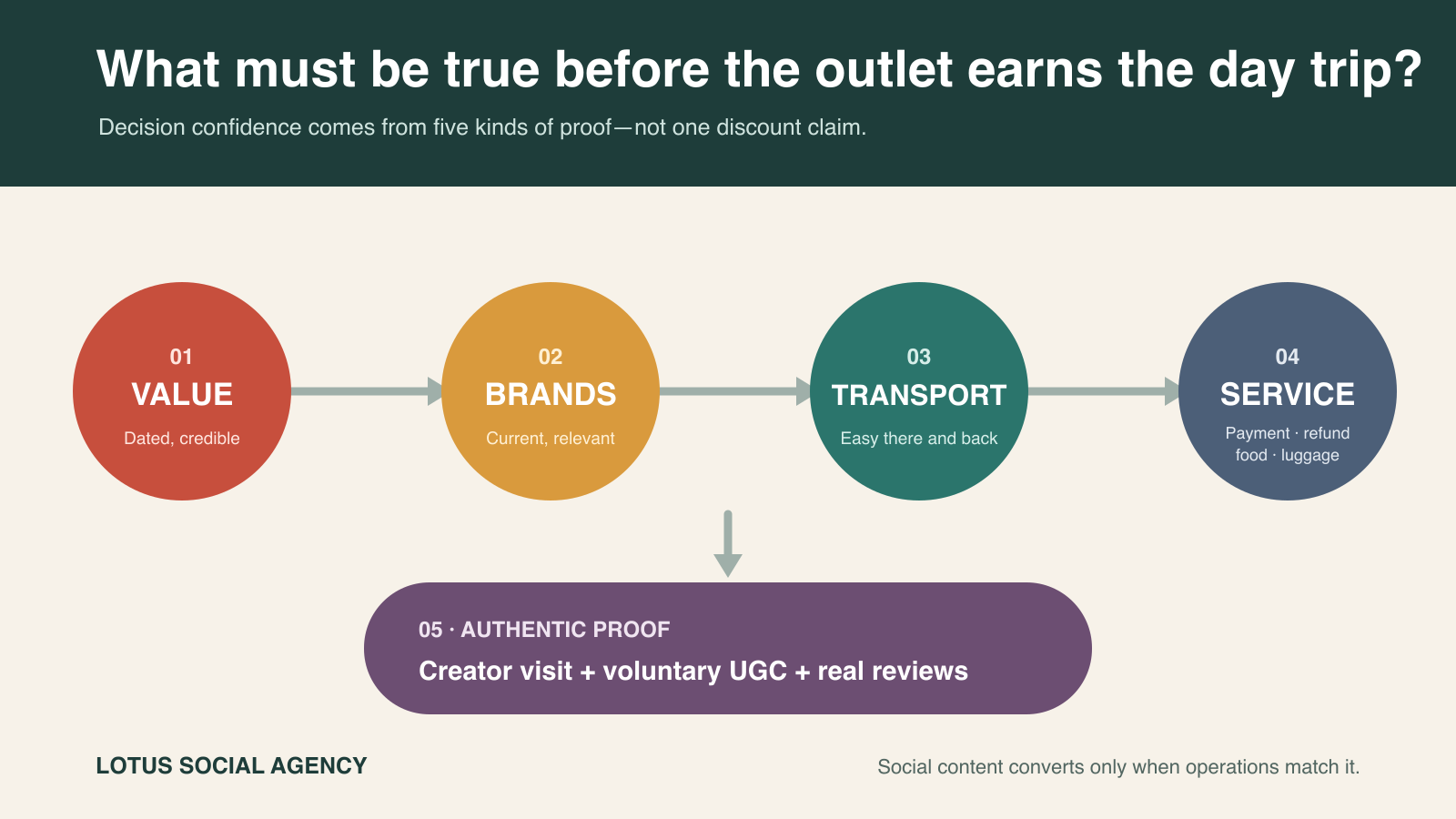
The outlet decision has five questions
Before saving an outlet to the itinerary, a Chinese traveller needs to know:
Is the value credible? What kind of previous-season, outlet-only or promotional pricing should I realistically expect?
Are the brands relevant to me? Is the directory current, and which stores are distinctive at this location?
Can I get there and back easily? What is the verified train, shuttle, driving or private-transfer route?
Can I complete the practical shopping journey? What are the luggage, payment, tax-refund, dining and language-support arrangements?
Is the trip worth the time? Can a couple, family or mixed-interest group enjoy several useful hours there?
Every platform should answer one or more of these questions.

1. RedNote Official Account: build value and trip confidence
On RedNote, a traveller may search the outlet's Chinese name, “Paris outlets,” “Milan outlet transport,” “European designer outlet worth it,” “tax refund,” or a specific brand plus “outlet price.” The official account should meet that intent with evidence and context.
Choose one Chinese outlet name and use it consistently with the local name, nearest city and transport hub. Search live results first: unofficial translations and creator nicknames may already dominate.
What an outlet should publish
A complete day-trip guide. Show departure point, travel time range, booking or ticket instructions, first stop on arrival, meal options and the return route.
Brand edits, not directory dumps. Group current tenants by luxury, contemporary fashion, sports, beauty, children's wear, home or local brands.
Dated value examples. Explain the outlet pricing model and show representative baskets only with date, store and exclusions. Never imply that one photographed item will remain in stock.
Tax-refund walkthroughs. State eligibility, minimum spend, documents, where forms are issued, where validation happens and which parts are controlled by stores or refund operators.
Shopping strategy. Offer realistic routes for two hours, half a day and a full day; explain busy periods, rest points, luggage and family facilities.
Interest-led stories. Style a capsule wardrobe, compare gift ideas, introduce a local designer or pair shopping with nearby food, culture or countryside.
RedNote Professional Account eligibility is jurisdiction-, industry- and document-specific for overseas entities. Confirm the outlet operator's exact route before promising verification, advertising or link functions.
Once organic notes prove which questions create saves and transport enquiries, the Juguang advertising platform can extend the strongest content against an appropriate objective. Do not optimise a trip-planning campaign to superficial likes when the next measurable action is guide reading, shuttle interest or offer redemption.
2. Use KOLs to test the journey, not recite a discount claim
The most persuasive outlet creator content shows the whole decision:
where the creator started;
how transport worked;
what the outlet looked like on arrival;
which categories were genuinely interesting;
one or two dated price or value examples;
where they ate and rested;
what happened with payment and tax-refund paperwork;
how they returned to the city.
Choose creators by fit, not follower count alone:
Travel planners make the day trip understandable.
Fashion and luxury creators can assess product, styling and value.
Sportswear or family creators reveal different store and service needs.
Chinese residents and students near the outlet bring local knowledge and can revisit as seasons change.
Small KOCs often answer practical questions with more specificity than a celebrity itinerary.
Give creators a fact pack and enough time to shop normally. Do not script praise or stage a false “last item.” Require clear commercial disclosure and agree on content rights before the visit.
Turn one visit into a useful campaign
Plan a pre-trip RedNote note, a transport clip, an on-site WeChat Channels walkthrough, a post-visit haul or styling edit, and an FAQ built from comments. Use creator codes or campaign landing pages where platform rules permit, but do not let a discount mechanic overwhelm the quality of the guide.
3. WeChat Channels: make distance and scale feel manageable
An outlet is visual and spatial. WeChat Channels can show what a static article cannot:
the walk from station or shuttle stop to guest services;
a “first 30 minutes” route;
what a half-day visit looks like at a comfortable pace;
food, seating, luggage and family facilities;
interviews with a stylist, concierge or local designer;
dated previews of an event or seasonal window;
a live Q&A before a major travel period, if trained Chinese-speaking staff can answer accurately.
Open with the traveller's problem: “Can you visit from Milan without a car?” or “What can a family do here for four hours?” Use vertical footage, readable Chinese captions and a visible filming date. Avoid generic drone montages that never show the entrance, transport or service points.
Tencent describes Channels, Official Accounts, Search and Mini Programs as connected parts of the Weixin journey. Send video viewers to the outlet's current Chinese guide, shuttle information or approved offer rather than an English homepage that repeats none of the promise.
4. WeChat Official Account: own the practical truth
Outlet information changes: shuttle timetables, holiday hours, tenant mix, event dates, tax rules and refund-desk hours. The WeChat Official Account should be the maintained Chinese source, not a brochure frozen on launch day.
The core guide should contain:
Chinese and local names, exact address and map pin;
transport options with official booking links, meeting points and return instructions;
opening hours, seasonal exceptions and time zone;
a dated brand directory and category map;
dining, toilets, prayer facilities, accessibility, family services and rest areas;
luggage storage, hands-free shopping or delivery only where actually available;
tested payment methods and any store-by-store limitations;
country-specific tax-refund requirements and the operator's role;
guest-services location and Mandarin assistance hours;
emergency disruption instructions for shuttle cancellation, extreme weather or closure.
A Mini Program may be justified if it solves a maintained service such as shuttle reservations, digital coupons, membership, interactive wayfinding or tenant search. Do not build one because competitors have one. The service owner, data responsibilities, account eligibility and long-term update budget should be clear first.
Tencent says Weixin uses Official Accounts for brand content and engagement, Channels for video and livestreaming, and Mini Programs for services and shopping. The ecosystem's scale is meaningful, but an outlet still needs creator distribution, search-aware content and on-site QR acquisition to build an audience.
5. Dazhong Dianping: support the traveller after arrival
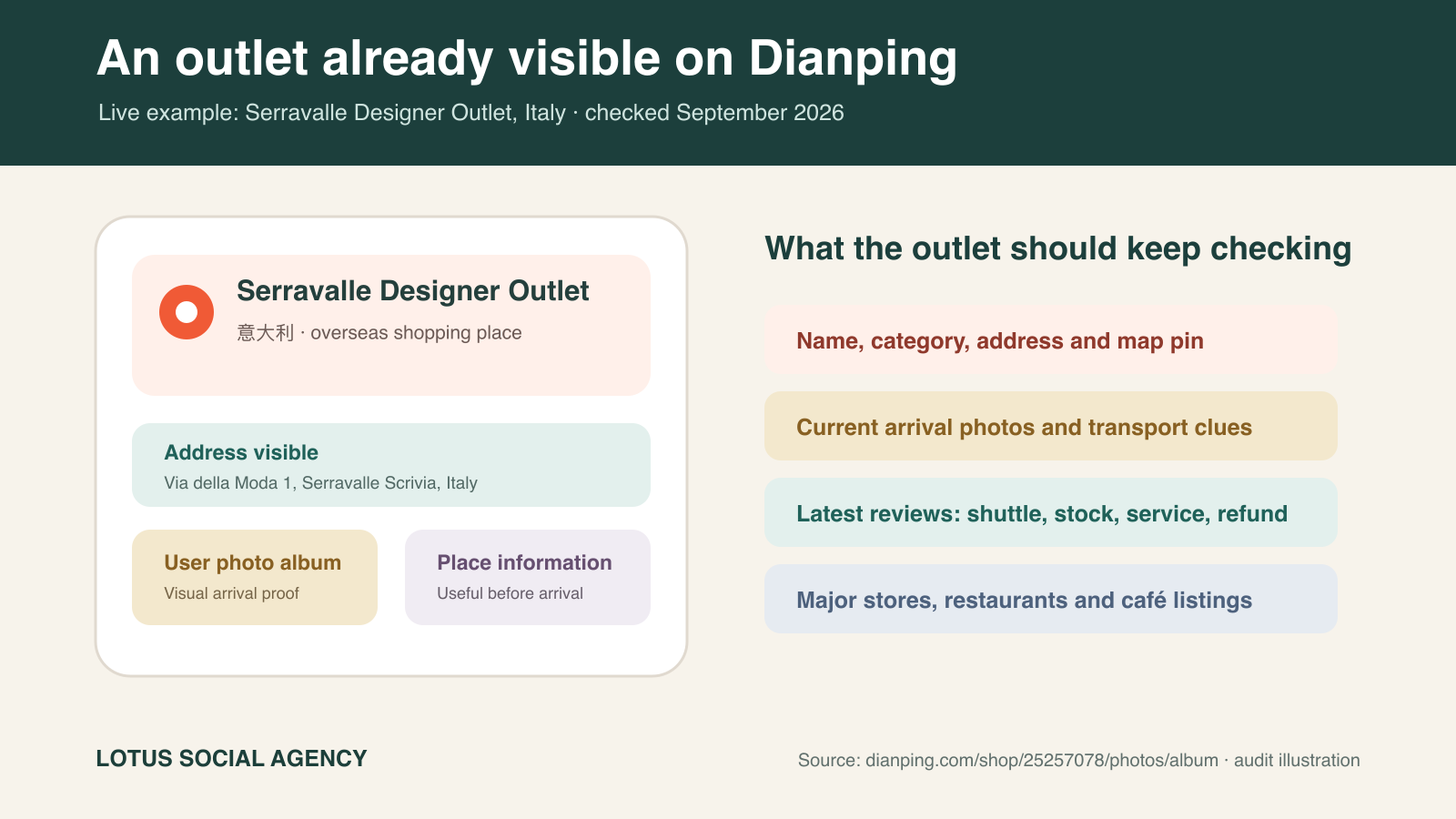
Dazhong Dianping contains overseas shopping and mall discovery as well as food and attractions. A live page for Serravalle Designer Outlet in Italy, for example, includes the outlet's name, address and user photo album. That makes Dianping useful even when no transaction product is attached.
Audit the outlet page and surrounding ecosystem:
Search every Chinese and local name variant.
Find duplicates, wrong categories and obsolete map pins.
Verify address, phone, opening days, website, shuttle references and entrance imagery.
Check whether major stores, restaurants and cafés have accurate individual pages.
Read recent reviews for transport, queue, stock, service, tax refund and dining problems.
Correct factual errors through available channels and respond to legitimate feedback without defensiveness.
A public place page does not establish that the outlet controls it or that every overseas operator can self-register. Meituan's current rules cover overseas cooperating merchants and transaction products, so control, eligibility, settlement, support and any offer mechanics should be confirmed for the exact entity and market.
Never buy ratings or reward a positive review. Dianping's merchant statement prohibits businesses from hiring people to post fake reviews, and its 2026 review rules stress authentic, useful and relevant consumer experience.
6. Make tax refund and payment content operationally true
Tax refund can influence an outlet decision, but generic claims create risk. Rules differ by country, residency, store, product and travel route. The outlet should document the live process with its refund partner and legal team.
For example, Serravalle's official site currently states that eligible non-EU residents shopping in Italy must meet a same-day, same-store minimum, request a form, carry the required documents and validate the forms before leaving the EU; it also describes on-site refund desks. That is a useful model for clarity, not a template to copy into another country.
Every Chinese guide should answer:
who is eligible;
the current minimum spend and whether it is per store or can be combined;
which original documents or digital copies are accepted;
where the form is issued;
whether the goods must remain unused;
when and where customs validation happens;
what refund options and fees apply;
who handles a delayed or rejected refund.
The same standard applies to Weixin Pay, Alipay and UnionPay. Confirm acceptance at participating stores and the guest-services desk. State limitations. A payment logo at the outlet entrance is not proof that every tenant can complete the transaction.
7. Design UGC that documents a useful day out
Outlet UGC becomes more valuable when it helps the next visitor plan. Build prompts around substance:
“My half-day route from the city”;
“Three categories worth browsing this season”;
“What I ate and where I rested”;
“What the tax-refund process actually required”;
“A family day at the outlet”;
“One local brand I discovered.”
Provide photogenic but useful moments: a clear arrival landmark, seasonal installation, styling station, local-food stop, landscape or architecture. Where legal, a digital shopping passport can reward visits to several zones or completion of a route. Keep participation optional, publish terms and do not condition a reward on praise.
Ask permission before republishing visitor content. Credit the creator, retain the original context and define where and for how long the asset will be used.

8. Optional channels that may strengthen the plan
RedNote, WeChat and Dianping form a strong core, but other channels may matter after research:
Ctrip/Trip.com: consider it if the outlet has a bookable shuttle, day-trip product, hotel package or destination partnership. Confirm supplier responsibility, inventory, refund and customer support before listing anything.
Hotel and airline partners: distribute the Chinese guide or shuttle information where travellers are already planning and staying.
Chinese payment and tax-refund partners: use verified merchant media or offer programs only when the on-site service is ready.
Local Chinese communities: residents and students can be excellent research participants, service testers and KOCs, but should not be treated as a source of manufactured reviews.
A realistic first 90 days
Days 1–30: audit the complete day trip
Search the outlet's name across RedNote, WeChat, Dianping and Chinese travel search. Travel the route as a first-time visitor. Verify shuttle, station, taxi, opening hours, directory, payment, tax refund, dining, luggage and Mandarin support. Record repeated review questions and establish a baseline for Chinese page traffic, enquiries, offer redemptions and attributable footfall.
Days 31–60: publish decision-quality content
Create or refresh the RedNote Official Account if eligible. Publish a full route guide, two interest-led edits and a transparent value explainer. Build the WeChat visit guide and a compact Channels series. Correct Dianping listing errors through available routes. Host a small, relevant group of creators who can test the journey honestly.
Days 61–90: test one travel window
Choose one source market, travel period and proposition: fashion value, family day trip, luxury edit, sportswear or local-design discovery. Use a trackable guide, shuttle code, visitor QR or offer. Measure the steps from content save to route enquiry to visit and redemption. Fix the strongest operational objection before expanding media.
What should an outlet measure?
search visibility for Chinese and local outlet names;
RedNote saves, transport questions and comments about specific categories;
WeChat guide reads, menu actions, shuttle or offer clicks;
Channels completion, shares and qualified questions;
Dianping saves, directions, listing accuracy and recurring review themes where accessible;
shuttle referrals or bookings, QR scans and offer redemptions;
visitor-centre enquiries, tax-refund transactions and participating-store sales where data can be lawfully aggregated;
creator cost per guide save, qualified route enquiry, visit or redemption.
Avoid claiming that views equal visitors. Use campaign codes, dated QR destinations, Chinese-language landing pages and reasonable comparison periods to build an evidence chain.
Frequently asked questions
Should an outlet publish exact prices on RedNote?
Only when the example is dated, store-specific and approved. Explain that stock, size, colour, promotion and exchange rates can change. A transparent range or basket is more credible than a permanent “up to” claim with no context.
Does an outlet need a WeChat Mini Program?
Not automatically. Start with a reliable Official Account guide and working transport path. Build a Mini Program only when a service such as shuttle booking, membership, wayfinding or coupons justifies the maintenance.
Which creators work best for outlet campaigns?
Match the creator to the proposition and journey. A small fashion KOC who can explain value and transport may be more useful than a celebrity who never shows how to arrive. Review audience location, past travel content, comment quality and delivery rights.
Can we ask visitors for Dianping reviews?
You may invite honest feedback where platform rules allow, but do not pay for positive ratings, provide scripts or require praise. Fix the causes of negative feedback rather than manipulating the score.
What if the outlet is far from the city?
Transport becomes part of the product. Publish the route, meeting point, duration, return options and disruption plan in Chinese. Consider an authorised shuttle or package only when capacity, support and refunds are operationally clear.
What is the first priority with a limited budget?
Fix the route and visitor facts, create one excellent Chinese day-trip guide, and commission a small set of credible RedNote visits. Paid reach is wasted if transport, tax refund or on-site guidance still creates doubt.
Why Lotus is a natural partner for outlet destinations
Lotus's bilingual team is based in China and uses RedNote, WeChat and Dianping every day. We understand these platforms not only as media inventory but as travellers who search, compare, save and share. We also share a genuine desire to explore the world, which makes us naturally interested in the route, value, local story and small service details that turn a remote shopping location into a confident day-trip choice.
Lotus can research the live Chinese search landscape, define each platform's role, build and operate official accounts, create Chinese content, coordinate KOL and UGC campaigns, audit Dianping, and connect reporting to shuttle, footfall, visitor-service and tenant outcomes. We will tell you when a platform feature or media buy is not yet operationally justified.
