

A good creator brief makes the work usable
A China creator brief should do more than tell a creator what to post. It should connect the brand’s commercial decision, the audience’s situation, the creator’s role and the evidence the team needs to collect.
That sounds simple. In practice, international teams often send one of two documents: a global campaign deck that is too broad to produce from, or a rigid list of instructions that leaves the creator with no natural way to speak. Both create the same downstream problem. Content may be delivered on time, yet still be difficult to approve, difficult to use and disconnected from the wider China plan.
The useful middle ground is a working brief. It protects the facts and brand boundaries that matter, while giving the creator enough room to make the idea credible in their own format and voice.
This guide starts after creator selection. It does not cover creator scoring, commercial contracts or content-usage rights. Its job is narrower: help an international marketing manager give a selected creator a brief that the creator, the China team and global stakeholders can all work from.
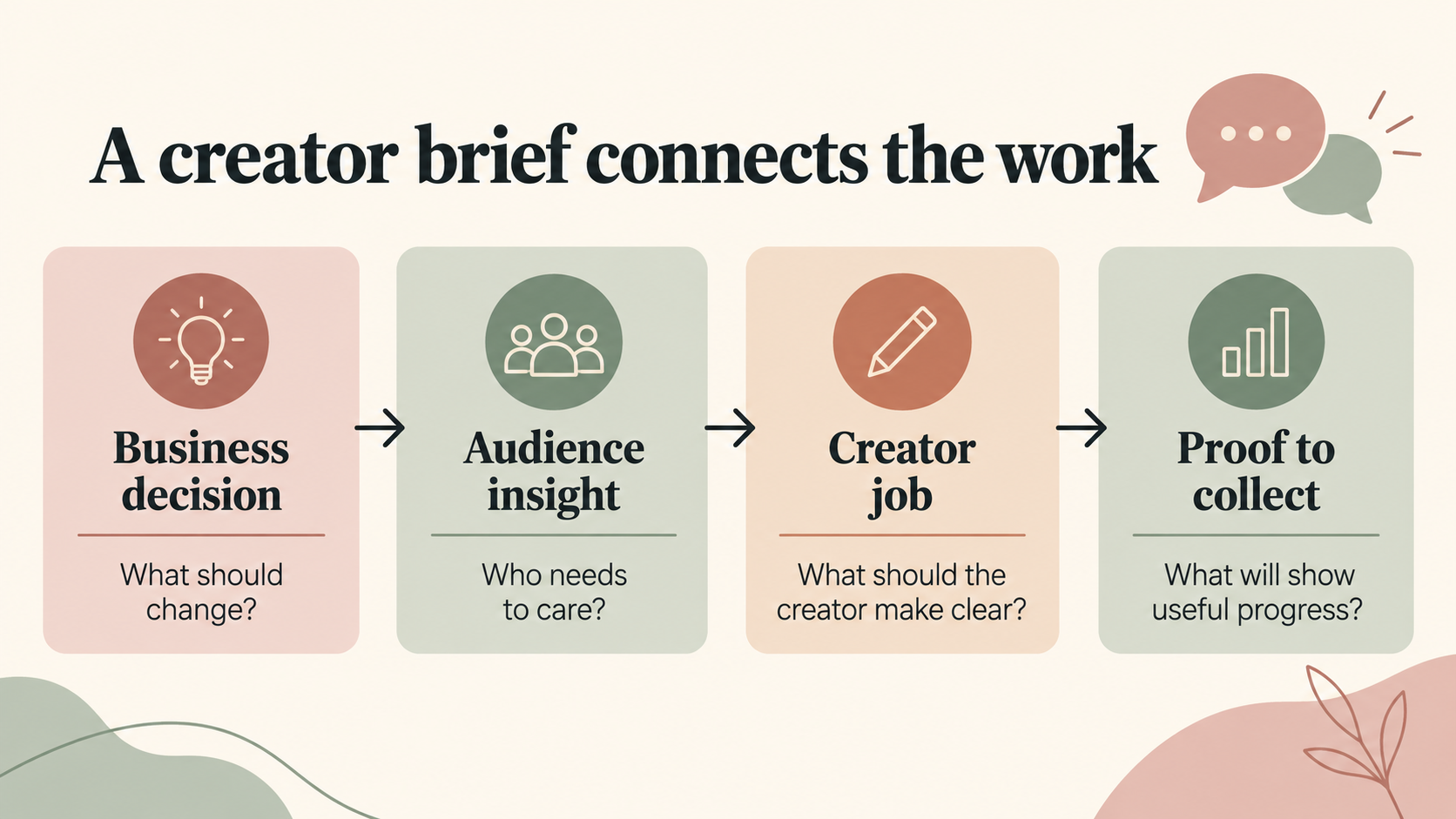
1. Start with the decision, not the deliverable
“One short video” is a deliverable. It is not a reason for the collaboration.
Before describing format, length or product shots, write down the decision the content should help the audience make. The decision does not need to be an immediate purchase. It might be:
whether the product is relevant to a specific situation;
whether the brand feels credible enough to investigate;
whether a destination belongs on a shortlist;
whether a technical service is worth discussing internally;
whether the audience should save, search for or compare something next.
This gives the creator a much better creative starting point. “Make a 45-second product video” invites a production response. “Help first-time category buyers understand when this product is useful and what to compare” invites a story.
Keep the creator’s job singular. If the brief asks one post to introduce the brand, explain five benefits, correct misconceptions, drive store visits, collect leads and announce a promotion, the result usually becomes a compressed advertisement. Choose the most important audience movement and allow the rest of the campaign to support it.
2. Describe the audience as a person in a situation
Demographic labels rarely give a creator enough to work with. “Urban women aged 25–34” may be useful for media planning, but it does not explain what those people are trying to solve, what they already believe or what would make them keep watching.
A practical audience section answers four questions:
Who are they in relation to this decision? First-time buyers, experienced users, parents researching on behalf of a family, professional evaluators or people comparing alternatives?
What is happening when the content reaches them? Are they browsing for inspiration, actively searching, checking a claim, planning a trip or preparing an internal recommendation?
What do they already know? State the likely baseline so the creator does not waste half the content explaining something obvious.
What creates hesitation? Name the real uncertainty: unfamiliarity, fit, price logic, practical access, trust, complexity or a lack of Chinese-language proof.
For China, this context also needs to match the chosen platform. A useful answer on RED (Xiaohongshu) may be structured for discovery, comparison and saving. A Douyin story may need to establish relevance much faster through a visible situation, a strong opening and a creator-led demonstration. A longer Bilibili explanation may earn attention by taking a question seriously and showing the reasoning behind the recommendation.
The brief should not turn those tendencies into stereotypes. Platform habits vary by category, creator and audience. Give the selected creator the audience problem, then ask how they would make it feel natural in their established content world.
3. Give the creator one clear job
The creator’s job sits between the brand objective and the content format. It explains why this creator is present.
Useful creator jobs include:
demonstrate a product in a realistic use case;
translate a technical feature into an everyday consequence;
compare decision criteria without forcing a verdict;
show what preparing for an experience actually involves;
answer the question the audience is likely to search next;
provide a credible first-person perspective on a bounded topic;
make an unfamiliar category easier to understand.
Avoid writing the job as “say our key messages”. A creator is not a voice actor for the brand deck. The brief should make clear what the audience needs to understand, then let the creator propose a credible way to get there.
At this stage, also explain why the selected creator is a fit. Mention the relevant content strength, such as practical demonstrations, patient explanation, humour, visual transformation or a trusted perspective within a particular interest community. This prevents the concept from drifting towards a generic format that any creator could have made.
4. Build a message hierarchy the creator can use
Brand teams often provide too many messages because every stakeholder wants their point included. The creator then has to choose what matters, usually under time pressure and without the strategic context behind the list.
Use a simple hierarchy:
One core takeaway: the single idea the audience should remember.
Two or three supporting points: the proof or explanation that makes the takeaway credible.
Required facts: names, specifications, availability or process details that must be accurate.
Optional material: useful context the creator may use if it strengthens the story.
Out-of-scope claims: statements the content should not make because they are unverified, too broad or outside the agreed campaign.
Write the core takeaway in plain language, not campaign language. If the line would sound strange when spoken by a real person, it is probably not ready for a creator brief.
The supporting points should not repeat the same claim in three forms. Give each one a different job: one could explain relevance, another could provide evidence, and a third could handle the audience’s most likely doubt.
5. Separate locked elements from creative freedom
The most productive briefs are precise about what is fixed and equally clear about what is open.
Lock what protects meaning:
the audience and intended decision;
the core claim and required facts;
product or service naming;
genuine non-negotiable brand cues;
statements that must not be made;
the agreed call to action;
the delivery date and approval moments.
Leave room where the creator adds value:
the opening hook;
the order of the story;
the creator’s natural language and rhythm;
visual treatment and familiar recurring formats;
personal examples that are truthful and relevant;
the balance between explanation, demonstration and reaction.
The point is not to maximise freedom. It is to place freedom where it improves the content without weakening the brief.
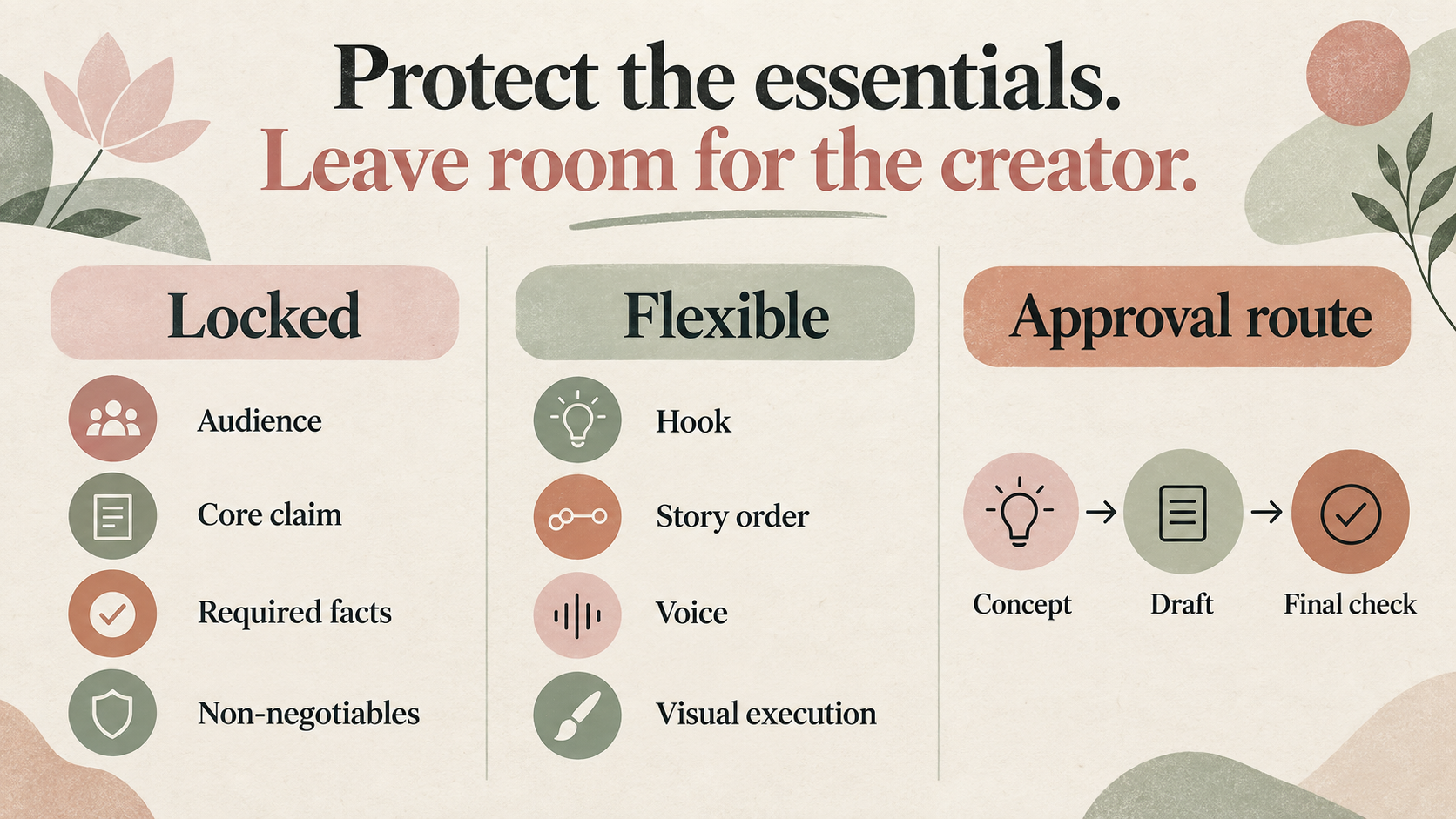
If every sentence is locked, the brand has effectively written a script and should manage the collaboration accordingly. If nothing is locked, the creator is being asked to guess what the brand can support. A working brief makes that trade-off visible before production begins.
6. Specify deliverables without designing the content twice
The deliverables section should remove operational ambiguity. It should not recreate the entire creative idea in spreadsheet language.
For each deliverable, state:
platform and publishing account;
content format;
approximate duration or length where relevant;
required orientation or aspect ratio;
language and subtitle expectations;
required product, location or service appearance;
caption, cover, title or thumbnail needs;
tagging or account-mention requirements;
agreed call to action;
concept, draft and final delivery dates;
what files or platform previews the team needs for review.
Be careful with technical requirements that are really creative preferences. “Show the product in the first three seconds” may be essential for one idea and destructive for another. State the reason behind a requirement where that context helps the creator find a better solution.
For multi-platform work, do not assume one master asset can simply be resized. Decide whether the creator is producing one idea adapted for several environments or genuinely different pieces. The brief should name which elements stay consistent and which may change by platform.
7. Give the creator an evidence pack, not an asset dump
A folder containing 200 global campaign files is not a content kit. It transfers the problem to the creator.
Build a compact evidence pack with only what helps them make accurate content:
the latest product or service facts;
a concise brand and category explanation;
approved Chinese names and terminology;
the specific proof behind the core claim;
a small set of usable visual assets;
product access, sample or location details;
a named contact for factual questions;
examples of previous brand work only when they clarify a boundary.
Explain the status of each item. A product fact may be approved and required. A global tagline may be context rather than mandatory copy. A visual may be available for reference but unsuitable for direct use in the creator’s post.
Translation alone is not enough. If the source material assumes knowledge that the Chinese audience may not have, include the missing context. If a claim depends on a particular model, market or product version, state that scope clearly.
Lotus often treats this evidence pack as part of the Chinese content localisation and production process rather than as an administrative attachment. The quality of the inputs shapes how confidently the creator can explain the idea.
8. Design an approval route that protects the idea
Approval is where otherwise strong creator work often loses momentum. A global team comments on brand language, a China team comments on cultural clarity, a product team adds facts, and several people rewrite the creator’s voice. The creator receives a long list of contradictory edits with no priority.
The brief should name:
one person who consolidates brand feedback;
one person who confirms Chinese-language clarity;
one person who owns factual accuracy where specialist product knowledge is needed;
the stages the team will review: concept, draft and final check;
the expected response time at each stage;
what counts as a necessary correction rather than a preference.
Review the work against the brief, not against whichever stakeholder joins last. Ask:
Does the content still serve the agreed audience decision?
Is the core takeaway clear?
Are required facts accurate?
Does the creator still sound like themselves?
Has a requested edit introduced a new promise or changed the scope?
Is the call to action natural and correct?
Consolidated feedback matters especially when the creator is working in Chinese and stakeholders are reviewing through a translation. An English back-translation can help global teams understand meaning, but it should not become a line-by-line script for the Chinese copy.
9. Define useful evidence before the post goes live
A brief should tell the creator and the brand what will be observed after publication. This does not mean promising a result. It means choosing signals that match the creator’s job.
If the job is to explain, the team may look at watch depth, saves, substantive comments and the questions people ask next. If the job is to support consideration, profile actions, branded search behaviour, product-page visits or qualified enquiries may be more useful. If the job is to produce reusable learning, the team should record which hook, proof point and audience hesitation appeared to matter.
Keep platform-reported data in context. Views and engagement can describe what happened within a platform, but they do not by themselves prove commercial impact. Use a clear measurement note in the brief so the creator understands which content behaviours matter and the brand team knows what it can responsibly conclude.
Measurement detail can be expanded in the campaign plan. The creator brief only needs enough to connect the content job with the evidence the team intends to collect.
10. Use this final creator-brief checklist
Before sending the document, confirm that it contains:
Strategy and audience
one audience decision the content should support;
a specific audience situation, not just demographics;
the hesitation or information gap the content should address;
one clearly worded creator job;
a note on why this creator fits that job.
Message and evidence
one plain-language core takeaway;
two or three distinct supporting points;
accurate required facts and approved terminology;
a compact evidence and asset pack;
explicit out-of-scope or unsupported claims.
Creative boundaries
a list of locked elements;
a list of areas where the creator can lead;
platform and format requirements;
a natural call to action;
enough context for the creator to challenge an instruction that would weaken the content.
Delivery and review
clear deliverables and dates;
named reviewers and one feedback consolidator;
concept, draft and final-check stages;
a realistic feedback turnaround;
a definition of what the team will observe after publication.
If the document cannot pass this checklist, adding more slides usually will not fix it. Tighten the decision, clarify the hierarchy and remove material the creator does not need.
Common briefing mistakes to remove
Several patterns make briefs look complete while making the work harder:
The compressed global deck. It contains the campaign history, brand architecture and every approved line, but does not tell the creator what to do for this audience now.
The disguised script. It calls for authenticity while prescribing the hook, wording, shot order and conclusion. If a script is required, name it honestly rather than asking the creator to simulate spontaneity.
The empty freedom brief. It says “we trust your creativity” but gives no decision, evidence or boundaries. The creator is left carrying strategic risk that belongs with the brand.
The translation handoff. It treats Chinese as the last production step. Useful creator content needs local audience context, platform logic and natural phrasing from the start.
The approval maze. It lists many stakeholders without explaining who decides or how feedback will be consolidated.
The metric wish list. It includes every available number without explaining which ones relate to the content’s job.
The strongest brief is not necessarily the longest. It is the one that lets everyone make the same decisions when questions appear.
Make the brief part of the operating system
For brands planning regular creator work, the brief should become a repeatable operating tool rather than a one-off document. Keep the stable sections—brand facts, terminology, approval roles and core platform information—under controlled ownership. Refresh the audience situation, creator job, message hierarchy, deliverables and evidence plan for each collaboration.
That structure makes it easier to compare what the team intended with what the content actually produced. It also gives creators a clearer reason for feedback and gives global stakeholders a more reliable view of how Chinese content decisions are being made.
Lotus supports international teams with China influencer and KOL marketing that connects creator direction with Chinese content and day-to-day coordination. If your team wants a creator brief that is clear enough to govern the work and flexible enough to produce natural content, discuss your China creator programme with Lotus.
