

International brands often begin with a sensible efficiency goal: create one strong content idea, then use it across WeChat, RED and Douyin. The problem starts when “use it across” becomes “publish the same asset everywhere”. A global campaign film is cropped vertically. Its script becomes a RED caption. The campaign press release becomes a WeChat article. The message is technically consistent, but none of the executions feels designed for the place where people encounter it.
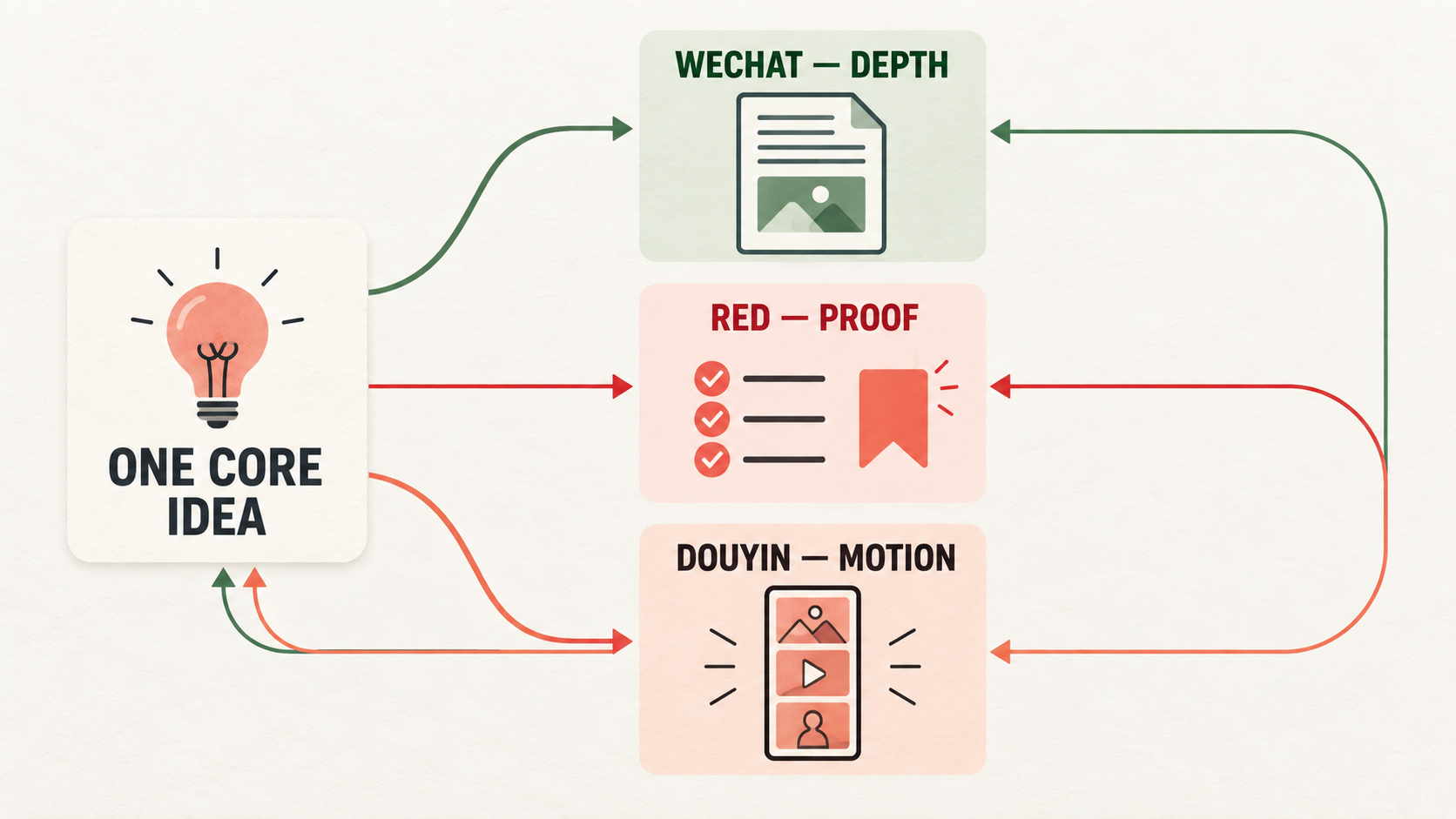
A better model is one core idea, three different content treatments. The strategic centre remains stable: the audience tension, the brand promise, the proof the brand can genuinely provide and the next business decision. The execution changes around it: the opening, format, proof order, pacing, visual language, creator role and next action.
For most international teams, the practical comparison is straightforward. WeChat is where an idea can gain depth and continuity. RED (Xiaohongshu) is where it often needs useful proof and real-life context. Douyin is where it needs motion, immediacy and a reason to keep watching. These are working roles, not universal platform laws. The value is that they force the content team to make deliberate choices instead of treating adaptation as a resizing task.
This article uses “WeChat”, the name most international marketing teams know, while referring to the mainland Weixin operating environment. Tencent describes Weixin and WeChat as interoperable sister services designed for mainland and international users respectively. That distinction matters when a global team is reviewing account capabilities, user journeys or product documentation.
Separate the core idea from the platform execution

The core idea is not a slogan. It is the smallest complete strategic thought the audience should understand and remember.
For example: “This specialist product is easier to use than people assume.” That thought can travel. A particular headline, 40-second edit or six-image carousel cannot travel as cleanly because each one already reflects a format and an audience situation.
Before production begins, write the idea in a compact content card:
Audience tension: What uncertainty, need or misconception are we addressing?
Brand promise: What useful change can the brand credibly help create?
Proof boundary: What can we show or explain without exaggeration?
Required identity: Which names, product facts, visual codes and tone cues must remain recognisable?
Desired next step: What should an interested person understand, investigate or do next?
That card becomes the common brief. It is the piece the global brand team approves for consistency. The local content team then develops a platform execution from it, rather than asking a translator or editor to rescue a finished foreign-market asset.
This distinction also makes feedback more useful. “The promise has changed” is a strategy issue. “The Douyin opening is too slow” is an execution issue. When teams mix the two, every platform edit turns into a fresh debate about the campaign itself.
What should stay consistent across all three platforms
Consistency still matters. International brands should not sound like three unrelated companies simply because the platforms are different. Five elements normally deserve tight control.
First, keep the audience problem consistent. If the WeChat article addresses a procurement concern while the RED note shifts to lifestyle aspiration and the Douyin clip chases an unrelated trend, the campaign no longer compounds understanding.
Second, keep the promise consistent. The wording can change, but the value being offered should not. A product cannot be positioned as the safest option in one place, the fastest in another and the most premium in a third unless the brand has intentionally chosen a broader architecture and can support each claim.
Third, keep the evidence boundary consistent. Every execution should work from the same approved facts, demonstrations and limitations. The short-video team should not invent a stronger claim because it makes a cleaner hook.
Fourth, keep identity cues consistent. Product naming, Chinese terminology, pack shots, colour treatment and distinctive brand assets should create recognition, even when the format changes.
Finally, keep the intended business contribution consistent. That does not mean every platform needs the same call to action. It means the three outputs should serve the same campaign decision rather than accumulate unrelated engagement.
Everything else is available for adaptation.
What should change: hook, format, proof order and next action
The opening should change because the audience meets the idea in a different state of attention. The format should change because a long article, a visual note and a short video are not containers of equal shape. The proof order should change because some environments reward immediate demonstration while others allow the reader to build confidence step by step. The next action should change because a person who saves a useful RED note may not be ready for the same response as a WeChat follower reading an official explanation.
A good adaptation therefore asks five questions for each platform:
What will make this specific audience pause or continue?
Which part of the proof should appear first?
What format makes the idea easiest to understand here?
What behaviour would show that the content did its assigned job?
What should the team learn and feed back into the next execution?
The answers create three related pieces of content, not three copies.
WeChat: give the idea depth and continuity
WeChat is useful when the audience needs an official, structured explanation or a dependable place to return to. Tencent positions Official Accounts as a publishing and communication route for individuals and organisations, while Weixin Search connects users with content and services across the ecosystem. For an international brand, that creates room for a clear article, a practical guide, an update or an explanation that remains useful after the campaign’s first burst.
Adapt the core idea for WeChat by expanding the reasoning. Start with the decision the reader is trying to make, then organise the article around the questions that block that decision. Add definitions, examples, limits and a clear next step. Headings should describe real information, not repeat the campaign line in different words.
The WeChat execution should usually answer:
Why does this matter to the reader now?
What does the idea mean in practical terms?
What evidence supports it?
Where does it apply, and where does it not?
What should an interested reader investigate next?
This is not permission to turn the article into a translated brochure. Depth means resolving uncertainty, not adding more brand adjectives. It also does not require every WeChat piece to be long. The useful length is the length needed to make the decision clearer.
For the example idea—“this specialist product is easier to use than people assume”—the WeChat version might be a decision guide explaining the setup process, the three moments users usually misunderstand and the support available after the first use. The campaign promise remains intact, but the execution earns confidence through sequence and detail.
RED: turn the idea into useful, credible proof
RED content has to feel useful inside a community built around people sharing experiences, references and recommendations. Xiaohongshu’s current community covenant emphasises truthful, original sharing and asks for headlines and covers that match the actual content. Its creator standards also push against mechanically publishing brand-written materials or low-effort promotional templates within the stated commercial-creator scope.
The practical implication is not “make it look less branded”. It is “build the idea around a situation someone can recognise”. The RED execution should make clear who the content is for, what question it resolves and what evidence the reader can inspect or save.
Adapt the same core idea by changing the proof format. Use a scenario, checklist, comparison, demonstration sequence or creator perspective. Put the most decision-relevant detail in the cover and opening, but make sure the body delivers exactly what they promise. Give the reader enough specificity to judge whether the experience applies to them.
For the specialist-product example, a RED note could become “Four setup moments that look complicated but are not”, supported by close-up images, plain-language annotations and one honest boundary about when expert help is still useful. A suitable creator might demonstrate the process in a real work or lifestyle setting. The brand provides the facts and guardrails; the creator or local editor provides the human point of view.
RED adaptation should not be a WeChat article chopped into cards. The note needs a tighter question, a more visual proof sequence and a reason to save or discuss it. If a commercial creator collaboration is involved, platform, content and client review steps can also affect production timing. Build those checks into the workflow instead of locking global copy first and discovering later that the local execution needs to change.
Douyin: make the idea legible through motion
Douyin needs a video idea, not a vertical version of a static campaign. Its open-platform documentation centres content and video capabilities for institutions, creators and service providers. The publishing documentation also makes clear that video posts operate with platform-specific elements and a review stage. For the content team, the central question is whether the promise can become visible quickly.
Adapt the idea for Douyin by finding an action. Show the moment the problem appears, the product or service changing that moment and the proof that makes the change believable. The opening should establish tension without withholding the subject for so long that the viewer cannot understand what they are watching.
For the specialist-product example, the Douyin execution might begin with the apparently difficult setup already in motion, then reveal the three actions that complete it. On-screen wording should carry only the information the viewer needs at that moment. The spoken line, edit rhythm, demonstration and sound should support one another rather than repeat the same sentence four ways.
A useful Douyin treatment often needs variations. The team may test a problem-first opening, a demonstration-first opening and a user-reaction opening while keeping the same promise and proof boundary. This is controlled adaptation, not message drift.
Avoid turning every idea into entertainment for its own sake. If the subject requires more context than the video can responsibly carry, let the clip perform a narrower job and connect it to an owned explanation. A strong short video makes the next question clearer; it does not have to answer every question.
Compare the three treatments before production starts
The following working comparison helps a brand team review the plan without judging all content by the same standard.
WeChat treatment
Primary job: explain and organise the idea
Useful opening: the reader’s decision or unresolved question
Typical proof: structured facts, process, examples and boundaries
Production focus: Chinese editorial logic, headings, clarity and continuity
Useful response: qualified reading, follow-on exploration or an informed enquiry
RED treatment
Primary job: make the idea useful and credible in context
Useful opening: a recognisable situation, question or comparison
Typical proof: images, lived scenarios, creator demonstration and savable detail
Production focus: cover-body consistency, specificity and human relevance
Useful response: saves, relevant comments, search interest or deeper investigation
Douyin treatment
Primary job: make the idea immediately visible through motion
Useful opening: action, tension or a clear result in progress
Typical proof: demonstration, sequence, performance and visual contrast
Production focus: first-frame clarity, pacing, creator delivery and repeatable variants
Useful response: qualified viewing, meaningful interaction or movement to the next step
This comparison is a briefing tool, not a promise that one platform always behaves in one way. Platform products overlap, audiences vary and execution quality matters. The point is to give each piece one clear information job.
Build one master evidence kit, then three platform briefs
Efficient production does not come from making one master asset. It comes from making one master evidence kit.
That kit can include approved product facts, Chinese terminology, claim boundaries, demonstrations, expert input, frequently asked questions, visual assets, customer-language observations and the intended business contribution. It gives every platform team reliable material without telling them to use the same narrative order.
From that kit, create three one-page execution briefs. Each brief should specify:
the platform job;
the audience situation at the moment of encounter;
the chosen hook;
the proof that must appear;
the native format and asset list;
the elements that may be changed locally;
the elements that require brand approval;
the intended response and measurement signals.
This is where good Chinese content localisation and production moves beyond translation. The local team is not rewriting the brand from scratch. It is converting an approved strategic idea into Chinese-language content that makes sense in a specific platform environment.
If the brand has not yet decided which platforms deserve an ongoing role, resolve that question first. The Lotus guide to Chinese social media platforms addresses channel selection; the present workflow begins only after WeChat, RED and Douyin have been assigned a real job.
Design approvals around risk, not around every word
Cross-platform content slows down when every stakeholder approves every detail at the same level. It also becomes weak when local teams are given a vague instruction to “make it native” without clear boundaries.
Split approval into three layers. The global brand owner approves the core idea, promise, evidence boundary and identity requirements. The China strategy or editorial lead approves the local interpretation, terminology and platform logic. The production owner approves the execution details that do not alter the claim: crop, pacing, sequencing, on-screen wording and other format choices.
Escalate only when an execution changes the promise, introduces new evidence, creates a sensitive claim or moves outside the agreed audience. This makes governance stronger because reviewers spend time on decisions that can genuinely change meaning.
The final review should happen in context. A storyboard cannot be judged only as a transcript, and a RED note cannot be judged only as a caption in a spreadsheet. Review the WeChat article as a reading experience, the RED note as a cover-plus-body unit and the Douyin video as an actual paced sequence.
Measure the assigned job, then compare the learning
Do not compare the three executions by forcing every platform into one engagement-rate table. The metrics are defined inside different products and reflect different behaviours. Instead, judge whether each content treatment performed its assigned job.
For WeChat, look for evidence that people reached and used the important parts of the explanation, then connect that behaviour cautiously to owned enquiries or follow-on actions. For RED, examine whether the content generated relevant saves, questions, searches or other signs that the proof was useful. For Douyin, look at whether the opening held qualified attention, whether viewers reached the proof and whether the next action was understandable.
Then compare the learning at the idea level:
Which audience tension produced the most useful response?
Which proof was repeatedly noticed or questioned?
Which wording created confusion?
Which platform revealed a new question the others should answer?
Which execution can be improved without changing the promise?
This feedback loop is more valuable than declaring one platform the winner after a single post. Kantar’s digital creative work similarly treats context as part of how creative is evaluated. For a brand team, the practical lesson is simple: compare what you learned about the idea, but assess each execution in the environment it was built for.
Common mistakes that make cross-platform content feel generic
The first is starting with a finished global asset instead of a transferable idea. By the time the China team receives it, the narrative, format and proof order are already fixed.
The second is changing the surface while keeping the structure. A video becomes a carousel of stills; an article becomes a long caption; a visual note becomes a voice-over script. The dimensions change, but the audience experience does not.
The third is chasing a platform cliché. RED is not automatically “soft and aesthetic”, Douyin is not automatically “loud and viral”, and WeChat is not automatically “formal and long”. Those shortcuts produce interchangeable work. Begin with the audience question and the evidence.
The fourth is giving every platform the same call to action. The right next step depends on the job of the content and the readiness of the audience.
The fifth is allowing adaptation to become claim inflation. A faster opening does not justify a stronger promise. Local relevance and brand accuracy have to coexist.
The sixth is measuring output volume rather than content learning. Publishing three assets is not proof that the idea has been adapted well.
The practical standard is recognisably one brand, clearly three executions
Before approving the set, review it without the platform labels. The three pieces should still feel like one brand addressing one audience problem with one credible promise. Then add the platform context back. Each piece should make a different, defensible use of that environment.
The WeChat execution should give the idea depth. The RED execution should make the proof useful and credible. The Douyin execution should make the idea legible through motion. If any piece could be moved unchanged to another platform, it probably needs another round of adaptation.
For an international team, this approach creates a healthier balance between global consistency and local judgement. It reduces waste because research, facts and assets are shared. It improves quality because the execution is not predetermined. And it gives stakeholders a clearer way to review content: protect the strategic centre, then let the platform treatment do its job.
If you have a global campaign idea that needs to work across WeChat, RED and Douyin, discuss it with Lotus. We can help you identify what should stay fixed, what should change and what the China content team needs to produce credible platform-native work.
