

Why Trending Topics Matter for International Brands Creating Content in China
An international brand can publish perfectly translated, beautifully designed content in China and still feel strangely absent from the market. The posts are correct, but they do not connect with what people are discussing, searching for or trying to understand at that moment.
That is why trending topics matter. They reveal movement: a new consumer question, a shift in language, an emerging use case, a cultural moment or a category conversation that is gaining energy. For a brand team, the value is not simply the chance to borrow attention. The deeper value is learning what audiences consider relevant now and using that knowledge to make the content plan more responsive.
The distinction matters. Reactive content rushes to join whatever is visible. Timely content notices a meaningful change, verifies it and responds in a way that fits both the audience and the brand. One chases a spike; the other builds relevance.
Why topical relevance matters so much in China

China's digital ecosystem moves through several different discovery systems at once. A conversation can surface through social discussion, lifestyle search, short-video participation, industry commentary or a sudden increase in active search demand. Each signal tells the brand something slightly different.
Weibo's first-quarter 2026 hot-search report, for example, said vertical-interest topics made up 38% of its main-list hot searches. That does not mean every vertical topic is a brand opportunity. It does show that public attention is not limited to mass entertainment or national news. Technology, products, sport, hobbies and everyday consumption can all move from specialist circles into wider discussion.
For international brands, this creates a practical advantage. A timely topic can provide an easier entry point than a brand-led announcement. Instead of asking an audience to care about the brand first, the content can begin with a question, behaviour or tension the audience already recognises. The brand then earns attention by adding useful perspective.
There is also a discovery benefit. Social attention often produces follow-on questions. People search for explanations, examples, comparisons and recommendations. A useful response can therefore support more than a momentary social post; it can become a searchable article, a sales-enablement asset, a WeChat explanation or a reference point for future conversations.
None of this guarantees reach. It simply improves the odds that the brand is speaking into a real conversation rather than publishing in isolation.
A trend is an audience signal, not a content brief
The biggest mistake is to treat a trending label as an instruction: the topic is popular, so the brand must post about it. Platform data does not support that leap.
Xiaohongshu's official hot-list rules say its rankings are based on real user behaviours such as search and interaction. Weibo similarly describes its hot searches as the result of user search and discussion activity, with multiple forms of engagement contributing to heat. These systems indicate that attention exists. They do not say that a specific brand has permission to enter the conversation or that any particular response will be welcomed.
The platform rules also point to the risk of superficial participation. Xiaohongshu's current content-review guidance identifies the use of a hot topic in a title or cover when the actual content is unrelated as a form of click inducement. Its community guidance also stresses authenticity and asks users to verify information that is uncertain or potentially controversial.
The practical lesson is simple: use a trend as evidence to investigate, not as a ready-made creative idea. The content brief should come only after the team understands why the topic is moving, who cares and what the brand could contribute.
Different platforms reveal different kinds of momentum
There is no single China trend dashboard that explains the whole market. A strong monitoring system combines several views.
On Weibo, teams can examine real-time, 24-hour and seven-day hot-word lists as well as keyword trends. This makes it useful for seeing the pace and public shape of a conversation. A fast rise may indicate urgency, while a topic that holds attention for several days may deserve deeper analysis.
On Xiaohongshu, the hot list is built around search and interaction behaviour and recalculates frequently. A separate hot-topic feature also considers publishing and consumption activity and may personalise what each user sees. That makes the platform valuable for identifying lifestyle language, emerging use cases and the questions people bring to a category. It also means one team member's feed is not a complete market view.
Ocean Engine's official trend-insight service offers content-consumption trend tools and platform-native indices. Baidu Index, meanwhile, separates search, information and media interest and provides related-query and demand views. Comparing these signals can help a team distinguish a conversation that is socially visible from one that is also producing active information demand.
This is why the China social media ecosystem should be treated as a set of complementary behaviours, not a collection of interchangeable posting channels. A phrase that is accelerating on one platform may need more evidence before it earns a place in a cross-platform content plan.
International brands face a higher relevance test
A domestic brand may already understand the slang, humour, emotional context and boundaries surrounding a topic. An international team can be several steps removed. The global office may first see the conversation through an English-language summary; the local team may receive a pre-approved global campaign that has little room to adapt; and the brand's normal approval cycle may outlast the topic itself.
That distance creates two opposite risks. The first is silence: the team avoids anything timely and produces content that feels permanently generic. The second is overreaction: the team joins a conversation without understanding its local meaning, then sounds opportunistic or simply out of place.
The answer is not to abandon governance. It is to build a local decision process that is faster because the boundaries are clear. The team should know in advance which topic categories are always excluded, which subjects require senior review, which brand experts can respond credibly and which formats can be produced without compromising quality.
The aim is selective participation. Most trending topics should not become brand content.
The five-part trending-topic fit filter
Before a topic enters production, ask five questions. If any answer is no, the brand can still learn from the signal without publishing about it.
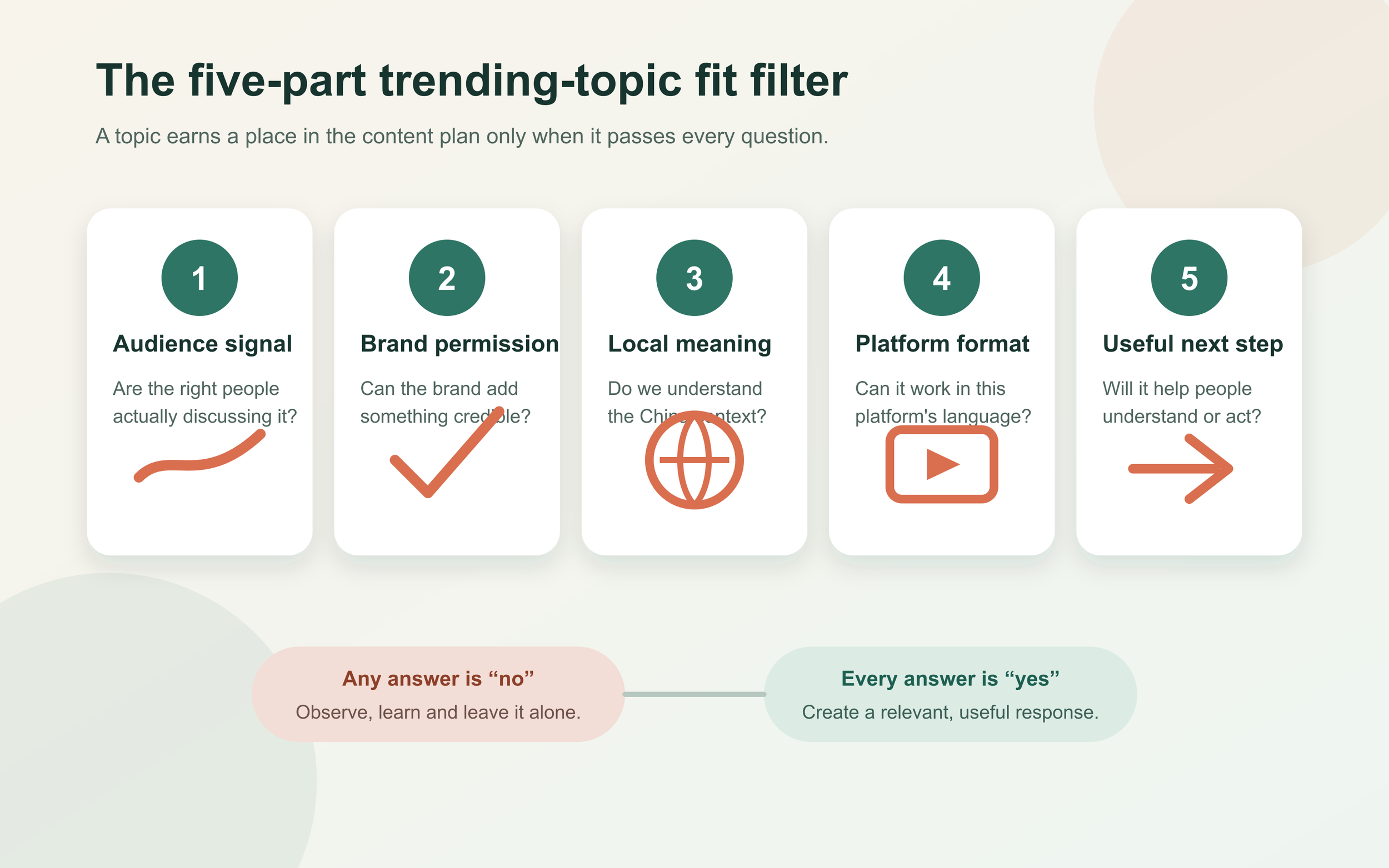
1. Is this a real signal from the right audience?
Volume alone is not enough. Check whether the conversation involves people the brand wants to understand: category buyers, business decision-makers, travellers, fans, partners or another defined audience. Look for the language they use, the questions they ask and whether the behaviour appears on more than one relevant surface.
A high-volume entertainment topic may be irrelevant to a B2B technology company. A smaller discussion about workflow friction could be far more valuable if it reflects a real buyer problem.
2. Does the brand have permission to contribute?
Permission comes from relevance and credibility, not from account ownership. A brand may have useful knowledge because of its product, history, people, research or direct experience. If the only connection is a weak pun or a forced visual reference, there is probably no contribution worth making.
This question protects the brand from treating culture as decoration. It also encourages better ideas. When the connection is genuine, the team can explain, demonstrate, compare or help rather than merely announce that it has noticed the topic.
3. Does the team understand the local meaning?
Translate the context, not only the phrase. Ask how the topic started, who is driving it, what emotional tone surrounds it and whether the meaning has changed as it spread. Check original posts and platform-native discussion rather than relying on screenshots or second-hand summaries.
Topics linked to politics, public emergencies, health, finance, legal disputes or other sensitive matters should stay outside routine content production. If the team cannot confidently explain the context and boundary, it should not publish.
4. Can the idea work in the platform's natural format?
A useful topic does not automatically produce the same post everywhere. Xiaohongshu may reward a practical, experience-led explanation. Weibo may suit a concise point of view tied to the public conversation. WeChat can give the issue more depth. Short video may require a clear demonstration or human voice rather than a repurposed poster.
Start with the job the content needs to do, then choose the format. The wider principles in our guide to creating Chinese social media content still apply: localisation involves story, tone and platform behaviour, not just language.
5. Will the audience receive a useful next step?
The response should help someone understand, decide or act. It might explain why the topic matters, show how to evaluate a choice, answer an emerging question or connect the conversation to a real use case.
If the post ends at recognition — “this is trending and we saw it too” — it adds little. A useful next step turns attention into trust.
Build a repeatable monitoring and response workflow
Trend work becomes inefficient when every topic creates a new debate. A simple operating rhythm keeps the team fast without lowering standards.
Listen. Monitor platform-native trend tools, category searches, comments, creator conversations, customer-service questions and sales-team feedback. Keep the sources visible to both local content staff and decision-makers.
Classify. Tag each signal by audience, category, platform, likely lifespan and potential brand connection. Separate an emerging consumer need from a meme, a seasonal pattern from breaking news, and a sustained shift from a temporary spike.
Verify. Return to the original platform evidence. Confirm the phrase, context and timing. Look for active questions, not just copied posts. Cross-check social attention with search or category evidence when possible.
Decide. Apply the five-part filter. Record a clear reason to respond or not respond. This reduces subjective arguments and helps the team learn which signals tend to become useful content.
Create. Choose the smallest format that can add real value. A concise post may be enough. A deeper shift may justify a long-form article, visual explainer or series. Do not stretch every trend into a campaign.
Extend. If the response performs because it answers a genuine question, turn the insight into an evergreen asset. Remove temporary framing where necessary and preserve the useful explanation.
Review. Compare the result with the original purpose. Did the content attract the intended audience? Did it generate useful questions, saves, qualified visits, branded search, enquiries or insights for the next content cycle?
Common mistakes that make trend content feel opportunistic
The obvious mistake is arriving too late. A slow approval process can leave a brand explaining a topic after the audience has moved on. But speed is not the only failure mode.
Some teams copy the visible format without understanding why people care. Others use a trending phrase as packaging for an unchanged product message. Some publish identical creative across several platforms, ignoring how the conversation behaves in each place. Another common problem is overproducing: by the time a polished hero film is ready, a straightforward expert response would have been more useful and more credible.
There is also a measurement trap. A trend-linked post may generate broad reach from people who will never become relevant to the brand. That is not automatically bad, but it should not be confused with progress. The team needs to know whether the topic strengthened category relevance, audience understanding or a meaningful next action.
Finally, brands should resist manufactured urgency. Platform hot lists change quickly, and not every spike deserves executive attention. A calm decision not to publish is part of a mature content system.
Measure the quality of the connection, not just the size of the spike
Views and engagement can indicate that the format travelled, but they do not explain whether the brand used the moment well. Measure the response against its intended job.
For awareness, look at relevant reach, completion, shares and the quality of comments. For understanding, look at saves, follow-on questions and whether people use the brand's explanation in their own language. For discovery, look at profile visits, branded search movement, article visits and related-query growth. For commercial relevance, look at qualified enquiries, sales-team feedback and whether the topic reveals a need the brand can genuinely serve.
Negative evidence matters too. If a post receives high reach but people question the brand's connection to the topic, the fit filter failed. If the team repeatedly discovers useful topics after they peak, the monitoring system needs work. If every trend response looks different but none builds on the last, the brand has activity without a learning loop.
The best outcome is not a lucky viral post. It is a stronger understanding of the market and a more responsive content operation.
Topical relevance should strengthen the brand's long-term position
Trending topics are most valuable when they help a brand notice change early, speak in language people already use and contribute something worth remembering. They should make the content plan more connected to real demand, not more chaotic.
For international brands in China, that requires local listening, clear exclusions, trusted decision-makers and a repeatable standard for relevance. The team does not need to join every conversation. It needs to recognise the few conversations where the brand can be timely, credible and useful at the same time.
If you want to build a practical way to monitor emerging China conversations and turn only the right ones into useful brand content, talk with Lotus about the audiences, platforms and decisions that matter to your team.
