

International businesses often enter China with a polished global message, a translated brand book and a list of priority platforms. What they do not always have is a reliable way to hear how the category is actually discussed in mainland China.
That gap matters. People may use a local nickname rather than the official product name. They may organise a buying decision around a problem the global team considers secondary. A competitor may have taught the market to expect a particular proof point. A content format may look popular while attracting the wrong kind of attention. None of this is obvious from a global dashboard.
Social listening helps an international business observe those patterns before it turns assumptions into a content calendar. It combines public and properly authorised platform signals with human interpretation: the language people use, the questions they repeat, the comparisons they make, the creators they trust and the situations in which a category becomes relevant.
The value is not a giant volume-of-mentions chart. The value is a better decision. Listening can help a team choose clearer language, sharpen a content theme, identify a gap in competitor communication, improve a creator brief or decide what needs deeper research. It is directional evidence—not a replacement for interviews, owned customer data, sales conversations or representative research.

Why China makes the listening gap more expensive
China is not one social feed. Discovery, search, entertainment, detailed product research, professional discussion and private sharing are distributed across different platforms and formats. A useful conversation may appear as a RED note, a Douyin comment, a Bilibili video, a WeChat article, a Zhihu answer, a Baidu query pattern or a customer-service question. Each source shows a different part of the picture.
This creates three practical challenges for an international team.
First, familiar global tools do not automatically cover the platforms that matter. Even when a vendor says it supports China, the team still needs to ask what is collected, which formats are included, how frequently data is refreshed and what cannot be accessed. Text, images, video, audio, comments and search signals are not interchangeable.
Second, literal translation loses commercial meaning. A direct translation may miss slang, category shorthand, ironic phrasing, phonetic spellings, unofficial brand names or the emotional distinction between two words that look similar in English. Listening requires people who can read the language and understand the platform context around it.
Third, platform numbers are shaped by platform behaviour. A rising term on a short-video platform shows that attention is moving there; it does not automatically prove demand across the market. A highly active comment section can reveal useful questions; it does not tell you what silent consumers think. China social listening becomes valuable when these limits are made explicit rather than hidden behind a single score.
What a business can learn from social listening
The vocabulary people actually use
The first output should often be a language map. It can include the official Chinese brand name, common abbreviations, transliterations, category terms, problem phrases, use occasions and the words people use when comparing alternatives.
This is useful well beyond social copy. It can improve research prompts, creator briefs, website headings, customer-service scripts and search planning. It also exposes a common entry mistake: translating the product description before understanding the problem language already established in the market.
The questions behind consideration
Repeated questions are more informative than generic engagement. They show where an audience needs explanation, proof or reassurance. An education provider may see recurring questions about outcomes and support. A B2B technology company may find that integration and implementation language matters more than its global feature hierarchy. A travel brand may discover that planning confidence depends on details the global campaign treats as operational footnotes.
Those questions should not be copied blindly into posts. They should be grouped by the decision they represent: understanding the category, comparing options, checking credibility, reducing practical friction or deciding what to do next. This gives the content team a usable structure instead of a pile of comments.
The competitive story surrounding the category
Listening can reveal how competitors and creators frame the market. Which benefits are repeated so often that they have become category table stakes? Which claims attract scepticism? Which use cases are crowded? Which useful questions remain poorly answered?
This does not mean copying the loudest competitor. The point is to distinguish between the language the market already understands and the position the brand still needs to make its own. A strong content opportunity often appears where audience interest is clear but current explanations are shallow, confusing or overly promotional.
The formats that make an idea understandable
The same message can behave differently as a detailed article, a demonstration video, a creator review, a question-and-answer post or a visual checklist. Listening helps a team see which formats people use when they are trying to learn rather than merely pass time.
That distinction is important. High interaction around entertainment does not necessarily make that format suitable for explaining a complex proposition. The useful question is whether the format helps the intended audience complete the next step in its decision.
What social listening cannot prove
Listening is powerful partly because it is fast and close to real language. It is limited for the same reason: the people who post publicly are not a representative sample of everyone who may buy, influence or reject the product.
Social listening cannot, on its own, prove market size, purchase intent, demand, product-market fit or likely sales. It cannot tell you why silent people did not comment. It cannot turn platform activity into a reliable forecast. It should not be used to make sensitive decisions about identifiable individuals.
It also cannot remove interpretation. Automated sentiment is particularly easy to over-trust when a dataset includes slang, mixed languages, irony, image-led posts or fast-changing cultural references. A positive word can be used sarcastically; a negative phrase can describe a problem the product solves. Human review is not an optional polish step. It is part of the method.
For important decisions, listening should be triangulated with other evidence. Search behaviour, interviews, customer-service themes, CRM data, campaign results, retailer feedback and sales-team observations can confirm, challenge or qualify what appears in social content. Lotus treats social signals as one evidence stream within a broader China market research and entry decision.
Build a signal map before choosing a platform
A listening project should begin with a business question, not a tool login. “What are people saying about us?” is too broad to guide action. Better questions include:
Which words do Chinese buyers use when they describe the problem we solve?
What questions appear before people compare brands in this category?
Which proof points are already expected, and which are still distinctive?
What makes an audience reject or misunderstand the current proposition?
Which content formats help people move from curiosity to informed consideration?
Once the question is clear, map the signals that could answer it. Public category content may reveal language and narratives. Search and trend tools may show whether terms are rising or connected. Creator content can reveal credible demonstrations and audience questions. Comments can expose confusion, objections or missing information. Brand-owned account analytics can show which topics attract useful response. Customer-facing teams can add enquiries that never appear publicly.
Official platform products illustrate why this mapping matters. Ocean Engine’s data-insight tools describe hot-topic trends, related content and audience patterns within its ecosystem. Douyin’s official documentation distinguishes hot-term and ranking data, account analytics, interaction data and comment-management capabilities, with access dependent on the relevant permissions. These are meaningful signals, but they are not a complete view of China and should not be blended as if every platform measures the same thing.
Use a decision loop, not a monthly mention report
A strong listening programme connects five stages: frame, observe, interpret, decide and learn.
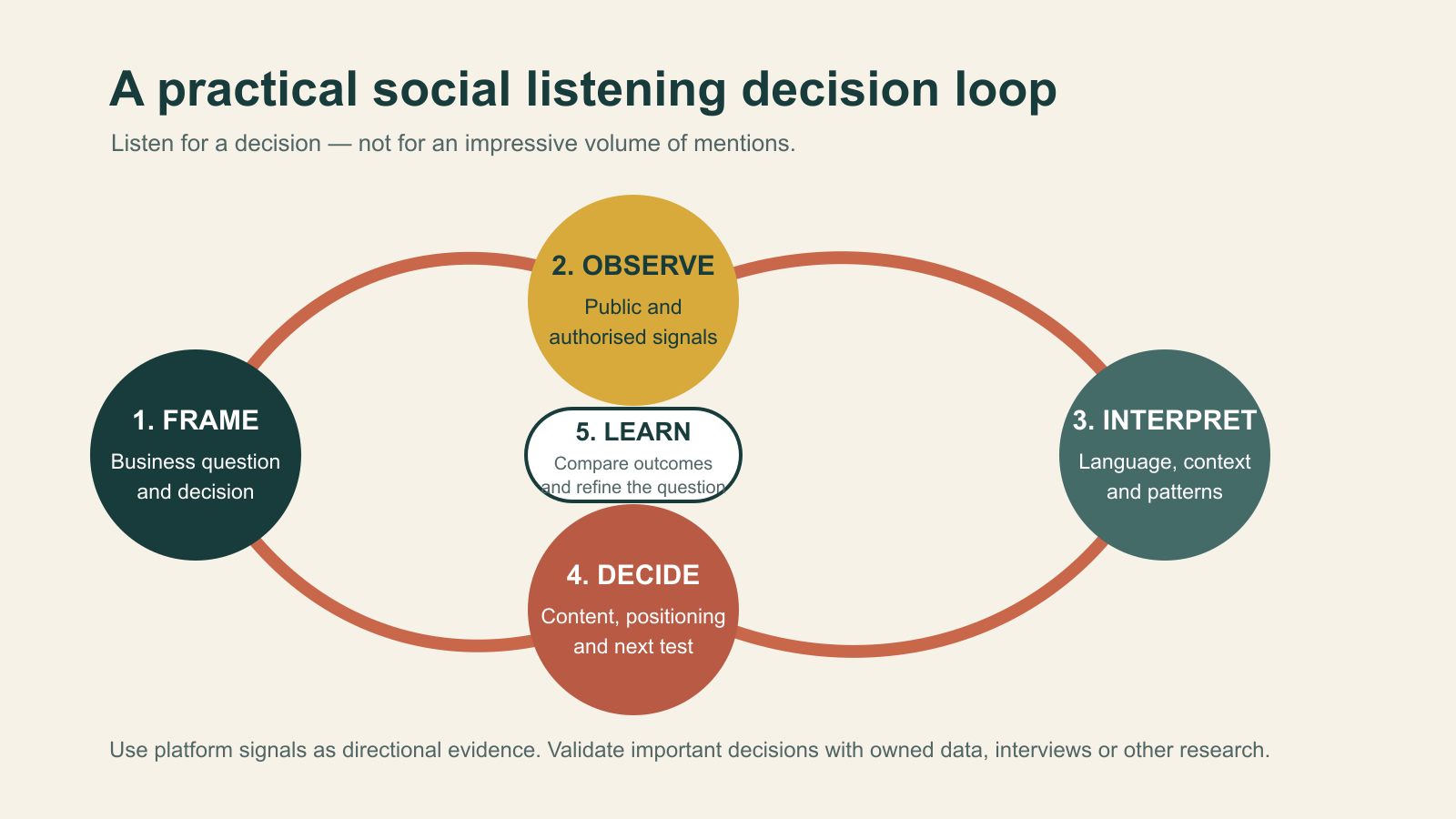
Frame. Define the business question and the decision that will follow. If no one can say what would change after the analysis, the scope is not ready.
Observe. Collect only public or properly authorised signals that are relevant to the question. Keep source, time, platform and format visible so context is not stripped away.
Interpret. Group evidence into themes, language patterns, questions, contradictions and meaningful exceptions. Review the original content, not only an automated label or translated summary.
Decide. Turn the pattern into a bounded action: revise a message, create a content theme, test a proof point, update a creator brief or commission deeper research.
Learn. Compare the outcome with the original hypothesis. If the new content attracts different questions or better-qualified response, the listening has improved the decision. If nothing changes, refine the question rather than manufacturing a success story.
The loop prevents social listening from becoming a passive reporting exercise. It also creates a record of why a decision was made, which is valuable when regional and global teams remember the same conversation differently.
Translate observations into better China content
The handover from research to content is where many listening projects lose value. A deck full of charts is not a content strategy. Each insight needs an editorial implication.
If the audience repeatedly asks the same practical question, the implication may be an explanatory article, a demonstration or a creator brief built around that decision barrier. If local category language is more concrete than the global brand language, the implication may be clearer headings and examples—not a wholesale change to brand positioning. If competitor content all makes the same broad promise, the implication may be to show a more specific use case or a more credible form of proof.
Listening should also change what the team chooses not to make. A trendy format is not useful when it pulls the brand away from the intended audience or removes the detail needed for trust. A popular topic is not automatically relevant to the brand. The evidence should help the team judge fit, not create pressure to imitate everything that is moving.
For ongoing publishing, a China social media management workflow can connect listening with briefs, local editing, community questions and performance review. The operating advantage comes from closing the loop: planners see what audiences ask, creators understand why the brief changed, and the next listening cycle checks whether the change improved the conversation.
Read competitors for context, not imitation
Competitor listening is useful when it explains the category’s communication environment. It becomes unhelpful when the team treats every high-performing post as a template.
Start with positioning language. What problem does each competitor claim to solve? Which audience is addressed? What proof appears repeatedly? Then examine the audience response. Are people asking for more detail, challenging the claim, comparing alternatives or moving the conversation to a different use case?
Look for patterns across several pieces of content rather than celebrating one visible spike. A single post can be affected by paid support, creator distribution, timing or an unrelated trend. A repeated pattern is more useful, especially when similar questions appear across different sources.
The goal is a whitespace hypothesis: a credible question or use case that matters to the audience and is not being answered well. That hypothesis still needs to fit the brand’s real capability. Social listening should never persuade an international business to claim an advantage it cannot substantiate.
Treat language and cultural context as analytical work
China listening cannot be reduced to exporting Chinese text and running it through machine translation. The analyst needs to recognise entity ambiguity, homophones, abbreviations, nicknames, coded language, sarcasm and category-specific meanings. Visual and video context may carry the main message even when the caption looks ordinary.
An entity dictionary should therefore be maintained as working research infrastructure. Include official and unofficial names, common misspellings, old product names, relevant executives or creators, category terms and exclusion terms that prevent false matches. Record why a term was added and check examples before expanding the dataset.
Human review should sample both obvious and uncertain items. The surprising cases often matter most: a phrase that changes meaning inside a subculture, a product name that overlaps with an everyday word, or a positive-looking comment that is actually mocking the content. This work is slower than pressing an “analyse” button, but it protects the business from confident misinterpretation.
Set governance without turning the project into surveillance
A useful strategic boundary is simple: focus on aggregated patterns from public or properly authorised signals, not on building profiles of individual people. Keep only the data needed for the business question. Separate research from direct customer handling. If a project involves personal data, private spaces, sensitive categories or contact-level action, route it to the appropriate specialist process rather than stretching a marketing listening brief.
Tool selection deserves the same discipline. Ask which platforms and formats are covered, whether deleted or edited content is handled, how spam and duplicates are treated, what languages the model supports, whether original context can be reviewed and how the provider defines sentiment, reach or influence. ESOMAR’s current guidance for unstructured-data services reinforces this buyer responsibility: the objective is to understand what the tool can and cannot support before comparing outputs.
This boundary is not a disadvantage. It keeps the work focused on decisions an international marketing team can responsibly make: language, content, positioning, platform roles and research priorities.
Common mistakes that weaken the result
Only starting with a brand-name search. This misses category language, use occasions, competitor framing and questions from people who do not yet know the brand.
Using translated global keywords only. Local terms, nicknames and problem language may reveal a very different conversation.
Treating volume as importance. A small cluster of detailed questions can be more commercially useful than a large wave of low-relevance mentions.
Combining unlike metrics. Search interest, video views, comments, saves and owned-account responses should not be collapsed into one “buzz” score without a defensible method.
Automating interpretation too early. Dashboards help organise evidence; they do not remove the need to read context.
Ignoring quiet or negative evidence. Absence, confusion and weak-quality response can be informative when the team considers alternative explanations.
Stopping at the report. If the finding never changes a message, brief, research question or decision, the project has not delivered its practical value.
Make listening part of how the China team decides
Social listening is essential for international business in China because it reduces the distance between global assumptions and local reality. It helps the team hear the language of the market, identify real audience questions, understand the competitive story and choose content opportunities with a stronger reason behind them.
It works best when the scope is disciplined. Listen for a defined decision. Preserve platform and cultural context. Treat signals as directional rather than representative. Combine them with other evidence. Then document what changed.
Lotus can help international teams turn China platform signals into a focused listening brief and a practical content decision. If you want to understand which conversations matter for your category—and what your brand should do with them—talk with Lotus.
