

WeCom vs WeChat vs WeChat Official Accounts: What Does Your Business Need?
WeCom, personal WeChat and a WeChat Official Account are connected, but they are not interchangeable. The simplest distinction is purpose:
Personal WeChat belongs to an individual and supports personal communication.
A WeChat Official Account gives an organisation a public content and service presence.
WeCom gives employees a company-managed environment for work communication and approved customer, partner or community relationships.
Most international brands do not need to choose only one. They need to decide which role each tool should play—and where the handoff between them should happen.
WeCom vs WeChat vs Official Accounts at a glance
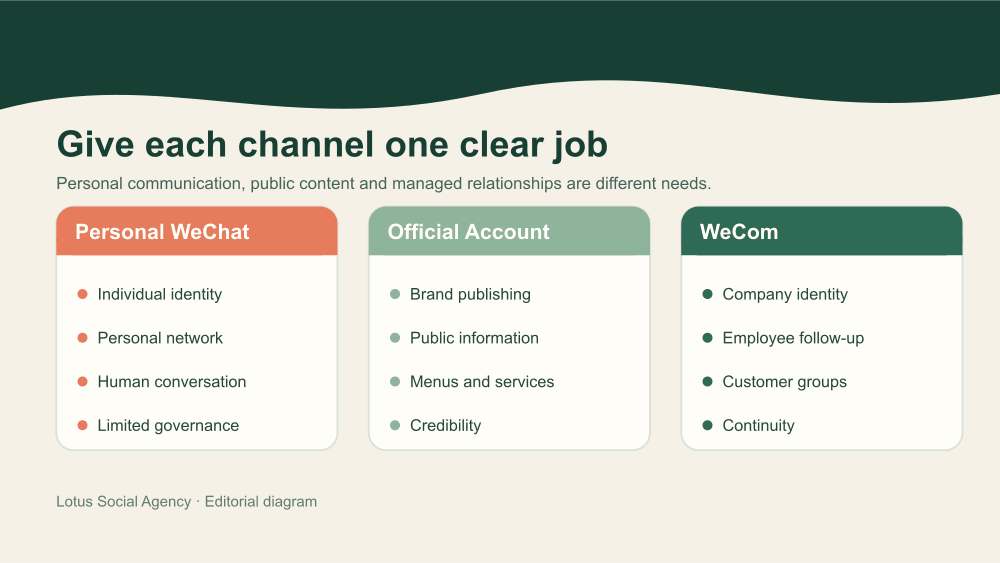
Comparison of personal WeChat, WeChat Official Accounts and WeCom by role, governance and customer-relationship ownership
Personal WeChat — best for individual networking and one-to-one conversation. Relationships are tied to a person, so company governance and handover are limited.
WeChat Official Account — best for public content, credibility, menus, campaigns and service information. It is a publishing and service entry point, not a sales-contact handover system.
WeCom — best for company-managed customer relationships, groups, partner communication and structured follow-up. It supports continuity but does not replace the editorial role of an Official Account.
In short: use personal WeChat for human connection, an Official Account for credibility and reach, and WeCom for continuity and structured follow-up.
What personal WeChat does well
Personal WeChat is familiar and convenient. A founder, salesperson or partner can build genuine relationships through a tool that many people already use. For a very small or exploratory operation, that may be the fastest route to a conversation.
The weakness is governance. The customer relationship is closely tied to one person's account, habits and availability. The business may have limited visibility when contacts are scattered across personal accounts, and continuity becomes harder when roles change.
Personal WeChat should not be treated as automatically inappropriate. It should be recognised for what it is: an individual communication account, not a complete company relationship system.
What a WeChat Official Account does well
A WeChat Official Account gives the brand an official publishing and service destination. It can carry detailed articles, updates, menus, event information and links to other approved touchpoints. It is often where a prospective customer checks credibility after hearing about the company elsewhere.
An Official Account is strongest when the editorial purpose is clear. People need a reason to follow, read or return. Lotus's WeChat marketing support connects account structure, Chinese content and customer journeys rather than treating publishing as an isolated task.
An Official Account can open a path to enquiry, but it does not by itself create a responsible sales or service workflow. That is where WeCom can add structure.
What WeCom does well
WeCom is built for enterprise communication and office collaboration. Its connection with WeChat lets approved employees serve customers who remain in the familiar consumer environment, while the organisation manages employee identities, permissions and customer responsibilities.
WeCom is most relevant when the business needs:
a recognisable company identity around employee conversations;
ownership and backup for sales or service contacts;
structured customer groups;
reassignment when a responsible employee leaves;
consistent welcome messages, resources and follow-up rules;
native tracking through tools such as Smart Sheets; or
an integration path to a wider customer system.
It is not automatically a full CRM implementation. It can support customer management natively and connect to other systems, but the organisation still needs to define fields, stages, access and data responsibilities.
When the three work together
A connected journey might look like this:
A person discovers useful Chinese content through an Official Account or WeChat Channels.
The content offers a relevant next step, such as asking a question, receiving a guide or speaking with a specialist.
The person adds an approved WeCom contact or enters an appropriate service route.
The responsible employee confirms the context, records the minimum useful information and follows up.
The customer returns to public content, a Mini Program, an event, a meeting or another appropriate action.
This is not a fixed funnel. A service customer, B2B prospect and community member will need different messages and next steps. Read Lotus's existing perspective on how WeChat, Channels and WeCom work together for another view of the connected ecosystem.
Which option fits your situation?
Choose an Official Account first when:
the main need is an official Chinese content presence;
the audience needs detailed information before speaking with anyone;
brand publishing and in-platform discovery are the priority; or
the team is not yet ready to manage direct conversations at scale.
Prioritise WeCom when:
qualified people already ask to speak through WeChat;
sales or service conversations are spread across personal accounts;
events generate contacts but follow-up lacks ownership;
customer or partner groups need company governance; or
staff changes create continuity risk.
Use personal WeChat selectively when:
the relationship is genuinely individual;
the organisation understands and accepts the continuity limits; and
the use does not conflict with internal privacy, security or record-keeping rules.
Five decisions before implementation
Purpose: What must each channel achieve?
Audience: Who needs public content, and who needs a direct conversation?
Ownership: Which legal entity, administrator and team will operate each account?
Handoff: What promise or context moves with the user from content to conversation?
Measurement: Which signals show that the journey is useful—such as qualified contacts, response quality, meetings, service resolution or sales progression?
These decisions prevent a common failure: opening several accounts but leaving the customer to work out how they connect.
How Lotus helps choose and run the right mix
Lotus plans WeChat and WeCom around the audience journey, the operating team and the action the business needs to support. Work can include account readiness, Chinese content, entry points, welcome messages, contact and group workflows, event follow-up, regular management and practical reporting.
The recommendation may be a connected programme, a focused WeCom pilot or a stronger Official Account foundation first. The point is to choose the smallest system that can be run well.
Explore Lotus WeCom support or share your current China setup with our team.
