

How to Measure WeCom Performance: A Practical Framework for International Brands
International brands should measure WeCom across four connected layers: who enters the journey, whether the interaction is useful, whether the team operates it reliably, and whether the journey creates business or service value. Contact totals and group size are context, not proof of performance.
The measurement question is not “How many WeCom contacts do we have?” It is “Does this WeCom journey help the right people reach a valuable next step, and can our organization deliver that experience consistently?”
This framework is for China-market leaders, regional marketers, sales teams, customer-experience owners and headquarters stakeholders reviewing an existing WeCom program or defining reporting before launch. Lotus Social Agency’s WeCom service connects measurement to customer-journey design, Chinese content and daily operations so reporting can guide decisions rather than decorate them.
Why WeCom measurement often goes wrong
WeCom sits at the intersection of communication, customer relationships and business operations. Tencent describes the platform as connecting enterprises with Weixin users and with parts of the wider ecosystem, while also supporting third-party applications. The range means different brands can use WeCom for very different purposes: event follow-up, clienteling, service, distributor coordination, onboarding, community operations or retention.
One universal dashboard cannot judge all those journeys. A customer-service workflow should not be evaluated like a retail clienteling program. A long-cycle industrial sales journey should not be judged by the same short-term conversion expectation as an appointment campaign.
Measurement commonly fails because:
the business goal is vague;
every visible count is treated as a KPI;
contact acquisition is measured but customer value is not;
sales, marketing and service use different definitions;
response delays and handover failures are hidden;
revenue is claimed without a reliable attribution path;
a CRM or SCRM integration is assumed to make the data meaningful automatically;
teams report activity without stating what decision it should change.
Four layers of WeCom measurement
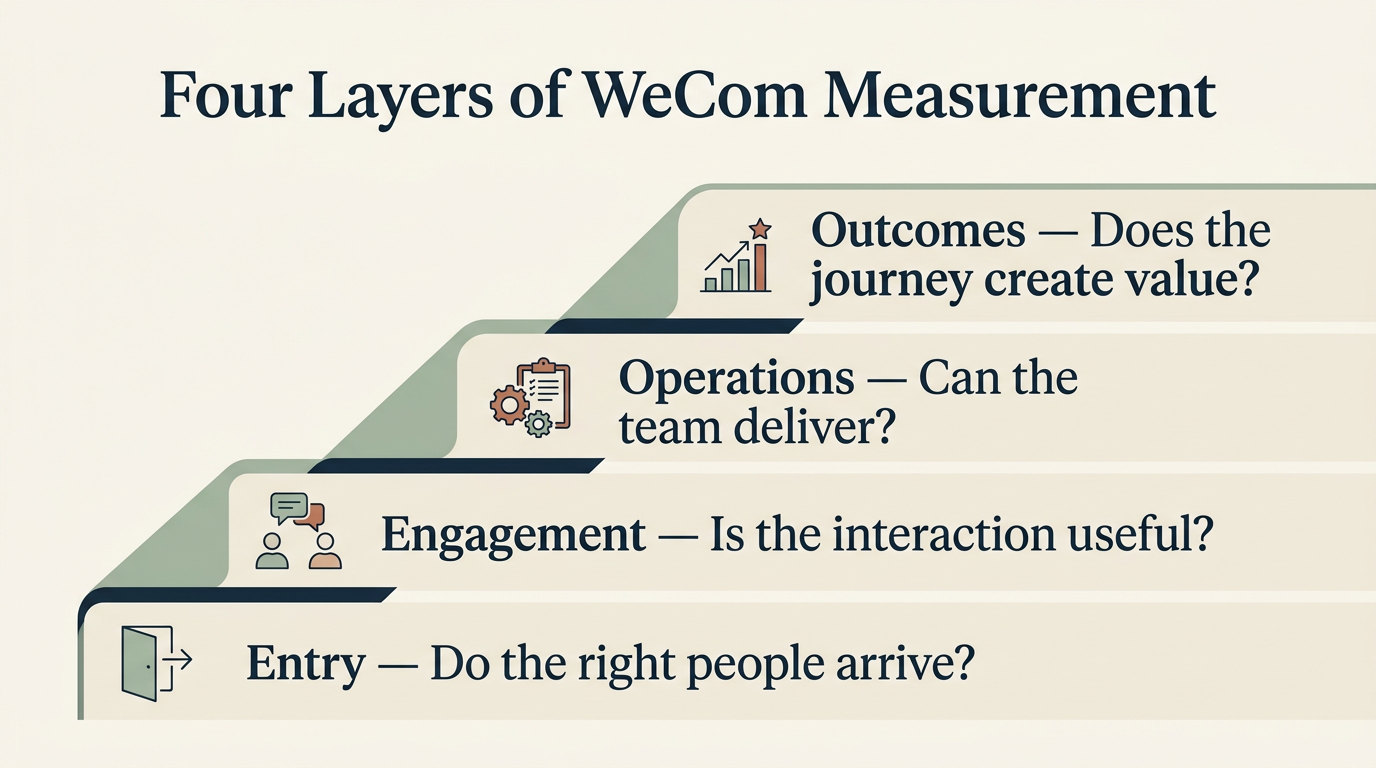
The four layers reveal where a customer journey creates value—and where a weak result actually begins.
Layer 1: Entry — do the right people arrive?
Entry measures show how people reach the WeCom journey and whether they match the intended audience. Volume matters only in relation to eligibility and source quality.
Useful questions include:
How many eligible people saw the invitation?
How many entered or accepted the next step?
Which sources, campaigns, events, stores or employees generated them?
What proportion matches the intended segment?
Why did people connect, decline or abandon the route?
Was the invitation clear about the value and expected interaction?
Possible measures include invitation exposure, entry rate, source mix, audience-fit rate and cost per relevant entrant. The exact terms and denominators must be defined. For example, “entry rate” could use everyone exposed, everyone eligible or everyone who clicked; teams should not compare different definitions.
An entry problem may be an acquisition issue, but it can also be a value-proposition problem. A QR code or contact link does not explain why a customer should form an ongoing relationship.
Layer 2: Engagement — is the interaction useful?
Engagement should measure meaningful customer behavior, not the number of messages the brand sends. The relevant action depends on the use case.
Examples include:
the customer completes a welcome or discovery interaction;
a qualified question receives a useful response;
a customer accesses relevant content or assistance;
a distributor supplies information needed for the next action;
a service case progresses toward resolution;
a VIP customer accepts an appointment or consultation;
a software customer completes an adoption milestone;
a customer remains active without excessive messaging.
Define “meaningful conversation” before reporting it. A greeting, an automated response and a substantive needs discussion should not necessarily count equally.
Also track negative or protective signals: complaints, opt-outs, inactivity after entry, repeated unanswered questions and irrelevant-message feedback. A growing audience with deteriorating usefulness is not healthy growth.
Layer 3: Operations — can the team deliver?
Operational measures show whether people and processes can produce the intended experience. They are often the most actionable part of a WeCom dashboard.
Measure areas such as:
first-response performance;
time to owner assignment;
follow-up completion;
service resolution or sales-handover completion;
open conversations without a next action;
escalation volume and closure;
incorrect routing or duplicate records;
content gaps and recurring unanswered questions;
staff adoption and workflow adherence;
coverage by hour, location, language or team;
customer and work transfer during employee changes.
Do not reduce operations to speed alone. A fast but inaccurate response can damage the journey. Pair timing with completion, quality review or customer outcome.
Tencent states that customer relationships can be company-owned and preserved when employees move. Brands should still measure whether their own transfer workflow is completed and whether the receiving employee has enough context. This statement should not be treated as a promise that every historical message, attachment or internal note transfers automatically.
Layer 4: Outcomes — does the journey create value?
Outcome measures should connect to the original business goal. They may be commercial, service-related, operational or relational.
Sales and lead development
Track qualified opportunities, accepted next steps, meetings, proposals, sales-stage progression and attributable revenue where the data supports it. Avoid assigning full revenue credit to WeCom merely because it was one touchpoint in a longer journey.
Customer service
Track resolution, repeat contact for the same issue, escalation, customer effort, avoidable delay and retention-related signals. Satisfaction measures can help if sampling and wording are consistent.
Retail and clienteling
Track completed appointments, consultation outcomes, assisted purchases, repeat purchase, VIP re-engagement and store or employee contribution—subject to reliable identity matching and attribution.
Customer success and retention
Track onboarding milestones, product adoption, risk identification, completed success actions, renewal progression and expansion opportunities. A message count is not evidence that a customer adopted the product.
Distributor or partner operations
Track case resolution, document completion, training participation, lead or service routing, response quality and issue recurrence. The most important value may be reduced friction rather than a direct sale.
Build a metric tree from one decision
Start reporting design with a decision, not a data export. A metric tree can follow this logic:
Business decision: Should we scale the event-follow-up journey to more exhibitions?
Outcome: Qualified opportunities and completed sales next steps from event leads.
Journey evidence: Relevant conversations, needs identified and follow-ups accepted.
Operating evidence: Response, ownership, handover and completion performance.
Entry context: Eligible attendees invited, entries and source quality.
Every measure should help explain the decision or diagnose a result. If nobody knows what would change when a metric rises or falls, it may be informational rather than a KPI.
How to define a useful WeCom KPI
For each KPI, document:
the business question;
the exact numerator and denominator;
the audience and journey stage;
the data source and system owner;
the reporting cadence;
exclusions and known blind spots;
the person who acts on the result;
the threshold or trend that triggers review.
Avoid fixed external benchmarks unless they are truly comparable. Performance varies by industry, audience, use case, acquisition source, response model, season and maturity. A credible baseline from the brand’s own controlled pilot is usually more useful than an unexplained market average.
Diagnose before you optimize
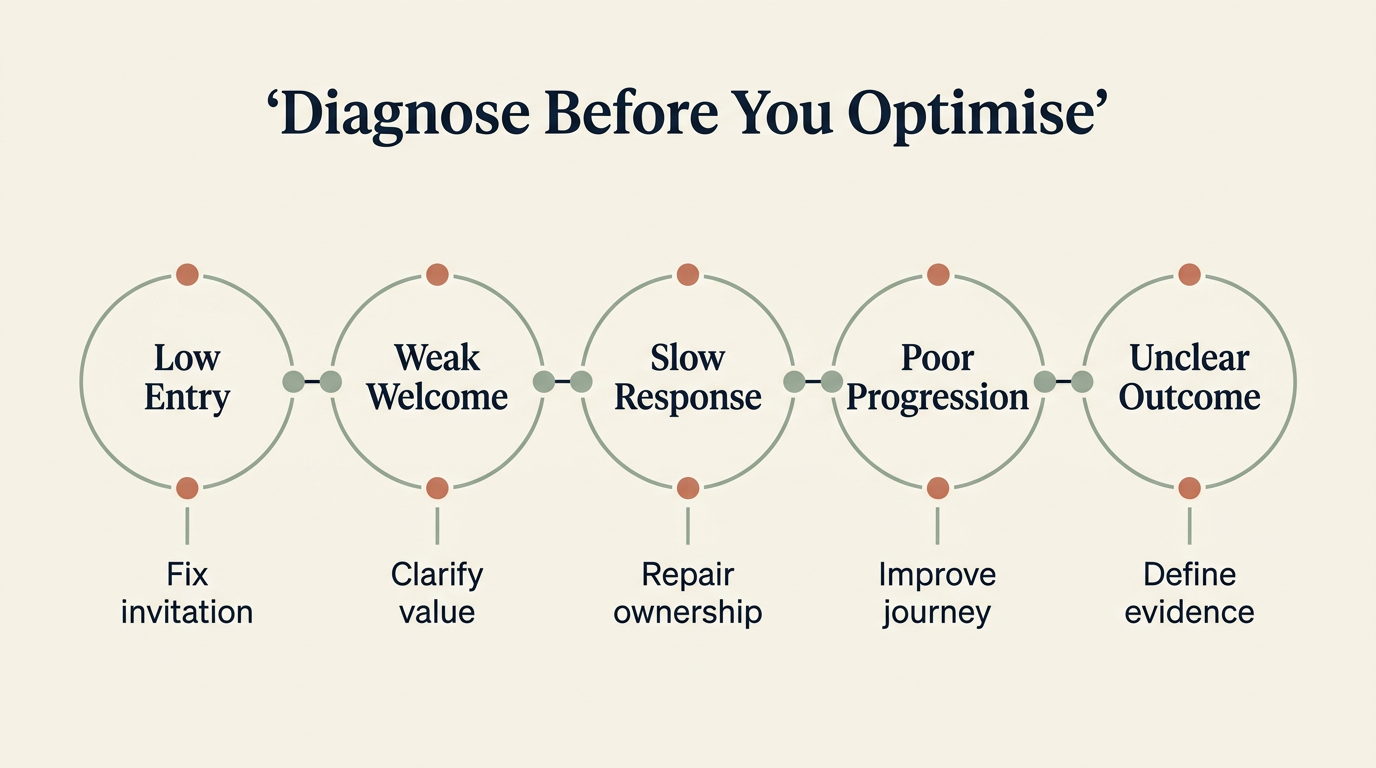
Low entry: fix the invitation
Check audience, placement, trust, timing and value exchange. More exposure will not solve an invitation that feels irrelevant or unclear.
Weak welcome: clarify the value
Check whether the first interaction confirms what the customer will receive, what to do next and who is speaking. Remove unnecessary questions and generic promotional language.
Slow response: repair ownership
Check staffing, working hours, routing, notifications, escalation and backup coverage. Automation can acknowledge receipt, but it should not disguise an unowned case.
Poor progression: improve the journey
Check whether the team asks the right questions, supplies relevant content and offers a realistic next step. A conversation can be active without moving toward value.
Unclear outcome: define evidence
Check identity matching, CRM or SCRM fields, stage definitions, service closure, data quality and attribution boundaries. Do not manufacture certainty where the journey cannot be traced reliably.
A monthly reporting rhythm
1. Validate the data
Check missing sources, duplicate records, inconsistent dates, incomplete owners, failed integrations and changes in definitions. State material limitations on the report.
2. Read the journey from left to right
Review entry, engagement, operations and outcomes in sequence. A later-stage result often reflects an earlier-stage problem.
3. Segment before averaging
Break results down by relevant source, audience, location, employee, product, campaign or journey. An average can hide one strong segment and one broken one.
4. Review real examples
Where permitted and appropriately governed, examine a small sample of successful, stalled and escalated journeys. Quantitative data shows where to look; operational review helps explain why.
5. Choose a small number of actions
Assign an owner and due date to each change. Examples include revising an entry message, adding an answer to the content library, changing a routing rule, retraining a team or clarifying a CRM field.
6. Record what changed
Keep a versioned optimization log. Without it, a team may misread a performance shift caused by a campaign, staffing change, season or altered definition.
What belongs in a headquarters report
A global stakeholder usually needs a decision summary, not every operational field. A concise report can include:
the journey and business goal;
audience and period covered;
four-layer scorecard;
material data limitations;
changes since the previous period;
the two or three most important insights;
corrective actions and owners;
risks, governance issues and resource needs;
the requested decision.
Translate local platform activity into business language without hiding uncertainty. “We added 4,000 contacts” is incomplete. “The event journey brought in the intended audience, but delayed handover reduced qualified progression; we are changing ownership before the next event” is decision-useful.
Data, CRM and privacy limits
WeCom can work alongside CRM, SCRM, service and analytics tools, but integration does not automatically create accurate identity resolution or attribution. Define which system is authoritative, how records match, which fields are necessary, who can access them and how failed updates are handled.
Personal-information processing, third-party providers and cross-border data flows require assessment under applicable law and company policy. Use qualified legal, privacy and security specialists for the actual design. Collecting more customer data “for analytics” is not automatically necessary or justified.
How Lotus supports WeCom measurement
Lotus can help international brands define the WeCom use case, measurement tree, source and journey taxonomy, operating scorecard, reporting rhythm and optimization backlog. The same team can connect reporting to Chinese content, customer or community operations and China social media management.
The objective is not a larger dashboard. It is a smaller set of evidence that helps the brand decide what to repair, stop or scale. Lotus will not promise a fixed performance result or treat platform activity as proof of revenue.
Frequently asked questions
What is the most important WeCom KPI?
There is no universal KPI. The most important measure is the one closest to the primary business decision while still being reliably observable. For an event pilot it may be qualified progression; for service it may be resolution; for onboarding it may be a completed adoption milestone.
Should contact count be reported?
Yes, as context. Pair it with source quality, audience fit, engagement, operating capacity and outcomes. A contact total alone does not show customer value.
Can WeCom revenue be measured?
Sometimes, when identity, stage and transaction data can be connected reliably. State the attribution method and blind spots. Avoid giving WeCom full credit for revenue influenced by several channels and teams.
Does a CRM or SCRM solve measurement?
Not automatically. Systems help store and connect records, but definitions, ownership, data quality, integrations and human use determine whether measurement is credible.
How often should performance be reviewed?
Operational issues may need daily or weekly attention during launch. Management reporting may be monthly, with deeper quarterly reviews. The cadence should match journey volume, risk and decision timing.
What if the program has too little volume for reliable conversion analysis?
Use operational evidence, qualitative patterns and clearly labeled directional signals. Extend the observation period when appropriate. Do not present unstable percentages as firm conclusions.
Measure the journey, not the noise
A credible WeCom program can explain who entered, what value they received, how the team operated and what outcome followed. That chain makes investment decisions stronger and exposes where improvement is actually needed.
If your current reporting is dominated by contacts, messages or screenshots, ask Lotus for a WeCom measurement and operating review. We can turn your use case into a practical scorecard and an optimization plan your China team and headquarters can both use.
