

How International Restaurants Can Build Trust With Chinese Diners on Dianping Before They Visit
For an international restaurant in mainland China, a Dianping page is not a passive directory entry. It is often part of the visit decision. A potential diner may use it to confirm that the venue is real, understand what kind of meal to expect, judge whether the price feels appropriate, look at recent dishes and interiors, read what other guests noticed and see how the restaurant responds when something goes wrong.
That judgement is cumulative. A polished hero image cannot rescue inaccurate opening hours. A strong rating does not remove uncertainty if the menu is difficult to understand. A thoughtful reply cannot compensate for a recurring service issue that remains unresolved on the floor.
The practical job is therefore bigger than “optimising the listing”. It is to reduce the gap between what the diner sees online and what the restaurant can reliably deliver. The most trusted pages tend to make a few things easy: finding the correct venue, recognising the real experience, understanding the offer, interpreting customer feedback and planning the visit with fewer surprises.
This is where many international restaurant teams need a different operating mindset. Dianping should sit between marketing and operations. Brand, local marketing, restaurant management and customer-facing staff all own part of the experience. If those teams work from different information, the page will eventually show the cracks.

Treat the Dianping page as a decision surface
Dianping brings several kinds of evidence together: merchant information, photographs, customer reviews, merchant responses and, depending on the setup, offers or other actions. Diners do not necessarily evaluate these elements separately. They scan for consistency.
Imagine someone considering an unfamiliar international restaurant for a birthday dinner. The photos suggest an intimate dining room, but user images show a bright, busy space. The menu description sounds premium, but no useful price context is visible. A review mentions that a signature dish was unavailable, while the listing still presents it as central. The address is correct, yet the entrance is difficult to identify from the street.
None of those issues alone has to destroy trust. Together, they create work for the diner. Every contradiction makes the visit feel slightly harder to predict.
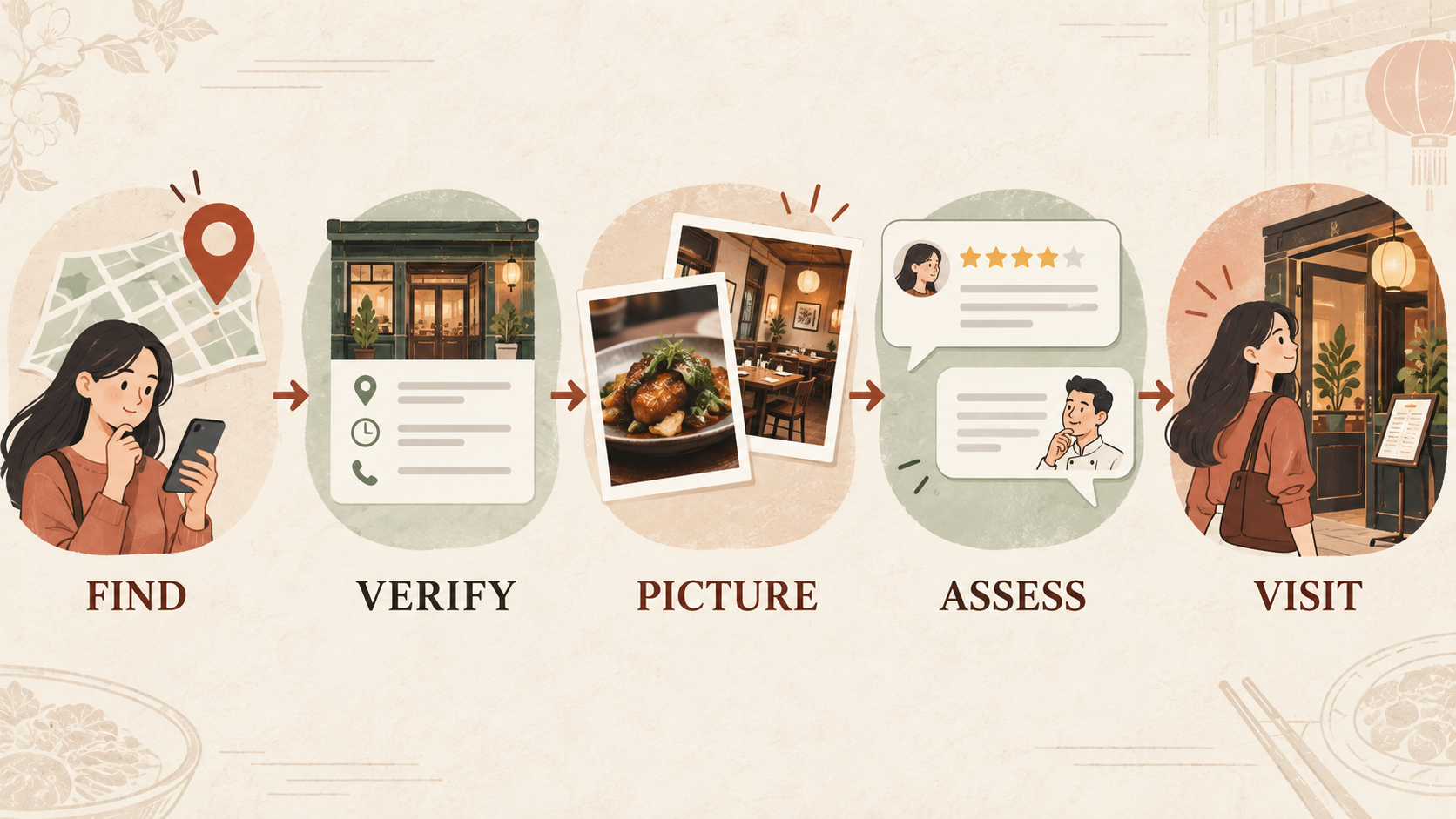
A useful audit follows the same sequence a diner does:
Find: Is this clearly the correct restaurant and location?
Verify: Are the category, hours, contact details and service conditions current?
Picture: Do the food and venue images show the experience honestly?
Assess: Do reviews and merchant replies help the diner understand what is normal?
Visit: Can the person arrive with the right expectations and complete the next step?
This journey should guide the work. It prevents the team from spending all its time on promotional content while basic decision information remains weak.
Fix the truth layer before adding more content
Meituan's official restaurant merchant-information standard places a clear emphasis on information being truthful, complete, consistent and current. That is a sensible working standard even before the team thinks about creative improvement.
Start with the fields that create avoidable friction:
the official Chinese and English restaurant names;
the correct branch, category and map location;
current opening hours, including split service or special sessions;
telephone and other approved contact details;
the entrance, floor, building or landmark information needed to find the venue;
the service format, such as tasting menu, à la carte, buffet or counter service;
realistic price context and any conditions that materially affect the visit;
current information about temporary closures, refurbishment or a changed offer.
Do not assume headquarters knows what changed at branch level. A general manager may update a printed menu without telling the person responsible for Dianping. Marketing may keep using an old dining-room photograph after a renovation. A holiday service change may appear in a staff group but never reach the public listing.
The answer is simple ownership. Give each location a named person who confirms operational facts and a central person who controls naming, tone, imagery and escalation. Every meaningful restaurant change should trigger the question: does the Dianping page also need to change?
The objective is not to fill every available field. It is to make the information a diner relies on accurate enough to act on.
Use visual proof instead of campaign polish
Restaurant photography on Dianping has a practical job. It should help a diner recognise the meal and the place. Official merchant guidance also expects images to be clear, authentic and consistent with the real venue, product or service.
That does not mean the photography has to look amateur. It means it should remain representative.
A useful image set usually covers four evidence categories:
Food: recognisable dishes, realistic portions, current presentation and a sensible range across the menu.
Space: the dining room, table spacing, private rooms where relevant, bar or counter areas and the atmosphere at the time guests are likely to visit.
Arrival: exterior, entrance, building context, lift or floor information and any detail that removes uncertainty at the door.
Occasion: the experience the restaurant can genuinely host, such as business dining, a family meal, a casual lunch or a more formal evening.
Avoid a gallery made entirely from global campaign assets. Those images may express the brand beautifully while telling the diner very little about the local branch. Local images should answer local questions.
User photographs will also sit alongside official images. The goal is not to make every photo look identical. It is to ensure the restaurant's own material establishes an honest reference point. If user images repeatedly reveal a different experience, the team should investigate the operation rather than trying to out-publish the evidence.
Image rights still matter. The restaurant should know who created each asset, where it can be used and whether any identifiable people have been appropriately cleared. A crowded gallery is not stronger if its ownership is uncertain.
Make the menu legible to someone outside the brand
International restaurant teams often underestimate how much knowledge their menu assumes. A dish name may be obvious to a chef or global brand manager but vague to a Chinese diner who has not encountered the cuisine before.
Good Chinese menu information does more than translate the English. It helps the person picture the order. Depending on the concept, that may include the core ingredient, cooking style, flavour profile, portion or sharing context, signature status and realistic price.
The official merchant standard gives similar weight to complete product information, including the product type, name, suggested number of diners, combinations, price and imagery where applicable. The useful principle is clarity, not filling a template for its own sake.
Review the listing through common decision questions:
What is distinctive about this restaurant rather than the cuisine in general?
Which dishes help a first-time guest understand the concept?
Is it clear whether an item is a main course, side, tasting portion or sharing dish?
Can a diner form a reasonable expectation of the spend?
Are set menus or limited offers described in a way the restaurant can fulfil?
Does the Chinese wording sound natural, or does it read like internal product copy?
Be careful with dietary, health or ingredient claims. Only publish what the restaurant can verify and deliver consistently. Where a request depends on kitchen practice, cross-contact risk or local conditions, the listing should not create certainty that the operation cannot support.
Treat reviews as operational evidence, not a score-acquisition project
Dianping's current review rules emphasise authenticity, usefulness, relevance and fairness. They also make clear that review content reflects individual experiences and can be subjective. Both points matter for restaurant management.
First, do not buy reviews, manufacture feedback or design incentives that distort what diners say. Apart from the platform risk, false praise makes the information less useful to the restaurant itself. The team loses the signal it needs to improve.
Second, do not treat every critical review as a complete account of what happened. One guest may dislike a service style that another values. A complaint may be based on a misunderstanding. A review can also be wrong. The stronger operating response is to look for patterns across a meaningful set of comments and compare them with reservation notes, staff reports and actual service conditions.
Useful themes to track include:
difficulty finding the correct entrance or branch;
a mismatch between menu descriptions and what arrived;
uncertainty about price, portion or ordering sequence;
dishes or facilities that appear online but are no longer available;
language or service expectations that were not met;
waiting time and pacing;
the suitability of the venue for the occasion the listing implies.
Tagging themes is more useful than circulating screenshots without context. It allows marketing to see where information is unclear and operations to see where delivery is inconsistent. A monthly discussion between the two teams can then separate content fixes from service fixes.
This is also the point where Dazhong Dianping marketing for international brands becomes an operating discipline rather than a one-off setup task.
Respond so the next diner learns something useful
A merchant response is not only for the person who wrote the review. It is public evidence for everyone considering the restaurant afterwards.
The platform's restaurant merchant standard says responses should address the user's issue simply and concisely, and should not become traffic diversion or promotion. That is a helpful constraint. The strongest reply is usually specific enough to show attention, restrained enough to stay credible and practical enough to explain what happens next.
For positive feedback, acknowledge the detail the guest valued. A reply that mentions the occasion or dish feels more attentive than the same thank-you pasted under every review.
For mixed feedback, recognise the useful point without arguing over the rating. Clarify only what can be confirmed. If the review exposes unclear information, update the listing as well as replying.
For a serious complaint, avoid public speculation. Acknowledge the experience, state what the restaurant can responsibly check and move any sensitive follow-up into the appropriate service channel. The public response should not reveal personal information or make a promise the team has not authorised.
Hospitality research outside China offers a useful caution here. A Cornell study of hotel responses on TripAdvisor found diminishing returns when management replied too broadly, while constructive responses to negative feedback were more valuable than simple acknowledgements of positive comments. That is not a restaurant or Dianping benchmark, but it supports a sensible principle: useful judgement matters more than reply volume.
Assign response roles before pressure arrives. Local teams need a clear tone, language standard, escalation route and authority level. Without that structure, easy reviews get generic replies and difficult reviews wait until the issue has already shaped other diners' impressions.
Align the page with what happens on the floor
Digital trust fails quickly when the real visit contradicts the listing. The best Dianping work therefore reaches into restaurant operations.
Front-of-house staff should know the Chinese restaurant name shown on the platform, the current offers and menus, and any information guests are likely to quote. The host team should understand how the entrance, queue or reservation process is described. Managers should know who owns responses and how recurring feedback is shared.
The marketing team, meanwhile, needs an accurate route into the restaurant. It should not have to discover a changed menu, temporary closure or new service charge through a review.
For restaurants serving Chinese travellers outside mainland China, the same principle applies but the wider journey may involve destination research, maps, booking platforms and WeChat. Lotus's China travel and tourism marketing approach can help connect those touchpoints. The Dianping page still needs a clear job; it should not be asked to carry the entire journey.
Give multi-location brands a shared standard and local evidence
Restaurant groups have a particular trust problem: consistency is expected, but every branch is physically different.
Central governance should protect the parts that must not drift:
official Chinese naming;
category and positioning;
core description and tone;
image rights and brand standards;
response principles and escalation;
the process for reporting material changes.
Local teams should own the facts that headquarters cannot reliably maintain from a distance:
location, entrance and opening details;
current branch photography;
local menus, availability and occasions;
recurring customer questions;
service recovery and operational improvements.
Do not solve inconsistency by copying one branch page across the estate. Repeated descriptions and reused images may be efficient internally, but they weaken the diner's ability to judge a real place. Build a shared template, then require local evidence.
A simple change log is often enough. Record what changed, which locations are affected, who confirmed the fact, which listing elements need updating and when the update was checked. This is unglamorous work, but it protects trust more effectively than another layer of campaign content.
Measure whether uncertainty is falling
Dianping work should not be judged from one headline number. Ratings and rankings are visible, but the restaurant does not fully control them and should not promise an outcome.
Measure the parts the team can improve:
completeness and freshness of high-intent information;
coverage of the food, space, arrival and occasion image set;
repeated questions that the listing should already answer;
review themes by branch and whether the underlying issue is changing;
response quality and escalation completion;
mismatches between the page, menu, service and physical venue;
available platform actions that indicate a diner moved closer to a visit, interpreted within the access and tracking the restaurant actually has.
Avoid turning the dashboard into a wall of numbers. A useful report explains what customers are uncertain about, what the team changed and whether the next set of evidence looks different.
The most valuable insight may be operational. If several diners mention that the restaurant is difficult to find, the answer might be a better arrival image and clearer Chinese directions. If reviews repeatedly describe a price surprise, the issue may be menu clarity or the service itself. If guests praise a dish that barely appears in official content, the visual plan may be missing the strongest proof.
Audit the trust gap in the right order
When a Dianping presence feels weak, resist the urge to begin with a promotion. Start with the highest-risk uncertainty and work outward:
Confirm that the correct location, name, category, hours and contact information are live.
Check that menu, price and service details match what guests can currently receive.
Replace outdated or unrepresentative images with current, rights-cleared evidence.
Review recurring customer themes and decide which require content changes and which require operating changes.
Set a response standard that is natural in Chinese, specific to the issue and properly escalated.
Give every location an owner and a route for reporting changes.
Only then decide whether offers, campaigns or paid visibility have a strong enough foundation.
This order is deliberately practical. More attention magnifies whatever is already present. If the page is incomplete or the real experience is inconsistent, promotion can increase scrutiny faster than trust.
Make the restaurant easier to choose, not merely easier to notice
For an international restaurant, Dianping trust is built through alignment. The facts are current. The photos resemble the real experience. The menu helps an unfamiliar diner understand what they are choosing. Reviews are treated as evidence rather than an obstacle. Merchant replies show attention without becoming advertising. The restaurant team knows what the page promises.
That standard does not guarantee a rating, ranking or visit. It gives the restaurant a more credible basis for being judged.
If your team is unsure whether the real gap sits in merchant information, Chinese menu content, visual evidence, review response or the handoff to restaurant operations, talk with Lotus. We can review the full pre-visit journey and help you decide what should be fixed first.
