

An overseas shopping mall does not win Chinese tourists by translating its store directory and waiting for tour buses. It wins when a traveller can discover a compelling reason to visit, understand how the mall fits into the trip, verify the practical details and enjoy an experience worth sharing.
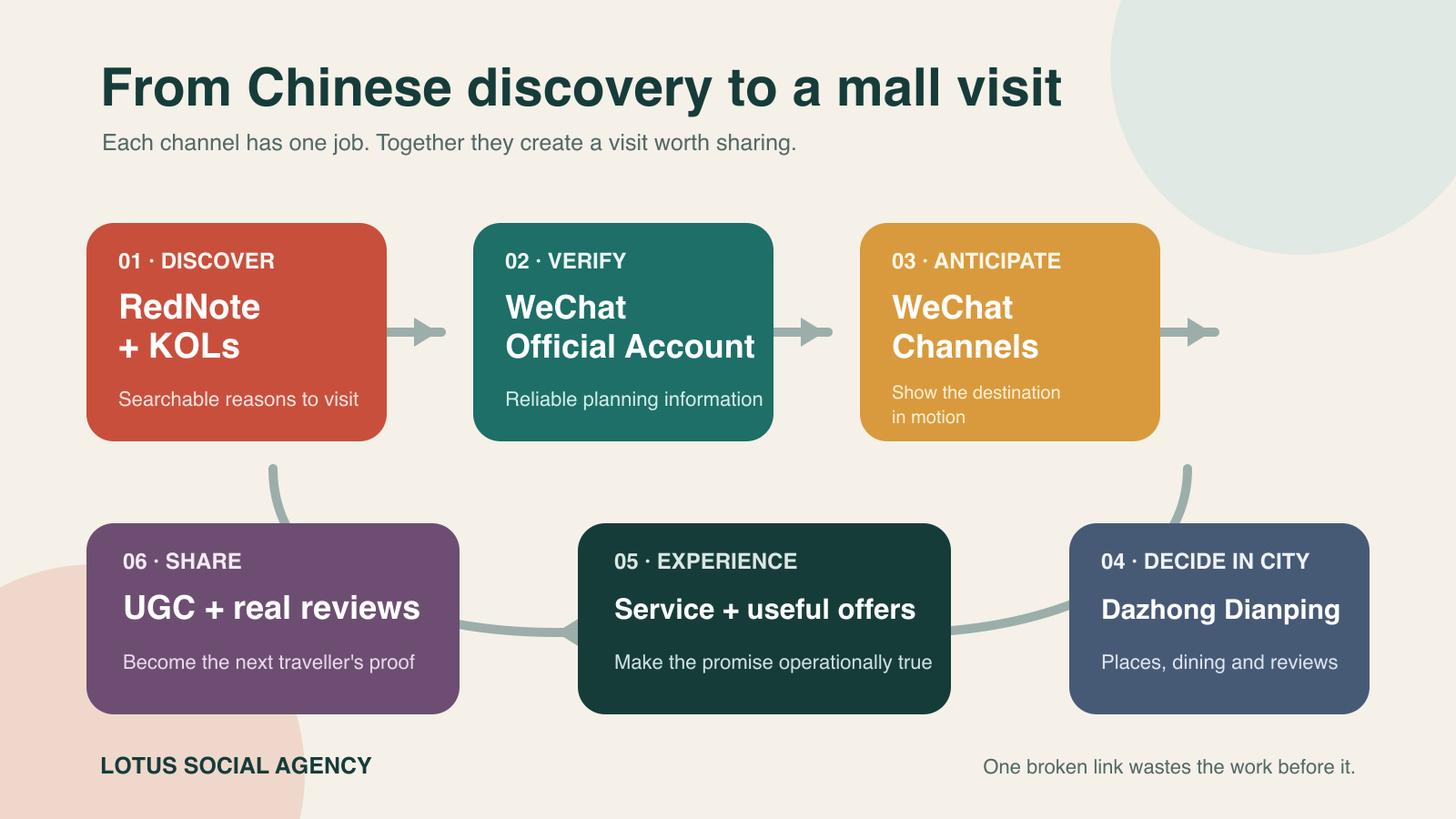
Use a RedNote Official Account and relevant creators to make the mall searchable before departure. Use WeChat Channels to show the destination in motion, and a WeChat Official Account to maintain reliable Chinese-language visit information. Audit the mall and its tenants on Dazhong Dianping for in-city discovery. Connect all four with authentic KOL visits, voluntary UGC, Chinese-friendly service and measurable offers. The content should sell a half-day experience—shopping, food, local culture, events and convenience—not simply a long list of brands.
China's Ministry of Culture and Tourism reported 148.36 million outbound tourism trips by mainland residents in 2025, up 20.8% year on year. That figure counts trips rather than unique travellers, and it does not predict visits to any particular mall. It does show why a serious visitor strategy deserves current research rather than assumptions based on the pre-2020 group-tour market.
At the same time, recent cross-border consumption research describes a more experience-led traveller who spends across transport, dining and entertainment rather than treating shopping as the entire trip. For a mall, that is an opportunity. A destination with local food, design, family activities, events, architecture or a useful city location has more stories to tell than “we have many shops.”
The Chinese visitor journey is a chain
A saved RedNote post may put the mall on a Paris, London, Dubai or Singapore itinerary. A WeChat article confirms opening hours, transport and tax-refund guidance. A Dianping search helps the traveller compare nearby restaurants and read recent local reviews. At the mall, clear Chinese information and a useful visitor offer remove hesitation. A short video or honest review then becomes another traveller's starting point.
Discovery — RedNote Official Account, KOLs and KOCs: create searchable reasons to visit.
Proof — authentic UGC: show what the experience looks like through real people and real itineraries.
Planning — WeChat Official Account: keep practical Chinese-language information accurate.
Anticipation — WeChat Channels: use short video and livestream selectively to make the destination feel current.
In-city decision — Dazhong Dianping: maintain accurate place information and learn from reviews.
Conversion — the on-site experience: make transport, wayfinding, payment, tax refund and service match the promise.
This is a planning model, not a claim that every traveller uses every app. Search the live Chinese results for your destination, mall name, neighbourhood and retail categories before choosing channels or spend.
1. RedNote Official Account: make the mall searchable before the flight
Xiaohongshu (小红书), widely called RedNote in English, is where a traveller may search “London shopping,” “Paris rainy-day itinerary,” “Dubai mall with children,” “local designer brands” or a mall's Chinese name. The job of an official account is not to post corporate announcements. It is to publish useful, saveable answers to those searches.
Start by choosing and consistently using one Chinese mall name. Pair it with the local-language name, city, district and nearby landmark. Search all variants before launch: an unofficial traveller nickname may already be more common than the translation approved by headquarters.
Content series that earn a place in an itinerary
The 90-minute or half-day route. Show a realistic sequence: signature store, local lunch, design feature, family stop and the easiest exit or taxi point.
What is distinctive here. Feature local designers, regional products, architecture, food, exhibitions, pop-ups and services a traveller cannot get from a generic store directory.
Practical planning. Publish transport, entrance, opening hours, holiday changes, luggage storage, family facilities, accessibility, payment and tax-refund guidance with a visible update date.
Interest-led guides. Create routes for beauty, sneakers, luxury, local fashion, food, gifts, art, architecture or travelling with children.
Seasonal reasons to return. Cover exhibitions, launches, markets and holiday programming without promising stock or offers that may have expired.
RedNote's current Professional Account rules support overseas entities only according to the platform's open jurisdictions, industries and documentation requirements. Verification, external linking and advertising eligibility should be checked for the mall's exact legal entity before a launch date is promised.
Paid promotion can extend a proven note, but it should not be the first test of a weak idea. RedNote's Juguang platform separates objectives such as product seeding, lead collection and external conversion; a mall should choose an objective that matches the next step it can actually measure.
2. Build KOL and UGC campaigns around decisions, not reach
“Invite an influencer” is not a strategy. The useful question is: which traveller decision should the content resolve?
Use a portfolio rather than one celebrity post:
A travel-planning KOL can show how the mall fits into a city itinerary.
A fashion or beauty creator can explain brands, edits and price positioning without making unreliable availability claims.
A food creator can make the dining offer a reason to visit even for a companion who does not want to shop.
A family creator can test toilets, changing facilities, play areas, lifts, rest stops and meal options.
Chinese residents or students in the destination can produce credible, lower-cost KOC content with strong local knowledge.
Actual visitors can create the UGC that reveals questions your official content has missed.
Every hosted creator should receive factual guardrails—correct Chinese name, transport, filming rules, opening times, offer terms and what must not be promised—but not a scripted opinion. Commercial relationships should be disclosed and each platform's current rules followed.
Design one visit to produce several useful assets: a RedNote planning note before the peak travel window, a WeChat Channels walkthrough, short clips for the official account, an FAQ drawn from comments, and a post-visit edit. Negotiate usage rights, duration, paid-media rights and raw footage before production.
UGC without fake advocacy
Create moments that visitors naturally want to document: a city-view terrace, local-food trail, art installation, seasonal market, personalisation station or useful shopping map. Then make the prompt optional and specific: “show your three-hour route” is more valuable than “post a selfie.” A gift or competition may reward participation where lawful, but never require a positive review.
Do not buy Dianping reviews or manufacture “traveller” posts. Dianping's rules emphasise authentic, relevant consumer experience and prohibit businesses from hiring people to create false reviews.
3. WeChat Channels: show the mall in motion
Weixin Channels (微信视频号), often called WeChat Channels in English, is suited to short video, livestreaming and sharing inside the wider Weixin ecosystem. Tencent describes Channels, Official Accounts, Search and Mini Programs as connected touchpoints rather than isolated products.
That makes Channels useful for content where motion matters:
a walk from the metro or hotel district to the correct entrance;
“three floors in three minutes” orientation;
a chef, designer or curator introducing a limited event;
a family route showing lifts, rest points and activities;
a food-hall or local-brand edit;
a calm before-opening walkthrough that makes the space legible;
a live preview only when the team can answer questions accurately in Chinese.
Optimise the opening seconds around a traveller problem: “What can you do here in two hours?” is stronger than a logo animation. Add the accepted Chinese mall name, city and visit window in the caption. Date temporary content clearly.
Channels should lead somewhere useful: the mall's WeChat Official Account, a current Chinese visit guide, an approved Mini Program or a trackable offer. A Mini Program is not automatically necessary. Build one only if a defined service—wayfinding, membership, booking, coupon wallet or tenant search—justifies the technical and operational maintenance.
4. WeChat Official Account: become the reliable Chinese-language source
RedNote can create desire; the WeChat Official Account should reduce uncertainty. Use it as the authoritative Chinese visit layer that a traveller can save, forward and reopen on the day.
The evergreen “Plan your visit” article should include:
the official Chinese and local-language names;
address in both scripts and a map pin checked against the actual public entrance;
public transport, taxi drop-off, parking and walking instructions;
opening hours, holiday closures and time zone;
floor map, guest services, accessible routes and family facilities;
luggage storage, Wi-Fi and charging availability;
participating payment methods, stated only after live testing;
tax-refund eligibility, minimum spend, documents and validation steps, with country-specific wording and a date;
current events and offers with start, end and exclusions;
a Chinese-language contact route and expected response time.
Do not turn the account into a permanent stream of promotions. A traveller needs a concise guide, seasonal updates and useful service notices. Connect the article to RedNote bios where permitted, creator content, hotel partners, airport or station materials, the mall website and on-site QR codes.
Tencent lists Official Accounts for brand content and engagement, Channels for video and livestreams, and Mini Programs for services and shopping. The combined Weixin/WeChat ecosystem exceeded 1.4 billion monthly active users in Q1 2026, but scale alone does not deliver discovery for a new mall account. Distribution still needs creators, search-aware titles, partners and on-site acquisition.
5. Dazhong Dianping: win the in-city decision
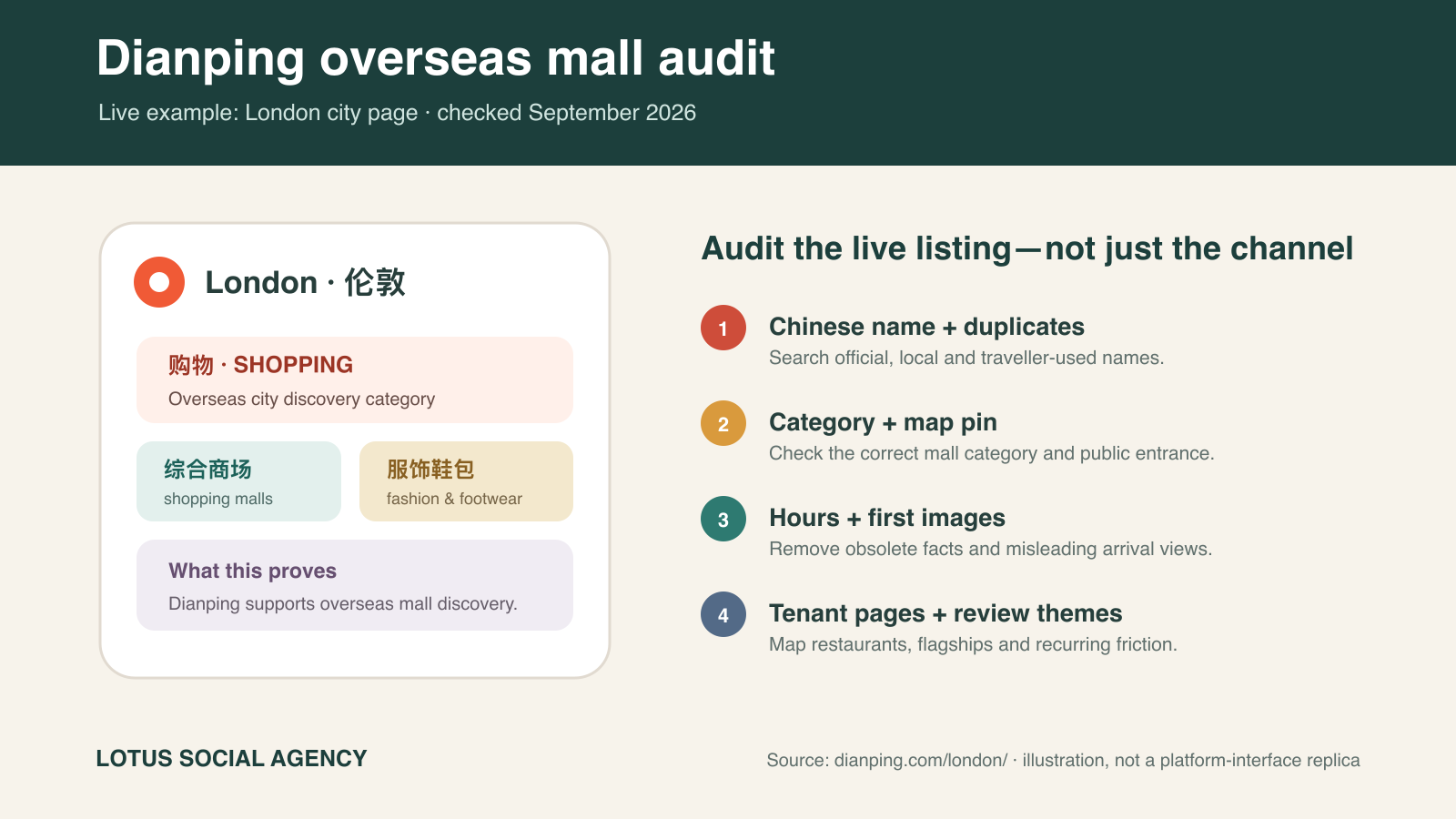
Dazhong Dianping (大众点评) should not be treated as a restaurant-only app. Meituan's own technical documentation says overseas city sections contain food, shopping, malls, attractions, tickets and local activities. Dianping's London city pages, for example, expose both “shopping” and “shopping mall” categories.
Live example: Dianping includes shopping and mall discovery in its London overseas-city page. This audit visual is based on the live page and is not a replica of the platform interface. Checked September 2026; platform information can change.
Audit the mall as a visitor would:
Search the Chinese name, English name, former names and common misspellings.
Check whether duplicate place pages split photos and reviews.
Verify category, city area, map pin, entrances, address, phone, opening days and official website.
Review the first images: do they show the current destination or an obsolete façade?
Read recent reviews for repeated issues around queues, staff, payment, tax refund, food, transport or wayfinding.
Map major tenant listings too. A correct mall page cannot compensate for a restaurant or flagship store pinned in the wrong building.
A place listing does not prove the overseas mall operates a merchant account, and cooperation routes vary by market and category. Meituan's 2026 rules explicitly cover overseas cooperating merchants and products, but a mall should confirm current eligibility, control, commercial terms and available functions directly for its entity.
Respond to genuine feedback in natural Chinese when the platform permits. Do not demand that a legitimate negative review be removed. Fix the operational cause and explain the correction. Explore Lotus's Dianping services.
6. Make the mall worthy of the content
Social marketing can expose an experience; it cannot repair one. Before buying media, test the visit with Chinese speakers who have not seen the internal briefing.
Prioritise:
A consistent Chinese name. Use it across social accounts, Dianping, maps, signage and concierge scripts.
A reason beyond transactions. Build a route around local design, food, art, architecture, events or family time.
Chinese-language wayfinding at decision points. Entrances, guest services, tax refund, toilets, lifts, prayer rooms, taxis and exits matter more than translating every decorative sign.
Payment accuracy. If Weixin Pay, Alipay or UnionPay is promoted, test it at participating tills and state limitations. Do not promise mall-wide acceptance when only some tenants support it.
Country-specific tax-refund guidance. Rules vary by jurisdiction and can change; name the operator, minimum spend, documents, validation step and whether refund service is on site.
Mandarin support with escalation. A bilingual concierge, scheduled Chinese help desk or reliable chat route is more useful than a sign nobody can act on.
Basic travel utility. Wi-Fi, charging, luggage storage, family facilities and clear taxi pickup points remove friction that visitors remember.
7. Turn seasons into planning windows
Chinese New Year, Labour Day, summer, National Day Golden Week and school holidays can matter, but the correct lead time depends on destination, visa requirements and flight capacity. Long-haul travellers may plan well before the holiday itself. Trip.com data for Golden Week 2024 found visa applications averaging 68 days before the holiday and long-haul stays in several European markets extending beyond ten days. Treat that as a planning signal, not a permanent forecast. Source: Trip.com Group.

Work backwards:
Eight to twelve weeks before: search research, creator selection, guide updates and hero content.
Four to eight weeks before: publish itineraries, seed KOL/KOC visits and amplify proven posts.
One to four weeks before: answer practical questions, confirm hours and promote date-specific events.
During the travel window: use Channels and WeChat for live updates; monitor Dianping and RedNote questions.
After the visit: request voluntary feedback, secure creator usage rights and turn recurring questions into the next guide.
A realistic first 90 days
Days 1–30: fix discoverability and service
Audit the mall's Chinese names across RedNote, WeChat, Dianping and mainstream Chinese travel search. Check tenant listings, transport, payment, tax refund and on-site Chinese information. Interview concierge and store teams about real questions. Build a baseline for branded search results, Chinese-language page traffic and Chinese visitor footfall where lawful and feasible.
Days 31–60: publish the minimum useful system
Create the RedNote Official Account if the entity is eligible. Publish three search-led notes and a WeChat “Plan your visit” article. Produce a compact Channels series. Correct listing issues through available Dianping channels. Host a small group of well-matched Chinese creators only after the practical journey is ready.
Days 61–90: test, measure and improve
Run one seasonal or interest-led campaign with a trackable offer, QR code or landing page. Measure saves, qualified questions, guide visits, directions, coupon redemption and attributable footfall—not just impressions. Read comments and reviews for repeated friction, fix it and document the change before scaling media.
What should a shopping mall measure?
visibility for the mall's Chinese and local-language names;
RedNote saves, shares and comments asking about transport, brands or offers;
WeChat Official Account article reads, menu use and trackable outbound clicks;
Channels completion rate, shares, follows and qualified questions;
Dianping listing views, directions, saves, review themes and correction status where accessible;
Chinese-language landing-page sessions and offer redemptions;
concierge enquiries, tax-refund transactions and participating-tenant sales where data can be lawfully aggregated;
creator cost per saved guide, qualified visit or redeemed offer—not only cost per view.
No single metric proves incremental footfall. Use several signals, document the campaign window and compare with a reasonable baseline or control market where possible.
Frequently asked questions
Does every overseas mall need all four platforms?
No. Start with the live search results and visitor journey. RedNote plus a reliable Chinese guide may be the minimum for a little-known destination; Dianping may be critical in a city where travellers use it heavily; Channels becomes more useful when the mall has video-worthy programming and a distribution plan.
Should a mall open a RedNote Official Account before working with creators?
The two can develop together. Creator content supplies third-party perspective; the official account supplies reliable, reusable information. Do not launch an empty account or depend on one viral post.
Is WeChat Channels a replacement for a WeChat Official Account?
No. Channels makes the destination visible and current; the Official Account holds durable planning and service information. Link them so inspiration can become action.
Can a mall reward UGC?
Yes, where local law and platform rules allow, but the mechanic should reward participation rather than a positive opinion. Publish clear terms, disclose commercial relationships and never incentivise fake reviews.
Should we advertise tax-free shopping in every market?
Only if the mall and participating tenants can deliver the claim. Tax eligibility, minimum spend, validation and refund methods differ by country and sometimes by store. Date the guidance and assign an owner to update it.
What if the mall already has many Chinese visitors?
Use research to identify missed value: poor dining discovery, low repeat contact, inaccurate listings, long tax-refund queues, weak event awareness or visitors concentrated in only a few stores. The goal may be better experience and wider tenant distribution rather than simply more footfall.
Why Lotus approaches mall marketing from inside the audience
Lotus's bilingual team is based in China and lives with RedNote, WeChat and Dianping in daily life. We use these platforms as travellers planning, comparing, messaging and sharing—not only as marketers reading dashboards. We also share one common interest: exploring the world. That makes us naturally curious about the food hall, local designer, view, event or service that could make a Chinese traveller say, “This belongs in my itinerary.”
Lotus can audit the Chinese discovery journey, establish the platform roles, create culturally resonant content, coordinate KOL and UGC campaigns, support verified account applications, assess advertising, and connect reporting to the mall's actual visitor and tenant goals. We will also say when an account, Mini Program or media buy is not yet the right investment.
Discuss your shopping mall's Chinese visitor journey with Lotus.
