

For an international brand in China, community management often looks deceptively simple from outside the local team: monitor the channels, answer questions and pass anything difficult to the right colleague. The reality is more demanding. A public comment may be a product question, a joke, a service problem, a misconception or the start of a wider conversation. A direct message may need a useful answer, more context or a careful handoff. The team must respond naturally in Chinese, respect the norms and tools of each platform, protect the brand’s factual boundaries and preserve enough context for someone else to continue the conversation.
Without a shared playbook, the work becomes a series of individual judgements. Simple questions wait for approval. Different people give different answers. Sensitive cases move between teams without a clear owner. Useful audience language disappears inside screenshots and chat groups. The answer is not a library of rigid scripts. It is a lightweight operating system: one that makes routine decisions faster while making uncertain decisions safer.
This guide shows how to build that system around the work a China social team actually needs to do: capture, triage, answer, escalate, close and learn.
Treat community management as an operating function

A social account does not stop being part of the brand after a post goes live. The comment area and message inbox become part of the audience experience. They reveal where the content was unclear, which details people need before taking a next step, what language they naturally use and where the brand’s operating reality does not match its communication.
That means community management needs more than a friendly tone. It needs five connected capabilities:
visibility over the incoming work;
a consistent way to classify it;
named people who can make each kind of decision;
clear response and escalation boundaries; and
a learning loop back into content and operations.
These capabilities should work across the brand’s China channels without pretending the channels are identical. Douyin provides authorised comment-management routes for approved use cases, including central review and replies. Weibo’s current community rules address comments and private messages, including low-quality or high-frequency behaviour. Xiaohongshu emphasises truthful, useful participation. Meituan’s rules for restaurant merchants include their own expectations for response content. The practical lesson is not that one platform rule can govern the whole system. It is that the brand needs one operating core with a current platform overlay for every active channel.
Define exactly what enters the community queue
Start with an inventory of the surfaces the team is expected to manage. For each account, record the platform, account owner, public comment surfaces, private-message route, available management tools, operating hours, language needs and any channel-specific restriction that affects a reply.
The inventory should distinguish three kinds of work.
Owned-account interactions are comments and messages received directly on the brand’s official accounts. These are normally the easiest to assign because the brand controls the account and can see the conversation history available there.
Authorised related interactions may include comments surfaced through an approved platform tool or integration. Douyin, for example, documents authorised workflows for retrieving and replying to comments within defined permissions. The brand should record exactly what the authorised access covers instead of assuming that a tool represents all public conversation.
Observed conversation includes public posts or comments the team notices but does not own or have an authorised response route for. This belongs in social listening, not automatically in the response queue. A brand should not insert itself into every mention simply because it can see it.
This distinction prevents two common problems. First, it stops the team from missing ordinary work inside a neglected inbox. Second, it stops “community management” from expanding into unrestricted monitoring, outreach or personal-data collection.
The queue itself should contain enough information to support the next decision: platform, account, time received, public or private surface, conversation link or native identifier, original Chinese wording, concise English context where the international team needs it, category, urgency, assigned owner and current state. Avoid copying more personal information than the work genuinely requires.
Build a triage matrix around the required decision
The best category is not a description of the user. It is a description of the work the brand needs to do. A practical starting matrix may include the following.
Routine information question
The answer already exists in an approved and current source. Examples may include opening information, a published product feature, an event detail or where to find an official guide. The community manager can answer within the approved boundary and link to an appropriate Lotus or brand-owned destination when useful.
Clarification needed
The question is reasonable, but the team does not have enough information to answer safely. The correct action is to ask one focused follow-up or explain what detail is needed, not guess.
Feedback or suggestion
The person is sharing an experience, preference or idea rather than asking for a resolution. Acknowledge the substance, record the theme and avoid implying that the brand has committed to a change.
Service issue requiring handoff
The interaction concerns an order, booking, account, product problem or other case that the social team should not resolve in public. Move it to the approved service route, preserve the context and tell the person what will happen next. The community team remains responsible for a clean handoff, even when another team owns the outcome.
Sensitive or specialist-owned issue
The content raises safety, legal, compliance, medical, financial, political, security or other specialist concerns. The community manager should pause and use the named escalation route. The playbook should define who receives the case; it should not attempt to teach the community team how to adjudicate it.
Abuse, spam or platform-rule issue
The interaction may require native moderation tools or a platform report rather than a brand reply. The platform overlay should show the current options and the authorised decision owner. Do not improvise a universal delete, hide or block rule across channels.
Positive engagement with no service need
Not every positive comment requires a branded sentence. A natural acknowledgement may be appropriate, but repetitive template replies can make the account feel automated. Sometimes the most human choice is a short, specific response; sometimes no response is needed.
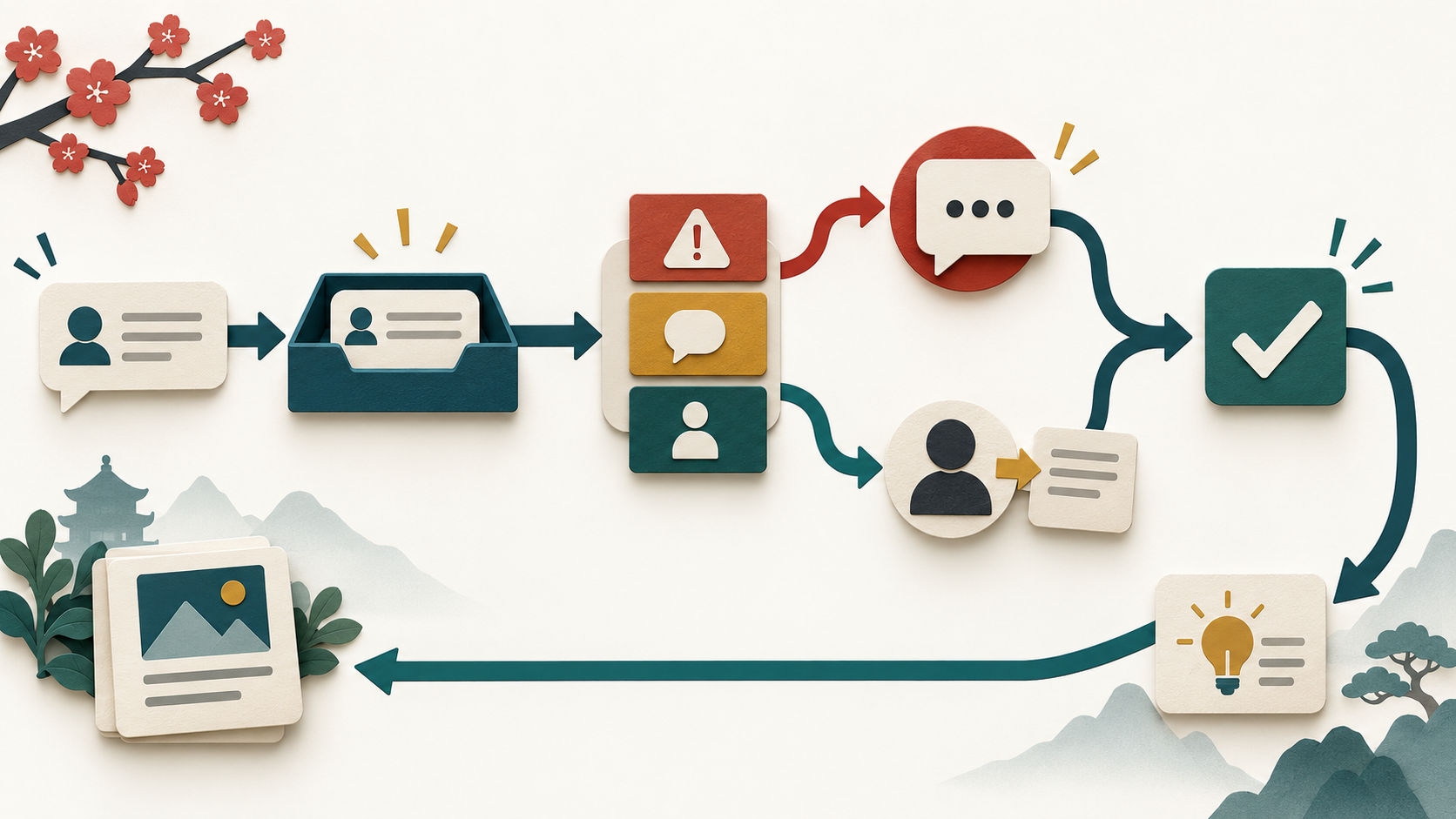
For each category, define the default action, who can approve it, what evidence is needed, when it leaves the community queue and what must be recorded. This turns classification into an operating decision rather than a reporting label.
Separate response ownership from subject ownership
One person should own the interaction from intake to closure. That does not mean the same person must know or decide everything.
The response owner keeps the queue moving, preserves the conversation context and sends the final approved reply. The subject owner confirms the factual answer. The escalation owner decides what happens when the issue falls outside routine community work. On some teams, one person may hold two roles, but the distinction should still be visible.
This matters for international organisations because the knowledge is often distributed. A China-based community manager understands the language, platform context and conversational tone. A product, operations or customer-service colleague may hold the answer. A global brand lead may own a sensitive positioning decision. The playbook should connect those people without making every routine reply wait for all of them.
Build an ownership matrix by category, not by seniority. For example:
published factual question: community manager answers from the approved knowledge base;
unclear product detail: product owner confirms, community manager replies;
local event or stock question: operations owner confirms, community manager replies;
service case: community manager hands off with context, service owner takes the case;
sensitive issue: community manager pauses, designated specialist owner decides the next step.
Include a backup for every essential role. A playbook that works only while one bilingual colleague is online is not yet a system.
Set useful response standards without scripting the conversation
The team needs shared standards, but a script library can create a new problem: technically approved replies that sound copied, avoid the actual question or repeat the same phrase under every post.
Use response principles instead.
Answer the real question first. If someone asks whether a feature is available in a specific market, do not begin with a brand slogan. Give the clearest accurate answer the evidence allows.
Match the level of certainty in the source. If availability varies, say so. If the team still needs a detail, ask for it. Do not make the Chinese reply more definite than the operational reality.
Use natural local language. A grammatically correct translation may still feel distant or overly formal. The local writer should preserve the brand’s character while choosing phrasing that fits the platform and the situation.
Keep the public reply proportionate. A simple question deserves a simple answer. A public service concern may need acknowledgement plus a private handoff, not a long defence. On Meituan’s restaurant surfaces, for example, the current merchant rule specifically favours concise answers to the user’s issue and restricts promotional diversion. That is a platform-specific requirement, but the wider operating lesson is useful: a reply should serve the conversation before it serves the campaign.
Do not turn every interaction into acquisition. Comments and DMs are not automatically leads. Moving someone to another channel should solve a real need—such as protecting private information or continuing a service case—not merely create a contact.
Avoid artificial repetition. Weibo’s official comment-governance explanation identifies repeated, templated and machine-like comments as low-quality interaction. Even where another platform uses different rules, a brand should still check whether its reply sounds like a human response to this person’s actual point.
The playbook can include approved factual building blocks, tone examples and prohibited claims. It should still require the responder to assemble a relevant answer rather than paste a universal paragraph.
Create a clear boundary between reply and escalation
Escalation should be triggered by the decision required, not by how uncomfortable the comment feels. A critical comment may be easy to answer factually. A polite question may raise a specialist issue the community team should not touch.
Useful escalation triggers include:
the approved source does not support a confident answer;
the person is reporting a potential safety or security issue;
the conversation includes personal data that should not remain public;
the issue concerns a transaction or service case outside the social team’s access;
the reply would require legal, compliance, medical, financial or policy judgement;
the content could materially affect employees, partners or a public brand position;
the interaction is attracting unusual attention and the normal response owner cannot assess the implications; or
the platform action under consideration—such as hiding, reporting or restricting—requires a designated owner.
The escalation record should be short but complete: what happened, where it happened, what the person is asking for, what has already been said, what evidence is available, what decision is required and when the community owner will check back.
Do not promise that the specialist team will reach a particular conclusion. Give the audience a truthful next step and keep internal ownership visible.
Preserve context when the conversation moves
Poor handoffs force the person to repeat the problem and force the receiving team to reconstruct the thread from screenshots. Cross-market customer-service research consistently points to the value of preserving history and context across touchpoints. In practice, this does not require a complex technology project. It requires disciplined minimum information.
When a case moves, pass:
the original wording and a link or native identifier;
a concise explanation of what the person appears to need;
any answer or acknowledgement already sent;
relevant product, booking, event or account context the person has voluntarily provided;
the reason for the handoff;
the new owner and expected next internal action; and
the public or private channel where the response should continue.
The community manager should not create an unnecessary shadow database of personal information. Keep only what the approved workflow needs, in the approved system, for the approved period.
This is also where bilingual discipline matters. The English summary should help an international colleague decide; it should not erase ambiguity in the Chinese message. If a phrase has more than one plausible meaning, say so and preserve the original.
Design the platform overlay
The master playbook should explain the operating logic. A short overlay for each active platform should explain how that logic works there today.
Each overlay should record:
which comment and message surfaces the team manages;
the native or authorised tools available;
account access and backup-owner arrangements;
platform-specific response or moderation constraints;
how public and private interactions differ;
the current evidence source and last review date; and
what the team must never assume from another platform.
On Douyin, an authorised comment-management integration may allow central review and replies within its permission scope. That does not mean every account has the same setup or that private messages are included. On Xiaohongshu, the brand’s participation should respect the platform’s emphasis on truthful, useful community contribution, but the covenant is not a ready-made corporate response manual. On Weibo, comments and private messages sit within current community rules on authentic interaction, spam and harassment. These distinctions belong in the overlay, where the team can refresh them without rewriting the entire operating model.
Assign one person to review each overlay on a defined rhythm and whenever a material platform change is confirmed. Record the source and date. A screenshot remembered from last year is not a reliable rule.
Close the interaction, then capture the learning
A reply is not the same as closure. Define what “done” means for each category.
A routine question may close when an accurate answer has been sent. A clarification may close when the person receives the requested detail or stops responding after the brand’s reasonable follow-up. A service issue may leave the social queue when the approved service owner confirms receipt, while the community owner still records the handoff outcome. A sensitive case closes only when the designated owner releases it from escalation.
Use simple states such as new, assigned, waiting for internal answer, waiting for user detail, handed off, responded and closed. Avoid a long list of status labels that the team cannot apply consistently.
Then separate case data from learning data. The content team does not need every conversation transcript. It needs patterns: repeated question, confusing phrase, missing proof, misunderstood feature, practical barrier or emerging content opportunity. Record the theme without turning individual people into profiles.
This is where community work improves the wider content system. A repeated product question may justify a clearer explainer. Confusion under a campaign may reveal that the Chinese localisation is technically accurate but not decision-useful. A service handoff pattern may show that the account bio or pinned content sets the wrong expectation. The team should take those themes into a regular content and operations review, not rewrite the strategy after one loud comment.
Use a quality checklist that fits daily work
Before sending a non-routine reply, the responder should be able to answer these questions quickly:
Have I understood the question or am I filling in missing context?
Is the answer supported by a current approved source?
Does the reply match the platform and the public or private setting?
Does it sound natural in Chinese and consistent with the brand?
Am I disclosing, requesting or copying more personal information than needed?
Am I making a promise the operating team has not approved?
Should this move to a subject or specialist owner?
If I hand it off, will the next person understand what has already happened?
What state should the item enter after I send this?
Does the interaction reveal a reusable theme worth logging?
Managers can review a small sample of completed interactions for accuracy, relevance, tone, handoff quality and closure—not simply reply volume. Speed matters when an audience needs help, but a single universal response-time target can distort priorities. The team should set internal service expectations by category, staffing reality and channel importance, then revise them using actual queue evidence.
What this means for international brands
The core challenge is rarely a lack of goodwill. It is fragmented ownership. The China team sees the conversation but may not hold the answer. The global team holds the answer but may not understand how it should be expressed on the platform. Operations can solve the issue but may never see the original context. A good playbook makes those connections explicit.
Start small. Define the active surfaces, the triage categories, the owners and the escalation boundaries. Build a current answer base for recurring factual questions. Add platform overlays. Review completed cases for quality and feed recurring themes back into content and operations.
This is part of mature China social media management: publishing, community response and learning should operate as one connected system. The objective is not to maximise the number of replies. It is to make every necessary interaction accurate, useful, human and operationally accountable.
If your China comments and DMs are moving between platforms, agencies and internal teams without clear ownership or context, talk with Lotus. We can help you identify the gaps and shape a community-management playbook your local and international teams can use with confidence.
