

WeCom for SaaS Companies in China: Customer Success, Adoption and Renewal Workflows
For an international SaaS company in China, WeCom can serve as a relationship layer between product telemetry, support systems and human customer success. Its best role is to help the right customer-success owner guide activation, reinforce adoption, resolve friction, run business reviews and prepare renewals in a communication environment familiar to Chinese stakeholders.
WeCom is not a substitute for the SaaS product, product analytics, support platform or CRM. It becomes valuable when those systems produce a meaningful signal and a trained person uses the signal to help the customer take a useful next step.
This article is for global and regional SaaS leaders building a China customer-success motion after initial sales. Lotus Social Agency’s WeCom service can help connect the local customer journey, Chinese enablement content, operating procedures, governance and reporting.
Why China customer success needs more than translated support
International SaaS companies often enter China with a global onboarding sequence, an English knowledge base, email-led account management and product alerts designed for another market. The product may work, but the operating experience can feel distant.
Common gaps include:
customers do not know who owns onboarding locally;
global emails do not reach or motivate the right stakeholder;
users receive instructions without Chinese context;
product issues and adoption questions enter the same queue;
customer-success managers learn about risk too late;
a champion leaves and the account relationship loses momentum;
headquarters sees usage data but not local organizational context;
renewal conversations begin before value has been demonstrated.
Tencent describes WeCom as enterprise communication integrated with Weixin and able to connect with applications through an ecosystem and APIs. That makes it a possible communication layer, not an automatic customer-success system.
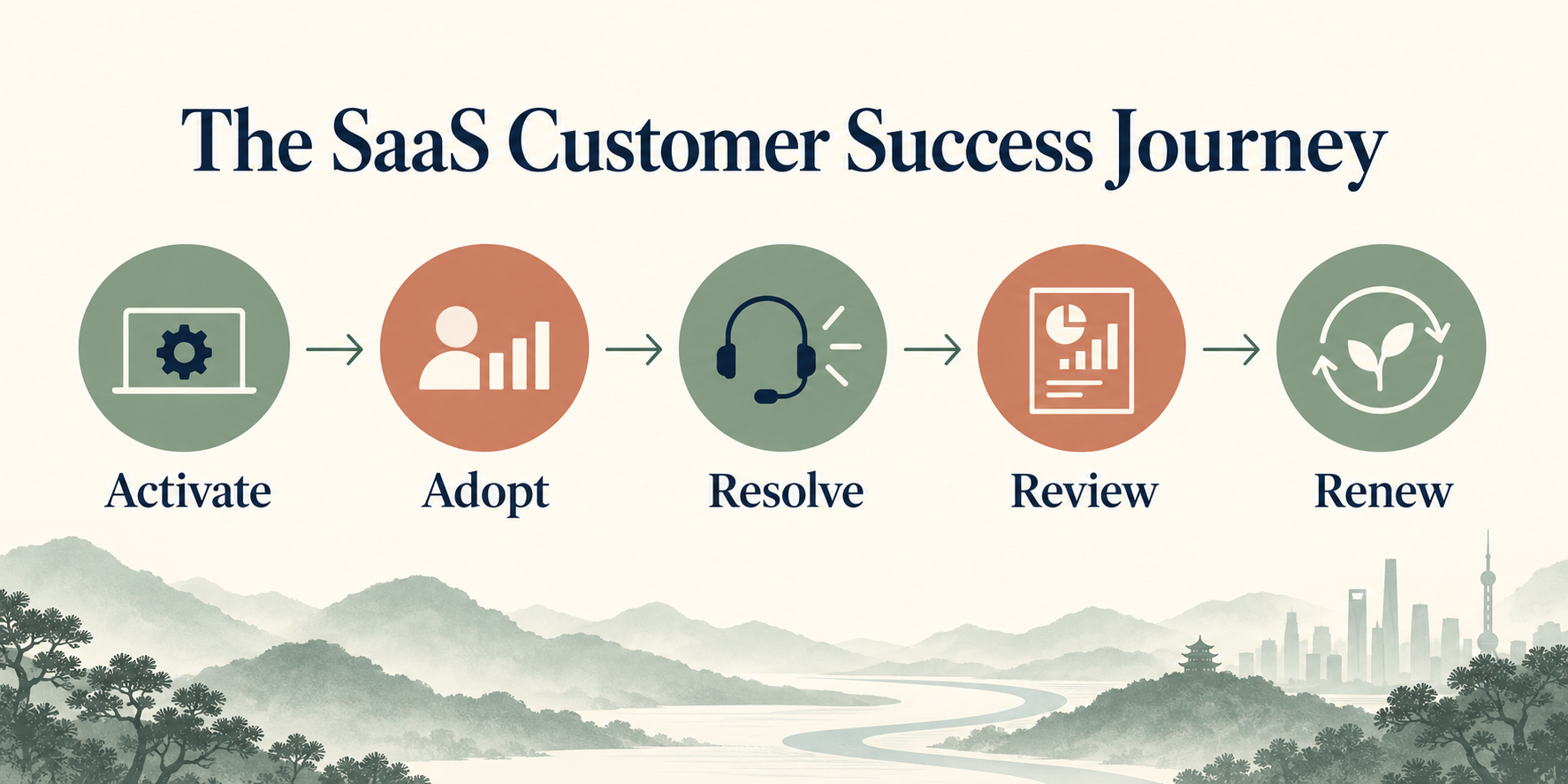
WeCom can keep human guidance close to the customer while product, support and CRM systems retain their specialist roles.
The SaaS customer-success journey
Activate: turn purchase into a usable start
The activation stage should establish the customer team, desired outcome, implementation responsibilities, milestones and communication rules.
A WeCom onboarding journey can support:
introduction of the named customer-success owner;
confirmation of key stakeholders and working language;
links to current Chinese onboarding material;
milestone reminders and progress questions;
coordination of training sessions;
escalation when a dependency is late;
documented next steps after each interaction.
Avoid creating a group before deciding who belongs in it and why. A working group for project owners may need different content and access from a wider user community.
Adopt: connect product signals with useful guidance
Adoption is not message frequency. It is progress toward the behavior that produces customer value. Define the few actions or milestones that matter for the chosen product and customer segment.
Product analytics might reveal low usage or an incomplete setup. WeCom can help a customer-success manager understand the context: Is the customer blocked? Was the wrong user trained? Has the business process changed? Does the Chinese team need a different example?
Create a Chinese enablement library with:
role-based quick starts;
outcome-led workflows;
short troubleshooting guides;
approved product-change explanations;
training clips or event invitations;
answers to recurring local questions;
escalation routes for technical and contractual matters.
Content should link to a controlled source where possible. Sending files into conversations without version discipline can create inconsistent guidance.
Resolve: separate support from customer-success ownership
Customer success owns the relationship and outcome; technical support owns diagnosis and resolution within its process. WeCom can make escalation easier, but the service platform should retain authoritative case records when that is the company’s design.
Define:
what the customer may report through WeCom;
minimum information required for triage;
how a support case is created and referenced;
response and escalation expectations;
what customer success can answer directly;
when engineering, security or legal specialists are required;
how the resolution and learning return to the account plan.
An automated acknowledgement can set expectations. It should not be reported as resolution or used to disguise an unstaffed queue.
Review: translate activity into customer value
A business review should connect the customer’s original objective with adoption, outcomes, unresolved risk and the next plan. WeCom can help coordinate inputs and follow-up, but the review should not be reduced to chat excerpts.
Prepare:
agreed success outcomes and current status;
relevant product and usage evidence;
completed and overdue actions;
support themes and root causes;
stakeholder and priority changes;
customer feedback and requested improvements;
the next period’s measurable actions.
Store the agreed account plan in the system chosen as the source of truth. WeCom can carry the relationship; it should not become an invisible parallel CRM.
Renew: begin with demonstrated value
Renewal risk should be managed throughout the lifecycle. A customer who has not activated, adopted or resolved key issues should not first hear from the vendor when the contract is near expiry.
Use WeCom to support a transparent renewal journey: confirm stakeholders, summarize achieved value, address open risks, clarify the formal commercial process and agree next steps. Final pricing, contractual promises and approvals should follow the company’s authorized systems and roles.
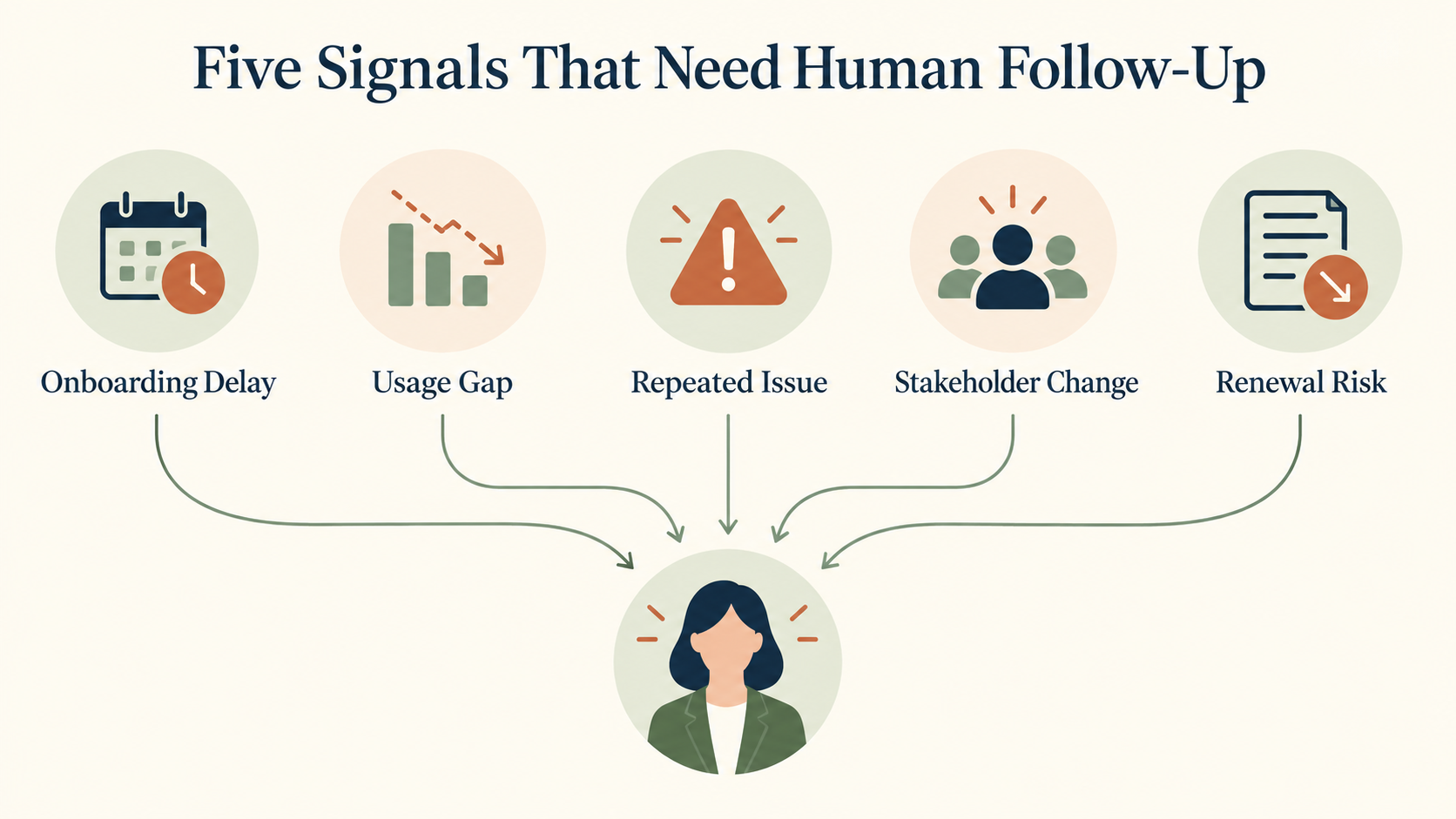
Automation can surface risk, but a responsible customer-success owner must interpret context and choose the next action.
Five signals that need human follow-up
Onboarding delay
Confirm the actual dependency before sending another reminder. The blocker may be internal approval, integration, staffing, training or a misunderstood outcome.
Usage gap
Distinguish low activity caused by poor adoption from intentional low-frequency use. Ask what successful behavior should look like for that account.
Repeated issue
Connect support history, product context and account impact. Repeated tickets may indicate missing training, a configuration problem or a product gap that needs a formal owner.
Stakeholder change
Reconfirm outcomes, decision authority, working team and access. Tencent says WeCom customer relationships can be enterprise-owned and preserved when employees move, but the SaaS vendor should not assume every message, attachment or internal note transfers automatically. Test handover and maintain account records elsewhere as needed.
Renewal risk
Bring evidence and options, not pressure. Identify the unresolved value gap, accountable owners and decision path. Do not use automated promotional messaging as a substitute for an honest renewal conversation.
Design the operating model
Segment by success motion
High-touch strategic accounts, guided mid-market accounts and digital or community-led users may need different staffing and content. Do not create segments solely from contract value if adoption complexity and risk differ.
Assign one relationship owner
Every active account should have a customer-success owner or defined queue and a backup. Clarify the roles of sales, implementation, support, product, partner and agency teams.
Define communication boundaries
State which topics belong in one-to-one conversations, account groups, communities, support cases, email and formal documents. Protect sensitive commercial, security and customer information.
Connect systems carefully
Define which events travel from product analytics, CRM or support into the operating workflow; who receives them; what action is expected; and what evidence returns. More alerts can create less attention if they are not prioritized.
Build a Chinese content rhythm
Combine milestone content, use-case education, product updates, live sessions and targeted guidance. Frequency should match customer value and segment—not a generic social calendar.
Measuring WeCom-enabled customer success
Activation
kickoff and stakeholder confirmation;
setup or onboarding milestones;
training participation;
time to first relevant value.
Adoption
agreed product behaviors or outcomes;
usage gaps requiring review;
enablement participation;
completed success actions.
Support and operations
time to correct owner;
first useful response;
case resolution and repeat issues;
overdue actions and escalations;
content gaps and handover failures.
Retention and growth
risk identification and recovery;
business-review completion;
renewal progression;
retention or expansion where attribution is reliable;
stakeholder coverage and relationship continuity.
Do not claim that WeCom caused renewal merely because it was used during the account lifecycle. Measure the complete customer-success motion and state attribution limits.
Data and governance guardrails
Product usage, support history, contact details and business context may involve sensitive or confidential information. Define purpose, access, retention, system of record, third-party roles and cross-border handling. Use qualified legal, privacy and security review for the actual design.
WeCom does not automatically replace CRM, SCRM, support, consent or security processes. API availability does not by itself establish that a proposed data flow is necessary, permitted or well governed.
Common SaaS mistakes
Creating a customer group without a named outcome or owner.
Translating a global email sequence without local adaptation.
Treating login count as proof of value.
Sending every product alert to every customer.
Mixing support cases and success actions without a source of truth.
Allowing renewal to become the first strategic conversation.
Automating risk messages that require human judgment.
Assuming company relationship ownership transfers all history.
Building integration before defining the action each signal should trigger.
Measuring messages instead of activation, adoption and customer outcomes.
How Lotus supports SaaS customer success in China
Lotus can help international SaaS companies map the China customer lifecycle, design WeChat-to-WeCom entry and account journeys, create Chinese enablement content, establish roles and service procedures, coordinate CRM/SCRM and support requirements, train teams and build reporting.
Lotus can work with the company’s product, support, privacy, security and integration specialists. The service is designed to make local customer communication operationally useful—not to replace core SaaS systems or promise retention outcomes.
Frequently asked questions
Can WeCom replace a customer-success platform?
Not automatically. It can support communication and workflows, while product analytics, CRM, support and customer-success systems retain authoritative data and process roles.
Should every SaaS customer have a WeCom group?
No. Use one-to-one relationships, account groups or communities only when they serve a defined audience and purpose and the company can operate them responsibly.
Can product alerts trigger WeCom follow-up?
Potentially, through an appropriate integration or operational process. Define the current technical feasibility, necessary data, recipients, action, testing and governance before implementation.
Who owns support issues raised through WeCom?
The company should route them to a named support process and reference the authoritative case. Customer success coordinates relationship impact; qualified support or engineering teams own diagnosis and resolution.
How should a departing customer-success manager hand over accounts?
Transfer stakeholders, outcomes, active actions, risks, groups and relevant records to a named owner, then confirm access changes. Do not assume every historical message or file moves automatically.
Put customer value before communication volume
For SaaS companies, WeCom succeeds when it helps a customer activate, adopt, resolve issues and recognize value with less friction. That requires local language, accountable humans and connected systems—not more notifications.
If your SaaS business needs a China customer-success operating model, talk to Lotus about a WeCom adoption and renewal journey. We can help align Chinese content, human follow-up, governance and measurement around the outcomes customers need.
