

Music Promotion in China: A Practical Guide for International Artists
China’s music market rewards preparation more than noise. For an international artist, a successful launch depends on rights, distribution, verified identity, platform roles, localised storytelling and a measurement plan that can distinguish curiosity from durable demand.
Use this framework before committing to a large campaign. It is designed to help artists, labels and management teams sequence the work and make evidence-based investment decisions.
Start with rights and release readiness
Confirm master and publishing rights, permitted territories, contributor approvals, artwork clearance and the metadata required by the chosen distributor or platform partner. Translate artist names, track titles and credits consistently so audiences and platforms can connect the same release across touchpoints.
Build a simple rights record covering owners, authorised uses, campaign assets, licence periods and approval contacts. Resolve gaps before creator outreach or paid promotion; a viral moment is difficult to use when the underlying permissions are unclear.
Test for meaningful demand
Look beyond headline population figures. Assess existing search activity, unauthorised uploads, playlist appearances, fan communities, comments, prior media coverage and enquiries from local partners. Separate genuine artist or track demand from broad category interest.
Tencent Music Entertainment reported RMB 6.51 billion in online-music-services revenue for the first quarter of 2026, up 12.2% year on year; music-subscription revenue was RMB 4.57 billion, up 6.6%. These company results show a large paid digital-music economy, not guaranteed opportunity for any individual artist.
Use a small pre-launch listening, search or content test to identify which audience, story and track create the strongest qualified response.
Give each platform a clear role
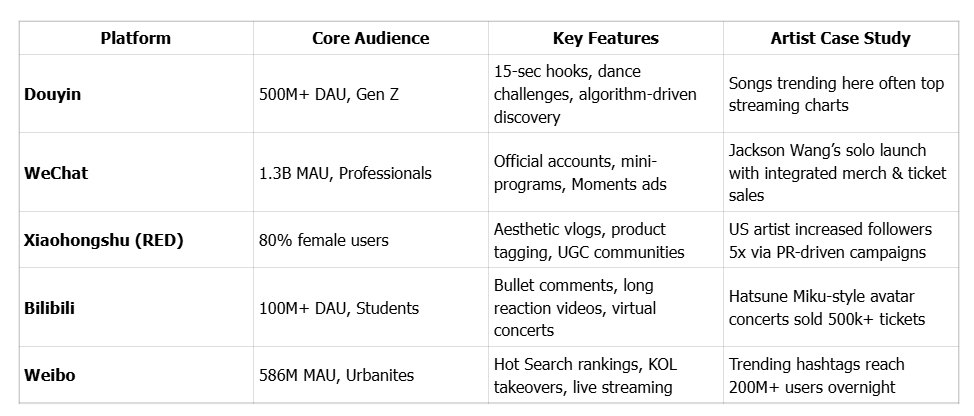
Tencent Music Entertainment services and NetEase Cloud Music can support official releases, artist pages, playlists and fan engagement, subject to current distribution arrangements. WeChat can provide an owned communication and service layer. Douyin can test short-video concepts, creator participation and cultural moments. Xiaohongshu can support searchable storytelling, recommendations and visual context.
Do not copy the same post everywhere. Define what users should discover, understand and do on each platform, then connect the journeys. Confirm account, advertising, commerce and music-use eligibility in the current official tools before promising a feature.
Build and protect the artist’s digital identity
Choose one approved Chinese artist name and use it consistently across distributor metadata, platform profiles, campaign assets and press materials. Record which legal entity owns each account, who holds administrator access and how recovery works.
Verification is not only a badge. It helps audiences distinguish the official artist presence from fan or impersonation accounts and gives the team a reliable base for future releases. Store credentials and approval history in a brand-controlled register rather than an individual contractor’s account.

Make it stand out
Whatever it is, the way you tell your story online can make all the difference.
Create a campaign narrative, not a translation pack
Localise the reason to care. Useful creative territories can include the origin of a song, performance craft, visual world, collaborations, fan interpretation or a relevant cultural connection. Adapt the framing and pace for each platform while protecting the artist’s voice and approved claims.
Brief creators around audience fit, storytelling role and rights. Confirm audio usage, disclosure, reposting, paid amplification and term length in writing. A smaller group of credible partners can create more useful evidence than a broad reach-only buy.
Make it stand out
Whatever it is, the way you tell your story online can make all the difference.
Measure in stages
Stage one checks readiness: rights, metadata, distribution, identity and account ownership. Stage two tests response: searches, qualified views, saves, playlist actions, follows and meaningful comments. Stage three evaluates outcomes: repeat listening, fan conversion, enquiries, partnership interest, ticket or merchandise actions where relevant and measurable.
Set the decision rule before each stage. Expand only when the evidence supports it; otherwise adjust the track, story, audience or channel mix. Document the source and date for every market statistic or platform claim used in planning.
For current market context, review Tencent Music Entertainment’s official investor releases and the relevant platform or distributor guidance.
Planning a China release or artist presence? Contact Lotus to build the rights-ready, platform-specific promotion plan.
Continue exploring: learn how to test China demand for entertainment IP and review China social media for international artists.
