

Most international brands already have plenty to say in China. The harder editorial decision is what local customers still need explained. Global calendars fill up with launches, brand stories and campaign themes, yet the same practical questions resurface in comments, direct messages, sales calls and partner meetings. That repetition is useful evidence: it shows where a customer still lacks the clarity to evaluate the brand, compare an option or take the next step.
Treat repeated questions as evidence of unresolved decision friction, not as proof of demand. Collect them responsibly, group them by the need underneath the wording, then check the pattern against current search and platform evidence. Done well, the exercise produces a sharper China content agenda without pretending that the inbox represents the whole market.
Locally useful content starts from the audience decision rather than the next item on a global messaging calendar. The job is to turn recurring operational evidence into a clear content choice without exposing individual customer data, overreacting to one loud comment or creating a page for every wording variation.
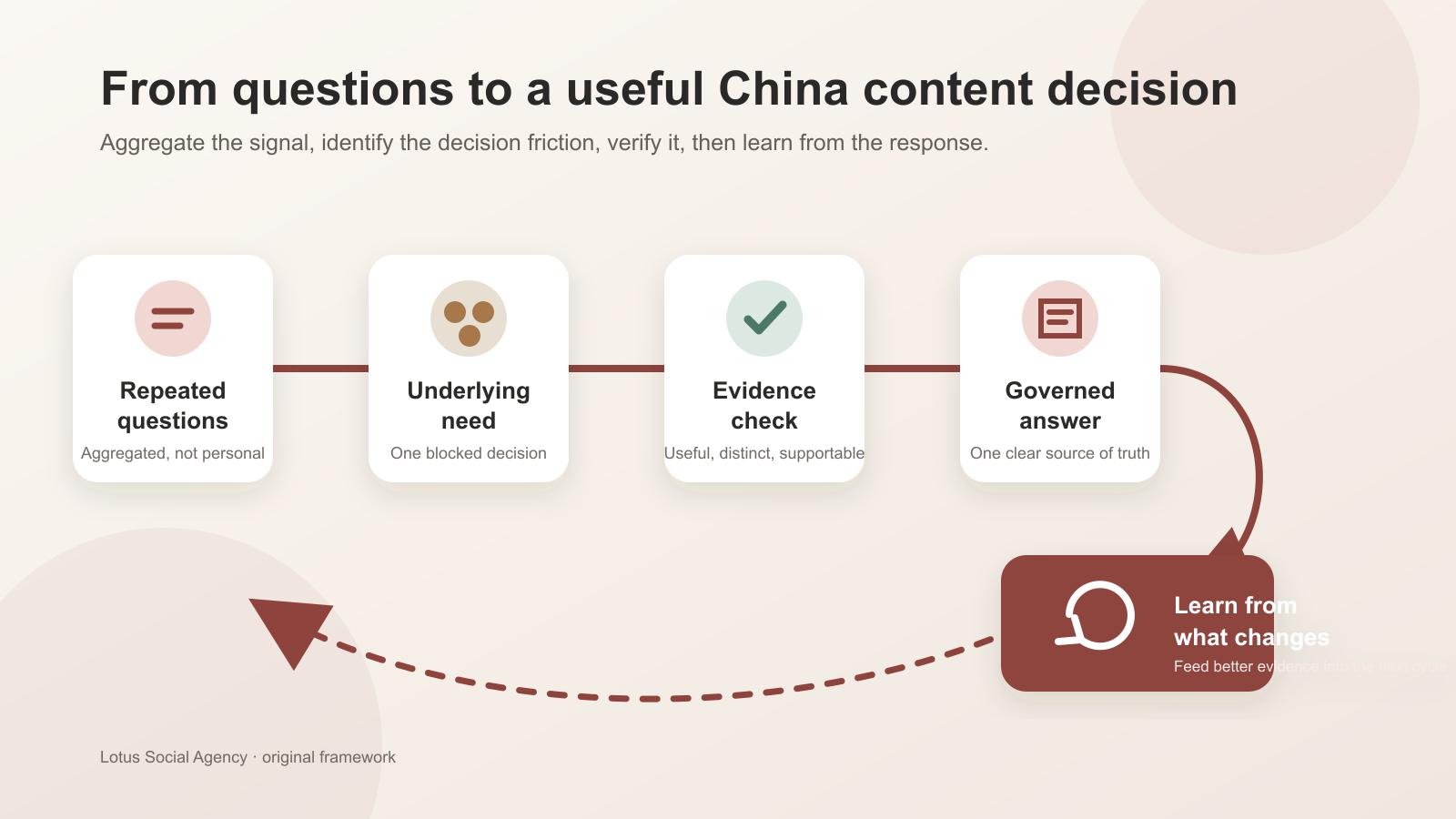
Repetition exposes unresolved decision friction
A question becomes strategically interesting when it keeps appearing across more than one interaction. The exact wording may change, but the hesitation underneath it is often stable.
A traveller may ask whether an attraction suits a short family visit. A software buyer may ask who will support implementation in China. A consumer may ask how two product formats differ. An entertainment partner may ask which official channel carries the most reliable release information. These are not simply requests for facts. Each one points to a decision that current content has not made easy enough.
The difference changes the response. Five questions about where to find an address may point to a navigation or listing problem. Repeated questions about whether a venue works for families reveal a broader gap: the brand has not translated its experience into the criteria that matter to that audience. Fix the first in the relevant field. The second may justify an article, explainer, comparison or set of platform-native assets.
For international teams, recurring questions often expose the distance between global assumptions and local customer context. Inside the business, a product category or channel journey may feel self-evident. In mainland China, customers may frame the category differently, enter through different platform touch-points or expect different proof before committing. Their questions show exactly where the translation has failed.
A customer question is a clue, not yet a brief
The mistake is turning every incoming question into a content assignment. One unusual request may reflect an individual circumstance. A sudden burst may point to an unclear campaign detail rather than a durable audience need. Some questions belong in customer service, account support or the product interface; publishing them would only move the confusion elsewhere.
Before promoting a question into the content plan, ask what kind of signal it represents:
A missing fact: the information exists internally but is difficult to find or absent from customer-facing material.
A comparison problem: people understand the options but cannot see the practical difference between them.
A trust gap: the brand has made a claim without providing enough context, evidence or local relevance.
A process uncertainty: the customer does not know what happens next, who is involved or what preparation is required.
A category misunderstanding: the audience is using a familiar global frame that does not fully fit the China market.
A temporary operational issue: a changing date, price, feature or availability question needs a maintained update rather than an evergreen article.
Classification keeps the editorial calendar from becoming a transcript of the inbox and makes the response easier to choose. A direct answer may resolve a single case. A help page can fix a recurring operational question. A deeper article earns its place when the answer requires explanation, comparison or judgement that will remain useful to a broader audience.
Look across the whole China customer journey
Public comments are only the visible layer of the China customer journey. Useful themes also appear in direct messages, community-management logs, sales calls, distributor conversations, customer-service escalations, event conversations, partner briefs and internal handovers.
WeCom can support communication between employees and Weixin customers, while Chinese social platforms create their own combinations of public interaction, private messaging, search and discovery. No single surface provides the full picture: each customer-facing team sees a different part of the decision journey.
A marketing team may notice questions about how a product fits local routines. Sales may hear objections about implementation or ownership. Customer service may see confusion after purchase. A local partner may hear the same concern expressed in category-specific language. When those teams compare themes rather than forwarding isolated screenshots, the brand gains a fuller view of where content can reduce friction.
Keep the collection method simple and non-personal. Record the question theme, context, journey stage, frequency band and date range. Leave names, private screenshots and other identifying details out of the content repository. The team needs to understand the recurring need, not profile the person who raised it.
Group different wording around the same underlying need
Customers rarely phrase a need in the language a content strategist would use. Ten surface questions may belong to one meaningful theme.
For example, “Does this work with our China team?”, “Can local colleagues manage it?”, “Who owns the account?” and “What happens when an employee leaves?” may all point to an ownership-and-continuity concern. Publishing four thin pages would fragment the answer. One well-structured piece about operating responsibility, with the necessary distinctions, would be more useful.
Clustering should happen before title writing. Begin by removing names and personal details, then group questions that block the same decision. Give each cluster a plain-language description such as “choosing between two formats,” “understanding local operating ownership” or “deciding whether this experience fits a family visit.” Only after the underlying need is clear should the team decide whether the best response is an article, FAQ entry, landing-page improvement, social series or sales enablement asset.
This is also where bilingual judgement matters. A literal English translation of a Chinese question can hide its commercial meaning. Likewise, an English question from a global stakeholder may need to be reframed around the way a Chinese customer actually encounters the category. Translate the need, not merely the sentence.
Decide which question clusters deserve content
Score each question cluster on audience usefulness and business relevance. The signal becomes stronger when several conditions line up.
Look for repetition across more than one customer-facing channel; a decision the brand is equipped to support; an answer grounded in current product truth, official information or credible operational experience; a topic broad enough to help more than one person but focused enough to answer clearly; and a meaningful next step that clearer content could improve.
Volume alone should not choose the topic, especially when the questions sit far from the brand’s priorities. Commercial convenience should not choose it either when customers show no corresponding need. The useful opportunity sits where demonstrated audience friction meets a decision the brand can credibly support.
Risk matters too. A repeated question does not authorise the content team to give legal, medical, financial or regulatory advice. If a useful answer depends on specialist interpretation, stop it at the risk gate. The brand can sometimes explain a high-level process or direct people to an appropriate official route, but it should not turn uncertain specialist territory into confident marketing copy.
Check the pattern against independent evidence
Internal questions matter because they come from real customer conversations. Their weakness is equally practical: they reflect the customers, channels and teams the business already reaches. Before committing resources, challenge the pattern with evidence from outside that immediate sample.
Baidu Index can help a team examine search trends, related demand and changes in user interest. Platform search suggestions, current on-platform results and existing competitor content can reveal the language people use and whether the information gap is already well served. Website search terms, landing-page behaviour and sales notes can add another view. None of these sources should be treated as a complete measure of market demand; they are directional checks.
Use those checks to answer three questions: Do people outside the immediate conversation express a similar need? Which wording is natural in the market? What does current content still fail to explain? A small but commercially important question can justify content when it blocks a high-value decision. A popular query may still be unsuitable when the brand has no distinct, reliable answer.
Build one authoritative answer before multiplying formats
Once a question cluster passes the relevance, evidence and risk checks, create one governed answer. This is the point where the team agrees what is true, what needs qualification, what the audience should understand and which next step the content can reasonably support.
The core answer needs to stand on its own. It should demonstrate first-hand understanding, explain the distinctions that affect the decision and leave the reader better able to act. Thin pages built around wording variants usually add little value. Search guidance favours people-first, original content over multiplying pages that repeat the same basic answer.
From that core, the team can adapt the idea for different contexts. A website article may carry the durable explanation. A WeChat article may develop the narrative for an existing audience. Xiaohongshu content may break the decision into visible, saveable criteria. A short video may demonstrate a practical contrast. Sales and community teams can use a concise approved response that links back to the deeper explanation where appropriate.
This is not a copy-and-paste exercise. Each format needs a clear role, but the underlying answer should remain consistent. Chinese content localisation and production is most useful when it preserves the brand truth while changing the framing, sequence and treatment for the local audience and channel.
Match the content to the decision stage
The same question can require different depth depending on when it appears.
An early-stage audience may need help recognising the category and understanding why the distinction matters. A comparison-stage audience may need criteria, trade-offs and evidence. A customer near action may need process clarity, ownership and realistic expectations. An existing customer may need operational guidance rather than persuasion.
Keeping the decision stage visible prevents one article from absorbing every possible answer or rushing to a sales message. Someone comparing Douyin and TikTok needs the strategic differences before a service pitch. A marketing leader deciding how to organise local content production may need an operating checklist rather than a trend overview.
The content should end with a proportionate next step. That might be reading a related explanation, checking an official product page, discussing internal ownership or speaking with a local specialist. The next step should fit the decision the article has helped move forward.

Create a feedback loop between content and customer-facing teams
Once the content is live, the original question cluster becomes a practical baseline for learning.
Watch how the questions change after customer-facing teams begin using the content. If customers still ask for the same basic explanation, the asset may be hard to find, too abstract or poorly connected to the journey. More specific comparison or implementation questions can indicate progress. If sales, service or community teams ignore the piece, it probably misses the real issue or is too awkward to share.
Review this evidence alongside normal content performance. Page views and engagement show distribution and interest; they cannot reveal on their own whether the content resolved the decision friction. Add the operating evidence: which teams used the asset, which follow-up questions appeared, where misunderstandings persisted and whether the answer remains current.
Ongoing China social media management is especially useful when community observations, content planning and performance review are connected. The operating rhythm matters more than a one-off brainstorming session. Recurring questions should inform the next cycle, and the next cycle should generate clearer evidence about what the audience still needs.
A workflow turns recurring customer-question themes into evidence-checked China content and a measurable feedback loop.
Avoid the traps that turn useful signals into weak content
Teams tend to weaken this method in a few predictable ways. Counting mentions without reading context. Frequency can be misleading when one campaign, incident or active commenter produces most of the volume. Review the contexts behind the cluster.
Copying the customer’s wording into a title. The original phrase may be awkward, overly narrow or based on a misunderstanding. Preserve the need, then use natural language for the intended reader.
Publishing a separate page for every variation. Closely related wording usually deserves one complete answer with clear sections, not a collection of thin pages competing with one another.
Letting the loudest team choose the topic. Sales, service, marketing and local partners see different parts of the journey. Use a shared view of the evidence.
Promising more than the evidence supports. A recurring question reveals friction; it does not guarantee demand, ranking, reach or commercial performance.
Forgetting maintenance. Questions about features, availability, platform processes or operating details can become outdated. Assign an owner and a sensible review trigger.
Exposing personal information. Store themes and aggregate context, not customer identities, private screenshots or unnecessary conversation details.
Turn everyday questions into a sharper China content agenda
International brands can keep global strategy and local audience evidence in the same planning system. Brand truth sets the boundary; recurring China-market questions show what still needs explanation.
Begin with repeated friction and put colourful one-off comments to one side. Group different wording around the decision underneath it, check the pattern against search, platform and business evidence, then build one credible answer. Adapt that answer to the channels and decision stages where it will be useful. Over time, the content system becomes more responsive without becoming reactive.
If your team is hearing the same China-market questions but has not yet turned them into a coherent content agenda, talk with Lotus. We can help you identify the most useful themes, shape them for international brand priorities and develop locally relevant English and Chinese content without losing the underlying brand truth.
